
Managing your finances as a student means building habits around budgeting, tracking spending, and saving before financial pressure forces you to. Student money management is the practice of allocating limited income across fixed costs, variable expenses, and savings goals with enough structure to stay out of debt. Methods like the 50/30/20 rule, zero-based budgeting, and tools like expense tracking apps give you a real system to work with. A starter emergency fund, student discounts, and smart credit habits round out the foundation. Get these right early, and you spend your college years focused on learning, not stressing about money.
How to set up a realistic budget as a student
A budget is not a restriction. Budgeting is a control mechanism that puts you in charge of where your money goes instead of wondering where it went. That shift in mindset changes everything.
Two budgeting methods work best for students. The 50/30/20 rule splits income into 50% for needs, 30% for wants, and 20% for savings. Zero-based budgeting is more effective for students with tight or irregular income because it assigns every dollar a specific purpose, leaving nothing unaccounted for. If your income changes month to month from a part-time job or financial aid, zero-based budgeting keeps you from accidentally overspending.
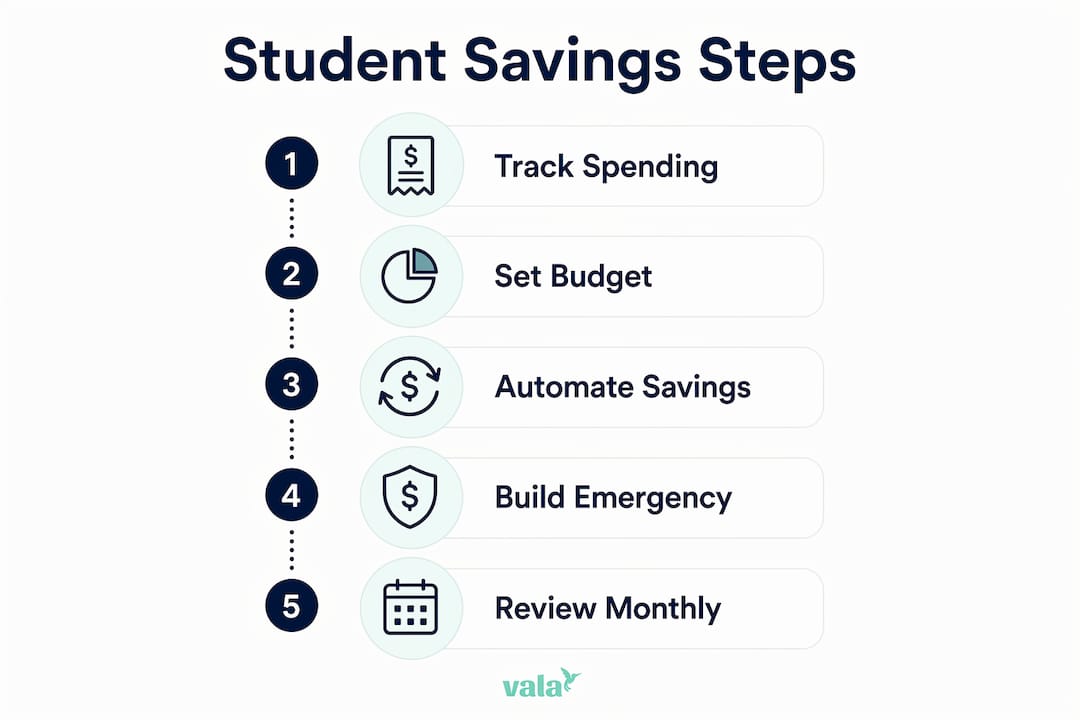
Here is a step-by-step process to build your first student budget:
- List all income sources. Include part-time job pay, financial aid disbursements, family support, and any freelance work. Use the actual amount you receive, not what you expect.
- Categorize your fixed expenses. Rent, tuition fees, loan payments, and subscriptions do not change month to month. List these first.
- Estimate your variable expenses. Groceries, transportation, dining out, and entertainment shift each month. Look at your last 30 days of bank statements to get realistic numbers.
- Separate needs from wants. Rent is a need. A streaming service is a want. This distinction tells you exactly where you can cut if money gets tight.
- Set weekly spending limits. Breaking your monthly budget into weekly amounts gives you faster feedback. If you overspend in week one, you can adjust before the month is gone.
- Build in a 10% cushion. Add a 10% buffer above your planned expenses to cover the unpredictable costs that always show up. A broken laptop charger or a last-minute textbook should not wreck your budget.
Pro Tip: Track your actual spending for one full week before you write a single budget number. Starting with real data prevents budget abandonment because your plan reflects how you actually live, not how you think you live.
How do you track and control spending as a student?
Tracking spending is where most student budgets succeed or fail. Writing a budget takes 20 minutes. Sticking to it takes daily attention.

Digital tools make expense tracking far easier than spreadsheets. Apps that categorize transactions automatically show you exactly where your money goes without manual entry. A simple expense tracking guide can help you build this habit from scratch. The goal is to check your spending at least once a week, not once a month when the damage is already done.
Key habits that keep spending under control:
- Separate fixed and flexible expenses. Fixed costs are set. Flexible costs are where you make daily decisions. Focus your attention on the flexible category.
- Use weekly limits, not monthly totals. Weekly spending limits are more effective for impulse control because the decision window is shorter. Knowing you have $60 left this week feels more real than knowing you have $240 left this month.
- Apply a 48-hour rule for non-essential purchases. Wait two days before buying anything that is not food, transport, or a bill. Most impulse purchases lose their appeal quickly.
- Avoid drastic budget cuts. Cutting everything fun at once leads to budget burnout. Reduce one category at a time and give yourself a week to adjust.
- Review your subscriptions monthly. Streaming services, gym memberships, and app subscriptions add up fast. Cancel anything you have not used in 30 days.
Pro Tip: Automate your bill payments and savings transfers on the day your income arrives. Automation removes the temptation to spend money that was already assigned a job.
Small, consistent tracking steps and paying bills on time build financial confidence over time. Financial coaches consistently point to these two habits as the most reliable way to reduce money stress during college.
How to build savings and an emergency fund on a student budget
Every student needs an emergency fund before they need anything else. The goal is a starter emergency fund of $500 to $1,000 to cover minor unexpected costs without reaching for a credit card or calling home. That range is realistic for a student and achievable faster than most people expect.
Here is how to build it:
- Start with $20 per week. Saving $20 weekly adds over $1,000 in a year. That is your full starter emergency fund built in 12 months with one small, consistent action.
- Pay yourself first. Transfer your savings amount the moment income hits your account. Do not wait to see what is left at the end of the month. There will never be anything left.
- Open a separate savings account. Keeping savings in your checking account makes it invisible and easy to spend. A separate account, even at the same bank, creates a clear boundary.
- Mimic a steady income if yours is irregular. If you receive financial aid in a lump sum, transfer it to savings immediately and set up automatic monthly transfers back to your checking account. This prevents the common mistake of spending the whole amount in the first two months of a semester.
Saving consistently matters more than saving large amounts. A student who saves $25 a week builds stronger financial habits than one who saves $200 once and then nothing for three months. Consistency is the skill you are actually building.
What are smart credit and banking habits for students?
Credit cards are a high-risk tool for students. Paying your balance in full monthly is the only safe way to use a credit card during college. Carry a balance even once, and interest charges start compounding against you.
Smart credit and banking habits to build now:
- Treat your credit card like a debit card. Only charge what you already have in your checking account. This builds your credit score without building debt.
- Set up autopay for the full balance. Never rely on remembering a due date. Autopay removes the risk of late fees and credit score damage.
- Choose a no-fee checking account. Monthly maintenance fees on checking accounts are money you do not need to spend. Banks like Ally, Chime, and many credit unions offer free student checking accounts.
- Turn on spending alerts. Most banking apps let you set notifications for every transaction or when your balance drops below a set amount. Use both.
- Use student discounts actively. Amazon Prime Student, Spotify Student, and Apple Music offer significant discounts with a valid college email. These savings add up across a full academic year.
- Avoid store credit cards. Retail cards often carry interest rates above 25%. They are designed to generate revenue from people who carry balances, not to help you save money.
Selecting the right budgeting apps for students alongside a no-fee bank account gives you a complete financial setup that costs nothing to maintain.
Key Takeaways
Effective student money management requires a budget, consistent tracking, a starter emergency fund, and disciplined credit habits working together from day one.
| Point | Details |
|---|---|
| Choose the right budgeting method | Zero-based budgeting works best for students with irregular income; assign every dollar a purpose. |
| Track spending weekly, not monthly | Weekly limits improve impulse control and give you faster feedback before overspending compounds. |
| Build a $500–$1,000 emergency fund | Save $20 per week and reach your starter fund in under a year without disrupting your budget. |
| Pay credit card balances in full | Carrying a balance triggers compounding interest; treat your card like a debit card to stay safe. |
| Automate savings and bill payments | Automation removes temptation and builds consistent habits without relying on willpower daily. |
What I have learned about sustainable student money management
Most students fail at budgeting not because they lack discipline but because they start with a plan that does not reflect their real life. They cut coffee, cancel every subscription, and commit to cooking every meal. Two weeks later, the budget is abandoned.
The approach that actually works is smaller and less dramatic. Daily small decisions shape your financial health far more than one big resolution. Choosing to check your bank balance before going out, waiting 48 hours before a non-essential purchase, or moving $20 to savings on payday. These are the decisions that compound over a semester.
Technology makes this much easier than it was five years ago. Automation handles the transfers you would forget. Apps categorize spending you would never manually track. The students who build lasting financial habits are not the most disciplined ones. They are the ones who set up systems that work even on a bad week.
My honest advice: do not wait until you feel ready to start budgeting. Start by tracking what you actually spend for seven days. No cuts, no rules, just observation. What you find will tell you exactly where to focus first. That one week of data is worth more than any budgeting template you can download.
— SaverStride
Valapoint makes student budgeting clearer
Knowing the right strategies is one thing. Having a tool that puts them into practice automatically is another. Valapoint is a personal finance app built to track expenses, categorize spending, and surface the patterns that quietly drain your budget.

For students managing part-time income, financial aid, and shared living costs, Valapoint handles the tracking so you can focus on your goals. You can set savings targets, monitor weekly spending limits, and get real-time visibility into where your money goes. The personal finance app is designed for exactly the kind of irregular, multi-source income that makes student budgeting tricky. You can also explore Valapoint’s free budgeting tools to get started without any commitment.
FAQ
What is the best budgeting method for college students?
Zero-based budgeting is the most effective method for students with tight or irregular income because it assigns every dollar a specific purpose, leaving no room for accidental overspending.
How much should a student save each month?
Saving $20 per week is a realistic starting point. That adds up to over $1,000 annually and builds your starter emergency fund without requiring a large monthly commitment.
Should students use credit cards?
Students can use credit cards safely by paying the full balance every month. Carrying a balance triggers high interest charges that quickly outpace any rewards or benefits the card offers.
How do weekly spending limits help students?
Weekly limits shorten your decision window, making it easier to catch overspending before it compounds. A monthly budget feels abstract; a weekly limit feels immediate and actionable.
What should a student keep in a separate savings account?
Keep your emergency fund and any lump-sum financial aid in a separate savings account. Transferring aid money out of checking immediately prevents you from spending it before the semester ends.