
Subscription creep is the slow buildup of recurring charges you forgot about, stopped using, or never meant to keep paying for. The fix starts small: pull your last three bank or credit card statements right now and scan for repeat charges you don’t recognize. That one check can uncover subscriptions you can cancel today.
TL;DR:
- Check bank and card statements, Apple or Google subscription screens, merchant accounts, and email receipts; list active plans with a next step for each.
- A CNET survey found US adults spend an average of $1,080 yearly on subscriptions, including nearly $200 on services they do not use.
- Cancel with the provider and save written confirmation; blocking your card does not end the contract, and billing error rights generally require written notice within 60 days.
- Turn on billing alerts and add renewal dates to your calendar; rotating streaming services can cut costs if you cancel before renewal.
- Streaming services often allow app cancellation, while gyms and meal boxes may require written notice or strict windows; check terms before signing up.
Table of Contents
- 1. What subscription creep is and how it happens
- 3. How to find every active subscription fast
- 4. How to cancel subscriptions and dispute unwanted charges
- 5. Practical ways to prevent subscription creep going forward
- 6. Psychological factors driving subscription creep
- 7. Role of AI and technology in detecting and managing subscription creep
- 8. How subscription creep impacts overall financial health and budgeting strategies
- 9. Differences between various types of subscriptions and their cancellation policies
- 10. How to evaluate the true value of each subscription before deciding to keep or cancel
- 11. Why catching money leaks early beats tracking spending after the fact
- Find and stop money leaks with Vala
- FAQ
- Sources
1. What subscription creep is and how it happens
Subscription creep builds up through a handful of familiar tricks. A free trial asks for your card details “just in case,” then quietly converts to a paid plan. A service renews automatically every year without a reminder. Prices can tick upward over time until the total barely resembles what you first signed up for.
Much of this runs on what regulators call negative option marketing: your silence is treated as consent to keep billing you. The FTC warns that negative option programs rely on this exact gap between inaction and agreement, trapping people in cycles they never actively chose.
Common patterns to watch for:
- Free trials that convert to paid plans without a clear reminder
- Annual renewals that bill once a year, making them easy to forget
- Small price increases added to an existing plan over time
- Add-on features or storage tiers bundled onto a base subscription
- Cancellation flows that require phone calls or hidden menus
This is widespread enough that regulators have made it a priority, not just a personal budgeting slip.
3. How to find every active subscription fast
A proper audit needs a system, not an elaborate process.
- Scan your recent statements. Flag every repeating charge, no matter how small, and note the merchant name exactly as it appears.
- Check your subscription screens. Open the Apple or Google subscriptions page, plus any streaming or merchant portals you use directly, and list every active plan.
- Search your email. Look for “receipt,” “trial,” “subscription,” and the names of companies you flagged, then add anything new to your list.
- Use your card issuer’s tools. Many banks let you view recurring payments directly or place a temporary block on unfamiliar merchants while you investigate further.
Set aside time for the audit and treat it as done once you have a full list of active subscriptions with a next action next to each one: keep, cancel, or investigate further.
Pro Tip: Screenshot your subscriptions list before you start canceling anything, so you have a record of what you found and when.
This process pairs well with a quick subscription-tracking audit guide if you want a repeatable checklist for future months.
4. How to cancel subscriptions and dispute unwanted charges
Cancel with the provider first, every time. Blocking a card or changing your card number does not end the underlying contract. As the CFPB explains about stopping automatic payments, blocking a card does not by itself cancel the underlying service agreement, so cancel directly with the provider.
Here’s the order that actually works:
- Cancel through the company’s app, account settings, or support line, and save written confirmation like an email or screenshot.
- If charges continue after cancellation, contact your bank to dispute the charge and consider a stop-payment order.
- Report the company to the FTC at reportfraud.ftc.gov if the cancellation process itself seems deceptive or deliberately difficult.
Timing matters. Under federal billing error rules, you generally need to notify your card issuer in writing within 60 days of the first statement showing the error, if you want to preserve your billing-error dispute rights. Your bank then generally has 10 business days to investigate and must usually issue a temporary credit if it cannot complete the investigation within that period. For unauthorized transactions specifically, the CFPB notes that banks generally have ten business days to investigate, or 20 business days for accounts open less than 30 days. Many disputes must be resolved within 45 days, subject to exceptions.
Regulators have been tightening the rules around this exact problem. The FTC announced a final click-to-cancel rule requiring sellers to make canceling as easy as signing up. Check the rule’s current status and effective date before relying on it.
For a full walkthrough, our step-by-step action plan for canceling unused subscriptions covers the exact wording and timing to use with each provider.
5. Practical ways to prevent subscription creep going forward
Preventing subscription creep takes less effort than fixing it after the fact. A short recurring habit keeps your spending visible before it adds up.
- Run regular audits using the same steps from your first check, and compare the total against a soft monthly cap you set for yourself.
- Try the rotation method for entertainment services: subscribe for the months you’ll actually watch, then cancel before the next renewal date.
- Turn on billing alerts through your bank or card issuer so any new recurring charge shows up immediately.
- Favor services with a simple, direct cancel flow over ones that bury the option in support tickets.
- Bundle services only when it genuinely lowers your total cost, and set a calendar reminder before each annual renewal.
Pro Tip: Put renewal dates directly into your phone calendar when you sign up, not just in a notes app you might forget to check.
The rotation method takes some tracking discipline since a missed cancellation date defeats the purpose, but paired with calendar reminders it keeps costs closer to what you actually use.
6. Psychological factors driving subscription creep
Subscription creep survives because of how we’re wired, not just how billing systems work. Inertia is the biggest factor: once a charge is automated, it takes active effort to notice and stop it, while doing nothing costs no visible effort at all.
Loyalty plays a role too. Many services tie subscriptions to points, streaks, or perks that make canceling feel like losing progress, even when the dollar value of that progress is small. Fear of missing out adds another layer, especially with streaming or event-based memberships where canceling feels like it might mean missing a show, sale, or feature everyone else is using.
Sunk cost thinking compounds all of this. If you’ve paid for a service for two years, canceling can feel like admitting the money was wasted, even though continuing to pay for something unused wastes more. Recognizing these patterns doesn’t require willpower alone. Treating cancellation as a neutral, routine decision, the same as reviewing any other bill, removes most of the emotional weight attached to it.
7. Role of AI and technology in detecting and managing subscription creep
Manual audits work, but they rely on you remembering to do them. Automated tools can close that gap by scanning transaction data instead of waiting for a manual check.
AI-driven detection can flag a new recurring charge the same week it starts, group charges by merchant even when billing names are inconsistent, and estimate how much a forgotten subscription has cost over time. That kind of pattern recognition catches things a quick statement scan often misses, like a price increase buried in a larger bundled charge or a trial that converted months ago.
Technology also helps with the follow-through. Instead of just telling you what’s recurring, a well-built tool can guide the next step, whether that’s a cancellation link, a reminder before a renewal date, or a prompt to dispute a charge that kept billing after you canceled. The goal isn’t replacing judgment about which subscriptions are worth it. It’s making sure nothing stays hidden long enough to become invisible again.
8. How subscription creep impacts overall financial health and budgeting strategies
A handful of forgotten subscriptions rarely breaks a budget on their own. The damage comes from how invisible they are: money leaving your account every month without showing up in your mental tally of expenses. A CNET survey found that the average US adult spends $1,080 a year on subscriptions, with nearly $200 going toward unused subscriptions.
That gap matters for budgeting because it skews your sense of fixed versus flexible spending. If you think your monthly obligations are $200 lower than they actually are, every savings goal, debt payoff plan, or spending limit you set is built on a wrong number. Subscription creep also makes expense tracking less reliable overall, since recurring charges blend into “miscellaneous” categories instead of getting reviewed individually.
Treating subscriptions as their own budget line, reviewed on a schedule, closes that gap. It turns a vague sense of “subscriptions probably cost me something” into an actual number you can compare against your goals.
9. Differences between various types of subscriptions and their cancellation policies
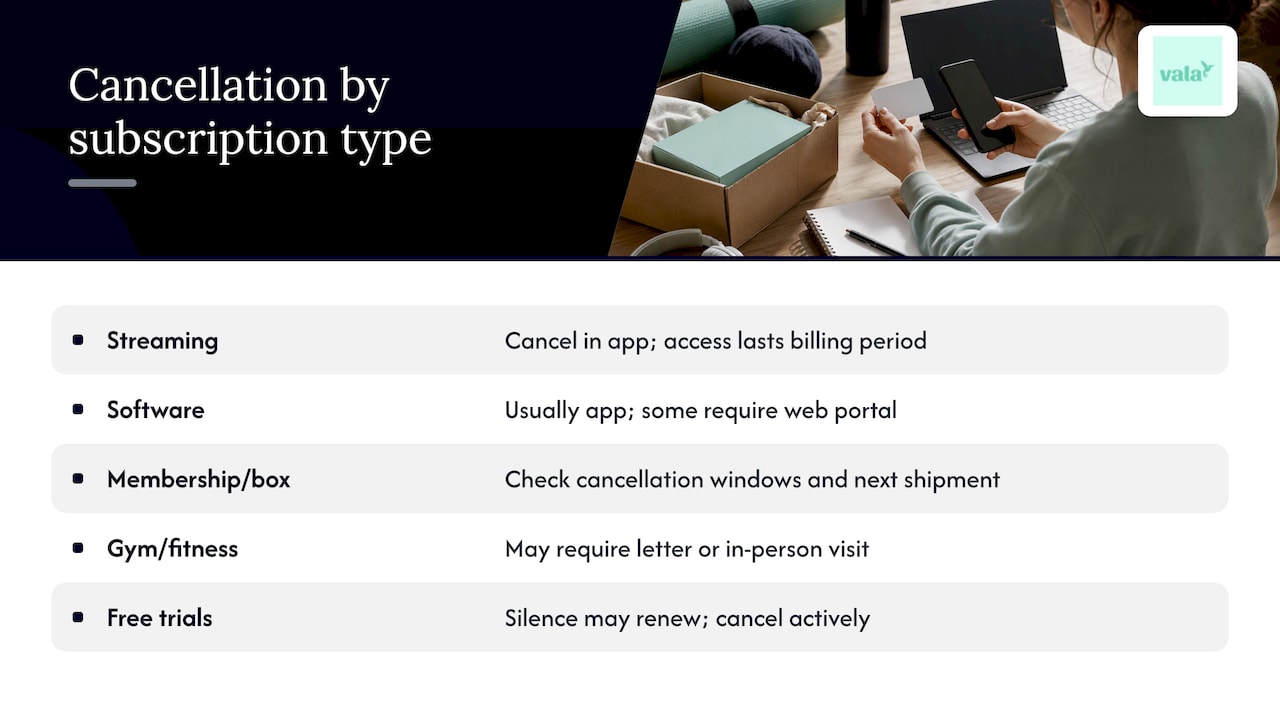
Not all subscriptions behave the same way, and knowing the category helps you predict how hard cancellation will be. Streaming services typically offer the simplest process: cancel in the app, and access usually continues until the current billing period ends. Software and productivity subscriptions often work similarly, though some require canceling through a web portal rather than the app itself.
Membership and box subscriptions, like meal kits or beauty products, may have stricter cancellation windows, so check the contract terms and next shipment date. Gym and fitness memberships are frequently the most rigid, sometimes requiring written notice, a certified letter, or an in-person visit, depending on the contract terms.
Free trials attached to any of these categories carry their own risk: the FTC’s guidance on free trials and auto-renewals notes that silence is often treated as consent to continue, so trial periods need an active cancellation step regardless of category.
Knowing which type you’re dealing with before you sign up, not just after you want out, saves a lot of friction later.
10. How to evaluate the true value of each subscription before deciding to keep or cancel
Before canceling or keeping a subscription, run it through three quick questions: How often do you actually use it? What would it cost to replace the value it provides another way? And would you sign up for it today, knowing what you know now?
Usage frequency matters more than the price tag. A low-cost app you open often may deliver more value than a pricier service you rarely use. Compare the cost per use, not just the monthly fee, to get a clearer picture.
Replacement cost helps with harder calls. If canceling a service means you’d need to buy the same thing another way, like replacing a meal kit with equivalent grocery costs, the subscription might still be worth it. If there’s a free or cheaper alternative that does the same job, that’s a signal to cut it.
The “would you sign up today” test cuts through loyalty and sunk cost thinking fast. If the honest answer is no, that’s usually reason enough to cancel, regardless of how long you’ve had it. Running this evaluation on every subscription, not just the ones that feel obviously wasteful, is what turns a one-time audit into a lasting budgeting habit.

11. Why catching money leaks early beats tracking spending after the fact
Most budgeting advice focuses on tracking what you’ve already spent. That’s useful, but it’s reactive. By the time a subscription shows up in a monthly spending report, you’ve already paid for it, sometimes for months.
A more effective approach treats subscription review as recovery work, not just record-keeping. The goal isn’t a prettier chart of where your money went. It’s catching a leak early enough that the next charge never happens. That shift, from observing spending to actively hunting for waste, is where real savings come from.
Combining a manual audit with an ongoing automated check gives you both a clear starting point and continued monitoring, so a new free trial or price increase is less likely to go unnoticed.
— SaverStride
Find and stop money leaks with Vala
We built our Money Leak Check to help you hunt for money leaks. Instead of scrolling through statements line by line, our tool helps you review recurring charges and decide what to do about the ones you don’t want.
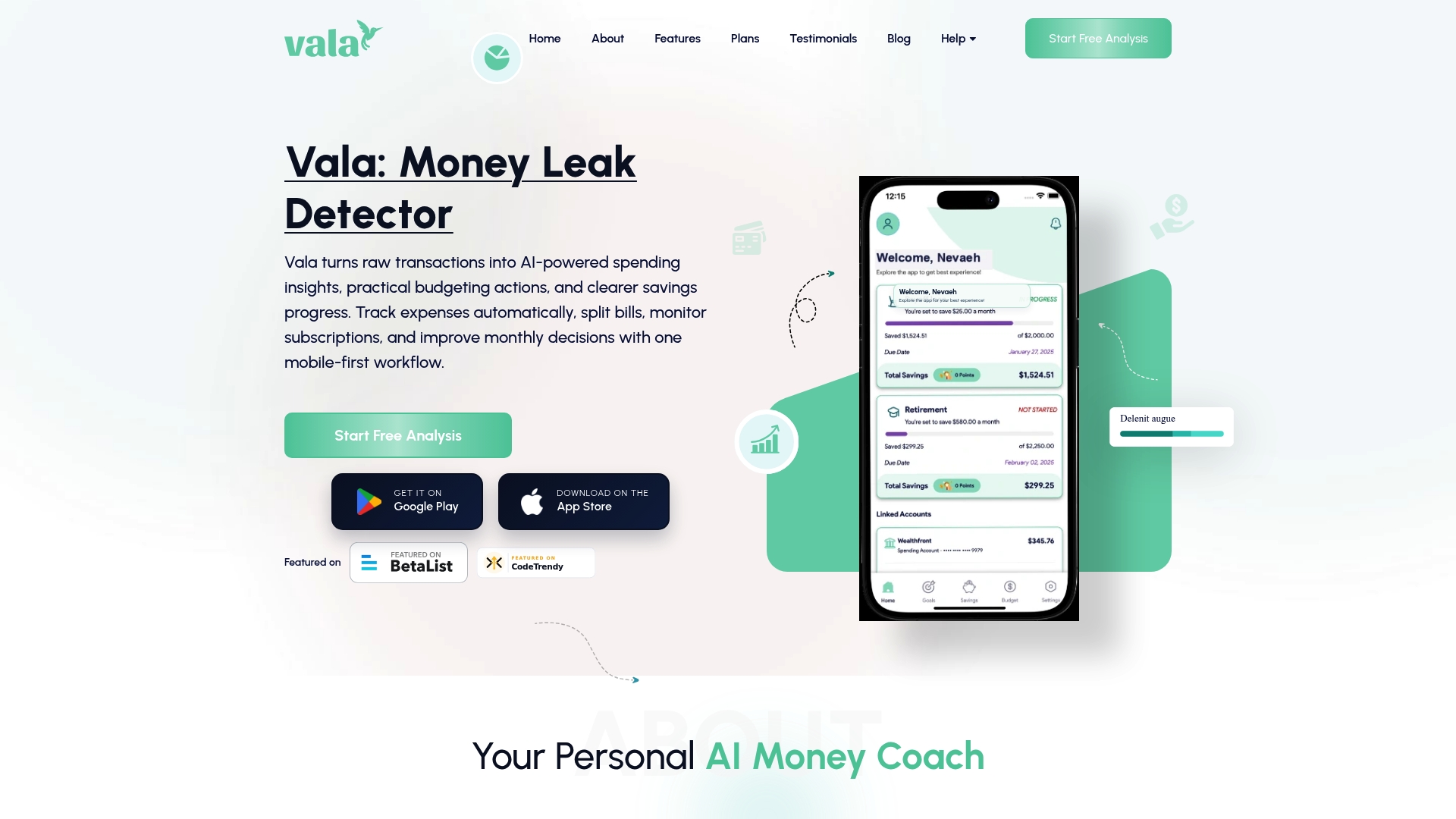
What that looks like in practice:
- Review recurring charges and identify subscriptions to look into
- Get actionable insights to help decide what to keep or cancel
- Track expenses and recurring charges
If you’d rather avoid subscriptions entirely for certain tools, a one-time purchase option like Green Cube’s offline AI software is worth a look for things like document review or private chat, since it skips recurring billing altogether. For the recurring charges you do want to track and manage, current prices are on our pricing page. Try our Money Leak Detector today and see what’s quietly draining your account.
FAQ
Why are people canceling subscriptions?
People may cancel after realizing how much unused recurring spending adds up. A CNET survey found nearly $200 a year goes toward unused subscriptions. Rising prices and forgotten free trials are common triggers for a cleanup.
What is the hardest subscription to cancel?
Gym memberships and certain box subscriptions tend to be the hardest, often requiring written notice, a phone call, or an in-person visit rather than a simple app toggle. New FTC click-to-cancel rules aim to make these processes as easy as signing up.
How do I cancel a subscription that keeps charging me?
Cancel directly with the provider first and keep written confirmation, since blocking your card alone does not end the contract. If charges continue, dispute the charge with your bank in writing within 60 days of the statement showing the error.
What happens if you never pay for a subscription?
An unpaid subscription typically leads to a canceled account, a declined renewal, or the balance being sent to collections if it was billed to a service you still owe money on. Simply ignoring a bill does not cancel the underlying agreement, so the safest route is always to cancel directly with the provider.
Sources
Hidden charges rarely show up in one obvious place. They spread across statements, app stores, and accounts you may not check often.
Start with your bank and credit card statements. Look for small, repeated charges from unfamiliar merchant names, since many subscription billers use a parent company name that doesn’t match the app or service you remember signing up for.
Next, check your phone. Apple and Google both have a dedicated subscriptions screen showing every app-based charge tied to your account, including ones you forgot you approved.
Then widen the search to these common hiding spots:
- Getting In and Out of Free Trials, Auto-Renewals, and Negative Option Subscriptions | Consumer Advice
- Federal Trade Commission Announces Final “Click-to-Cancel” Rule Making It Easier for Consumers to End Recurring Subscriptions and Memberships | Federal Trade Commission
- You May Be Losing $1,000 a Year to Subscriptions, and You May Not Even Know It, CNET Survey Finds – CNET
Checking these sources systematically catches far more than a quick glance at your checking account ever will. For a closer look at the kinds of merchants and line items to search for, see our examples of hidden recurring charges.