
A split transaction is simply a shared expense divided among two or more people, whether that’s rent, a dinner bill, or a group trip. The fastest way to handle one cleanly: agree on the split method out loud, write down the exact amounts, set a due date, then send or request payment through a trusted app after you’ve verified who’s actually on the other end.
TL;DR:
- Use equal splits for single occasion costs, proportional shares for rent based on income or room size, and itemized totals when consumption differs.
- Record amounts, payment direction, deadlines, and late or partial payment rules in a shared message, then settle within 48 hours of the expense.
- Payment app transfers are hard to reverse, so verify recipients, turn on a PIN and extra verification, and use bank transfers for larger sums.
- Document rent shares, utility duties, deposit division, late fees, and move out terms in a roommate agreement, then track each expense in a shared ledger.
- Recurring rent, utility, and subscription balances can shift each month, so automate requests and reminders or keep a shared ledger visible to everyone.
Table of Contents
- Common Ways to Split a Shared Expense
- A Step-by-Step Workflow for Creating and Settling a Split
- Keeping Your Money Safe When You Send a Split Payment
- Written Agreements and Recordkeeping That Prevent Disputes
- Why Recurring Splits Keep Causing Friction
- Let Vala Handle the Repeat Splits for You
- FAQ
- Sources
Common Ways to Split a Shared Expense
Most groups default to one of a few split methods, and picking the right one up front saves everyone a headache later.
An equal split works best for one-off social costs like a group dinner or concert tickets, where everyone got roughly the same value. Divide the total by the number of people and you’re done.
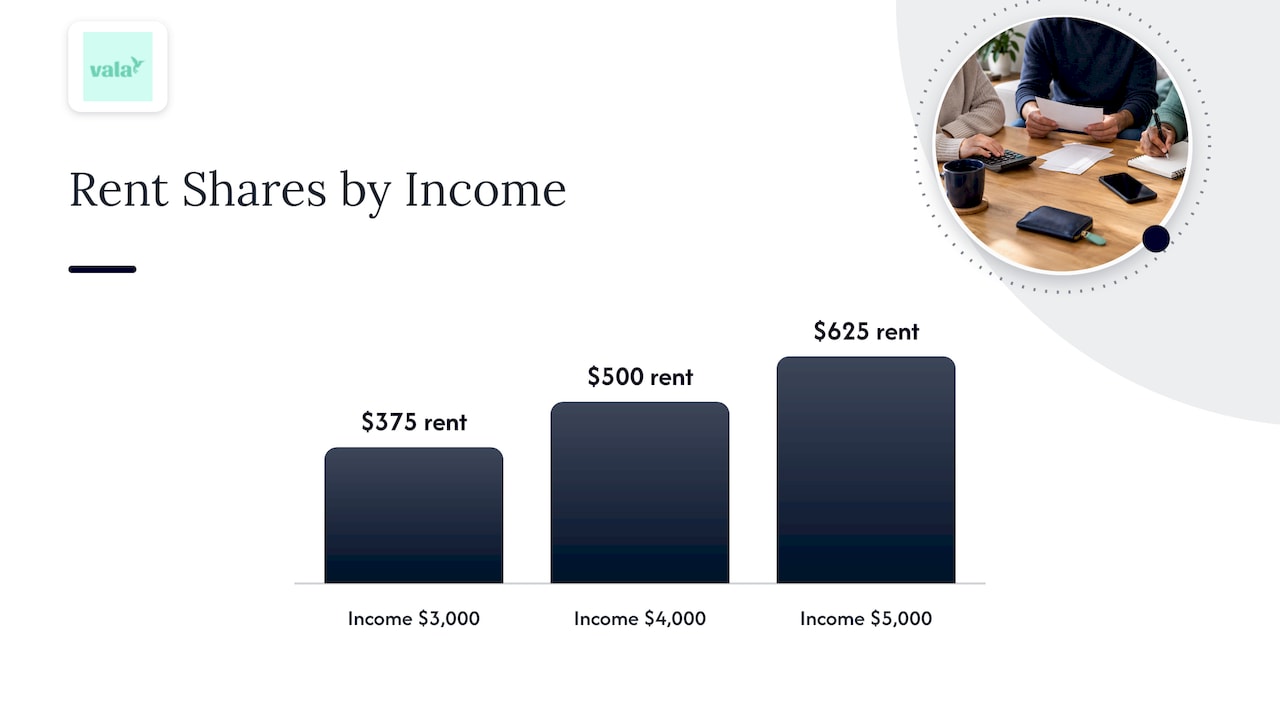
A proportional split fits ongoing shared costs like rent, where incomes or room sizes differ. Say three roommates earn $3,000, $4,000, and $5,000 a month. On a $1,500 rent bill, that’s $375, $500, and $625.
An itemized split makes sense when people order or use different amounts, like a restaurant tab where one person skipped drinks. Everyone pays for exactly what they consumed, plus their share of tax and tip.
Many households land on a hybrid: rent split proportionally by income or room size, but utilities and streaming subscriptions split evenly since everyone uses them about the same. This combination shows up often in shared housing, where proportional and shared-expense methods are common choices that groups adapt to their own dynamics.
- Equal split: best for one-time social costs everyone shares equally.
- Proportional split: best for recurring costs like rent, based on income or room size.
- Itemized split: best when people consume different amounts.
- Hybrid split: best for households mixing fixed and shared recurring costs.
If you want copyable math for rent scenarios like the one above, our guide on splitting rent with roommates walks through more examples.
A Step-by-Step Workflow for Creating and Settling a Split
Once you’ve picked a method, the actual process of creating, requesting, and settling a split transaction follows a consistent pattern.
- Agree on the method, the exact dollar amounts, and a due date, all in one message thread so nobody has to dig for context later.
- Record the split somewhere shared, whether that’s an app, a spreadsheet, or the same group chat, listing amounts and who owes what.
- Choose a settlement channel and spell out who sends money to whom and by when.
- Send the payment request with a clear deadline, and agree ahead of time what happens if someone pays late or only partially.
- Confirm receipt once payment lands, then mark the split closed so it doesn’t resurface in a month.
Partial payments are where splits usually fall apart. Agree in advance whether a partial payment is acceptable or whether the full amount is expected by the due date, and write that rule down once so it never needs repeating.
Pro Tip: Settle splits within 48 hours of the triggering expense. The longer a balance sits open, the easier it is to forget who owes what.
For recurring splits like rent or a shared streaming plan, our split bills and expenses walkthrough covers how to automate this workflow instead of repeating it manually every month.
Keeping Your Money Safe When You Send a Split Payment
Payment apps make settling a split fast, but speed cuts both ways. Mobile payment apps function like cash: once money is sent, it’s typically hard to recover, so verifying the recipient before you hit send matters more than almost any other step in the process.
A few habits reduce that risk substantially:
- Double-check the recipient’s username, phone number, or email before confirming a transfer, especially with someone new to the group.
- Turn on PIN protection and two-factor authentication in your payment app’s security settings, since these features exist specifically to protect against unauthorized access.
- Use a bank transfer instead of a payment app for larger sums, since bank transfers typically carry stronger dispute protections.
- Walk away from anyone who insists on gift cards or irreversible wire transfers to settle a shared expense. That’s a classic scam pattern, not a normal roommate request.
Verifying the recipient before every transfer is the single habit that prevents most payment-app losses, according to federal consumer-protection guidance.
Keep a screenshot of the payment confirmation and the original request message. If something looks off, like a payment that never shows up or a recipient who claims they never received it, that paper trail is what you’ll need to dispute the transaction or report it.
Written Agreements and Recordkeeping That Prevent Disputes
A short written agreement won’t change who’s legally on the lease, but it does set clear expectations before money gets involved. A non-legal roommate agreement that documents rent, utilities, chores, and payment timing reduces conflict even without changing lease liability.
A workable agreement should cover:
- Exact rent shares and the due date each month.
- How utilities are split and who’s responsible for paying the provider.
- How the security deposit will be divided at move-out.
- Late-fee handling if someone pays past the due date.
- Replacement rules if someone moves out mid-lease.
Sample agreements, like the example living agreement template, spell out these clauses with specific amounts and deadlines rather than vague language, which is exactly what makes them useful later. A roommate agreement template can give you a starting structure if you’re drafting from scratch.
Pair the agreement with a simple ledger: one row per expense, with the date, amount, who paid, and who still owes, and consider using a probate document checklist to organize essential estate documents alongside your financial records. A shared spreadsheet or app log works fine, as long as everyone can see it.
Why Recurring Splits Keep Causing Friction
Most disputes over split transactions aren’t about dishonesty. They’re about forgetting who paid what three weeks ago. Recurring splits like rent, utilities, and shared subscriptions are especially prone to this because the amounts shift slightly month to month and nobody wants to be the one chasing a roommate for $12.
The real fix isn’t a stricter agreement. It’s removing the memory problem entirely, which is where automated, privacy-first tracking does more than a spreadsheet ever could. We built Vala around AI-driven detection of recurring charges and subscription costs, the same category of expense that quietly causes most split disputes, and we connect bank data through Plaid’s encryption so that tracking shared costs doesn’t mean handing over sensitive financial details to a group chat.
— SaverStride
Let Vala Handle the Repeat Splits for You
Split-expense tracking tools can help avoid recreating the same group chat every month. Automated split requests, a shared ledger, and payment reminders can help recurring costs like rent or a joint subscription settle themselves instead of needing manual nudges.

| What you get | Why it helps with splits |
|---|---|
| Automated split requests | No more manually texting amounts each month |
| Shared ledger | Everyone sees who paid and who still owes |
| Recurring split handling | Rent and subscriptions split automatically each cycle |
| SaverPro plan | $2.99 per month for full-featured tracking (Valapoint) |
If you manage shared costs with roommates or a partner, try our split expenses tools or start a free trial to see your recurring splits in one place.
FAQ
What is the easiest way to split a bill fairly?
For one-time shared costs like a dinner or group outing, an equal split is usually fairest since everyone got similar value. For recurring costs like rent, a proportional split based on income or room size tends to feel fairer over time.
How do I split expenses in a group without arguments?
Agree on the method and exact amounts in writing before anyone pays, and keep a shared record of what’s owed. A short roommate agreement covering rent, utilities, and payment timing reduces most disputes before they start.
Is it safe to send money through apps like Venmo or Zelle?
Payment apps are generally safe when you verify the recipient first, since transfers are treated like cash and are hard to reverse once sent. Enable PIN protection and two-factor authentication, and use a bank transfer instead for larger amounts.
What should I do if someone can’t pay their share on time?
Agree in advance on your household’s rule for late or partial payments, such as a short grace period or a flat late fee. Document the shortfall in your shared ledger so it’s resolved at the next settlement instead of forgotten.
Can an app help manage split transactions automatically?
Yes. Tools like Vala can automate split requests, maintain a shared ledger, and send payment reminders so recurring costs like rent or subscriptions don’t require manual tracking each month.
Sources
- Mobile Payment Apps: How To Avoid a Scam When You Use One | Consumer Advice
- The Unwritten Rules of Rent Splitting: Navigating Relationships with Roommates – Florida State University
- Example living agreement (sample clauses)