
If your rooms and bills are basically the same, split rent evenly and call it a day. When rooms, closets, or private bathrooms differ, use a room-size or envy-free calculator instead. Either way, fold utilities into the same conversation, and write the final numbers down before anyone pays a deposit.
TL;DR:
- Room-size weighted splits better reflect usage when rooms differ significantly in size or amenities, but require precise measurements and adjustments.
- Income-based splits are fairer when roommates have widely varying earnings and prevent lower-income tenants from strain or resentment.
- Envy-free calculators reduce disputes by ensuring no roommate prefers another’s room and share preferences beyond just size or rent.
- Using shared expense apps like Vala automates recurring payments and maintains transparent records to minimize ongoing rent disputes.
- Regularly reviewing and renegotiating rent splits every six months helps accommodate changes like raises, room swaps, or added amenities, avoiding long-term resentment.
Table of Contents
- The Best Methods to Split Rent With Roommates
- Step-by-Step Math You Can Copy
- How Do Envy-Free Rent Calculators Actually Work?
- How Vala Helps Roommates Keep Rent Splits Fair Over Time
- What to Do When a Roommate Stops Paying Rent
- Fairness Versus Simplicity: What Actually Matters
- Try Vala to Keep Your Rent Split Fair, Automatically
- Sources
- FAQ
The Best Methods to Split Rent With Roommates
Every roommate household eventually asks the same question: what’s actually fair? The answer depends on how different your rooms and incomes are, not on some universal formula. Here’s how the main approaches stack up.
- Even split. Divide total rent by the number of roommates. It’s the fastest method and works well when rooms are close in size and everyone shares common spaces equally. Multiple how-to guides list this as one of the three standard approaches, alongside room-size and income splits.
- Room-size weighted split. Measure or estimate each room’s square footage, then adjust the total using those numbers. Add a premium for private bathrooms, walk-in closets, or extra windows, and offset it by trimming everyone else’s share slightly.
- Income-based split. Instead of dividing rent equally, you divide it proportionally to what each person earns. This matters most when incomes vary a lot, since an equal split can quietly strain the lower earner’s budget every single month.
- Envy-free split. Each roommate picks rooms at different price points until nobody would rather trade rooms and prices with someone else. This method handles subjective preferences, like natural light or noise, that square footage alone misses.
Couples sharing one bedroom, or a roommate who’s rarely home, change the math too. A couple often pays a bit more for a shared room since two people use it, while a low-usage roommate might negotiate a small discount. Neither adjustment is standard, so talk it through before signing anything.
Step-by-Step Math You Can Copy
Numbers settle arguments faster than opinions do. Here’s how to run each method with real figures, using a $2,000 total rent across three roommates as the working example.
- Even split. Divide the total rent equally among roommates. Simple, and fine when rooms are nearly identical.
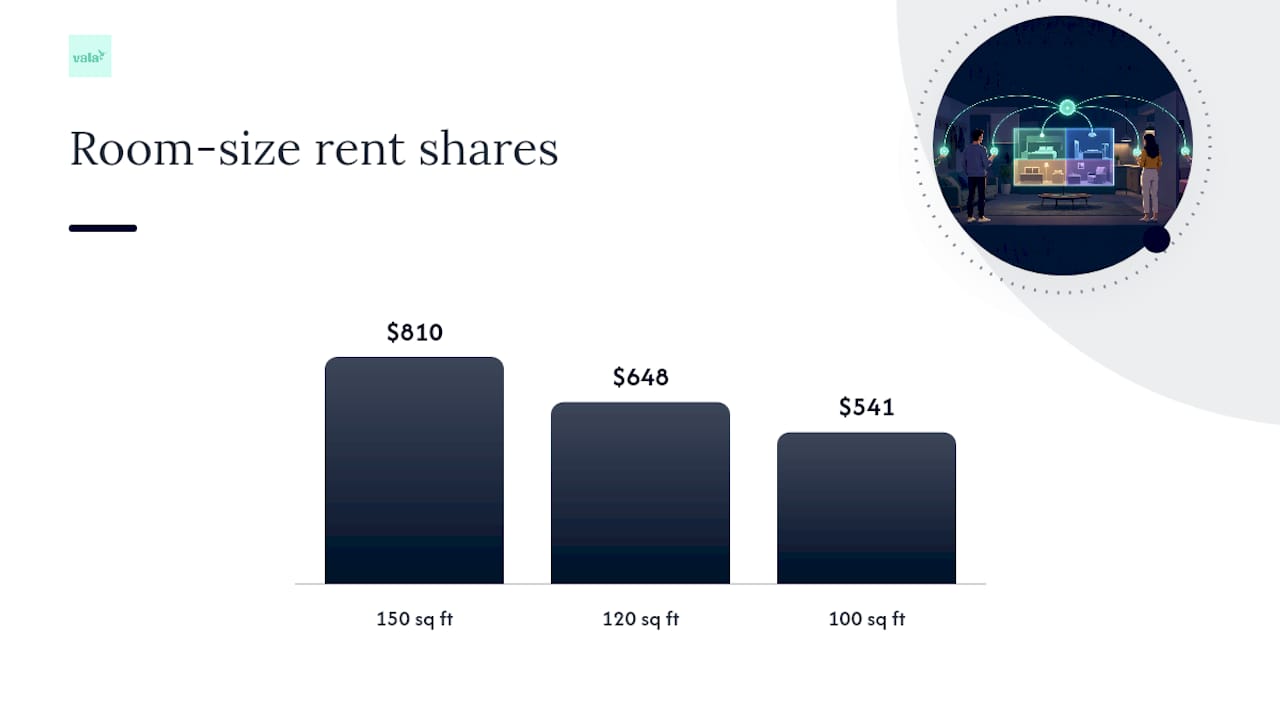
- Room-size weighting. Say the three bedrooms measure 150, 120, and 100 square feet, totaling 370 square feet. Each person’s share equals their room’s percentage of that total, multiplied by rent: 150/370 = 40.5%, or $810; 120/370 = 32.4%, or $648; 100/370 = 27%, or $541.
- Amenity premium. Add a flat premium to rooms with special features like private bathrooms, while subtracting that amount proportionally from the others, keeping total rent constant.
- Income-based split. If combined monthly income is $9,000 and one roommate earns $4,500, another $3,000, and the third $1,500, their shares of income are 50%, 33%, and 17%. Applied to $2,000 rent, that’s $1,000, $667, and $333.
The point-based formula behind most calculators is: individual rent equals (room point value ÷ total points) × total rent, where points reflect size and amenities together rather than square footage alone.
Pro Tip: Run the zero-sum amenity adjustment as its own line item. Add the premium to the room with the perk, then subtract the exact same dollar amount somewhere else, so the total rent never quietly creeps up.
How Do Envy-Free Rent Calculators Actually Work?
An envy-free rent split means no roommate would rather swap rooms and rent with anyone else in the house. Tools like the New York Times rent-division calculator get there by having each person bid on or rank rooms at different price points, then computing a division where every assignment beats every alternative for that person. Fair Divider works the same way, iterating through choices until the split stabilizes.
These calculators earn their keep in households with genuinely unequal rooms, because they turn “I feel like I got the worse deal” into a number everyone actually agreed to. That’s a real advantage over eyeballing square footage, since preferences (a quiet corner, morning light, a shorter walk to the kitchen) don’t always track with size.
Once rent is settled, a different category of tool takes over: ongoing expense trackers. Envy-free calculators solve the one-time question of who pays what. They don’t track whether Jordan’s Venmo actually landed on the first of the month, or whether the internet bill got folded in correctly. For that, you want:
- One-off calculators for the initial split decision.
- Shared-bill apps that split recurring charges like utilities and streaming.
- Full expense trackers that log payments, flag missed ones, and keep a running history everyone can see.
Utilities and recurring fees should ride on whichever split percentages you already settled on, unless you agree to split those evenly regardless of room size.
How Vala Helps Roommates Keep Rent Splits Fair Over Time
A calculator gets you a fair number once. Keeping that number fair for the next twelve months is a different problem, and it’s the one most roommate households actually struggle with.
Vala handles the ongoing part. Once you’ve agreed on percentages, whether even, room-weighted, or income-based, you can set up:
- Recurring entries so rent and utilities can be posted automatically each month.
- Shared balances that show exactly who’s paid and who hasn’t, in real time.
- Reminders before due dates to help prevent missed payments.
- A shared record accessible to the household to reduce disputes.
- Spending insights to help identify recurring charges or subscriptions affecting the shared budget.
A spreadsheet works fine for a one-time calculation. It falls apart once you’re tracking partial payments, a roommate who moved out mid-lease, or five separate utility bills a month. That’s when an app like Vala’s shared expense tools earns its place over a shared Google Sheet nobody updates consistently.
What to Do When a Roommate Stops Paying Rent
Start polite and documented, not confrontational. A simple written message asking for the payment, with a date attached, creates a record you might need later. Show them the shared ledger or app balance so the number isn’t in dispute, only the payment.
Before signing anyone on, put the agreement in writing: each roommate’s share, the due date, accepted payment methods, and what happens if someone pays late. Documenting the agreement upfront prevents most disputes that start from differing assumptions about who owes what.
If a roommate still won’t pay, check your lease first. Depending on how it’s structured, next steps can include mediation, small-claims court, or bringing the landlord in if one roommate is named on the lease and others aren’t.
- Set a review date, like every six months, to renegotiate the split.
- Base changes on real shifts: a raise, a room swap, or a new amenity like a finished basement.
Pro Tip: Renegotiate on a schedule, not just when someone complains. A standing six-month check-in turns “we need to talk about money” into a routine instead of a confrontation.
Fairness Versus Simplicity: What Actually Matters
Perfect fairness and easy fairness aren’t the same goal, and chasing the wrong one wastes energy. For short leases, near-identical rooms, or roommates who’ll move out in a year anyway, an even split beats an elaborate formula every time. Precision matters more in long-term households with real price gaps between rooms, where a lopsided split quietly breeds resentment for years.
What holds up in either case is the same: write the agreement down, and revisit it on a schedule rather than waiting for a fight to force the conversation.
— SaverStride
Try Vala to Keep Your Rent Split Fair, Automatically
Vala turns the math you just ran into something that actually sticks month after month. Once you’ve settled on even, room-weighted, or income-based percentages, Vala’s split bills app keeps applying them automatically instead of making you redo the calculation every time rent is due.

Here’s what that looks like in practice:
- Automated split calculations based on the percentages your household already agreed on.
- Recurring reminders before rent and utilities are due.
- Shared transaction history so nobody has to ask “did you actually pay me back?”
- Spending-insight tools that catch recurring subscriptions or fees eating into your shared budget.
If you want to see where your household’s money is actually going before you even finalize a split, run a Money Leak Check first. It’s a quick way to spot recurring charges you might be splitting unevenly without realizing it. From there, a paid subscription plan unlocks the full shared-expense toolkit for households that want to stop relitigating rent every few weeks.
Sources
- Envy-free rent division (scholarly overview)
- NYT rent-division calculator
- Fair Divider — Free, envy-free rent split calculator
- PayRent rent split calculator (point-based method)
- What to do when your roommate isn’t paying rent | Zillow
FAQ
What Is a Fair Way to Split Rent With Roommates?
For similar rooms, split rent evenly. When rooms or amenities differ, use a room-size weighted formula or an envy-free calculator so nobody would rather trade rooms and price with someone else.
Do Roommates Split the Rent Equally?
Not always. Even splits, room-size weighting, and income-based splits are the three most common approaches, and the right one depends on how different the rooms and incomes are.
What Is the 50/30/20 Rule for Rent?
The 50/30/20 rule is a personal budgeting guideline that puts needs, including rent, at roughly 50% of after-tax income. It doesn’t tell roommates how to divide rent between themselves.
What Can I Do If My Roommate Doesn’t Pay Their Half of the Rent?
Send a documented written request first, then check your lease before escalating to mediation, small-claims court, or landlord involvement. A shared expense app can keep a transparent balance history that helps if disputes escalate.