
The fairest way to split an Airbnb is to add every charge on the checkout page into one total, agree on a rule before anyone books, and settle in one round afterward. For equal rooms, divide by the number of guests. For unequal rooms or couples, split half the total per person and half by room. Put the rule in writing in the group chat. Most arguments come from rules nobody agreed on, not from the math.
This guide gives you the formulas, three worked examples and the answers to the questions that come up most: what to do with cleaning fees, how to handle a hotel or a rental car, and what happens when someone drops out.
TL;DR
- Split the checkout total, not the nightly price. Taxes and fees are part of what the group owes.
- Equal rooms: total ÷ guests. Mixed rooms: half per person, half by room, as in the example below.
- Cleaning fees go evenly per person. A security deposit is not split unless something is withheld.
- Airbnb does not let friends each pay their own share at checkout. One person pays and the rest pay that person back, so agree on the timing first.
- Hotels: price each room, divide it by the people in it, and multiply by the nights. Rental cars: split shared charges among everyone riding, the driver included.
Table of Contents
- Start with the real total
- Pick one of three simple methods
- Does a couple pay one share or two?
- What to do with cleaning fees, service fees and taxes
- Will Airbnb let you split the payment?
- Splitting a hotel instead
- Splitting a rental car
- When someone cancels or leaves
- Settle up in one round
- How Vala keeps the trip split simple
- Our view: agree on the unit, then the room
- FAQ
- Sources
Start with the real total
The nightly rate you saw while browsing is not what the group owes. Airbnb says the checkout page always shows the total price including fees and taxes, so the checkout total is the number to split. Dividing the base rate and then adding the fees later is how the booker ends up short.
Write down these lines from the checkout screen:
- Nightly rate times nights
- Cleaning fee
- Service fee
- Taxes
- Any add-ons, such as extra guest fees or a pet fee
Add them into one figure. That figure is what you split. If the final total changes after booking, for example because a host adds a charge or a refund comes through, recalculate with the new figure rather than patching one person’s share.
Pick one of three simple methods
There are three methods most groups choose from. Pick one before booking.
Method 1: equal split
Total ÷ number of guests. It works when the rooms are similar, everyone stays the whole time and nobody is bringing a partner who would otherwise not come.
Example: a $2,400 checkout total with 6 guests is $400 each. Easy to explain, easy to pay.
Method 2: split by room
Give each bedroom a share of the total based on its size, bathroom and bed. The people in the room divide that share. Couples pay for one room between them, and singles pay for their own.
This is the version that feels fair when one room is clearly better. As one travel-money piece puts it, valuing rooms by size means couples in a larger room pay a little more and singles in a smaller room pay a little less. It also gives people a choice: someone with a bigger budget can take the better room, while someone stretching a budget can take a smaller one.
The weakness is the common space. Everyone uses the kitchen, the living room and the pool, whatever room they sleep in. A pure room split makes a single in a small room pay for almost nothing of the shared house.
Method 3: the hybrid split (our default)
Split half the total equally per person for shared space, and half by room for the bedrooms. It handles couples, singles and uneven rooms without much debate.
Worked example. A house has a checkout total of $2,400 and 6 guests in four bedrooms:
- The master room: a couple
- A second room: a couple
- Two small rooms: one single each
Step 1: half the total, $1,200, is the shared-space half. Divided by 6 guests, that is $200 each.
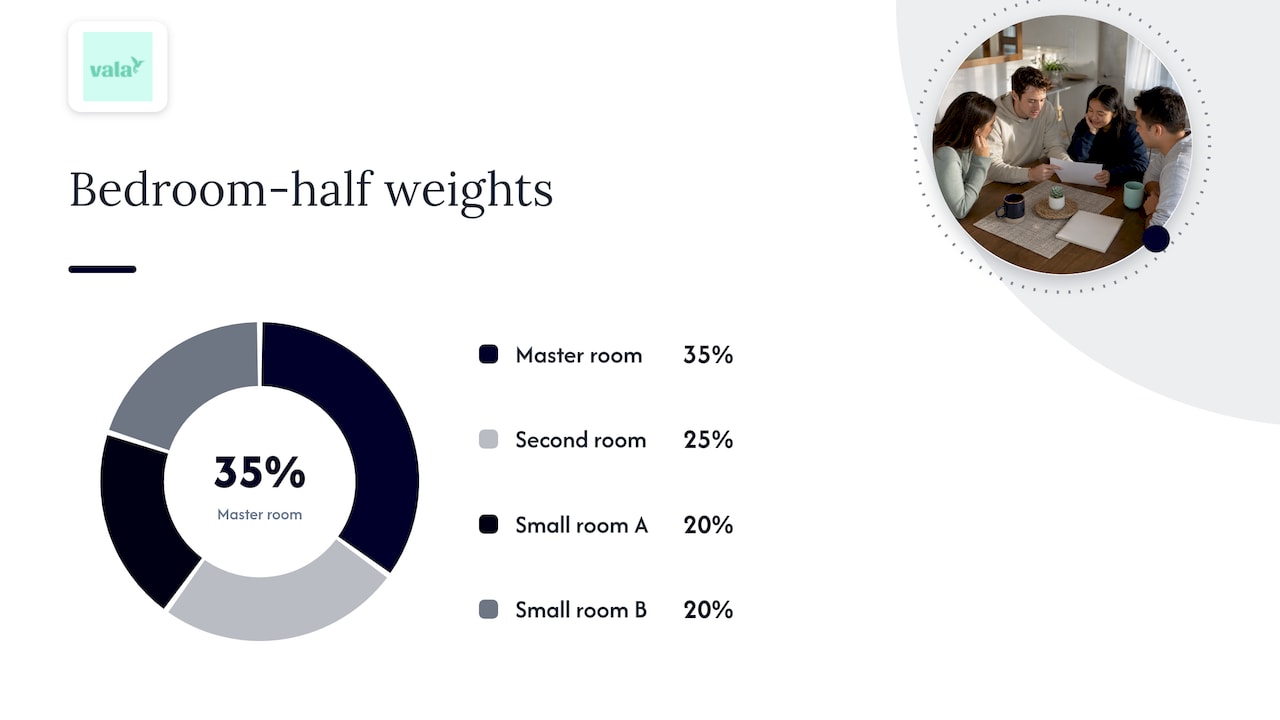
Step 2: the other $1,200 is the bedroom half. Weight the rooms: master 35%, second room 25%, each single room 20%. That gives $420, $300, $240 and $240.
Step 3: couples split their room’s share. Master couple: $210 each. Second couple: $150 each. Singles pay their own room in full: $240 each.
| Guest | Shared half | Room half | Total |
|---|---|---|---|
| Master couple, each | $200 | $210 | $410 |
| Second couple, each | $200 | $150 | $350 |
| Single in small room A | $200 | $240 | $440 |
| Single in small room B | $200 | $240 | $440 |
Check: $820 + $700 + $440 + $440 = $2,400.
Notice what happens. The singles pay the most per person, because they take a whole room alone. If that feels like too much, that is a reason to talk about the room weights before booking, not after. A couple that shares one room usually pays less per head than a single does, which is the usual logic of a room split.
Does a couple pay one share or two?
This is the question behind most of the forum threads on the topic. There is no rule. There are two defensible answers:
- Per person: each adult is a share. A couple pays two shares. It is simple, and it is fair when everyone gets similar use of the house.
- Per room: a couple is one room, so they pay for one room between them. It is fair when rooms are different and couples have to take whatever is left.
The hybrid method above is the compromise: each person pays for shared space, and the room half reflects what each room is worth. If kids are coming, agree on a rule for them too. A common version is that children under a set age pay a reduced share or none for the bedroom half. Whatever you pick, say it out loud.
What to do with cleaning fees, service fees and taxes
The checkout total has several lines, and they behave differently.
- Cleaning fee: a fixed charge no matter how many people stay. Split it evenly per person, even if the rest of the bill is split by room or by nights.
- Service fee and taxes: these are calculated on the booking. Split them the same way you split the rent they are charged on. In the hybrid example above, that is exactly what happens, because we split the whole total.
- Security deposit: not part of the cost. The booker fronts it and gets it back. If part is withheld for damage, split that amount by person-nights, or charge whoever broke the item if everyone agrees.
- Add-ons: a pet fee belongs to the person with the pet. A late checkout request or an extra-guest fee goes to whoever asked for it.
One more point: cleaning fees and taxes can be a big slice. A $2,200 base rate can end up well above $3,000 at checkout once fees and lodging taxes are added, which is why starting from the total matters.
Different arrival dates
If one friend arrives a day late or leaves early, count person-nights instead of heads. Divide the total by all the person-nights to get a rate per person-night, then multiply by each person’s nights. Keep the cleaning fee equal per person, since it does not depend on length of stay.
Example: a $2,100 total, 4 people for 3 nights is 12 person-nights, or $175 per person-night. Someone who stays only 2 nights pays $350 for lodging, not $525. If the nights do not add up to the same total, round the last share so everything adds up to the exact amount charged.
Will Airbnb let you split the payment?
Not among friends. Airbnb’s checkout charges one guest, the person who books. Airbnb’s help center does describe scheduled payments, but these split one guest’s payment into parts over time. They do not divide the bill among several guests.
The U.S. conditions, per Airbnb’s scheduled payments page, include an eligible payment method, check-in at least 14 days out, a stay under 28 nights and a remaining balance of at least $50. The booker can use this to spread the cost, which gives the group time to send money in. Check the cancellation policy first. If the second payment fails and is not completed within 72 hours, the reservation is canceled, and any refund of the first payment follows the listing’s policy.
Airbnb did once launch a group payment option. TechCrunch reported in 2017 that the organizer was charged first and the others had 72 hours to pay their share. Do not plan a trip around it. Plan for one person to pay and everyone else to repay them.
That makes the booker’s position risky. They carry a big charge on their card until everyone pays. So agree on dates:
- Post the split method and a price cap in the group chat before anyone looks at listings.
- Collect shares before booking if the stay is nonrefundable, or before the free-cancellation deadline if it is refundable.
- Keep the security deposit with the booker, as above.
- Settle variable costs, such as groceries and taxis, at the end in one round.
Splitting a hotel instead
Hotels split more cleanly than rentals because every room has its own price. Price each room, divide it among the people in it, then multiply by the nights. Taxes and resort fees follow the room they are charged on.
Example: a 3-night stay with a suite for a couple at $300 a night, a double for two friends at $180 and a single room at $140, taxes included.
- Suite: $900 total, so $450 each
- Double: $540 total, so $270 each
- Single: $420 for one person
Total: $1,860. Nobody subsidizes anyone, and nobody has to explain why they pay for a room they did not use. If the group would rather share the savings or the premium, you can use the hybrid idea again: average a small part across everyone and let rooms carry the rest. Group-wide extras, such as a shared breakfast or a parking fee, are split evenly among the people who use them.
Splitting a rental car
For a shared rental car, split every charge the whole group uses among everyone riding, the driver included. A common mistake is to divide by passengers only, which overcharges each passenger and lets the driver ride free.
Example: $360 for the base rate and taxes, a $48 fee for a second driver and $52 for fuel is $460. Four people riding is $115 each.
- Tolls and parking: charge to the people in the car at the time.
- A private detour: charge it to the people who chose it.
- A young-driver surcharge: that driver’s cost unless everyone agrees otherwise.
- Damage excess: agree on who pays before pickup.
If the trip includes ride-hailing as well, the same rule works for fares. We cover it in how to split a rideshare fare.
When someone cancels or leaves
The booking was made on headcount, so the group usually cannot recover the money. A sensible default:
- The person who cancels still pays their share, unless they find a replacement the group agrees to.
- If nobody replaces them and the booking cannot be changed, the group splits the gap.
- Any refund follows the booking’s policy and goes back in proportion to what each person paid.
- If someone leaves because the place was not as listed, the group should ask the host for a refund and then adjust the split.
Mention this in the same group chat message as the method. It feels awkward before the trip and is far worse afterward.
Settle up in one round
Six people sending money to one booker in different amounts at different times is how things get lost. Work out each person’s balance: what they paid minus what they owe. Then match the biggest debtor to the biggest creditor and repeat. A group of N people can always settle in at most N−1 payments. Four people need three payments at most, not six.

The same math applies when several people paid for different things: one covered the house, another the groceries, a third the rental car. Add everything together first, then work out balances.
If the trip is abroad, remember the smaller shared costs too. A prepaid eSIM is one example, and a guide on using your phone in Israel shows how travelers compare data options before they go. Decide early whether those costs go into the shared pot or stay personal.
If you want to read more about group settling, see how shared costs are settled and how group expense tracking works.
How Vala keeps the trip split simple
Doing this by hand takes a calculator, a spreadsheet and a lot of reminders. Vala is built to take that off your plate. It offers automated group and shared expense splitting, so you can add the Airbnb total, the groceries and the car in one place and see who owes what. Savings goals and bill reminders sit in the same app, so the trip share does not surprise your budget.
SaverLite is $2.99 per month, and SaverPro is also available. You can start with the Split Expenses page or run a Money Leak Check to see where your regular spending goes before you commit to the next trip.

Want a place to start? Start your free analysis with Vala and add your next trip total.
Our view: agree on the unit, then the room
Most trip splits go wrong for one reason: the group never agreed on what a share is. A share can be a person, a room or a night. Once you pick one, the math takes a minute.
We build Vala around that idea. Shared costs should live next to your own budget, so a $400 lodging share is not a surprise in the same month as rent and subscriptions. When the group total, your share and your savings goal sit in one view, you can decide what you can afford before you click yes.
Our advice to every group: write the rule down, include the fees, collect early and settle once. Our tools are designed to make each of those steps easier, so the friendship is not the thing that pays for the trip.
SaverStride
FAQ
Is it fair to split an Airbnb equally?
It is fair when the rooms are similar and everyone stays the whole time. If one room is clearly better or a couple shares a bed, an equal split can feel off. In that case, use the hybrid method: half per person, half by room.
Should the person who books pay extra for the work?
Some groups give the organizer a small discount, and others do not. The important part is to say so in advance. Whatever you decide, the booker should not carry the card charge for long, so set a payment date before you book.
Who pays the security deposit?
The booker fronts it and gets it back after checkout. It only becomes a shared cost if part is withheld. Then split that amount by person-nights, or charge whoever caused the damage if the group agrees.
How do we split the cleaning fee if rooms are unequal?
Split it evenly per person. It is a fixed charge for the whole house, and it does not change with the size of the room. The rest of the total can follow a room split, a night split or the hybrid method.
Sources
- Airbnb Help Center: checkout total and payment options
- Airbnb Help Center: scheduled payments
- Airbnb Help Center: failed second payments
- Moneywise: how to fairly split a vacation rental
- TechCrunch: Airbnb launches payment splitting for group trips
- SabraConnect: using your phone in Israel