Budget reforecasting means updating your budget with what actually happened, then adjusting the months ahead so the numbers match your real life. You compare planned and actual income and spending, find what drifted, and rewrite next month’s plan. It takes about 30 minutes a month, and it is the difference between a budget that works and one you abandon by February.
This guide is for you if you are a salaried employee, a student or a young professional, or if you split dining, trips and events with friends. You do not need finance training. You need your bank activity, a few categories and a routine.
TL;DR
- Reforecasting is a regular update of your budget using real income, bills and spending, not a new budget from scratch.
- Do a 5-minute weekly check, a 30-minute monthly review and a longer quarterly reset.
- Change the numbers that keep missing for two months in a row. A repeated miss usually means the target was sized wrong.
- Track bills, subscriptions and price increases first, because they quietly move your fixed costs.
- With friends, count what you owe and are owed as part of your forecast, so a group trip never surprises your balance.
Table of Contents
- What budget reforecasting means
- Why a static budget fails
- How often to reforecast
- The monthly reforecast, step by step
- Adjusting for income changes and bill increases
- Using the 50/30/20 rule as a sanity check
- Reforecasting with friends: shared dining, trips and events
- Tools that make reforecasting easier
- Make reforecasting automatic with Vala
- Our perspective
- FAQ
- Sources
What budget reforecasting means
A budget is a plan: how much you expect to earn and where each dollar should go. A forecast is a prediction of what will actually happen in the weeks and months ahead. Reforecasting is the step in between. You take the plan, see how far real life has moved from it, and rebuild the forecast for what is left.
Top search results for this phrase mostly come from the business world, where finance teams reforecast quarterly. The idea is the same for a household, only simpler. Your “finance team” is you, and your reports are your bank and card statements.
Budgeting, forecasting and reforecasting side by side
| Budgeting | Forecasting | Reforecasting | |
|---|---|---|---|
| Question it answers | Where should my money go? | What will probably happen? | Given what already happened, what should change? |
| Based on | Goals and past habits | Known income, bills and patterns | Actual results versus plan |
| Looks at | A month or a year | Weeks to months ahead | The rest of the period |
| When you do it | Once, then on big changes | Whenever you plan ahead | Weekly, monthly and quarterly |
You need all three. The budget sets direction, the forecast shows what is coming, and the reforecast keeps both honest.
Why a static budget fails
Most budgets fail for a boring reason: they were built from guesses. You assume $300 for groceries, then your real number is $380. You assume your phone bill stays the same, then a promotional rate ends. You assume a slow month socially, then three birthdays land in the same week.
A budget that never changes turns every miss into a feeling of failure. A reforecast turns the same miss into information. One personal finance planner puts it this way: a target missed by the same amount two months in a row is a mis-sized number, not a behavior problem. That is the mindset of this whole guide. You are not grading yourself. You are fixing the numbers.
How often to reforecast
Three rhythms cover most people. They add up to under an hour a month.
- Weekly, 5 minutes. Look at the two or three categories that usually run over, often dining out, groceries and shopping. You are checking for drift while it is still small.
- Monthly, about 30 minutes. The full review described below. One budgeting blogger recommends this kind of 30-minute monthly appointment in place of switching tools when a budget fails.
- Quarterly, about 45 minutes. Step back and re-check your income, your savings goals and your fixed costs such as rent, insurance and subscriptions.
Also reforecast immediately after a big change: a new job, a raise, fewer hours, a new roommate, a move, or a trip you just booked. Waiting for month end only means a longer stretch of working from a plan that no longer fits.
The monthly reforecast, step by step
Here is a routine you can repeat every month. It is built around how a cash flow plan works: instead of an abstract monthly total, you follow money as it arrives and leaves.
Step 1: Gather your actual numbers
Pull your bank and card activity for the month, your pay stubs and last month’s budget. Use real net pay (what landed in your account), not your salary on paper. If you have side income, tips or freelance work, record what you actually received.
Where it goes wrong: using projected numbers because they are easier to find. A forecast built on guessed income inherits the guess.
Step 2: Check balances against your records
Confirm that the balance in your tracker matches your real account balances. A mismatch usually means a missed transaction, a pending charge or a subscription you forgot. Fix it now, because every later step depends on a correct starting point.
Step 3: Compare planned and actual by category
List each category with the planned amount, the actual amount and the difference. Then label each difference:
- One-time: a flight, a repair, a gift. It will not repeat.
- Recurring overspend: it happened last month too.
- Underspend: you spent less than planned. Decide whether to move the extra to savings.
- Expected: it was seasonal or planned, such as a holiday month.
This labeling is what separates reforecasting from simply looking at your statement. The label tells you whether to change the plan or leave it alone.
Step 4: Diagnose the two or three categories that broke
Do not try to fix everything. Pick the few categories with the largest recurring gaps. Ask what changed: price, frequency, or a plan that was unrealistic from the start. Prices and frequencies are fixable. An unrealistic number should simply be resized.
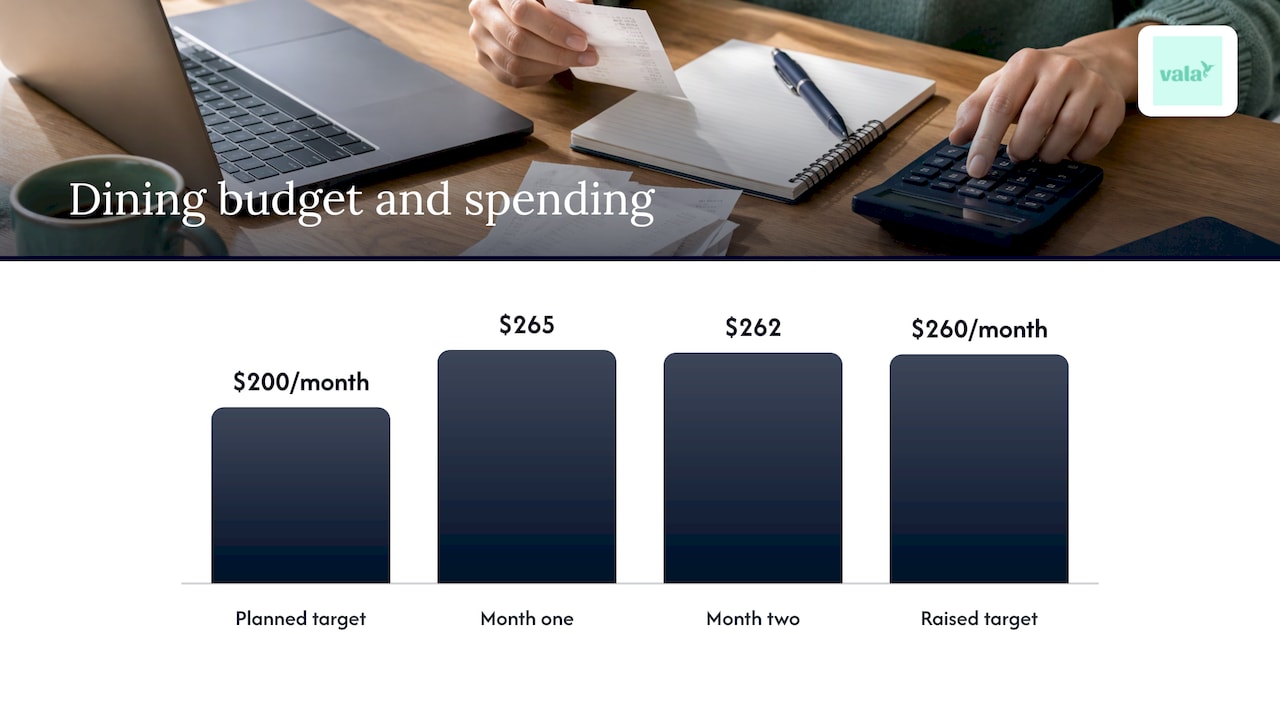
A worked example. Say you planned $200 a month for dining out and spent $265 and $262 in the last two months. That is a recurring overspend of about $63. You have two honest options: raise the dining target to $260 and take the $60 from somewhere else, or cut back to a real $200 by changing your habits. What you should not do is leave $200 on the page and feel guilty. One planner suggests that a target missed by $60 two months in a row should rise by $60 rather than be punished with tighter limits, and then be balanced elsewhere.
Step 5: Rebuild the next month week by week
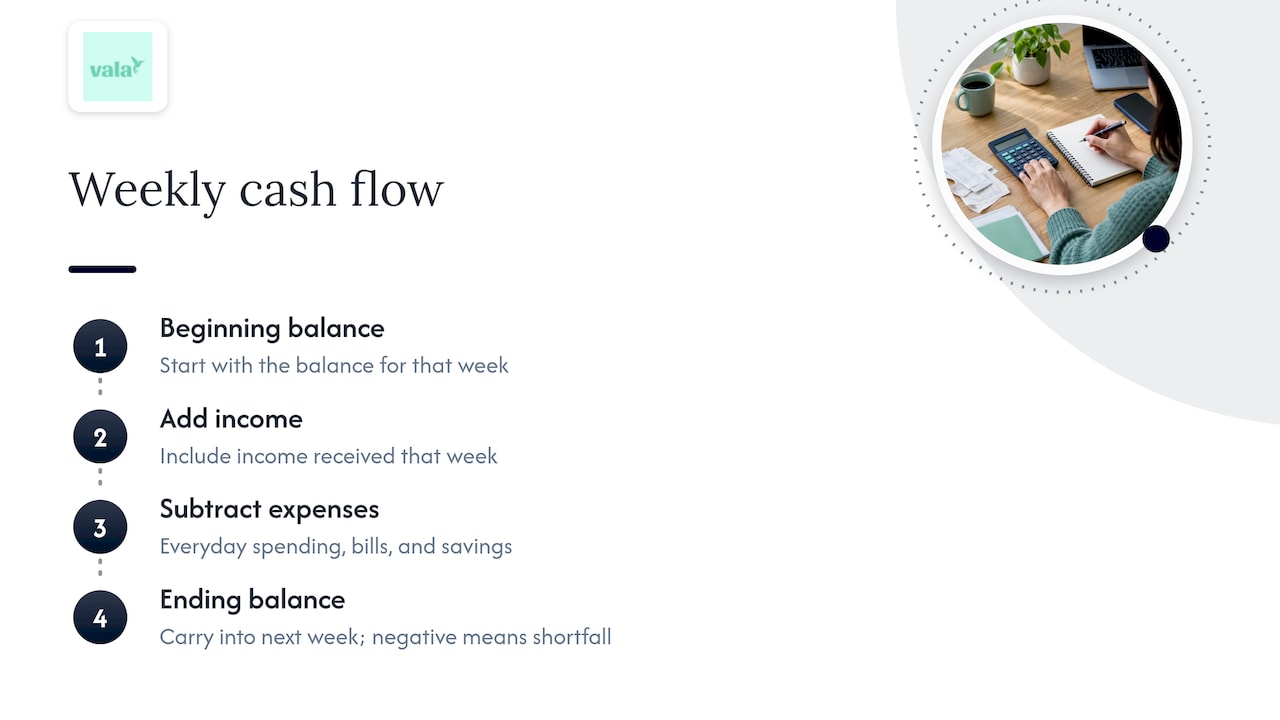
This is the forecast part. The Consumer Financial Protection Bureau’s cash flow budget tool shows the method. After tracking at least one month, for each week you enter your beginning balance, add the income you receive that week, subtract all expenses including everyday spending, bills and savings, and carry the ending balance into next week. A positive result means you have enough to get through the week. A negative one means you will fall short, and you can fix it before it happens.
A university extension guide makes the same point: a cash flow plan shows the timing of income and expenses, not only the totals, and you balance each period so the ending balance is zero or above. Timing matters a lot if you are paid biweekly or your rent lands before your next paycheck.
Step 6: Write down the adjustments
Change the numbers, not your intentions. A good monthly reforecast ends with a short list: three numbers changed and one behavior to try. Keep the list short enough that you will actually follow it.
Adjusting for income changes and bill increases
Two things move a budget more than anything else: your income and your fixed costs.
When income changes. If you start a side hustle, lose hours or get a raise, rebuild the budget from the new take-home figure instead of patching the old one. If your pay is irregular, base the plan on a low-but-realistic month and treat anything above it as a bonus to assign: first to bills and savings, then to wants.
When a recurring charge goes up. Streaming plans, phone plans, insurance and gym memberships all raise prices. Since these are fixed costs, a $6 increase is $72 over a year, and you will not notice it in the day-to-day. Check your recurring charges at least once a quarter. Look for price changes, free trials that turned into paid plans and services you no longer use.
When a bill spikes. Utility bills move with the seasons. Look at the same month last year, or the last three months, and forecast the season instead of the average. Then set aside the difference in the cheaper months.
When irregular expenses hit. Car registration, annual subscriptions, holiday gifts and travel are predictable if you list them. Divide each by the months before it is due and put that amount into a sinking fund, which is just a savings pot for a known future cost.
Using the 50/30/20 rule as a sanity check
The 50/30/20 rule puts about 50% of after-tax income toward needs, 30% toward wants and 20% toward savings and debt payments. It is a rough guide, not a law, but it works well as a quick reforecast check. One budgeting blogger gives the example of needs creeping up to 58%, a drift you would spot by comparing your categories against the rule. If your rent is high, your needs share will naturally sit above 50%. The point is the trend, not the exact percentage: when one group grows, something else has to shrink or your income has to rise.
Reforecasting with friends: shared dining, trips and events
Shared costs are where a personal forecast most often breaks. You pay for the group dinner on your card, your balance drops by $240 and your dining category looks wrecked, even though your own share is $60. Or you owe a friend for your part of a rental and forget it until it lands.
A few habits fix this:
- Separate what you paid from what you owe. Record the full amount you paid, then mark the part others owe you as money coming back. Your real spending is your share only.
- Put expected reimbursements in the forecast by week. If a friend will pay you back on Friday, count it on Friday, not before. If you owe someone, count it in the week you plan to pay.
- Settle often. Small balances settled right away are easier to forecast than a pile that builds across a whole trip.
- Budget your share before the event. For a weekend trip, estimate transport, lodging, food and activities, divide by the number of people and add your share as a one-time line in the month it is paid.
- Agree on the split rule up front. Equal split works for most dinners. For trips where people share unequally, such as one person driving or a bigger room, agree on the rule before spending starts.
If you are a couple sharing finances, the same logic applies at a bigger scale. Our guide to a budget tracking app for couples and shared expenses explains how to keep shared and personal money in one view.
Tools that make reforecasting easier
A spreadsheet works for a reforecast, and many people start there. The friction comes from entering data by hand, which is the first thing to slip when life gets busy. An app that connects to your accounts removes that step, so your monthly review starts with the actual numbers already in place.
If you want to see how the pieces fit, our guide to 13-week personal cash flow forecasting walks through the weekly view, and the monthly budget planner post gives you a layout to start from.
Make reforecasting automatic with Vala
Vala is built around the exact things a reforecast has to catch: subscriptions, recurring charges and bill spikes. It connects to your bank through Plaid, so your numbers come from your real accounts. It flags money leaks in your spending, sends reminders for upcoming bills and runs future cash flow simulations, so you can see next month before it arrives. It also handles shared and group expense splitting, so your forecast reflects your share, not the whole dinner check.
SaverLite is $2.99 per month. Start with the Money Leak Check to see which recurring charges and bill increases are costing you the most right now.

If you want to try bills first, the bill reminder app page shows how reminders keep due dates inside your forecast.
Our perspective
Most people think a budget fails because they lack discipline. We see it differently: it fails because it was never updated. A plan built on guesses will be wrong, and one that nobody revisits stays wrong.
That is why we built Vala around the leaks that change a budget behind your back: subscriptions that creep up, recurring charges you forgot and bills that jump without warning. These are not failures of willpower. They are changes in your numbers, and they should show up in your forecast as soon as they happen.
We also think budgeting should not feel like a monthly punishment. Tracking, bill reminders, future cash flow simulations and shared expense splitting all exist so the review is short, clear and calm. When your real numbers are already in front of you, reforecasting becomes a quick adjustment instead of a chore, and you can spend your energy on your goals.
SaverStride
FAQ
What is the difference between budgeting and reforecasting?
Budgeting sets your plan for how to use your income. Reforecasting updates that plan using real results, so the months ahead reflect what actually happened. You budget at the start and reforecast regularly after that.
How often should I reforecast my personal budget?
A good rhythm is a 5-minute weekly check on your riskiest categories, a 30-minute monthly review and a longer quarterly reset. Also update right away after a job change, a move or a major new bill.
What if I keep going over budget in the same category?
Treat it as a sizing problem first. If you have missed the target for two months in a row, raise it to a realistic number and take that money from another category. Then try one specific habit change, such as setting a weekly cap, instead of tightening everything at once.
How do I include shared expenses with friends in my forecast?
Record only your share as spending. Treat what friends owe you as incoming money in the week you expect it, and count what you owe as an outgoing payment. Settling up soon after each dinner or trip keeps your forecast clean.
Sources
- Creating a cash flow budget tool, Consumer Financial Protection Bureau
- Cash Flow Plan Sheet, Utah State University Extension
- How to Build a Budget That Actually Works in 2026, Personal One
- The Monthly Budget Review: A 30-Minute Routine, The Budget Bit