
You can often get a bank fee refunded. Overdraft, insufficient funds, monthly maintenance and out-of-network ATM fees are the ones banks reverse most often. A fee charged in error, or one that breaks your account terms or federal rules, is a dispute the bank has to take seriously. A fee that was correctly charged is usually a one-time courtesy you have to ask for. This guide shows you how to tell the difference, what to say, where to escalate, and how to confirm the money actually came back.
TL;DR
- Ask for a refund as soon as you spot the fee. Lead with the cause: a bank error, a posting-order problem or a charge that contradicts your account terms. If it was your own slip, ask for a one-time courtesy reversal.
- Banks cannot charge an overdraft fee on a one-time debit card purchase or ATM withdrawal unless you opted in to overdraft coverage. Checks and recurring payments are different.
- If the first agent says no, ask for a supervisor, put the request in writing, then file a complaint with the Consumer Financial Protection Bureau (CFPB).
- Refunds appear as a separate credit on your statement. Check the label and the date, because some banks post ATM refunds at the end of the statement cycle.
- The cheapest refund is the fee you never pay. Alerts and a regular review of your charges catch most repeat fees.
Table of Contents
- Which bank fees can you ask to have refunded?
- The overdraft rule that catches many banks
- How to ask for a refund, step by step
- What if the bank says no?
- Automatic refunds: what “overdraft fee forgiven” programs look like
- How to track an ATM fee refund
- Recognize the fee before you chase it
- Stop paying the same fee twice
- Find the next fee before it finds you
- FAQ
- Sources
Which bank fees can you ask to have refunded?
Most checking account fees are open to a request. The ones people get reversed most often are:
- Overdraft fees, charged when you spend more than your balance.
- Non-sufficient funds (NSF) or returned-item fees, charged when a payment bounces.
- Monthly maintenance fees, charged when you did not meet the requirements to waive them.
- Out-of-network ATM fees, charged by your bank or by the ATM owner.
- Foreign transaction fees, when they were charged in error.
- Any fee that breaks your bank’s own rules or disclosures.
That list comes from a guide to disputing bank fees. The same guide notes that banks routinely waive a first overdraft, NSF or maintenance fee for customers in good standing.
Courtesy refund versus fee you are owed
This distinction decides how you open the conversation.
A courtesy refund is goodwill. The bank charged the fee correctly under your agreement and chooses to give it back. You have no legal right to it, but a clean history, a long relationship and a first-time slip all help. One consumer-finance explainer puts it plainly: a waiver is goodwill, not a right, while an accounting error is a different matter.
A fee you are owed back is one the bank should not have charged. Examples:
- The fee is not in your fee schedule.
- The fee does not match the amount in your account disclosures.
- A deposit posted late because of the bank, and the fee followed.
- The bank charged an overdraft fee on a one-time debit card purchase or ATM withdrawal when you never opted in.
The FDIC says banks must disclose any fee tied to a deposit account, and that every deposit-related fee has to appear in the account opening disclosure and fee schedule. If a charge on your statement does not match those documents, you have your evidence.
The overdraft rule that catches many banks
Overdraft fees are the biggest refund category, and one rule works in your favor. The CFPB states that banks cannot charge an overdraft fee on one-time debit card transactions and ATM withdrawals unless you opt in. The same page says banks may still charge overdraft fees on checks and recurring electronic payments even if you never opted in.
So before you call, sort the fee by the kind of payment that triggered it:
| What caused the overdraft | Can the bank charge an overdraft fee without your opt-in? |
|---|---|
| One-time debit card purchase | No |
| ATM withdrawal | No |
| Check | Yes, it may |
| Recurring electronic payment (autopay, bill pay) | Yes, it may |
If the fee was on a coffee, a gas pump or an ATM withdrawal and you do not remember opting in, say so clearly and ask the bank to show you the opt-in record. The CFPB says that if you do not believe you authorized debit overdraft coverage and the bank charged you anyway, you may file a complaint with the CFPB.
The picture has more layers than a simple yes or no. Experian notes that even without opt-in, a bank can still charge a non-sufficient funds fee, and a merchant can charge a returned item fee for declined payments. Read the exact fee name on your statement before you decide which argument fits.
How to ask for a refund, step by step
1. Gather the facts first
Take five minutes before you call. A consumer-finance guide suggests you screenshot the fee’s date, amount and description, read the fee schedule linked in your account disclosures, and note your tenure, direct deposit and whether this was a first or rare event.
Have this on hand:
- The fee name, amount and date.
- The transaction that triggered it.
- How long you have banked there.
- Any other fees in the same month.
If you want a cleaner view of your own activity first, our guide to reconciling bank transactions walks through matching what the bank posted to what you expected.
2. Call or visit soon after the fee posts
Speed matters. The guide recommends you call within a few days, explain the charge and ask for a one-time courtesy refund. You can also speak to a teller or use in-app chat, and Experian suggests explaining what caused the overdraft, such as a delayed deposit or an automatic payment that cleared earlier than expected. It also notes banks may be more forgiving of long-time customers with a responsible history.
3. Lead with the cause
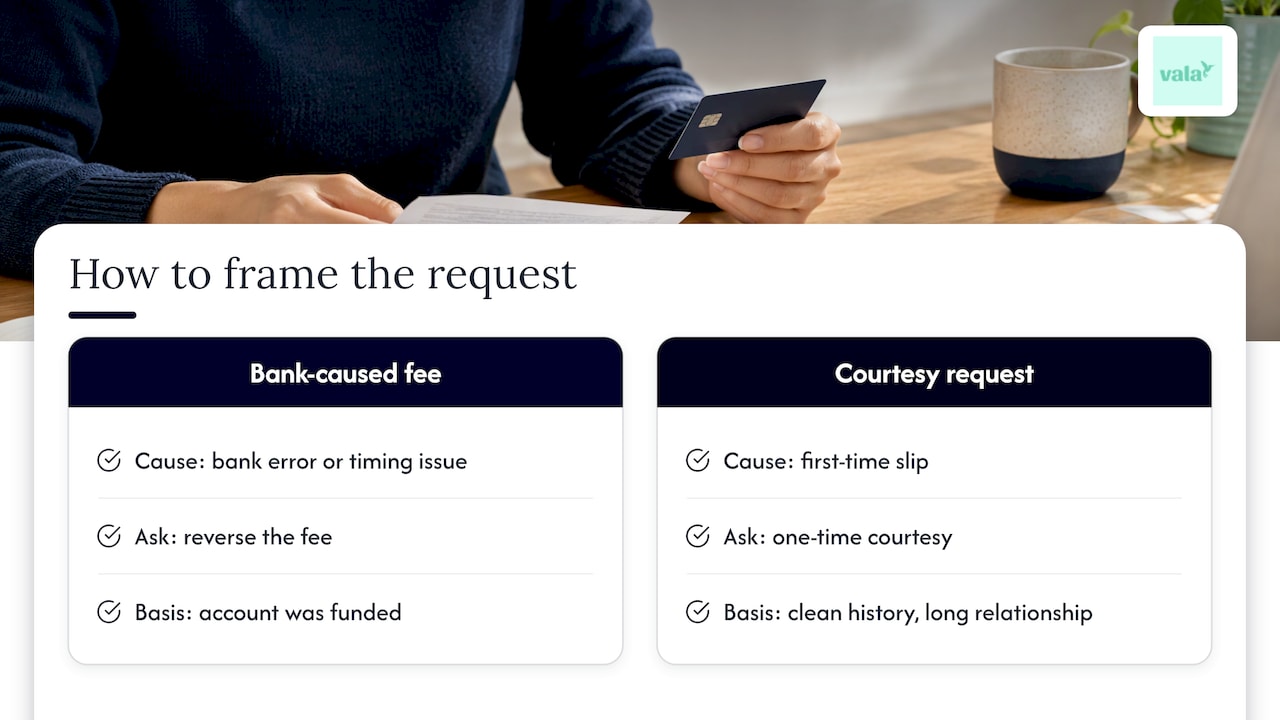
The opening line changes the weight of your request. If the cause was a bank error, a timing or posting-order issue, or something that contradicts your account terms, lead with that instead of asking for a favor. That is a dispute, and it carries more weight.
Sample wording for a bank-caused fee:
“I’m calling about a $35 overdraft fee posted on [date]. My paycheck was deposited on [date], before the purchase. I’d like the fee reversed because the account was funded.”
Sample wording for a courtesy request:
“I’ve banked with you for [X] years with direct deposit, and this is the first overdraft fee I can remember. Could you reverse it as a one-time courtesy?”
Keep it short, polite and specific. Ask for the outcome you want, then stop talking.
4. Get the result in writing
Before you hang up, ask when the credit will post and what it will be called. Write down the agent’s name, the date and a reference number. If the agent says a refund is coming, check for it within a few business days.
What if the bank says no?
A first “no” is often just the first agent’s limit. Work up this ladder:
- Ask for a supervisor or the retention team. Repeat the cause and your history.
- Write it down. Send a message through the bank’s secure inbox or a letter that states the fee, date, amount and reason it should be reversed, cites the rule or disclosure that applies, and sets a reasonable deadline. This is the approach recommended in the dispute guide.
- File a CFPB complaint. This is free and can be done online or by phone.
Filing a CFPB complaint
Describe the problem in your own words, include key dates and amounts, and attach statements. The CFPB sends the complaint to the bank, which generally responds within 15 days, or up to 60 days in more complex cases. According to Bankrate, some companies take up to 60 days to give a final response, and you then have 60 days to give feedback in a post-complaint survey.
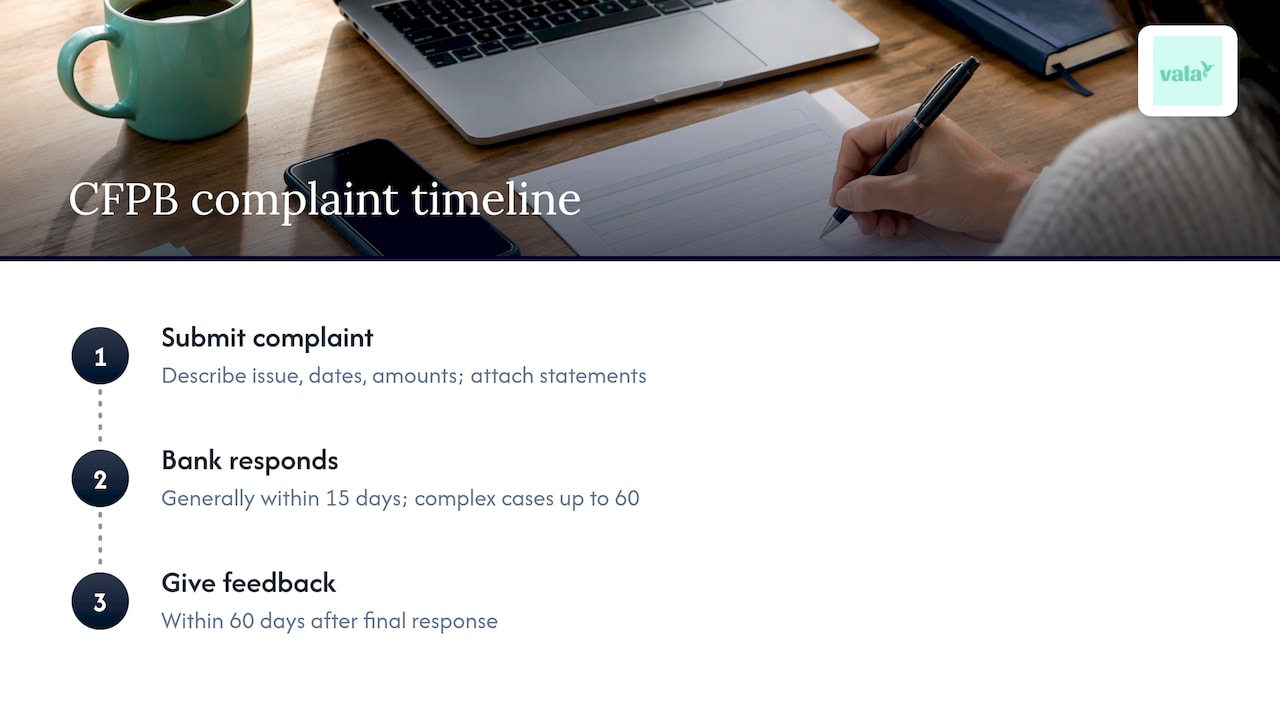
A complaint does not guarantee a refund. It does force the bank to formally address your dispute instead of closing it at the customer service level, and complaints go into a public database, so banks tend to treat them with care.
If the fee involved an unauthorized electronic transfer, the timeline is tighter. One source says you typically have 60 days from the date the charge appeared on your statement to dispute it under the rules, so do not wait.
Automatic refunds: what “overdraft fee forgiven” programs look like
Some banks build refunds into the account so you never have to call. These programs have rules, and the details matter. For example, U.S. Bank’s overdraft benefit refunds the overdraft fee if you make a qualifying deposit before 11 p.m. ET on the same day the balance went negative. If the account is overdrawn by $50 or less, no fee is charged. If it is overdrawn by $50.01 or more, the fee is not refunded.
If your bank offers something like this, set a reminder to deposit before the cutoff on any day your balance dips. Check your own bank’s account page for its current terms.
How to track an ATM fee refund
ATM fees come in two parts: the one your bank charges and the surcharge the machine’s owner adds. Some accounts reimburse them automatically. Others only reimburse if you ask.
LegalClarity says the average out-of-network ATM fee is around $3.19, and most banks that reimburse set limits, such as a monthly dollar cap (often near $10 per cycle) or a fixed number of reimbursements per month.
What the refund looks like
The label varies by bank. Here are real examples from bank help pages:
| Bank type | How it appears | When it posts |
|---|---|---|
| A large member-based bank | “ATM Rebate” on monthly statements, up to $10 per statement cycle | Each statement cycle |
| A community bank | “ATM SURCHRG REVERSAL” | No later than the second business day |
| A regional bank | Immediate refund of out-of-network fees, with annual caps of up to $250 or $150 depending on the account | Right after the ATM transaction posts |
More generally, ATM reimbursement credits often appear as a separate line labeled “Fee Rebate” or “ATM Surcharge Refund”. Some banks credit them within a day or two, while others issue one combined credit at the end of the statement cycle. Investopedia notes that in most cases reimbursements are automated, so you do not need to keep receipts or fill out paperwork.
A simple tracking routine
- When you pay an ATM fee, note the date and amount in your phone or screenshot the receipt.
- Wait for the window your bank states: a couple of business days, or the end of the cycle.
- Search your transactions for the refund label and match it to the fee.
- If it is missing after the window, contact the bank with the date, amount and ATM location.
- Keep track of any monthly cap so you know when you are paying out of pocket.
The same habit works for any refund. When a bank approves an overdraft refund, it shows up as a credit often labeled “Fee Reversal” or “Overdraft Refund”. If your account is negative at the time, the credit reduces or clears that balance once it posts.
Recognize the fee before you chase it
Bank statements use shorthand. Here is what common names usually mean, based on a plain-language fee explainer:
- Monthly Service Fee: you did not meet the requirements to waive it.
- Overdraft Fee or OD Fee: you spent more than your balance.
- NSF Fee: a payment bounced.
- ATM Fee: you used an out-of-network ATM.
- Paper Statement Fee: you receive mailed statements.
- Dormant or Inactivity Fee: the account has not been used.
- Early Account Closure Fee: you closed the account too soon.
- Stop Payment Fee: you asked to stop a check or payment.
- Returned Item Fee: a deposited check bounced.
The FDIC notes that overdraft fees may cost around $35 per transaction, and some banks also charge a continuous overdraft fee every day the account stays overdrawn. A few small fees can add up quickly, so it is worth reviewing your statement line by line.
Stop paying the same fee twice
A refund helps once. A routine helps every month. These steps come from the same fee explainer and from our own guides:
- Decide whether you want overdraft coverage at all. The fee explainer recommends opting out if you would rather have a purchase declined than pay a fee.
- Set a low-balance alert around $100 to $150, plus large-transaction and fee-charged alerts.
- Find your bank’s ATM network before you travel.
- Switch to e-statements if a paper statement fee applies.
- Time your autopay and bills so they clear after payday. See how to predict an overdraft before payday and our three quick changes to avoid overdraft fees.
- Watch for double charges that look like fees. Our guide to detecting duplicate charges fast shows what to look for.
Our perspective: fees are a pattern, not a one-off
We see a bank fee refund as a good first step, and a repeating fee as the signal that matters more. One $35 reversal feels like a win. But when the same type of fee shows up three months in a row, the real problem is timing, a balance that dips before payday, or a recurring charge you forgot about.
That is why we built Vala around money leaks instead of simple expense totals. Our approach is designed to help you spot recurring charges, subscriptions and unexpected bill spikes, connect them to your cash flow, and see what is coming before it lands. Bill reminders and future cash flow simulations are there so the next fee never gets the chance to post.
Our advice: ask for the refund, then use what you learned to close the gap. A fee you have a plan for is a fee you stop paying.
SaverStride
Find the next fee before it finds you
If you want a quick view of where small charges are slipping through, try our Money Leak Check. It looks at your spending for recurring charges, subscriptions and bill spikes, and bank connection runs through Plaid, so your sensitive details stay protected.

Vala is free to start, and paid plans start with SaverLite at $2.99 per month, with SaverPro also available for fuller tools. You can start your free analysis in a few minutes. If you want to see what a recovery plan can look like, read how an app can help with recovering $200 or more in 20 minutes.
FAQ
Can a bank refuse to refund an overdraft fee?
Yes, if the fee was charged correctly under your agreement, a refund is a goodwill decision. Ask again with a supervisor and lead with the cause. If you believe the fee broke your account terms or the opt-in rule for debit card and ATM transactions, put the dispute in writing and file a CFPB complaint.
How long does a bank fee refund take to show up?
It depends on the bank and the fee type. Some ATM refunds post right away or within a couple of business days, while others are combined into one credit at the end of the statement cycle. For a courtesy reversal, ask the agent when it will post and what it will be labeled.
Will asking for a refund hurt my account?
Nothing in the research we reviewed says asking for a fee reversal harms your account. Banks tend to be more forgiving toward long-time customers with a responsible history, so a polite request with your tenure and direct deposit mentioned is a reasonable approach.
Can I get ATM fees refunded?
Some accounts reimburse out-of-network ATM fees automatically, often with a monthly or annual cap. Check your account terms. If your account does not reimburse them, you can still ask for a one-time courtesy refund, and you can plan ahead by finding in-network machines.
Sources
- How to Dispute a Bank Fee and Get It Refunded
- How to Dispute a Bank Fee and When It Works
- CFPB: What can I do if my bank charged me a fee for overdrawing my account?
- FDIC: Overdraft and Account Fees
- Experian: How to Get Overdraft Fees Refunded
- Bankrate: How to File a Complaint With the CFPB
- LegalClarity: Will Banks Refund Overdraft Fees?
- LegalClarity: Overdraft Opt-In Rules and Regulation E
- LegalClarity: What Is ATM Credit?
- U.S. Bank: What is Overdraft fee forgiven?
- USAA: ATM Options
- Bank of Central Florida: Personal FAQs
- Gate City Bank: When Will the Bank Refund My ATM Fee?
- Investopedia: How ATM Fee Reimbursement Works
- Wealthvieu: Why Did My Bank Charge Me?