Yes, you can split a security deposit. Most roommates do it by each paying a share to one person, who hands the full amount to the landlord. The part that matters comes later: your landlord deals with the lease, not with your private math. So the smart move is to agree on shares, refunds and move-out rules in writing before anyone sends a dollar.
This guide walks you through how to divide the deposit fairly, what to write down, what happens if someone leaves early, and how to get the money back at the end.
TL;DR
- Roommates split the deposit by each paying a share to one person (or directly to the landlord), then sign a short written agreement on who gets what back.
- Equal shares are simplest. Shares based on room size or rent are fair when rooms differ a lot.
- If your lease makes everyone jointly and severally liable, each tenant can be on the hook to the landlord for the whole amount, no matter what you agreed among yourselves.
- When one roommate moves out mid-lease, the landlord usually holds the deposit until the last tenant leaves, so you settle up with each other.
- Keep a record of every payment, receipt and move-in photo. Deadlines and rules for returning the deposit depend on your state.
Table of Contents
- What “split security deposit” actually means
- Step 1: Decide how to divide the shares
- Step 2: Understand what the landlord can hold you to
- Step 3: Put your deposit agreement in writing
- Step 4: Plan for a roommate who moves out early
- Step 5: Document the unit so deductions are fair
- Step 6: Know the deadlines for getting the money back
- What if you only need to split the payment to the landlord?
- Our perspective: treat the deposit like any shared bill
- Keep the numbers clear with Vala
- A quick roommate deposit checklist
- FAQ
- Sources
What “split security deposit” actually means
People use the phrase in two ways, and it helps to know which one you need.
- Splitting the deposit among roommates. One lease, one deposit, several people. You divide what each person contributes and what each person gets back.
- Paying the deposit to the landlord in pieces. You ask to spread one person’s deposit across several payments instead of paying it all up front.
Most of this article covers the first meaning, because it is the one where mistakes cost real money. The second is covered near the end.
One point trips up a lot of renters. In a roommate setup, the landlord may divide the returned deposit equally among the tenants or send all of it to one tenant. The Boulder landlord-tenant handbook notes that tenants can agree in advance how the deposit or its remaining balance is disbursed, and can present the landlord with a signed agreement. That is the reason a written plan matters. Without one, you may get a check for an equal share, or the whole check may land with a single person who has to pass it along.
Step 1: Decide how to divide the shares
There is no single correct formula. What matters is that everyone agrees before the lease is signed. Here are the three most common approaches.
| Method | How it works | Best when | Watch out for |
|---|---|---|---|
| Equal split | Total deposit divided by the number of tenants | Rooms are similar in size and rent | Feels unfair if one person has a much bigger room |
| Proportional to rent | Each person pays the same percentage of the deposit as of the rent | Rooms and rents differ a lot | Needs a quick calculation, and a new calculation if rent changes |
| Hybrid | Equal base, with an adjustment for a private bathroom or larger room | One room clearly has a perk | More to explain, so write it down |
A worked example
Say three roommates rent a house with a $2,400 deposit and $2,400 total monthly rent. This is an illustration, not a real lease.
- Equal split: each person pays $800.
- Proportional split: Maya has the large room with a private bath and pays $1,000 of the rent. Jordan pays $800 and Sam pays $600. Because the deposit equals the rent here, their deposit shares are $1,000, $800 and $600.
If the deposit were different from the rent, you would multiply each person’s rent share by the deposit. For example, Maya’s share is 1,000 ÷ 2,400, about 41.7 percent. Apply that percentage to the deposit and round to the nearest dollar, making sure the shares still add up to the total.
For a deeper look at fair rent math, our copyable math to split rent with roommates uses the same logic, so you can reuse one method for rent and deposit.
Pick one person to collect
The simplest setup is one “lead” roommate who pays the landlord and collects each share. Choose someone organized and trusted. Everyone else sends their share by a method that leaves a record, such as a bank transfer with a memo like “security deposit, 123 Oak St.” Avoid cash without a signed receipt.
Step 2: Understand what the landlord can hold you to
Your private split is a deal among roommates. It is not a deal with the landlord unless the landlord signs on to it.
If the lease says tenants are jointly and severally liable, each signer can be responsible to the landlord for the full lease obligations, including a roommate’s unpaid rent or damage. A city tenant guide from Clare, Michigan explains that a private agreement may let you recover money from each other, but it normally does not remove the landlord’s rights under the lease. Detroit’s tenant-landlord guide says the same: each tenant is responsible for individual and co-tenant obligations under that kind of clause.
What this means in practice:
- If one roommate causes damage and leaves, the landlord can deduct the repair from the shared deposit, and everyone feels it.
- If someone skips out, you may need to claim the money back from that person yourselves.
- Read the liability clause in your lease before you sign. If it is unclear, ask the landlord to explain it.
Step 3: Put your deposit agreement in writing
A one-page agreement is enough. It prevents most arguments, and it gives you something to show the landlord. Wisconsin’s Tenant Resource Center recommends that roommates decide who paid the deposit, who receives what amount back, and whose name should appear on the check. It also advises writing the arrangement down, because under the Wisconsin rule it cites, landlords must follow written tenant instructions. Other states differ, so treat that as an example of why writing helps, not a universal rule.
Include these items:
- Total deposit amount and the lease address.
- Each person’s contribution, the date paid and how.
- Who receives the refund and in what proportions. Often it is the same as what each person paid, minus any deductions for which they are responsible.
- Who pays for damage. Damage in a bedroom usually falls on that tenant. Damage in common areas is shared, unless one person clearly caused it.
- Whose name goes on the check, if the landlord will cut one check.
- What happens if someone leaves early. See the next section.
- Signatures and dates from every roommate.
Also save the lease and any deposit receipt. California’s tenant guide, California Tenants: A Guide to Residential Tenants’ and Landlords’ Rights, says tenants should make sure the rental agreement clearly identifies the security deposit and its amount, and keep the agreement and any receipt in case of a dispute.
If you want a ready place to log who paid what, the Vala roommate bill workflow shows how to keep shared payments visible to everyone.
Step 4: Plan for a roommate who moves out early
This is where most deposit fights start. One person leaves in March, the lease runs through July, and nobody knows what happens to that person’s share.
The usual answer: the deposit stays put. The North Carolina Real Estate Commission’s renting brochure says a landlord typically will not refund a portion to a roommate who moves out while other lease tenants remain. The deposit is usually held until the last tenant leaves, then refunded, less lawful deductions, to the remaining tenants. UC Berkeley’s Student Legal Services describes the same pattern under California practice: with one lease, the landlord generally need not return the deposit until all original tenants move out, and the departing roommate has to arrange repayment with the roommates or a replacement tenant unless the landlord agrees otherwise.
So settle it among yourselves. A clean way to do it:
- Replacement tenant pays the leaver. The new person reimburses the departing roommate their deposit share directly. Put this in your agreement, and confirm the landlord approves the new tenant and updates the lease.
- Remaining roommates buy out the share. They pay the leaver now and keep the claim to that portion at the end.
- Leaver waits. The departing roommate gets their share when the deposit comes back, minus any deductions that traced to them.
Whichever you choose, write it in your agreement. Add a short move-out checklist so the leaver cleans their room and documents its condition.
Step 5: Document the unit so deductions are fair
A split deposit only helps if most of it comes back. Protect it from the first day.
- Take dated photos or video of every room, appliance, wall and floor at move-in. Do the same at move-out.
- Fill out a move-in checklist if the landlord offers one, and keep a copy.
- Report existing damage in writing within the first days.
- Clean to move-in condition before leaving.
Landlords can generally deduct for certain things. California Courts’ security deposit guide lists unpaid rent, cleaning needed to restore the unit to its move-in cleanliness, damage beyond normal wear and tear, and certain replacement or restoration costs. The American Bar Association similarly says leases commonly allow withholding for unpaid rent, damage beyond normal wear and tear, and sometimes cleaning required for the next tenant.
Normal wear and tear, such as small nail holes or lightly faded paint, is generally not a reason to deduct. Check your state’s definition.
Step 6: Know the deadlines for getting the money back
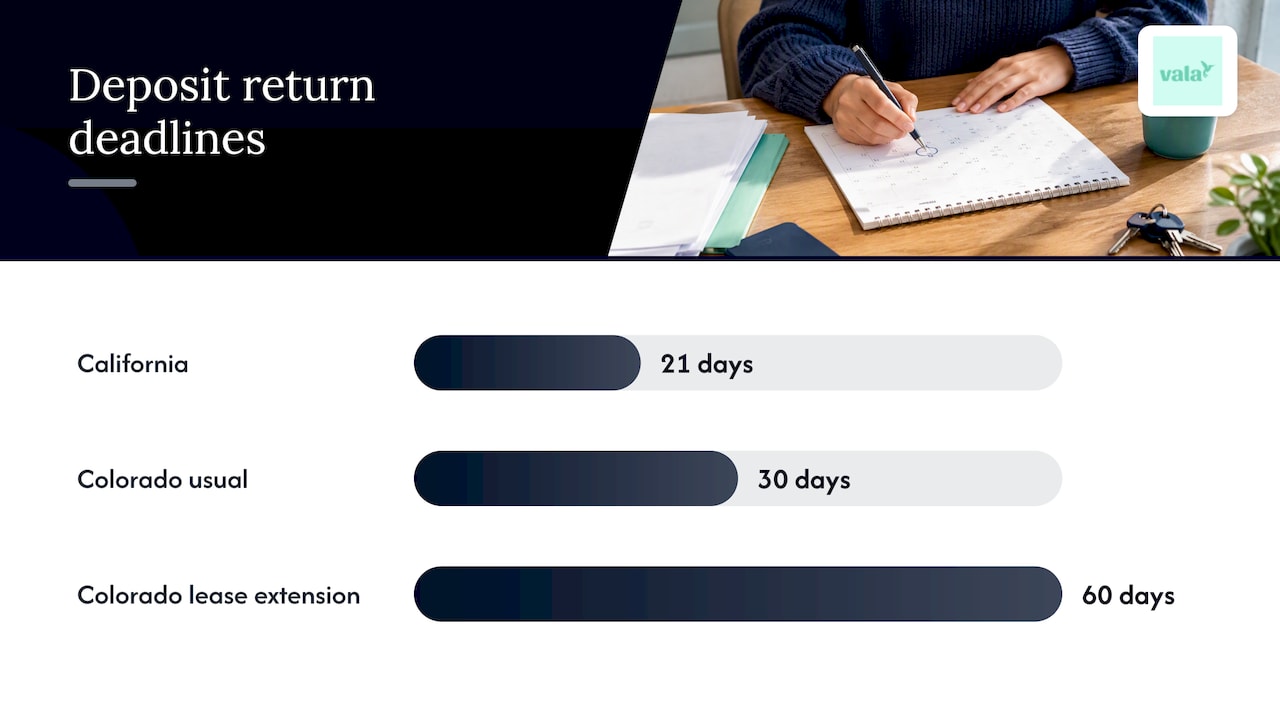
Return rules are set by state, and sometimes by city, so look up yours. A few examples show how much they differ:
| Place | What the source says |
|---|---|
| California | The landlord has 21 days after move-out to return the deposit or send the balance with an itemized statement. Deductions over $125 need invoices or receipts. (California Courts) |
| Colorado (Boulder handbook) | Return or itemize within 30 days after the tenancy ends, though the lease may extend that to 60 days. (Boulder handbook) |
| Most other states | A return-and-accounting deadline commonly lands around two to three weeks after move-out, but the exact period depends on state law. (Nolo) |
The Boulder handbook is dated 2006, so check the current statute for Colorado before relying on it.
Whether the landlord has to keep your deposit in a separate account is also a state question. The ABA notes that where segregation is required, a landlord who fails to do it may give tenants certain remedies. Look up your state’s attorney general or housing agency page for the current rule.
Give a forwarding address
Every roommate should give the landlord a forwarding address in writing, even if one person is collecting the check. If the deposit is split into separate checks, the landlord needs each address.
What if you only need to split the payment to the landlord?
Sometimes the question is about timing rather than roommates: you cannot pay the whole deposit plus first month’s rent at once. A few honest options:
- Ask the landlord directly. Some will agree to two payments, especially if you sign early or have strong references. Get any change in writing.
- Ask for separate due dates. The deposit due at signing and first month’s rent due at move-in can sometimes be staggered. Again, ask and document.
- Split it among co-tenants. Splitting among roommates lowers each person’s up-front cost, which often solves the problem.
- Build a move-in fund first. If you have a few weeks, set a weekly amount aside. Our subscription audit checklist helps you find monthly charges you can cancel to free up cash for it.
Be cautious about paying a deposit through a third-party installment product. Read its fees and terms carefully, and confirm the landlord accepts that form of payment. Do not agree to anything you cannot repay on schedule.
Our perspective: treat the deposit like any shared bill
We see the same pattern in shared-money problems. The deposit is usually the biggest single payment roommates make, yet it gets the least planning. Rent gets a due date and a reminder. The deposit gets a quick Venmo and a shrug.
Here is how we would handle it. Give the deposit its own line in your shared tracking, with each person’s contribution, the date and the proof of payment. Decide the refund rules while everyone still likes each other. Then check in at move-out, not after the check arrives.
The reason is simple. A deposit is shared money that sits untouched for a year or more, and that is exactly when details get forgotten. A clear record turns “I think I paid you” into a quick look at a screen. If you also use Vala for rent and utilities, you can see how shared costs are settled across roommates, couples and groups in one place.
— SaverStride
Keep the numbers clear with Vala
Splitting a deposit is a one-time job. Keeping up with rent, utilities, groceries and subscriptions is a monthly one. Vala helps you split expenses with friends, track what each person owes and see where money is leaking out of your budget.
- Run a Money Leak Check to spot forgotten subscriptions and recurring charges that eat into your move-in fund.
- Track shared household costs so everyone sees the same totals.
- Use SaverLite for $2.99 per month if you want the full toolset.
Ready to find extra cash before move-in day? Start your free analysis.
A quick roommate deposit checklist
Before signing the lease:
- Read the liability clause and the deposit terms.
- Agree on the share method and the lead payer.
- Write and sign a one-page deposit agreement.
At move-in:
- Pay by a traceable method and save receipts.
- Photograph every room and submit any existing damage list.
- Store the lease and agreement where everyone can reach them.
During the lease:
- Settle any early departure in writing and update the landlord.
- Keep the unit in good shape and report repairs promptly.
At move-out:
- Clean, photograph and return all keys.
- Send forwarding addresses in writing.
- Review the landlord’s itemized list and compare it with your photos.
- Pay out refunds as your agreement says.
FAQ
Can you split a security deposit with roommates?
Yes. Each roommate pays a share, usually to one person who pays the landlord. Agree in writing on how the refund will be divided, because the landlord may divide the return equally or send it all to one tenant. A signed agreement, presented to the landlord, helps your plan carry through.
What if the landlord sends the whole refund to one roommate?
That roommate should pay out the shares your agreement describes, minus agreed deductions. This is why the agreement should say whose name goes on the check and how the money is passed along. If someone does not pay their share, a written agreement and payment records support your claim against them.
Do I get my share back if I move out before the lease ends?
Usually not from the landlord. When others stay on the lease, the landlord generally holds the deposit until the last tenant leaves. You can arrange repayment with your roommates or a replacement tenant, ideally in writing before you go, and make sure the landlord approves any new tenant.
Can a landlord make me pay the whole deposit if my roommates don’t?
If your lease makes tenants jointly and severally liable, each tenant can be responsible for the full lease obligations, including another roommate’s unpaid rent or damage. Your private agreement may let you recover money from the roommate, but it normally does not change what you owe the landlord. Read your lease, and ask a local tenant organization or legal aid office if you are unsure.
How long does the landlord have to return the deposit?
It depends on your state. California gives landlords 21 days after move-out to return the deposit or send an itemized statement, while the Boulder handbook cites 30 days for Colorado, extendable to 60 by lease. Check your state attorney general or housing agency for the current rule.
Sources
- Landlord-Tenant Handbook (Boulder, Colorado)
- Tenants and Landlords guide (City of Clare)
- Tenant-Landlord guide (Detroit)
- Roommates and You (Tenant Resource Center)
- California Tenants: A Guide to Residential Tenants’ and Landlords’ Rights
- Renting Residential Real Estate Brochure (North Carolina Real Estate Commission)
- Security Deposits (UC Berkeley Student Legal Services)
- Guide to security deposits in California (California Courts)
- Security Deposits (American Bar Association)
- How to Get Your Security Deposit Back (Nolo)