
To reconcile bank transactions, you compare your bank’s record of an account with your own record of it, explain every difference, and stop when the adjusted balances match. You need your statement, a list of what you paid and deposited, and about 20 minutes. The process is the same for a checking account, a savings account or a credit card.
This guide walks you through it for personal money: paychecks, card payments, ATM cash, subscriptions and expenses you split with friends.
TL;DR
- Reconciling means matching each bank line to your own record, then explaining what is left over. The goal is a balance you can trust.
- Most differences are timing: deposits in transit and outstanding payments are not errors. Fees and interest are items you may have forgotten to record.
- Check at least every two weeks, and do a full pass when each statement closes.
- Catching an unauthorized charge quickly protects your dispute rights.
- Cash withdrawals and shared expenses need their own rules, or they get counted twice.
Table of Contents
- What it means to reconcile a bank transaction
- Why a displayed balance is not enough
- What you need before you start
- How to reconcile bank transactions step by step
- Timing differences vs. real errors
- How often to reconcile
- Why speed protects your money
- Handling ATM withdrawals
- Splitting expenses with friends
- Choosing a method
- Our perspective: reconcile first, then optimize
- Try a leak check on your reconciled account
- Common mistakes to avoid
- FAQ
- Sources
What it means to reconcile a bank transaction
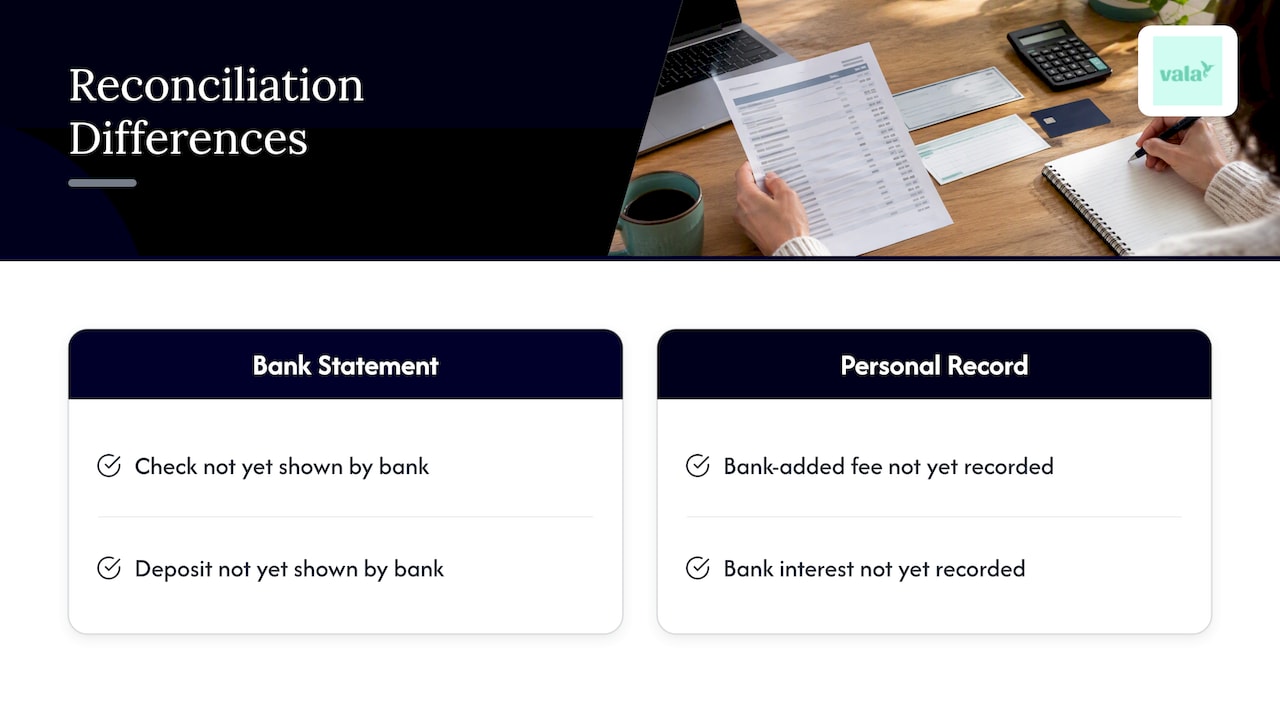
The bank and you each hold only part of the picture on any given day. The bank may not yet show a check you wrote or a deposit you made. Your own record may not yet include a fee or interest the bank added. The Utah Office of the State Auditor describes reconciliation as comparing the two and accounting for each difference, instead of forcing the numbers to agree by guesswork.
For a person, not a company, this is a cash habit, not an accounting exercise. OpenLearn calls checking your account this way a key part of financial management, and it matters most when your monthly cash flow is tight.
What gets reconciled? Accounts that produce a statement: checking, savings and credit cards. Spending categories such as groceries or dining are not reconciled, because there is no outside statement to compare them with. Categories are a second step, and they work best once the underlying transactions are complete.
Why a displayed balance is not enough
Your banking app shows a balance, but that number is not always what you can safely spend. Pending card payments, automatic debits, cash withdrawals and deposits that have not posted can all make it differ from your real position. Michigan State University Extension advises against relying only on the ATM printout or online statement, because you are the one with the current record of your own finances.
There are three practical reasons to reconcile:
- Know your real cash position. You see what is available after everything that is in motion clears.
- Spot suspicious activity. A charge you do not recognize is easy to see when you check every line.
- Avoid overdrafts. OpenLearn lists breaching an overdraft limit as one of the risks reconciling helps you avoid.
What you need before you start
Gather these items:
- The latest bank or card statement, or the online transaction list for your date range
- Your own record: a spreadsheet, a check register, receipts, or a finance app
- The ending balance in your record
- A pen or highlighter if you work on paper
If you use a spreadsheet, MSU Extension’s guidance points to a simple layout. Useful columns are date, merchant or payee, amount, category, payment method, cleared date and a cleared checkbox. Add a separate column for reimbursement status if you split costs with others.
How to reconcile bank transactions step by step
1. Set your start and end points
Pick the statement period and write down the bank’s starting and ending balances. Your record should start from the same opening figure. If it does not, fix last period first.
2. Match each bank line to your record
Go down the statement one line at a time. Tick each line that appears in both places with the same amount. Check the amount, not just the merchant. A $14.99 charge that your record shows as $11.99 is a difference to investigate.
3. Add what your record is missing
Some items appear on the bank side first. Typical ones are monthly service charges, interest credits, overdraft fees and automatic payments you forgot to enter. The U.S. Department of Justice’s reconciliation guide names interest, monthly charges and overdraft fees as items to adjust for. In personal terms, review paycheck deposits, refunds, transfers, subscription charges, overdraft fees and interest.
Add each valid item to your record. It changes your balance, not the bank’s.
4. List what the bank has not seen yet
Now list items in your record that are missing from the statement:
- Outstanding payments: checks you wrote or transfers you started that have not cleared.
- Deposits in transit: money you have received or deposited that the bank has not yet posted.
- Pending card transactions: purchases that have not settled.
The Washington State Auditor explains that a deposit in transit is money received but not yet reflected by the bank, and an outstanding check is money spent but not yet withdrawn. You adjust the bank balance for these two. You do not enter them again in your own record.
5. Calculate both adjusted balances
Use this simple layout:
| Bank side | Your record |
|---|---|
| Ending statement balance | Your ending balance |
| Add: deposits in transit | Add: interest earned |
| Subtract: outstanding payments | Subtract: fees and forgotten debits |
| Adjusted bank balance | Adjusted record balance |
The two adjusted figures should be equal. Washington’s guidance calls the target zero variance. Michigan State’s checkbook guide confirms the same idea for individuals: adjusted statement balance and adjusted register should agree.
6. Chase down any gap
If the numbers do not match, work through this list:
- Re-add your totals. Arithmetic slips are the most common cause.
- Look for a transposed number, such as $54 entered as $45. The difference is divisible by 9.
- Search for a missing or duplicated entry equal to the gap.
- Check whether a pending item has since posted for a different amount, like a restaurant tip or gas pump hold.
Do not plug the gap with a made-up adjustment. If you cannot explain it, leave a note and look again at the next check.
7. Clean up stale items
You are not done just because every statement line is ticked. The Utah auditor’s guidance says to investigate uncleared items. Old outstanding checks may never clear, and deposits in transit should normally show up in the next bank activity. Remove or correct stale items instead of carrying them forward month after month.
Timing differences vs. real errors
Do not treat every difference as a mistake. That creates duplicate entries. The Washington guidance separates the two cases clearly.
| Difference | What it is | What you do |
|---|---|---|
| Deposit in transit | Money received, not yet posted by the bank | Adjust the bank-side balance; re-check next period |
| Outstanding payment | Money spent, not yet taken by the bank | Adjust the bank-side balance; follow up if it stays open |
| Bank fee or interest | Bank-side item missing from your record | Add it to your record |
| Wrong amount | Entry or bank error | Correct your record, or contact the bank if the bank is wrong |
| Unknown charge | Possible unauthorized transaction | Contact the bank promptly |
How often to reconcile
OpenLearn suggests reconciling at least every two weeks, and more often when many transactions flow through the account. A practical rhythm for a salaried employee or student:
- Every two weeks: a ten-minute scan of recent transactions. Match pending items and flag anything unfamiliar.
- When the statement closes: a full reconciliation with the adjusted-balance check above.
If you use a debit card heavily or split lots of costs with friends, make the quick scan weekly.
Why speed protects your money
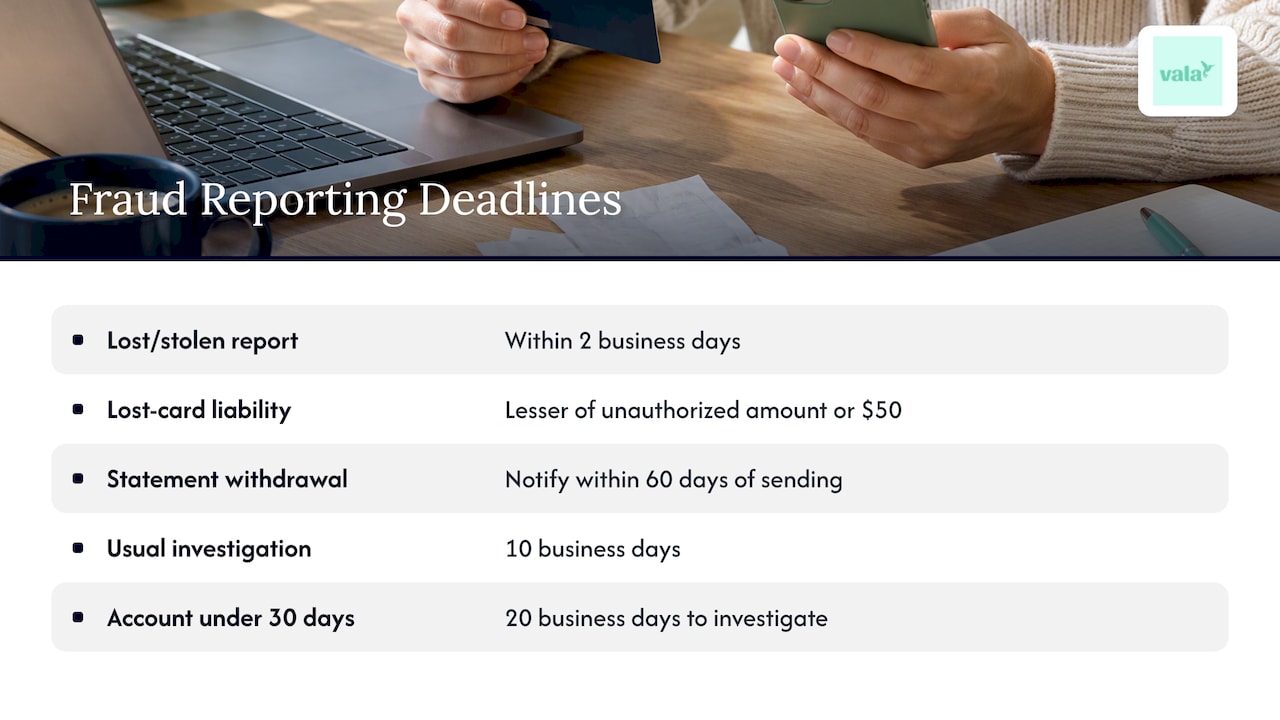
Time limits apply when something is wrong. According to the Consumer Financial Protection Bureau, if a debit card is lost or stolen and you report it within two business days, your liability is generally limited to the lesser of the unauthorized amount or $50. If an unauthorized withdrawal shows up on a statement and the card was not lost, you should notify the bank no later than 60 days after the statement was sent.
Once you report an unauthorized transaction, the CFPB says the bank generally has 10 business days to investigate, or 20 business days if the account is less than 30 days old. Provisional-credit rules may apply, with exceptions.
Small, unfamiliar debits deserve attention too. A fraudster may test an account with a tiny charge before attempting larger ones. Write down the merchant description, amount and date, and call your bank right away rather than waiting for the next monthly review. For a charge on a credit card, or a disputed amount that is not an electronic transfer, check your issuer’s dispute terms. If you are unsure which protections apply to you, ask your bank or credit union.
Handling ATM withdrawals
An ATM withdrawal shows up in your bank feed as one line, but you will spend that cash on many small things. The bank never sees those purchases. That makes cash easy to double count or lose track of.
Pick one of two methods and stick with it:
- Treat the withdrawal as the expense. Categorize it as “Cash” or “Cash spending” and do not log individual purchases. This is simplest, and a good fit if you take out small amounts.
- Log the individual purchases. Record each cash purchase under its real category, and treat the ATM withdrawal as a transfer to a cash wallet, not as spending.
The rule is to count the withdrawal or the purchases, never both. Also reconcile the fee: out-of-network ATM fees often appear as separate lines, and your bank may charge one on top of the operator’s fee. Record each one as a bank fee so your balance matches.
If you are saving toward a goal, method two shows you where the cash actually goes. Method one is enough if cash is a small part of your spending.
Splitting expenses with friends
Shared costs make reconciliation messy. You pay $240 for a group dinner or a rental house, and three friends send you money later. If you record the full amount as your own spending, your dining category is inflated. If you record the reimbursements as income, your income looks higher than it is.
A cleaner approach:
- Match the bank transaction to the full purchase. That is what left your account.
- Record each person’s share and reimbursement status separately.
- Treat repayments as reimbursements against that expense, not as paychecks or new income.
- Mark the expense settled only when everyone has paid.
When you reconcile, the full $240 charge matches the statement line, and the incoming payments match their own lines. The leftover unpaid share is a receivable you can see, not a mystery.
For couples, our guide to a budget tracking app for couples and shared expenses covers how to keep joint and personal money straight.
Choosing a method
You can reconcile with receipts, a spreadsheet, a check register or a finance app. They differ in effort and detail.
| Method | Best for | Trade-off |
|---|---|---|
| Paper register | Few transactions, check writers | Slow and easy to misplace |
| Spreadsheet | People who like full control | You enter every line yourself |
| Finance app | Many card and transfer transactions | Needs a bank connection and a review habit |
If you prefer to keep data on your own device, this guide to cutting manual budgeting time on iPhone covers an on-device approach. If you want automatic imports, our comparison of budgeting and expense tracking apps explains what to look for.
Whichever you choose, an app’s imported list is only a starting point. Automatic import brings in bank-side items, but you still decide whether each one is expected, duplicated or missing.
Our perspective: reconcile first, then optimize
We build Vala to find money leaks, the recurring charges and subscriptions that quietly drain an account. In our experience, the best insights come after your transactions are in order. A subscription review on top of messy data produces confusing results.
That is why we think the target of reconciling is a reliable cash position, not perfect categories. Washington’s zero-variance principle is a company control, but the idea carries over: get the totals right, then ask better questions about where the money goes.
When your bank lines are matched, three things get easier:
- Spotting a charge that repeats every month and that you forgot about
- Seeing which fees and interest actually hit your account
- Planning savings goals from money you really have
Those are the places where a bank connection and automated review help most: they do the matching and flag the odd lines, and you make the decisions. Our subscription audit checklist is a good next step once your transactions are clean.
— SaverStride
Try a leak check on your reconciled account
Once your balance is right, put it to work. Vala connects to your bank through Plaid and reviews your recurring charges, so you can see what to keep and what to cancel. Start with the free Money Leak Check. If you want the full set of budgeting, shared expense and AI insight tools, SaverPro is $2.99 per month, and you can learn more on the Vala home page.
Common mistakes to avoid
- Waiting too long. The longer you wait, the harder it is to remember what a charge was, and the closer you get to dispute deadlines.
- Entering timing items twice. Outstanding payments and deposits in transit are not new transactions.
- Ignoring tiny charges. Small unknown debits can be a sign of testing.
- Counting cash twice. Withdrawal or purchases, not both.
- Treating reimbursements as income. Keep them tied to the original shared expense.
- Carrying stale items. Clear or correct anything that never posts.
FAQ
What does it mean to reconcile a bank transaction?
It means confirming that a transaction in your own record matches the one on the bank’s record, with the same amount and date range. If it does not match, you find out why: timing, a fee, a typo or an error. Each matched line brings you closer to a balance you can trust.
What are the steps to reconcile a bank account?
Start with the statement balance, match each line to your record, add missing fees and interest, and list pending items such as outstanding payments and deposits in transit. Then compare the adjusted bank balance with the adjusted record balance. If they agree, you are finished.
Is bank reconciliation legally required for individuals?
No law requires you to reconcile your personal accounts, and we found no source stating one. It is still practical, because many dispute deadlines run from when your statement was sent. Businesses and public bodies may face their own rules, so check with an accountant if you run one.
How do I categorize ATM withdrawals?
Either categorize the whole withdrawal as cash spending, or treat it as a transfer to a cash wallet and log the purchases individually. Do not do both, or the same money counts twice. Record ATM fees separately as bank fees.
How often should I reconcile?
At least every two weeks, according to OpenLearn, and more often if your account has many transactions. Add a full reconciliation each time a statement closes.
Sources
- Bank Reconciliation, Utah Office of the State Auditor
- Best Practices for Bank Reconciliations, Washington State Auditor
- Managing my money for young adults, OpenLearn
- How do I get my money back after an unauthorized transaction, CFPB
- How to balance your checkbook, MSU Extension
- Bank Reconciliation Guide Sheet, U.S. Department of Justice