
A good vacation savings plan comes down to four numbers: what the trip costs, when you leave, how much you move each payday, and where that money comes from. Get those four right and the trip pays for itself before you board. This guide walks you through each one, with worked examples you can copy.
TL;DR
- Price the whole trip first, then divide by the number of paydays before you leave. That gives you a transfer amount, not a guess.
- Automate the transfer for the day after payday, and keep the money in a separate savings account.
- Look for the money in your existing spending. Forgotten subscriptions and recurring charges are often the easiest source.
- Check the account’s APY and insurance, but remember that on a short timeline your deposits matter far more than interest.
- If you travel with friends, agree on a shared budget early so nobody falls behind.
Table of Contents
- Step 1: Put a real price on the trip
- Step 2: Choose a departure date and do the division
- Step 3: Automate it and keep it separate
- Step 4: Find the money you are already spending
- Step 5: Pick where the money sits
- Our perspective: the leak is usually the plan
- Saving for a trip with friends or a partner
- Mistakes that derail a vacation fund
- Where Vala fits
- A simple 12-month timeline you can copy
- FAQ
- Sources
Step 1: Put a real price on the trip
A vague goal like “save for Europe” is hard to act on. A number is easy. Start by listing every cost in five buckets:
- Getting there: flights, gas, train tickets, checked bags, airport parking.
- Where you sleep: hotel, rental, or your share of one, plus taxes and resort fees.
- Food: a daily amount per person, not a vague hope.
- Doing things: tours, tickets, rentals, one or two splurges.
- Extras: travel insurance, a pet sitter, a few lost work hours, souvenirs.
Then add a cushion of 10 percent. That figure is our own rule of thumb, not an official standard, but trips almost always cost a little more than the spreadsheet says.
The CFPB points out that a specific goal, such as a vacation, keeps you motivated and that automatic transfers keep you consistent. A priced trip is the specific goal.
Example: a long weekend for two
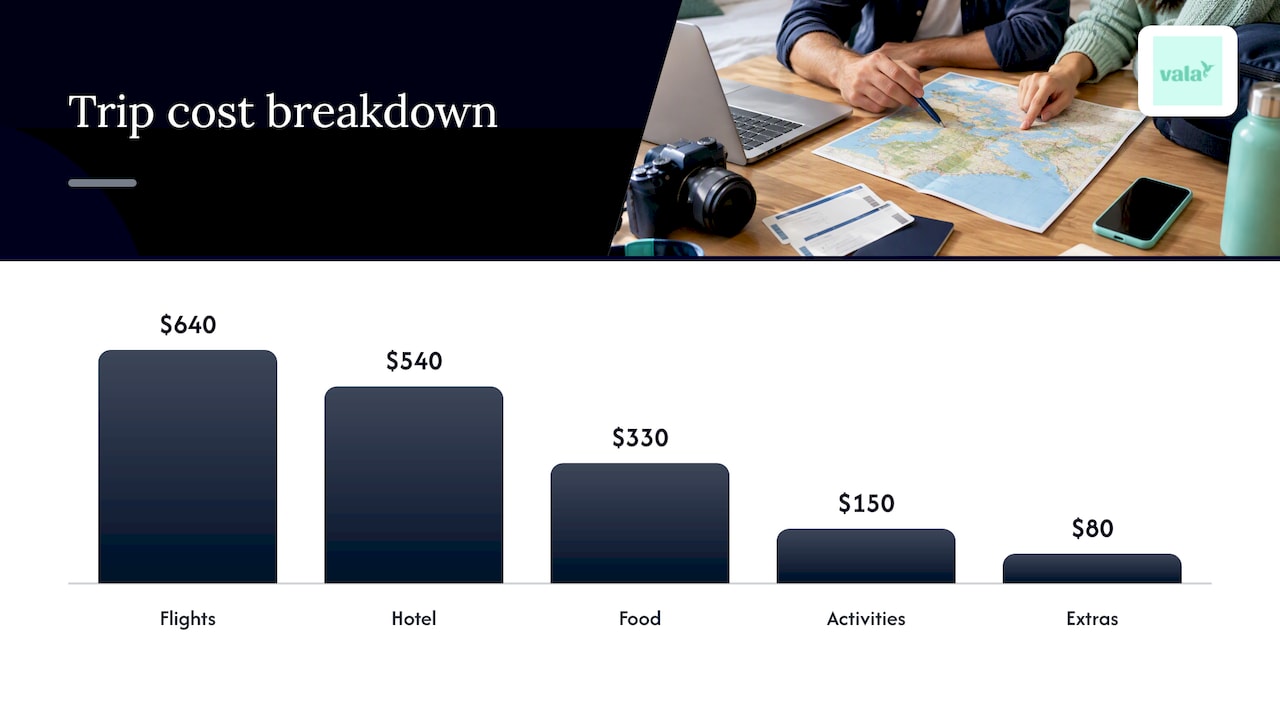
Say flights are $640 for both of you, three hotel nights are $540, food is $330, activities are $150, and extras are $80. That is $1,740. Add the 10 percent cushion and your goal is $1,914. Round it to $1,900 for the plan. These are made-up numbers to show the method, so swap in your own quotes.
Step 2: Choose a departure date and do the division
Your timeline decides your monthly amount. The formula is simple:
Trip goal ÷ number of paydays before you leave = transfer per payday
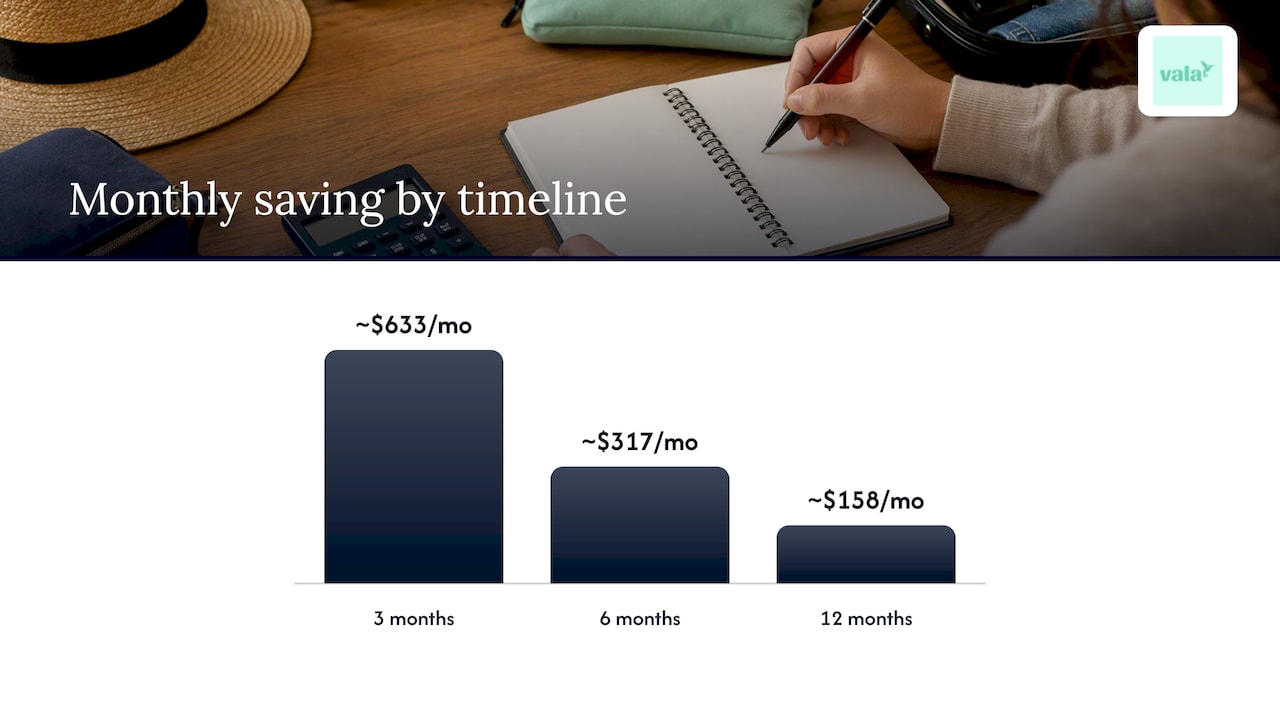
Here is what a $1,900 goal looks like on three timelines, if you are paid every two weeks (26 paychecks a year):
| Time until trip | Paychecks | Transfer per paycheck | Per month (approx.) |
|---|---|---|---|
| 3 months | 6 | $317 | $633 |
| 6 months | 13 | $146 | $317 |
| 12 months | 26 | $73 | $158 |
If $317 a month feels heavy, move the date, not the goal. Most people find the 12-month column is the one that fits a normal budget. If you are paid weekly or twice a month, divide by your own paycheck count. Our guide to budgeting by paycheck covers weekly and biweekly schedules.
What if the number is too big?
You have four levers, and you can pull more than one:
- Push the date back.
- Shrink the trip: fewer nights, a closer destination, a cheaper time of year.
- Split costs with the people you travel with.
- Free up more from your regular spending (Step 4).
Step 3: Automate it and keep it separate
Willpower is unreliable around payday. A transfer that happens without you is not. The CFPB describes making your savings automatic as moving money from checking to savings on a weekly, monthly, or payday schedule, so you “pay yourself first.”
A few details make this work better:
- Schedule it right after payday. The CFPB’s emergency fund guide stresses paying yourself first, so your goal ranks above everyday spending.
- Use a separate account. The FDIC says a dedicated savings account for a short-term goal like a vacation helps you resist spending the money. An account without checks adds friction.
- Watch your checking balance. Automatic transfers can trigger overdraft fees if checking dips below the transfer amount, so set a low-balance alert.
- Name the account after the trip. Seeing “Lisbon, May” beats seeing “Savings 2.”
If you want more on setting this up, we walk through the details in how to automate personal savings goals and in our pay yourself first guide.
Step 4: Find the money you are already spending
This is the step most vacation guides rush past, and it is where many people find their fastest progress. Before you cut anything you enjoy, look for spending you do not even notice.
Start with recurring charges:
- Streaming services you stopped watching.
- Free trials that quietly turned into paid plans.
- Apps you downloaded for one purpose.
- Duplicate memberships, such as two music services or an unused gym.
- Bank fees you could avoid.
Pull three months of statements and highlight everything that repeats. Then ask of each charge: did I use this in the last 30 days? If not, cancel it and send the same amount to your trip fund. Cancel a $15.99 subscription and a $9.99 one, and that is $25.98 a month heading toward your goal without touching your lifestyle. The amounts are examples, but the habit is real.
Our subscription audit checklist gives you a step-by-step workflow for this. If you would rather not dig through statements by hand, our Money Leak Check is built for exactly that job.
Small daily moves add up
Once the leaks are plugged, look at daily habits. Our piece on penny saver habits covers small changes that build savings. The FDIC’s Money Smart guide also suggests free entertainment such as libraries, parks, and festivals, and putting the price of a skipped outing straight into savings. You can find that tip in the FDIC Money Smart module.
Step 5: Pick where the money sits
For a goal under two years away, you want the money safe and reachable, not invested.
Savings account basics
The FDIC notes that federally insured accounts are protected up to at least $250,000 per depositor, per insured institution, and that unlike stocks or mutual funds they give you safe access to your money when you are ready to travel. That information is in the FDIC’s Money Smart guide. Check that any bank or credit union you choose is FDIC or NCUA insured.
When you compare accounts, look at the APY, the Annual Percentage Yield. It reflects compounding, so you can compare banks on equal terms. Also check for monthly fees and minimum balances that could eat your savings.
How much will interest add?
Less than you might hope on a short timeline. The FDIC’s own example shows $1,000 at 2 percent, compounded monthly, becoming $1,105.08 after five years. Your vacation fund will probably sit for months, not years, so interest is a small bonus. Your deposits do the heavy lifting. If you want to test your own numbers, a compound interest calculator shows what different rates and timelines do.
One more tip from the same guide: leave the money alone. Early withdrawals do not just take out that amount, they also shrink the base your future interest is calculated on.
What about installment or club accounts?
Some banks offer installment savings or club accounts with fixed, regular deposits. The FDIC has discussed installment savings as a way to set aside a fixed amount each month for goals such as a vacation. They can enforce discipline, but they may carry penalties for early withdrawal or missed payments. Read the terms before you commit, and ask the bank directly about fees.
Our perspective: the leak is usually the plan
We built Vala around one idea: most people do not have a savings problem, they have a visibility problem. Traditional budgeting apps tell you what you spent. We focus on what keeps repeating without you noticing, such as recurring charges and subscriptions, and on what you can do about it.
For vacation saving, that matters. When someone says they cannot afford $150 a month for a trip, the issue is rarely effort. It is that their money is already committed to things they stopped using. Reviewing those charges first turns a painful trade-off into a simple cleanup.
Our advice for a first trip fund:
- Set the goal and the date before you open any app.
- Review recurring charges and cancel what you do not use.
- Automate the transfer for payday, and start smaller than you think you need.
- Raise the amount every time you cancel something or get a raise.
- Keep shared trips transparent, so everyone sees who owes what.
Saving should feel clear and calm, not like punishment. A plan you can keep for 12 months beats a perfect plan you drop in week three.
— SaverStride
Saving for a trip with friends or a partner
Group trips add a second problem: other people’s budgets. A few habits keep things friendly.
- Agree on a per-person ceiling before booking. Do it in writing, in the group chat.
- Decide who fronts what. One person paying for the rental house is fine, as long as everyone pays them back by a set date.
- Track shared costs in one place. Dinners, gas, and tickets get messy fast.
- Share the plan, not just the bill. If one friend needs 12 months and another needs 6, find a date that works for both.
For couples, a joint trip fund works well. Each person transfers their share, and you both see the balance. Splitting expenses is something Vala handles with automated group and shared expense splitting, so a trip does not turn into a spreadsheet chore.
Mistakes that derail a vacation fund
- Skipping the cushion. Add 10 percent and you will rarely come up short.
- Mixing it with everyday checking. Money that is visible is money that gets spent.
- Ignoring the small recurring charges. Ten small leaks can cost more than one big purchase.
- Starting too aggressively. If the transfer causes overdrafts, you will quit. Start lower and raise it.
- Using a locked account without reading the terms. Penalties for early access can sting.
- Booking before you have saved. Prices are not the only reason to wait. Paying with savings avoids interest on borrowed money.
Where Vala fits
If you want help finding the money for your trip, start with a Money Leak Check. Vala connects to your bank through Plaid with bank-level encryption, reviews your recurring charges, and shows you what to keep and what to cancel. You can also track spending, set bill reminders, and manage savings goals in one place.
The free version covers the basics. SaverPro is $2.99 per month for the full-featured experience, including premium budgeting tools and AI-driven insights. If your trip fund needs an extra $25 a month, finding one forgotten subscription can pay for the plan several times over. Start your free analysis and see what turns up.
A simple 12-month timeline you can copy
| Month | What to do |
|---|---|
| 1 | Price the trip, choose a date, open a separate savings account |
| 2 | Set up the automatic transfer for the day after payday |
| 3 | Audit recurring charges and cancel what you do not use |
| 4 to 6 | Check progress monthly, raise the transfer if you can |
| 7 to 9 | Watch for flight and hotel prices, and compare to your budget |
| 10 to 11 | Book major costs from savings, not a credit card |
| 12 | Set aside a spending allowance for the trip, then go |
FAQ
How much should be in my vacation fund?
Enough to cover the full priced trip plus a cushion, which we suggest at about 10 percent. Build the number from flights, lodging, food, activities, and extras rather than a round guess. Then divide it by the paychecks you have before departure.
How can I save $100 a week?
Automate a $100 transfer for the day after each payday and treat it like a bill. Fund it by canceling unused subscriptions and trimming one or two recurring costs. If $100 is too much, start at $50 and raise it as you free up money. At $100 a week, you reach $2,600 in 26 weeks.
Should I use a high-yield savings account for vacation savings?
It is a good fit for a short-term goal, because the money is accessible and insured. The FDIC says federally insured accounts are protected to at least $250,000 per depositor, per insured institution. Compare APY and check for fees, but expect deposits, not interest, to do most of the work.
How far ahead should I start saving for a trip?
Six to twelve months suits most trips, because it keeps each transfer manageable. Shorter timelines mean larger transfers, as the table above shows. If you cannot raise the amount, move the date.
Sources
- CFPB: Looking for an easy way to save money? Make it automatic
- CFPB: An essential guide to building an emergency fund
- FDIC: Savings Are Great for Short-Term Goals Too
- FDIC: Money Smart for Adults, Module 5 Participant Guide
- FDIC: Installment Savings presentation