
Pay yourself first budgeting means moving money into savings the moment your paycheck lands, before a single bill or discretionary dollar gets spent. It’s also called reverse budgeting, and the action step is simple: set up an automatic transfer of 5% to 10% of your take-home pay today, with a goal of reaching 10% to 20% as your finances stabilize. The Federal Reserve found that 37% of adults couldn’t cover a $400 emergency in cash, which is exactly the gap this method closes. You don’t need FINRA credentials or an SIPC-insured brokerage to start. You just need one transfer, scheduled for your next payday.
- Start at 5%–10% of net pay; scale toward 10%–20% over time
- Automate it through payroll, split direct deposit, or a bank transfer rule
- Route the money somewhere you won’t casually spend it, like a separate savings account
- Use a tool like Vala to schedule and track the transfer automatically
Key Takeaways
Pay yourself first budgeting works because automating a fixed percentage of net pay into savings removes the willpower problem that derails manual budgeting.
| Point | Details |
|---|---|
| Start with 5%–10% | Automate this percentage of net pay now, scaling toward 10%–20% as your budget stabilizes. |
| Build a starter fund first | Save $500–$1,000 before tackling high-interest debt or bigger savings goals. |
| Match your automation to your accounts | Use payroll deductions for retirement, split deposit or transfers for emergency and sinking funds. |
| Adjust for variable income | Average 3–6 months of net pay before automating a percentage if your paycheck fluctuates. |
| Automate with a tool like Vala | Vala can schedule transfers, track savings goals, and flag spending leaks automatically. |
Table of Contents
- What Is the Pay Yourself First Method, Really?
- How to Set Up Pay Yourself First This Week
- Which Accounts Should Hold Your Pay-Yourself-First Money?
- Benefits, Pitfalls, and How to Avoid Them
- Is Pay Yourself First Right for You?
- A Simple Paycheck Example You Can Copy
- What the Data Says About Emergency Funds and Debt
- Adjusting for Variable Income and Tight Budgets
- How I’d Start This Method This Month
- Let Vala Handle the Automation for You
- Frequently Asked Questions
- Sources
What Is the Pay Yourself First Method, Really?
Reverse budgeting flips the traditional script. Instead of paying bills, spending on wants, and saving whatever scraps remain, you save first and build your spending plan around what’s left. NerdWallet frames this as the defining feature of the approach: automation removes the guesswork and the temptation to skip savings when money feels tight.
The psychology matters as much as the mechanics. Investopedia notes that treating savings like a fixed bill, rather than a leftover, changes how people relate to their money. You stop relying on willpower and start relying on a system.
This method works especially well for goals with a clear finish line:
- Building an emergency fund
- Contributing to retirement accounts
- Saving for a home down payment
- Funding a planned purchase through a sinking fund
How to Set Up Pay Yourself First This Week
You can have this running before your next paycheck hits. Follow these steps in order:
- Pick your percentage or dollar amount. Base it on net pay, not gross, and start at 5%–10% if you’re new to this.
- Choose your destination account. A high-yield savings account works well for near-term goals; a 401(k) or IRA works for retirement.
- Set up automation. Options include payroll deduction, splitting your direct deposit between two accounts, or scheduling a recurring bank transfer.
- Time it carefully. Confirm the transfer date and leave a buffer so your checking account doesn’t dip below what your bills need.
Each automation method has trade-offs. Payroll deductions (like a 401(k) contribution) are the most hands-off but limited to retirement accounts. Split direct deposit sends part of your paycheck straight to savings without you ever touching it. Bank-based recurring transfers are flexible but depend on you setting the date correctly. App-based rules, including automated savings goals, can layer on top of any of these for extra tracking.
Pro Tip: Schedule your transfer for the same day your paycheck posts, or the evening before your bills are due to clear. Moving money too early or too late is the most common way people accidentally overdraft while trying to save.
Which Accounts Should Hold Your Pay-Yourself-First Money?
Where the money goes matters as much as how much you send there.
- Emergency savings: An online high-yield savings account, kept separate from checking so it’s not an easy tap.
- Sinking funds: Sub-accounts for planned costs like car repairs, holidays, or annual insurance premiums.
- Retirement accounts: A 401(k), especially with an employer match, or an IRA for tax-advantaged long-term growth.
- Taxable investment accounts: Useful for medium-term goals beyond retirement, once your emergency fund and high-interest debt are handled.
Prioritize the emergency fund first, then retirement contributions up to any employer match, since that match is essentially free money. Save taxable investing for later in the sequence. One caution worth repeating: don’t treat a 401(k) or IRA as backup cash. Early withdrawals often trigger penalties and taxes that erase the benefit of saving in the first place.
Benefits, Pitfalls, and How to Avoid Them

The upside is real. Automating savings builds a consistent habit, removes the daily decision fatigue of “should I save today,” and lets you capture employer retirement matches without extra effort.
The downsides show up when the system isn’t planned around your actual cashflow.
Pros:
- Builds a durable savings habit without relying on motivation
- Increases consistency compared to saving “whatever’s left”
- Captures employer matches and compounding automatically
Cons:
- Can create cash shortfalls if the transfer amount is too aggressive
- May slow high-interest debt payoff if applied without a plan
- Harder to manage with variable or unpredictable income
Ramsey Solutions points out that pay yourself first works best paired with a zero-based budget, where every dollar left after saving has an assigned job. Start with a smaller percentage than you think you need, keep a small buffer in checking, and track expenses alongside your automated transfer so nothing slips through the cracks.
Is Pay Yourself First Right for You?
This method fits best if you have steady income and want a low-maintenance system that runs in the background. If your paycheck varies wildly or you’re carrying high-interest debt, the standard version needs a modification.
- Good fit: Steady paychecks, minimal high-interest debt, a preference for automation over active budgeting
- Needs adjustment: Living paycheck to paycheck, carrying credit card balances above 15% to 20% interest, or income that swings month to month
A simple sequence works for most people: build a small starter emergency fund, then attack high-interest debt, then scale your automated savings back up once that debt is gone. Ramsey Solutions recommends this starter-fund-first approach specifically for people managing tight cashflow or debt. If straight pay-yourself-first doesn’t fit yet, a hybrid plan (a small automated transfer plus targeted debt payments) or a full zero-based budget can bridge the gap.
A Simple Paycheck Example You Can Copy
Say your net pay is $3,000 a month. Here’s how a reverse budget might route it:
- Save first: 15% to savings = $450 (split $300 to emergency fund, $150 to retirement or a sinking fund)
- Needs: Roughly 50% = $1,500 for rent, utilities, groceries, transportation
- Wants: Remaining $1,050 for discretionary spending
That maps loosely onto the 50/30/20 framework, just reordered so the “20” gets claimed first instead of last.
To scale up without hardship:
- Month 1–3: Automate 10% while you adjust to the reduced take-home cash
- Month 4–8: Increase to 15% once you’ve confirmed bills are covered comfortably
- Month 9–12: Push toward 20% if debt is under control and income is stable
What the Data Says About Emergency Funds and Debt
The Federal Reserve reports that 37% of adults couldn’t cover a $400 emergency expense with cash on hand. That statistic is the strongest argument for prioritizing an emergency fund before anything else, including extra retirement contributions.
A sound priority order, backed by financial guidance across multiple sources:
- Build a $500–$1,000 starter emergency fund first
- Pay down high-interest debt (generally above 15% to 20% APR)
- Resume or scale automated savings toward retirement and other goals
For deeper reading, the Federal Reserve’s survey data, FINRA’s investor resources, and SIPC’s investor protection information all offer further grounding on savings gaps and account protections.
Adjusting for Variable Income and Tight Budgets

If your paycheck changes month to month, don’t automate a fixed percentage against your best month. Investopedia recommends averaging your last 3 to 6 months of net pay and automating a percentage against that baseline instead.
For low-income households, start smaller than feels significant. A fixed $25 or $50 per paycheck, split off through direct deposit, still builds the habit and the balance over time.
- Use a 3–6 month average of net pay for variable income
- Start with fixed dollar amounts if percentages feel unmanageable
- Send windfalls (tax refunds, bonuses, side gig income) straight to your starter emergency fund
Pro Tip: Route irregular income, like a tax refund or freelance payment, directly to savings the day it arrives. It accelerates your goal without ever touching your regular monthly cashflow.
How I’d Start This Method This Month
Here’s the plan I’d follow: set a 5% automatic transfer on my very next payday, open a separate savings account specifically for that money, and calendar a 3-month check-in to see if I can raise the percentage.
That’s it. Small, automated, and boring in the best way. The habit does more work than the percentage does at first, and the review date keeps it from becoming a “set it and forget it forever” mistake.
Let Vala Handle the Automation for You
Manually managing transfer dates, tracking savings goals, and watching for leaks in your budget takes time you’d rather spend elsewhere. Vala automates the transfers, tracks your savings goals in real time, and flags spending patterns that quietly drain the money you meant to save.
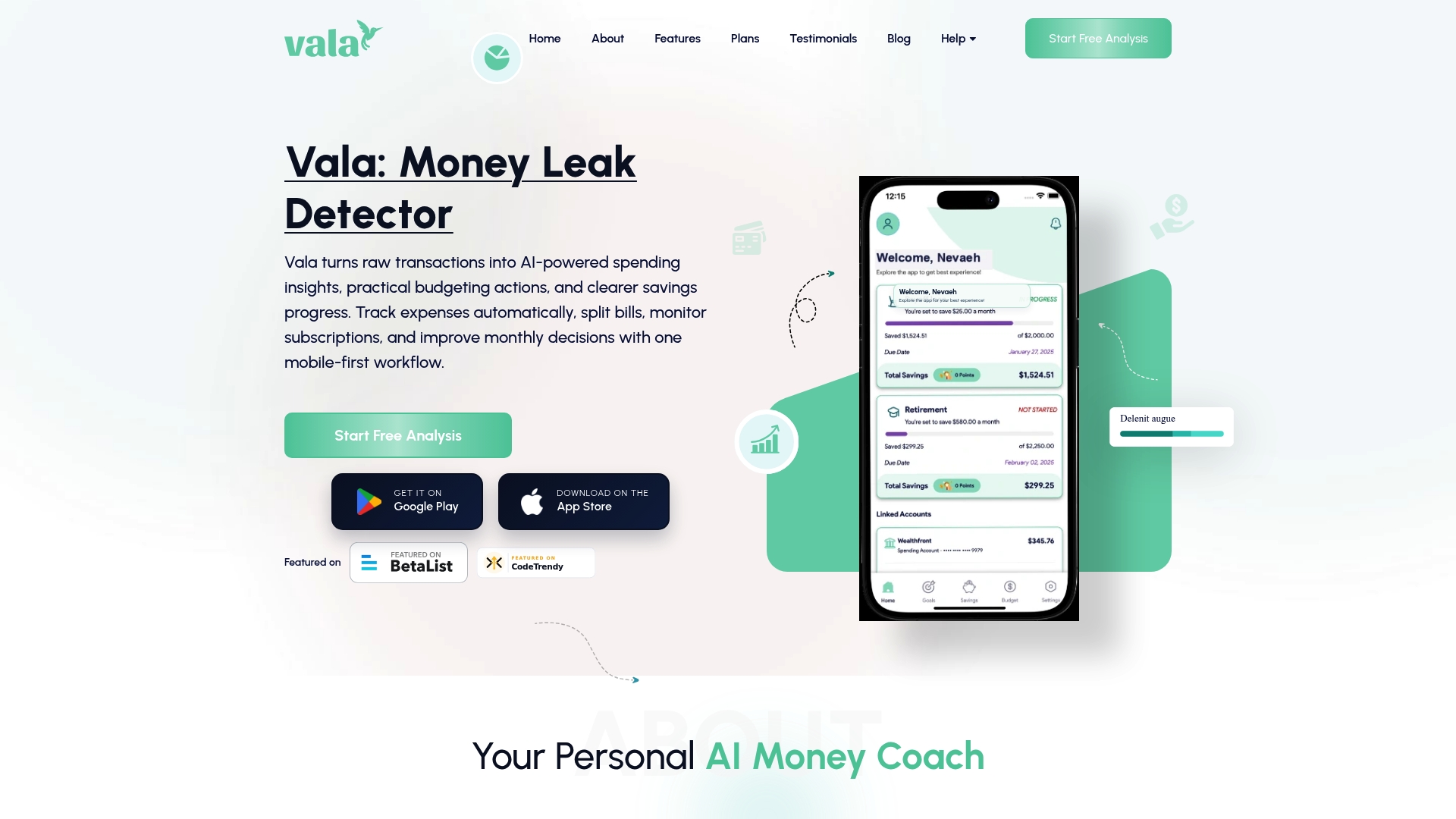
If you’re ready to put pay yourself first budgeting on autopilot, start with the Vala personal finance app and set your first automated savings goal today. This is an optional tool. The method works with a spreadsheet and a bank app too, but Vala removes the manual steps that cause most people to quit within a few months.
Frequently Asked Questions
How much should I save with pay yourself first budgeting?
Start at 5%–10% of your net pay and work toward 10%–20% as your budget allows. If you’re carrying high-interest debt, prioritize a $500–$1,000 starter emergency fund before scaling savings higher.
Is pay yourself first the same as the 50/30/20 rule?
Not exactly, but they overlap. The 50/30/20 rule allocates 50% to needs, 30% to wants, and 20% to savings. Reverse budgeting takes that same 20% and moves it to the front of the line, before needs and wants get funded.
Should I pay yourself first if I have credit card debt?
Skipping the debt to save aggressively usually costs more in interest than you’d earn in savings.
What if my income varies every month?
Average your net pay over the last 3 to 6 months and automate a percentage against that baseline instead of your best or worst month. This keeps transfers realistic and avoids overdraft risk during slower months.
This article is general information, not a substitute for advice from a qualified financial advisor. Consult a qualified financial professional about your own circumstances before acting on anything here.
Sources
- Are You Paying Yourself First? – Investopedia
- Federal Reserve economic data and survey pages
- Pay-Yourself-First Budget: What It Is, How It Works, and How – NerdWallet