
Most people don’t fail at saving because they lack discipline. They fail because saving manually requires a decision every single time. Every paycheck, you have to choose to move money before spending it, and that decision is easy to skip. When you automate personal savings goals, you remove that decision entirely. The money moves before you ever see it, and your savings build in the background while you live your life. This guide walks you through exactly how to set it up, what to watch for, and which tools make it easier.
Table of Contents
- Key takeaways
- How to automate personal savings goals the right way
- Setting up your automated transfers step by step
- Keeping your automation on track over time
- Tools that make automated savings easier
- My honest take on saving through automation
- Start saving smarter with Valapoint
- FAQ
Key takeaways
| Point | Details |
|---|---|
| Start small, then grow | Begin with 5% of take-home pay and increase by 1% every six months to avoid lifestyle shock. |
| Timing is everything | Schedule transfers 24 to 48 hours after payday to reduce the temptation to spend first. |
| Separate accounts protect savings | Keeping savings at a different institution creates a psychological barrier against impulse transfers. |
| Review quarterly, not daily | Check your automation every few months to catch issues and adjust for life changes. |
| Use tools to reduce friction | AI-powered apps and bank features can monitor, alert, and redirect funds without extra effort from you. |
How to automate personal savings goals the right way
Before you set up a single automated transfer, you need a clear picture of your money. Automation built on a shaky financial foundation creates problems, not solutions.
Start by listing your monthly take-home income and every fixed expense: rent, utilities, subscriptions, loan payments. Then track your discretionary spending for one month. You might be surprised by what you find.
Once you see the full picture, you can set realistic savings targets. A practical starting point is 5 to 10% of take-home pay split across separate savings categories. Three categories work well for most people:
- Emergency fund: Three to six months of living expenses. This comes first, before any other savings goal.
- Short-term goals: Vacations, a new laptop, home repairs. These are goals you want to hit within one to two years.
- Long-term goals: A down payment, retirement contributions, or a career transition fund. These move slower and need patience.
Separate accounts for each goal are not overkill. They give you clarity. You always know exactly how close you are to each target, and you’re less likely to pull money out impulsively when you can see what it’s earmarked for.
Pro Tip: Label each savings account with its specific goal. “Hawaii Trip 2027” is more motivating than “Savings Account 2.”
Setting up your automated transfers step by step
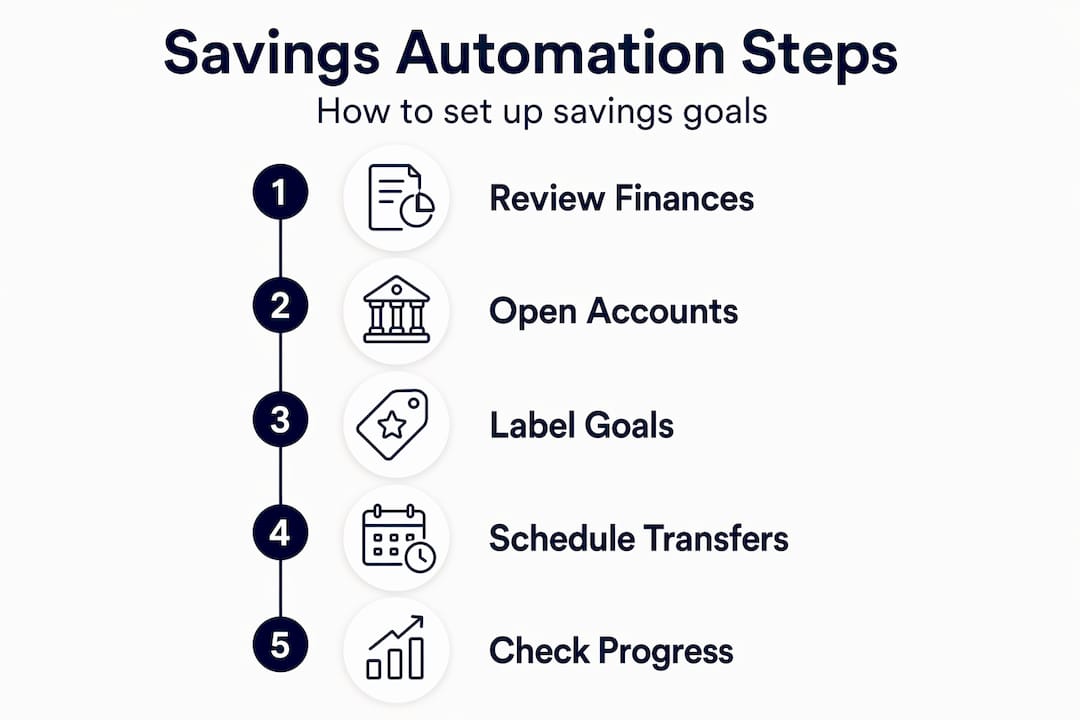
Once you know your targets, the setup itself is straightforward. Here’s the order that works best:
- Open separate savings accounts. If possible, open a high-yield savings account at a different bank than your checking. High-yield savings at separate institutions act as a natural barrier against impulsive transfers back to spending. Out of sight genuinely does mean out of mind.
- Set up direct deposit splits. Most employers and payroll systems let you split your direct deposit across multiple accounts. Send your savings percentage directly to your savings account so it never touches your checking.
- Schedule recurring transfers as a backup. If your employer doesn’t support deposit splits, schedule automatic transfers from checking to savings. Time them 24 to 48 hours after payday to keep the money out of reach before your spending impulse kicks in.
- Start with a manageable amount. Saving $75 per week is not small. Over three months, that’s roughly $900. Over a year, it exceeds $3,900. Match your initial contribution to what feels painless, not to what feels impressive.
- Set a calendar reminder to increase contributions. Every six months, bump your savings rate by 1%. Increasing by 1% every six months can bring you to a 10% savings rate within five years without any dramatic lifestyle change.
Here’s a quick comparison of savings account types to help you decide where your money lives best:
| Account type | Best for | Interest rate | Ease of access |
|---|---|---|---|
| Standard savings account | Emergency fund | Low | Immediate |
| High-yield savings account | Short and long-term goals | High | 1 to 3 business days |
| Brokerage account | Long-term investment goals | Variable (market-linked) | Moderate |
| Money market account | Emergency fund overflow | Moderate | Immediate to 1 day |
Pro Tip: Use your primary bank for your emergency fund so you can access cash in a real crisis. Park your other savings goals at a separate high-yield account to earn more and reduce temptation.
Using personal finance automation this way turns saving from a monthly willpower test into a background process you barely think about.

Keeping your automation on track over time
Setting up automation is the easy part. The harder part is avoiding two extremes: obsessing over daily balances or ignoring everything entirely.
Monthly or quarterly check-ins hit the right balance. During each review, ask yourself a few specific questions:
- Are all transfers completing without overdraft issues?
- Have any of my income or expenses changed significantly?
- Have I hit any savings targets that need to be redirected to new goals?
- Is my emergency fund fully funded? If so, should I redirect that contribution elsewhere?
Rebalancing your savings allocation at least once a year keeps your automation working for your current situation, not the situation you were in when you set it up.
One mistake people make is setting their automated savings rate too high from the start. If you save aggressively and your checking account runs dry before the next paycheck, you’ll start skipping transfers or overdrafting. Either outcome breaks the habit. Keep a small cash buffer of $200 to $500 in your checking account specifically to absorb small spending surprises.
Pro Tip: Automate a “savings review” calendar event every 90 days. Treat it like a bill. Thirty minutes every quarter keeps your system healthy.
The role of automated savings is not just convenience. Financial success comes from small repeated habits, and automation is the structure that makes those habits happen consistently without relying on motivation.
There is also a real risk called the “automation trap.” This happens when automated payments quietly drain your account because you never review them. The automation trap can result in overdrafts and eroded savings if you let months go by without checking. Quarterly reviews are your defense against this.
Tools that make automated savings easier
You don’t have to rely on willpower or manual spreadsheets to keep automated savings strategies running. Several tools can do the heavy lifting.
Bank-native features are the most underused resource. Most banks let you schedule recurring transfers, split direct deposits, and set balance alerts for free. Check your online banking settings before paying for a separate app.
Goal-progress and micro-saving tools work well for people who find it hard to commit to a fixed savings amount. These apps track savings goals every purchase to the nearest dollar and deposit the difference into savings. The amounts feel invisible, but they accumulate fast. Some apps also let you set up rule-based savings like saving $5 every time it rains or every time you skip a restaurant meal.
AI-powered budgeting apps go a step further. They analyze your spending patterns, identify financial leaks, and can alert you when you have extra room to save. AI-powered apps can monitor spending and direct excess funds into savings automatically, removing another layer of manual decision-making.
Here’s a snapshot of tool types and what they help with:
| Tool type | What it does | Best for |
|---|---|---|
| Bank auto-transfer | Schedules recurring savings transfers | Everyone, as a foundation |
| Goal-progress apps | Saves the change from every purchase | Beginners and low-income savers |
| AI budgeting apps | Analyzes spending and identifies savings opportunities | Anyone wanting smarter insights |
| Goal tracking apps | Visualizes progress toward each savings target | People motivated by visible milestones |
Valapoint’s Vala app fits into the AI budgeting category. It tracks expenses in real time, uncovers hidden spending patterns, and gives you clear visibility into where your money actually goes. That clarity makes setting savings targets and adjusting them much more accurate. You can also automate savings tracking directly within the app, so your goals and your progress live in one place.
If you want to avoid missed bill payments derailing your automation, pairing a reminder system with your automated transfers is a smart layer of protection.
My honest take on saving through automation
I’ve followed personal finance long enough to have one strong opinion: automation is not about discipline. It’s about system design. The people who save consistently aren’t more motivated than you. They’ve just set things up so that saving happens by default and spending requires the extra step.
That said, I’ve seen smart people fall into the automation trap. They set up transfers, feel proud, and never look again. Six months later, they’re surprised by a low balance because a subscription renewed, income dipped, or they set their savings rate too high for their real lifestyle. Automation must be treated actively, not as a fire-and-forget system.
What I’ve found actually works: start embarrassingly small. Transfer $25 a week if that’s what doesn’t hurt. Then increase it when you don’t notice it. Dividing discretionary money into weekly allocations while saving the rest removes guilt from spending. You’re not depriving yourself. You’re just being intentional.
The goal is not to feel like you’re sacrificing. It’s to build a system where saving happens automatically and spending feels guilt-free within your set boundaries. That balance is where automation actually sticks long-term.
— SaverStride
Start saving smarter with Valapoint
If you’re ready to put these strategies into practice, Valapoint’s Vala app gives you the tools to make it real.
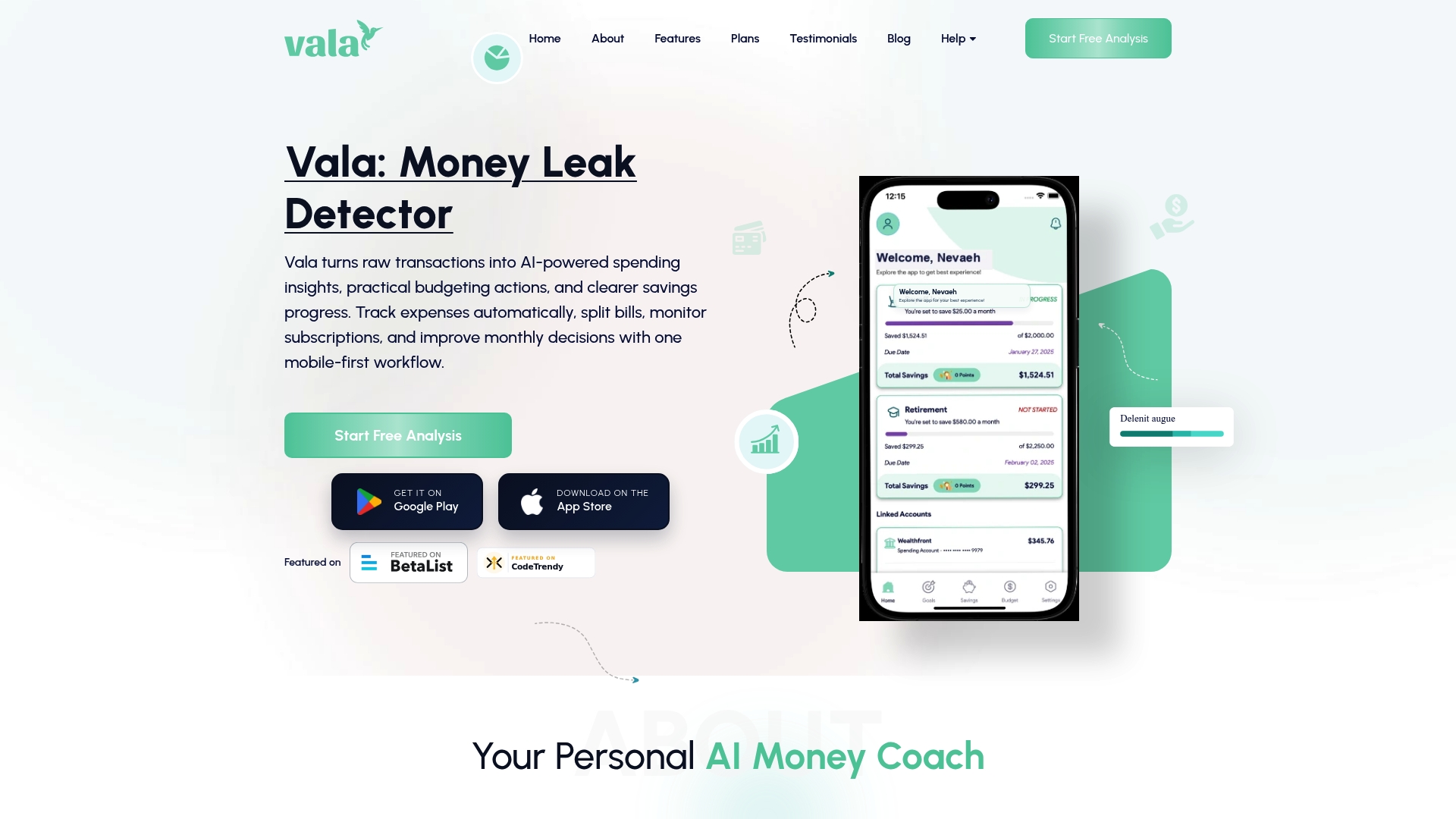
With Vala, you can track every expense, spot financial leaks, and see exactly how close you are to each savings goal. The budget goal tracker lets you set clear targets, monitor progress, and adjust contributions as your life changes. Need help figuring out how much to save? The personal finance calculators on Valapoint make setting savings targets fast and accurate. Vala works in real time, so your savings plan stays current without you having to chase the numbers manually. Try Valapoint today and build a savings system that works even when you’re not thinking about it.
FAQ
What does it mean to automate personal savings goals?
Automating personal savings goals means scheduling recurring transfers from your checking account to dedicated savings accounts so money moves without any manual action from you. This removes the temptation to spend before saving and builds consistent habits over time.
How much should I automate into savings each month?
Start with at least 5% of your take-home pay and increase it by 1% every six months. This gradual approach helps you grow your savings rate to 10% or more without disrupting your daily spending habits.
What is the automation trap in personal finance?
The automation trap happens when automated transfers or payments quietly drain your bank balance because you stop reviewing them. Quarterly check-ins help you catch overdraft risks and make sure your savings setup still matches your current income and expenses.
Should I keep savings at my regular bank or a separate one?
Keeping savings at a separate institution, especially in a high-yield savings account, creates a psychological barrier that reduces impulsive transfers back to spending. It also earns more interest than a standard savings account at a traditional bank.
What tools help with automated savings strategies?
Bank auto-transfer features, savings goal apps, and AI-powered budgeting apps like Vala all support automated savings strategies. AI tools go further by analyzing spending patterns and alerting you when you have extra capacity to save.