
Student budgeting is defined as a distinct subset of personal financial planning that requires strategies built around irregular income, high living costs, and variable educational expenses. Most general budgeting advice assumes a steady paycheck and predictable bills. Students rarely have either. Over 51% of college students identify daily living costs like food and housing as their main financial stressor, ranking above student loan debt. That single fact explains why student budgeting is different from anything a standard finance guide covers. Your income arrives in chunks, your expenses shift every semester, and the rules most adults follow simply do not fit your situation.
Why student budgeting is different from regular financial planning
Student financial planning operates under conditions that most budgeting frameworks were never designed to handle. Your income does not arrive on the first and fifteenth of every month. It comes from part-time jobs with variable hours, semester-based financial aid disbursements, scholarships paid in lump sums, and occasional family support. Each source follows its own schedule. That combination creates a cash flow pattern that looks nothing like a salaried worker’s.
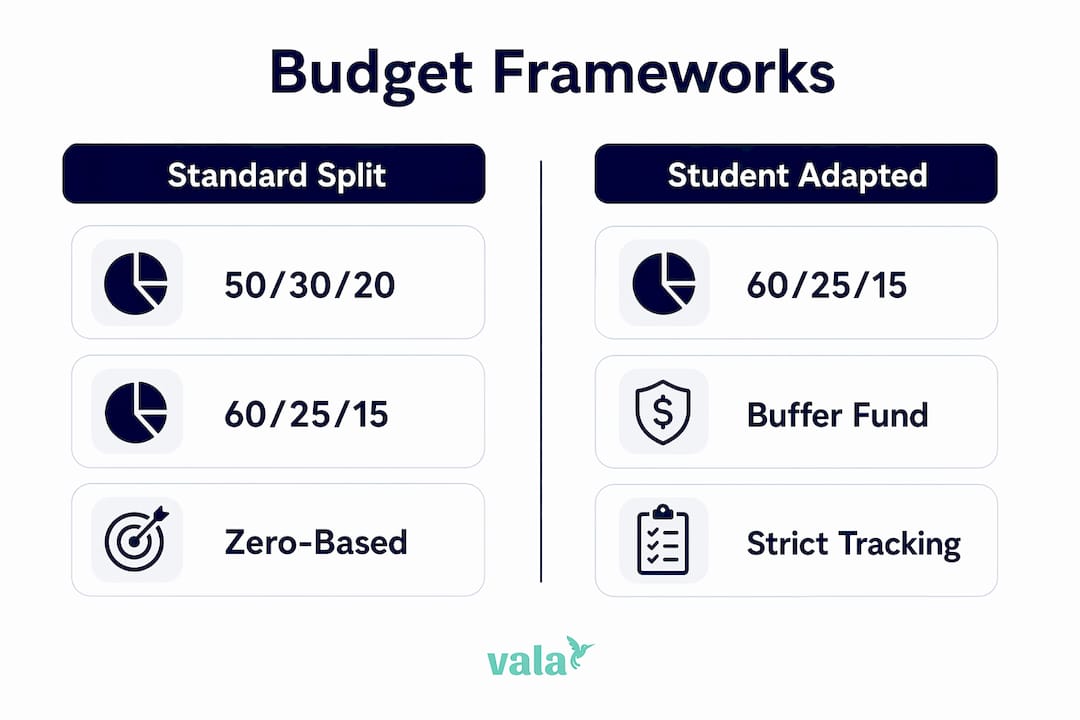
Standard budgeting advice, including the widely cited 50/30/20 rule, assumes that 50% of income covers needs, 30% covers wants, and 20% goes to savings. That split works when rent is a manageable fraction of a steady salary. For most students, housing and food alone consume far more than half of available funds. Experts recommend a 60/25/15 split for students, allocating 60% to essentials like housing, food, and transportation, 25% to lifestyle spending, and 15% to savings and debt repayment. The reallocation reflects a real difference in expense structure, not just a tweak.

The proportional weight of fixed costs also differs. A working adult might spend 25% of income on rent. A student in a college town might spend 50% or more. That leaves far less room for error in every other category. Irregular, multi-source income undermines financial self-efficacy and contributes to ongoing financial strain, particularly when institutional advice fails to reflect actual student income patterns.
Fixed vs. variable costs for students
Students carry a mix of fixed costs (rent, phone, subscriptions) and highly variable costs (textbooks, lab fees, social events, travel home). The variable side is where most budgets break down. Textbook costs alone illustrate this well. Over 55% of students spend $600 or less per year on textbooks, yet institutional budget estimates often assume $1,300 or more. That gap means students who rely on school-provided budget templates may be planning around numbers that do not match their actual spending.
Pro Tip: Build a separate “semester startup” fund each term to cover one-time costs like textbooks, lab supplies, and course fees. Treat it as a fixed expense, not a surprise.
How do students track spending and build realistic budgets?
Practical budgeting for students starts with one non-negotiable step: track your actual spending for at least one full term before making major changes. Tracking spending for one full term gives you real data on habits you would otherwise underestimate. Most students discover they spend more on food and less on textbooks than they assumed. That data becomes the foundation of a budget that actually holds.
Three budgeting methods work particularly well for students:
-
Zero-based budgeting. Zero-based budgeting assigns every dollar a job before the month begins. You list all expected income, then allocate every dollar to a category until the balance reaches zero. This method works well with variable income because it forces you to plan around what you actually have, not what you hope to have.
-
The envelope method. This approach sets hard spending limits for each category. You allocate a fixed amount to eating out, groceries, and entertainment at the start of the month. When the envelope is empty, spending stops. Students who overspend tend to do so in flexible categories like dining and socializing, and hard category limits address that directly.
-
The 60/25/15 adapted split. Apply the student-adjusted percentage framework to each income source as it arrives. When a financial aid disbursement hits your account, immediately allocate 60% to essential bills, 25% to a spending account, and 15% to savings or debt. This prevents the common mistake of treating a large disbursement as free money.
One underused tool worth knowing: a 0% interest student overdraft. A student overdraft acts as an interest-free buffer between income disbursements and regular expenses. Used responsibly, it prevents late fees and missed payments during cash flow gaps. It is not a spending tool. It is a timing tool.
Pro Tip: Use a student finance management app to log every transaction the day it happens. Weekly reviews take less than five minutes and catch problems before they compound.
What financial challenges do students face most often?
The unique challenges of student budgeting go beyond math. They involve psychology, social pressure, and the unpredictable nature of academic life.
- Housing and food costs dominate. The majority of students experience financial stress not from large debts but from immediate costs like monthly rent and groceries. Long-term debt feels abstract. This month’s rent does not.
- Textbook costs are unpredictable. Costs vary by major, semester, and professor. One course might require a $200 textbook. Another might use free PDFs. You cannot plan accurately until you know your course list.
- Social spending creates pressure. Eating out, concerts, trips, and group activities feel like small decisions in the moment. They add up faster than any other category for most students.
- Semester transitions create gaps. Income often drops or disappears between semesters while fixed costs continue. Summer months are particularly difficult for students who rely on campus-based jobs.
“Students’ financial strain often arises from mismatches between institutional budgeting advice and real-life income and expense patterns. Spending tracking reveals hidden leakages and irrational expenditure that guessing budgets miss, enabling better planning.”
— University of Illinois Chicago research, 2026
The psychological impact of irregular spending needs is real. When you do not know exactly what next month looks like financially, anxiety increases and impulsive spending often follows. Building a small emergency buffer, even $200 to $500, reduces that anxiety and protects the rest of your budget from one bad week.
How can students adapt general budgeting frameworks?
General budgeting rules need adjustment before they work for students. The table below compares three common frameworks and their student-adapted versions.
| Framework | Standard split | Student-adapted split | Why it changes |
|---|---|---|---|
| 50/30/20 rule | 50% needs, 30% wants, 20% savings | 60% needs, 25% wants, 15% savings | Higher housing and food costs as a share of income |
| 70/20/10 rule | 70% living, 20% savings, 10% debt | 70% living, 15% savings, 15% debt | Student loan repayment often starts during school |
| Zero-based | Every dollar assigned | Every dollar assigned per disbursement | Aligns with lump-sum income patterns |
The 60/25/15 framework is the most practical starting point for most students. It acknowledges that essentials take priority, gives you a real lifestyle budget, and still builds the savings habit. The 70/20/10 adaptation suits students carrying active loan balances who need to prioritize debt alongside savings.
A mental model that assigns every income dollar a purpose before spending builds discipline and awareness. This is especially useful when income arrives irregularly. Instead of asking “how much do I have left?” you ask “where does this dollar go?” That shift in thinking changes spending behavior over time.
A student budget checklist helps you apply these frameworks consistently each semester. Reviewing your allocations at the start of each term, when your course list and income picture are clearer, keeps your budget grounded in current reality rather than last semester’s assumptions.
Key Takeaways
Student budgeting requires a tailored approach because irregular income, high living costs, and variable educational expenses make standard financial frameworks unreliable without adjustment.
| Point | Details |
|---|---|
| Income is irregular | Students draw from multiple sources with different schedules, requiring flexible allocation strategies. |
| Essentials take a larger share | The 60/25/15 split reflects that housing and food consume more than 50% of most student budgets. |
| Track before you plan | Spending one full term tracking actual expenses builds a budget grounded in real habits, not guesses. |
| Social and variable costs derail budgets | Hard category limits using the envelope method prevent overspending in flexible categories. |
| Adapt frameworks, not just adopt them | General rules like 50/30/20 need recalibration to fit student income and expense realities. |
The habit matters more than the method
Most students I have observed struggle not because they lack a budget, but because they chose a framework designed for someone else’s life. The 50/30/20 rule is taught everywhere. It works beautifully for a 35-year-old with a salary and stable rent. For a student juggling a part-time job, a financial aid disbursement, and a semester that just added a $180 lab fee, it falls apart by week two.
The students who manage money well are not necessarily the ones with the most income. They are the ones who track consistently, adjust quickly, and do not treat a large disbursement as a windfall. I have seen students with modest budgets build real savings by simply assigning every dollar a purpose the day their aid arrived. That discipline, not the specific method, is what creates financial stability.
Technology helps, but only if it fits your actual behavior. A budgeting app for students that shows you real-time category balances changes how you make decisions at the point of spending. Seeing that your food budget has $18 left on a Wednesday changes your Thursday lunch choice. That is the kind of feedback loop that builds lasting habits.
Start with one term of honest tracking. Pick a framework that fits your income pattern. Adjust it every semester as your situation changes. Progress matters more than perfection.
— SaverStride
How Valapoint helps students manage their unique budgets
Student budgets do not fit neatly into generic finance apps built for salaried adults. Valapoint’s personal finance app is built for exactly the kind of financial complexity students face: multiple income sources, irregular timing, and spending categories that shift every semester.

With Valapoint, you can track every income source separately, set category limits that reset each month, and get real-time alerts when spending approaches your limits. The app’s AI-powered insights surface hidden spending patterns you would not catch by reviewing a bank statement once a month. You can also use Valapoint’s financial planning tools to model different budget splits and find the framework that fits your actual income. Set it up once, adjust each semester, and let the app do the tracking.
FAQ
Why is student budgeting different from regular budgeting?
Student budgeting differs because income arrives irregularly from multiple sources and living costs consume a higher proportion of that income. Standard frameworks like 50/30/20 require significant adjustment to reflect student financial realities.
What is the best budgeting method for college students?
Zero-based budgeting works well for students because it assigns every dollar a purpose before spending begins, which suits irregular, lump-sum income patterns like financial aid disbursements.
How much should students spend on essentials?
Experts recommend allocating 60% of income to essentials like housing, food, and transportation. This is higher than the 50% suggested by standard budgeting rules, reflecting the proportionally larger cost of living for students.
How do students handle unexpected expenses?
Building an emergency buffer of $200 to $500 covers most unexpected costs without disrupting the rest of the budget. A 0% interest student overdraft can also serve as a short-term cash flow tool between income disbursements.
How long does it take to build an accurate student budget?
Tracking spending for one full academic term gives you enough real data to build a budget that reflects your actual habits. Adjust your allocations at the start of each new semester as your course load and income change.