
Financial planning for young professionals is the process of organizing your income, expenses, savings, and investments into a coordinated plan that builds wealth and meets your future goals. The ages of 22–35 represent the most valuable window you have. Time compounds money faster than any salary increase ever will. The 50/30/20 rule remains the most widely used budgeting framework in 2026, and financial planners recommend saving and repaying debt at a combined rate of 15–20% of gross income. Getting these fundamentals right early sets the trajectory for everything that follows.
How to create a budget that actually works
A budget is not a restriction. It is a map of where your money goes so you can decide where it should go. Most young professionals skip this step and wonder why they feel financially stuck despite earning decent salaries.
The 50/30/20 framework divides your take-home pay into three categories:
- 50% for needs: rent, utilities, groceries, transportation, and minimum debt payments
- 30% for wants: dining out, subscriptions, travel, and entertainment
- 20% for savings and debt repayment: emergency fund, retirement accounts, and extra debt payments
The most common budgeting mistake is tracking only big expenses. A $12 streaming service, a $6 coffee habit, and a $15 gym you never visit add up to over $400 a year in spending you barely notice. These are the financial leaks that quietly drain your progress.
Automation fixes this problem. When you set up automatic transfers to savings on payday, you remove the decision entirely. You spend what remains, not what you intended to save. Budgeting apps that categorize transactions automatically give you a real picture of your spending without manual effort.

Pro Tip: Set your savings transfer to hit your account the same day your paycheck lands. You will never miss money you never see.
How to build an emergency fund and manage debt
An emergency fund is your financial defense system. Without one, a single car repair or medical bill forces you into high-interest debt, which sets back every other financial goal.
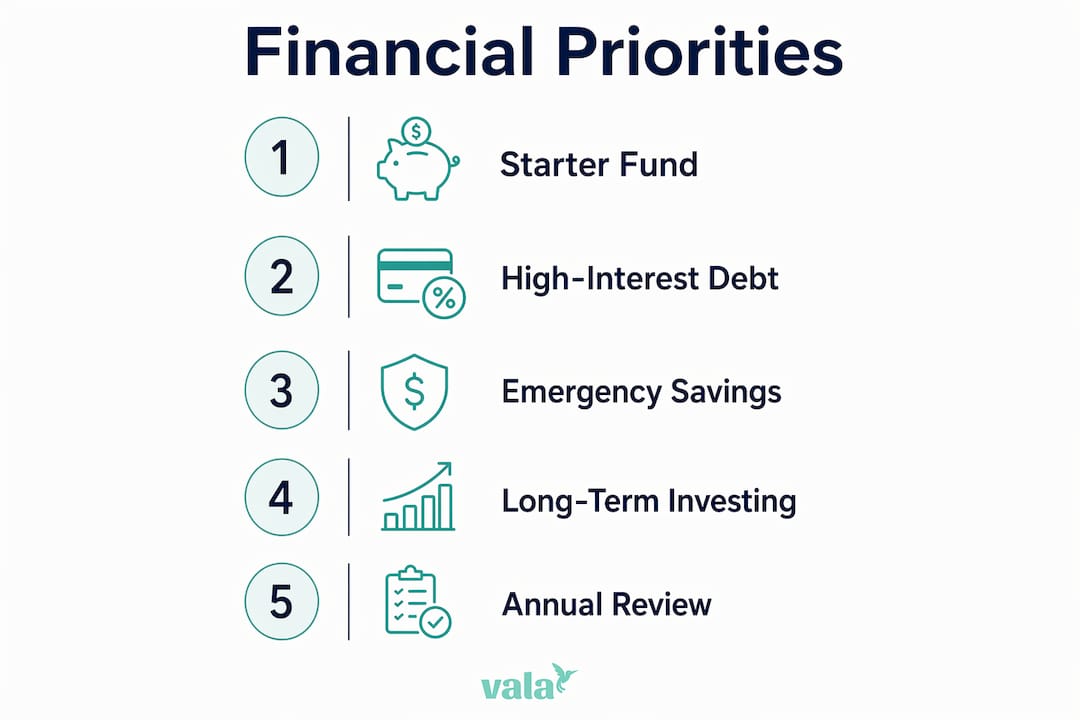
The fastest path to financial stability follows a clear priority order:
- Build a $1,000 starter emergency fund as quickly as possible
- Capture your full employer 401(k) match before doing anything else
- Pay down high-interest debt above 6–7% interest rate aggressively
- Expand your emergency fund to cover 3–6 months of essential expenses
- Contribute to tax-advantaged accounts like a Roth IRA or HSA
- Invest additional funds in a taxable brokerage account
The logic behind this ladder matters. A $1,000 starter fund prevents you from reaching for a credit card every time something unexpected happens. That single buffer stops the debt cycle before it starts.
High-interest debt above 6–7% is a guaranteed negative return on your money. Paying off a credit card charging 22% interest is equivalent to earning a 22% return on an investment. No index fund reliably beats that. Pay it down before investing beyond your employer match.
Pro Tip: While paying down debt, freeze your credit card use. Even one new high-interest charge slows your payoff timeline significantly.
Why starting to invest early changes everything
Compound interest is the single most powerful force in personal finance. A dollar invested at age 25 is worth roughly five times as much at age 65 as a dollar invested at age 45. That gap is not about skill or market timing. It is purely about time.
Delaying retirement contributions by even a few years creates a significant long-term cost. Each year of delay can cost tens of thousands in portfolio value over a lifetime, and catching up later often requires saving at 2–3 times the original rate. Starting small now beats starting big later.
Key accounts to prioritize as a young professional:
- 401(k) with employer match: Employer match contributions offer a near-instant 100% return on investment. Capture every dollar of it.
- Roth IRA: Contributions grow tax-free. At your current income level, you likely qualify, and the tax benefit compounds over decades.
- HSA (Health Savings Account): Triple tax advantage. Contributions are pre-tax, growth is tax-free, and withdrawals for medical expenses are tax-free.
- Taxable brokerage account: Use this after maxing tax-advantaged options. Dollar-cost averaging, meaning investing a fixed amount on a regular schedule, removes the pressure of timing the market.
Tax planning is a year-round process, not a once-a-year event. Using 401(k)s, HSAs, and FSAs throughout the year reduces your taxable income and increases the amount you keep.
Pro Tip: Always contribute enough to your 401(k) to get the full employer match before paying extra on low-interest debt or opening a taxable account. The match is free money with no strings attached.
Why integrated financial planning beats managing things separately
Most young professionals manage their budget in one place, their investments in another, and their debt in a third. This siloed approach creates blind spots. Managing financial elements separately leads to inefficiency and lost opportunities that an integrated plan eliminates.
A unified financial plan treats every dollar as part of a single system. Your budget feeds your savings rate. Your savings rate determines how fast you eliminate debt. Your debt payoff timeline determines when you can increase retirement contributions. Each decision affects the others, and sequencing them correctly maximizes every dollar’s impact.
The difference between siloed and integrated planning looks like this:
| Approach | What happens |
|---|---|
| Siloed | You invest in a brokerage while carrying 24% credit card debt |
| Integrated | You clear high-interest debt first, then redirect that payment to investments |
| Siloed | You save cash in a checking account earning 0.01% |
| Integrated | You route savings to an HSA or Roth IRA for tax-free growth |
A written financial plan reviewed annually, or after major life changes like a new job or marriage, keeps you accountable and adapts to your real situation. Working with a fee-only fiduciary advisor once a year gives you an outside perspective and a single source of truth for all your financial decisions.
Pro Tip: Schedule a 30-minute financial review every january. Update your income, expenses, and goals. A plan you never revisit is just a wish list.
How AI budgeting tools help young professionals save more
Automation removes the biggest obstacle to consistent financial progress: human inconsistency. AI-driven tools track spending, identify saving opportunities, and automate transfers to investments and savings without requiring you to log in and make decisions every week.
The right financial planning tools for young professionals share a few key features:
- Automatic expense categorization: Transactions sort themselves so you see exactly where money goes
- Spending pattern alerts: The app flags when a category spikes above your normal range
- Goal-based goal planning: You set a target, the app moves money toward it on schedule
- Real-time balance visibility: You always know your actual available balance, not just your bank balance
Personal finance automation reduces the mental load of budgeting. When saving is automatic, you do not need willpower. The system does the work. This is especially valuable for young professionals managing student loans, rent, and career expenses simultaneously.
Pro Tip: Automate your Roth IRA contribution on the first of each month. Treating it like a fixed bill makes consistent investing the default, not the exception.
Key Takeaways
Effective financial planning for young professionals depends on starting early, sequencing decisions correctly, and using automation to stay consistent without relying on discipline alone.
| Point | Details |
|---|---|
| Start with a budget framework | The 50/30/20 rule gives you a clear starting structure for income, spending, and saving. |
| Build your emergency fund first | A $1,000 starter fund stops unexpected expenses from creating new high-interest debt. |
| Capture the employer match immediately | Employer 401(k) matching is a near-instant 100% return. Never leave it uncaptured. |
| Invest early, not perfectly | A dollar invested at 25 is worth five times more at 65 than one invested at 45. |
| Integrate all financial decisions | Managing budgeting, debt, and investing as one system eliminates costly blind spots. |
What I’ve learned about financial planning that most articles won’t tell you
The biggest mistake I see young professionals make is not starting too late. It is starting without a sequence. They open a brokerage account before paying off a 22% credit card. They build a six-month emergency fund before capturing their employer match. Good intentions, wrong order.
The priority ladder exists for a reason. Every dollar has an optimal next destination, and skipping steps costs real money. I have watched people invest $500 a month in index funds while carrying $8,000 in credit card debt at 24% interest. The math on that is brutal. The debt wins every time.
The second thing most articles skip is the psychological side of a written plan. Knowing your numbers is not the same as writing them down and reviewing them. A plan you carry in your head shifts every time your mood shifts. A written plan reviewed annually holds you to your past self’s better judgment.
Technology genuinely helps here. Apps that automate savings and surface spending patterns remove the friction that causes most people to abandon their budgets by february. The best financial habit is the one that runs without you having to think about it. Automate the right behaviors, and the results follow.
Start where you are. Contribute $50 a month to a Roth IRA if that is all you can manage. Build the $1,000 buffer before anything else. The sequence matters more than the amount, especially in the first few years.
— SaverStride
Valapoint makes your financial plan work in real life
Building a financial plan is one thing. Sticking to it is another. Valapoint’s Vala app brings your budget, savings goals, and spending habits into one clear view so you always know where you stand.

Vala tracks your expenses automatically, flags spending patterns before they become problems, and helps you set savings goals with real timelines. Whether you are building your first emergency fund or tracking progress toward a Roth IRA contribution, the Vala personal finance app keeps every piece of your plan connected. You can also use Valapoint’s financial planning tools to calculate savings targets, model debt payoff timelines, and build a budget that fits your actual income. No spreadsheets required.
FAQ
What is the 50/30/20 rule for budgeting?
The 50/30/20 rule allocates 50% of take-home pay to needs, 30% to wants, and 20% to savings and debt repayment. It is the most widely used budgeting framework for young professionals starting their financial plan.
How much should I have in an emergency fund?
Start with a $1,000 buffer to cover small emergencies, then build toward 3–6 months of essential expenses. Reach the starter amount before expanding so unexpected costs do not push you into high-interest debt.
Should I pay off debt or invest first?
Capture your full employer 401(k) match first, then pay down debt above 6–7% interest before investing further. The match offers a near-instant 100% return that no debt payoff or investment reliably beats.
When should I start contributing to a Roth IRA?
Start as early as possible, ideally in your mid-20s when your income and tax rate are lower. Roth IRA contributions grow tax-free, and decades of compounding make early contributions significantly more valuable than later ones.
How often should I review my financial plan?
Review your plan at least once a year and after major life changes like a new job, a raise, or a move. A written plan reviewed annually keeps your goals current and your priorities correctly sequenced.