
A spending audit is defined as a backward-looking review of your actual financial transactions over a recent period, typically 30–90 days, to uncover where your money truly goes. Unlike budgeting, which plans future spending, an audit diagnoses what already happened. Behavioral economics research shows people underestimate their discretionary spending by 20–30% from memory alone. That gap between what you think you spend and what you actually spend is exactly what a spending audit closes. Valapoint’s tracking tools are built to make that gap visible fast.
What is a spending audit, and why does it matter?
A spending audit is a systematic review of every dollar you spent over the past one to three months. The goal is simple: see the full picture of your spending, not the version your memory constructed. 10–25% of monthly spending often goes to unallocated or forgotten categories. That means a real audit can surface $200–$500 in monthly savings for the average person.

The formal term used in personal finance is “expenditure review” or “personal spending analysis,” but “spending audit” has become the widely accepted everyday label. Both terms describe the same process. You pull your statements, categorize every transaction, and compare the results against your actual financial goals.
The audit matters because your memory is not a reliable financial record. You might recall the big purchases but forget the $14.99 subscription, the three delivery fees, and the two ATM charges that quietly added up. A spending audit replaces guesswork with data.
How does the spending audit process work?
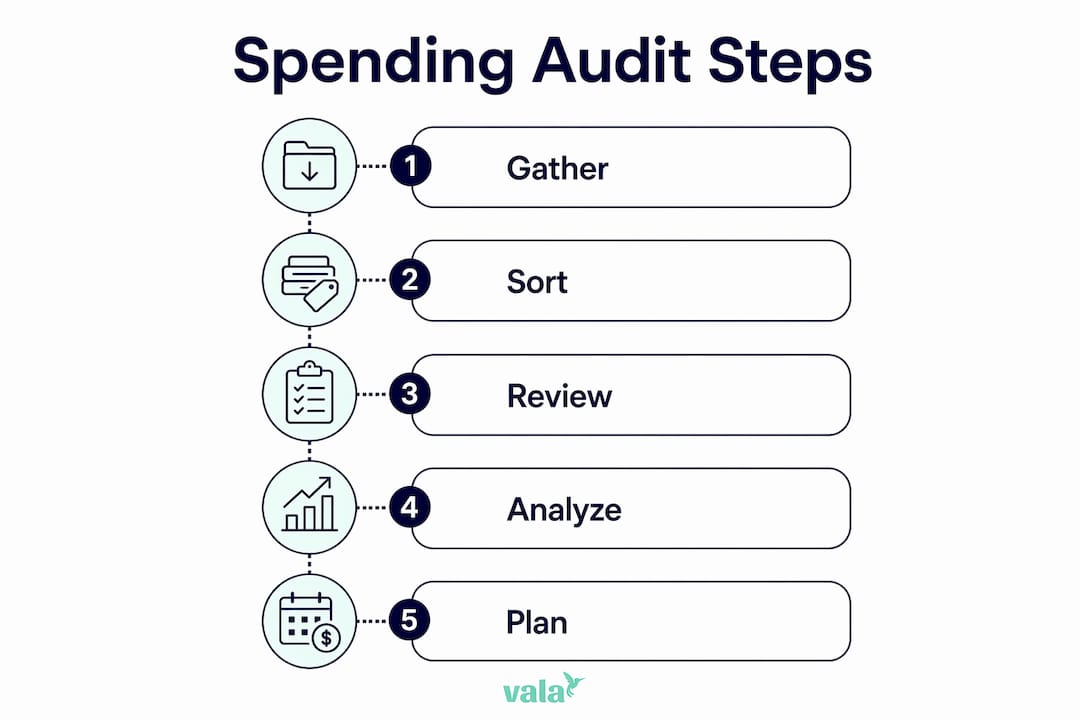
The spending audit process follows a clear sequence. Here is how to work through it step by step.
-
Gather your statements. Pull bank statements, credit card statements, and any digital payment records (Venmo, PayPal, Cash App) for the past 30–90 days. Include an honest estimate of cash spending. Collecting 1–3 months of statements gives you enough data to spot patterns without drowning in detail.
-
List every transaction. Copy every charge into a spreadsheet or notebook. Do not skip small amounts. A $3.49 charge repeated 20 times is $69.80 you may have never noticed.
-
Categorize each transaction. Group spending into categories: housing, groceries, dining out, transportation, subscriptions, entertainment, personal care, and miscellaneous. Be specific. “Dining out” and “coffee shops” are different categories with different solutions.
-
Flag recurring charges. Mark every charge that repeats monthly or annually. These are your highest-priority review items because they compound over time.
-
Total each category. Add up what you spent in each group. Compare the totals to what you expected to spend. The surprises are your audit findings.
-
Identify the leaks. Note any category where actual spending exceeded your mental estimate by more than 15%. These are the areas that need attention first.
A quick scan takes about one hour. A deep review that catches every cash purchase and recurring charge takes 2–3 hours. The deeper review pays off more.
Pro Tip: Never rely solely on your bank app’s auto-categorization. Automated categorization frequently misclassifies transactions and misses cash spending entirely. Always verify each category manually.
How does a spending audit differ from a budget?
A budget is a forward-looking plan. A spending audit is a backward-looking diagnostic. They serve different purposes, and confusing them is one of the most common financial mistakes people make.
Here is how the two tools differ in practice:
- A budget sets targets. It tells you how much you plan to spend in each category next month.
- An audit reveals reality. It tells you how much you actually spent last month, with no assumptions.
- A budget can be built on false assumptions. If you have never audited your spending, your budget categories are based on guesses.
- An audit makes your budget accurate. Once you know your real spending patterns, you can set budget targets that reflect your actual life.
- Audits expose category creep. Category creep is the gradual, unnoticed rise in small expenses within a category. A budget rarely catches it. An audit always does.
The psychological dimension matters here. People tend to remember their intentional purchases and forget their impulse ones. A spending audit removes that bias. It shows you the full picture, including the purchases you made on autopilot. That objectivity is what makes audit data so much more useful than a budget built from memory.
What hidden expenses does an audit typically uncover?
Hidden expenses are the charges you pay but rarely think about. They are the leading reason people feel financially tight despite a steady income.
Forgotten subscriptions top the list. Streaming services, app subscriptions, cloud storage plans, and gym memberships you signed up for and stopped using all continue billing until you cancel them. Silent recurring costs and subscription fatigue are leading causes of unnoticed monthly leakage, often totaling around $500 per month for the average household.
Small daily convenience purchases add up faster than most people expect. A $6 coffee five days a week is $120 a month. A $4.99 delivery fee three times a week is $60 a month. Neither feels significant in the moment. Together, they represent $180 a month, or $2,160 a year.
Cash spending and ATM fees are the most commonly omitted items in any audit. Recurring charges, convenience fees, and ATM fees quietly drain hundreds monthly. Cash withdrawals show up as a single lump sum on your statement, with no detail about where the money went.
Category creep is the subtlest leak of all. Your grocery bill was $350 six months ago. Now it is $430. Nothing changed dramatically. Prices crept up, habits shifted slightly, and the total grew without a single conscious decision. Spending audits uniquely reveal these leaks by examining detailed transactions over time, something a monthly budget review rarely does.
How to apply audit findings to improve your financial habits
Finding the leaks is only half the work. The other half is deciding what to do about them.
-
Pick three changes, not ten. Limiting initial actions to three changes avoids overwhelm and improves the chance you will actually follow through. Choose the three categories with the biggest gap between expected and actual spending.
-
Cancel or renegotiate recurring charges. Go through every flagged subscription. Cancel anything you have not used in the past 30 days. For services you want to keep, check if a lower-tier plan meets your needs.
-
Set category budgets based on real data. Use your audit totals as the baseline. If you spent $430 on groceries, set your grocery budget at $400 and work down from there. Starting from your actual behavior is more realistic than starting from an ideal number.
-
Align spending with your stated priorities. An audit creates a spending map that you can compare against your actual goals. If you say travel is a priority but your audit shows you spent nothing on savings and $200 on impulse dining, the data tells you something your budget never would.
-
Schedule your next audit. A quarterly review keeps your spending map current. Set a calendar reminder for 90 days out. The second audit takes less time because you already know the process.
Pro Tip: Use expense tracking best practices to maintain the accuracy you built during your audit. Consistent tracking between audits makes each subsequent review faster and more useful.
What tools support an effective spending audit?
The right tool depends on how detailed you want to get and how much time you want to invest.
| Method | Best for | Key limitation |
|---|---|---|
| Pen and paper | Simple, one-time audits | Slow; easy to miss digital transactions |
| Spreadsheet (Excel, Google Sheets) | Detailed, customizable reviews | Requires manual data entry |
| Expense tracking apps | Ongoing tracking with auto-import | Auto-categorization errors require manual correction |
| Personal finance platforms | Full financial picture with goal tracking | Setup time; learning curve |
No special software is required for an accurate audit. Accuracy depends more on consistent tracking and manual review than on the technology you use. A spreadsheet with honest data beats an app with sloppy categorization every time.
That said, apps that auto-import transactions save significant time during data collection. The key is to treat auto-categorization as a starting point, not a finished product. Always review each category manually before drawing conclusions. For readers who want a structured comparison of available tools, the best expense tracking apps guide covers what to evaluate before you install anything.
Downloadable spending audit templates are available from personal finance sites like Money Instructor and Phroogal. These give you a pre-built category structure so you are not starting from a blank page.
Key Takeaways
A spending audit gives you an accurate, data-based picture of your real spending habits, which no budget built from memory can match.
| Point | Details |
|---|---|
| Audits are backward-looking | They review past transactions, not future plans, making them a diagnostic tool rather than a planning tool. |
| Memory underestimates spending | Behavioral economics research shows people underestimate discretionary spending by 20–30%, making manual review essential. |
| Hidden costs add up fast | Forgotten subscriptions and small daily purchases can quietly drain hundreds of dollars each month. |
| Start with three changes | Focusing on three high-impact adjustments after an audit improves follow-through and builds lasting habits. |
| Quarterly audits maintain clarity | Reviewing your spending every 90 days keeps your financial picture current and catches new leaks early. |
Why I think most people skip the most valuable financial tool they have
Most personal finance advice jumps straight to budgeting. Set a budget, track your categories, stick to the plan. The problem is that a budget built without an audit is built on fiction. You are planning with numbers you made up, not numbers you measured.
The first time I worked through a full spending review, the results were uncomfortable. I thought I spent about $80 a month on subscriptions. The actual number was $214. I thought I rarely ordered delivery. My statement showed 11 delivery charges in one month. None of those purchases felt significant at the time. Together, they told a story I did not recognize.
That discomfort is the point. A spending audit is not a judgment. It is a measurement. You would not skip a health checkup because you were afraid of the results. The same logic applies here. Viewing an audit as a neutral health checkup rather than a verdict shifts your reaction from defensive to curious.
The readers who get the most from this process are the ones who stay curious. They do not try to fix everything at once. They pick the two or three findings that surprise them most and address those first. That focused approach builds confidence, and confidence builds the habit of regular review.
If you have never done a spending audit, your first one will likely be the most revealing financial exercise you have ever done. That is not a warning. It is a reason to start.
— SaverStride
How Valapoint makes your spending audit easier
Running a spending audit manually is entirely possible, and the process above works. But tracking every transaction, correcting miscategorized charges, and spotting recurring leaks takes real time.

Valapoint’s personal finance app auto-imports transactions, flags recurring charges, and surfaces spending patterns you might otherwise miss. You still review and confirm categories manually, which keeps your audit accurate. The difference is that Valapoint handles the data collection so you can focus on the analysis. For readers ready to build on their audit findings, Valapoint’s budget tracking tools let you set category limits based on your real spending data and monitor progress in real time.
FAQ
What is a spending audit in simple terms?
A spending audit is a detailed review of your actual transactions over the past 30–90 days to see exactly where your money went. It replaces memory-based estimates with real data.
How long does a spending audit take?
A quick scan takes about one hour. A thorough review that catches recurring charges and cash spending takes 2–3 hours. The deeper review produces more useful findings.
How is a spending audit different from a financial audit?
A financial audit is a formal, often legally required review of an organization’s financial records conducted by an external party. A spending audit is an informal personal review you conduct yourself to understand your own spending habits.
How often should you do a spending audit?
A quarterly review, every 90 days, keeps your spending picture current and catches new leaks before they compound. Annual reviews are better than nothing but miss the gradual category creep that builds month by month.
What are the biggest benefits of a spending audit?
The main benefits are identifying forgotten subscriptions, uncovering category creep, and building a realistic baseline for budgeting. Most people find monthly savings of $200–$500 after completing their first full audit.