
Expense categorization is defined as the process of grouping financial transactions into consistent, labeled categories to support tracking, budgeting, and tax reporting. Also called expense classification in accounting, it gives you a clear picture of where your money goes each month. Most small businesses and individuals base their categories on frameworks like IRS Schedule C, which provides 20 standard line items as a starting point. Without a consistent system, spending data becomes noise. With one, it becomes a tool you can actually use.
What is expense categorization and why does it matter?
Expense categorization is the practice of assigning every dollar you spend to a defined group, such as rent, travel, meals, or payroll. The goal is consistency. When every transaction lands in the right bucket, you can compare spending across months, prepare accurate tax returns, and spot budget problems before they grow.
Accounting standards divide business expenses into two main groups. Operating expenses cover day-to-day costs like salaries, utilities, and office supplies. Non-operating expenses cover indirect costs like interest payments or losses from asset sales. Knowing which bucket a cost belongs to affects how you read your profit and loss statement.

For individuals, the same logic applies. Grouping personal spending into categories like housing, groceries, transportation, and subscriptions shows you exactly where your paycheck goes. That clarity is the first step toward building a budget that actually holds.
What are the main types of expense categories?
Expenses can be classified in two ways: by function or by nature. Classification by function groups costs by their role in the business, such as Cost of Goods Sold (COGS) or Selling, General, and Administrative expenses (SG&A). Classification by nature groups costs by what they are, such as wages, rent, or utilities. Both methods are valid. The key is picking one and sticking with it.
Common expense categories for small businesses
Most small businesses work with a core set of categories that map directly to tax forms and accounting reports:
- Housing and rent: Office space, storage units, or home office costs
- Payroll and labor: Wages, contractor payments, and employer taxes
- Travel: Flights, hotels, mileage, and ground transportation
- Meals and entertainment: Business meals with clients or team events
- Office supplies: Paper, software subscriptions, and equipment under a set dollar threshold
- Utilities: Internet, phone, electricity, and water for business premises
- Marketing and advertising: Paid ads, design fees, and promotional materials
- Professional services: Accounting, legal, and consulting fees
- Insurance: Business liability, health, and property coverage
- Depreciation: Gradual cost recovery on major assets like equipment or vehicles
Fixed vs. variable expenses
Fixed expenses stay the same each month, like rent or a software subscription. Variable expenses change with activity, like shipping costs or raw materials. Tracking both separately helps you understand which costs you can control and which you cannot.
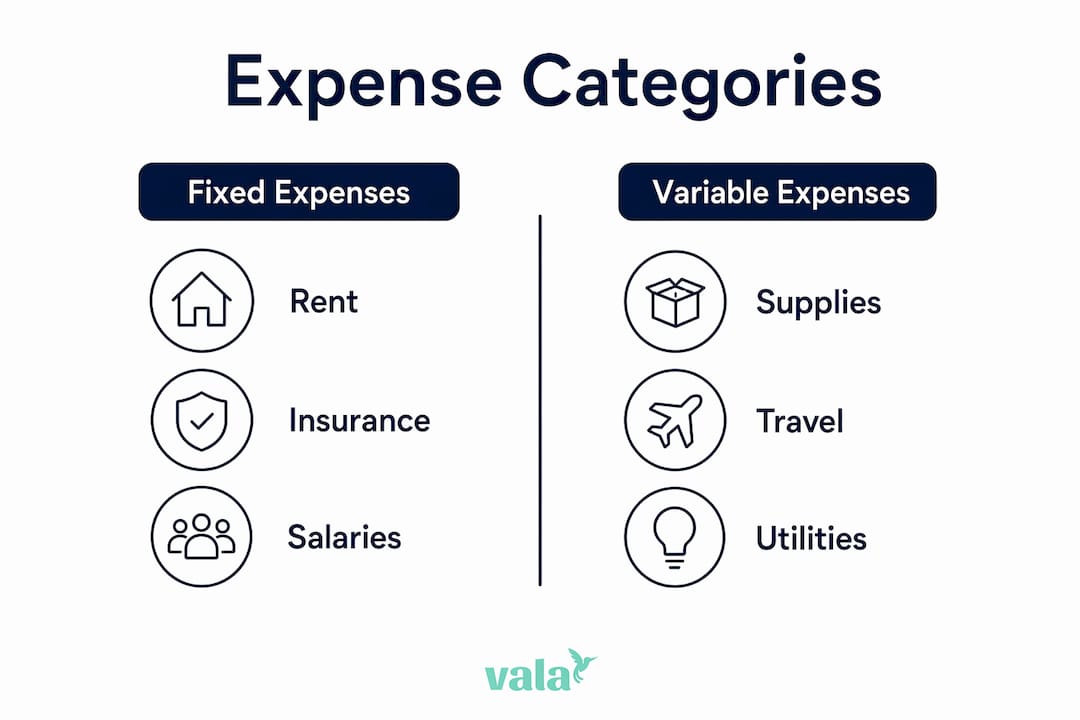
| Category type | Examples | Changes monthly? |
|---|---|---|
| Fixed operating | Rent, insurance, salaries | No |
| Variable operating | Supplies, shipping, utilities | Yes |
| Non-operating | Loan interest, asset losses | Varies |
| Personal fixed | Mortgage, car payment | No |
| Personal variable | Groceries, dining, fuel | Yes |
How does categorization affect budgeting, taxes, and financial insights?
Accurate expense classification directly improves your budget. When you know exactly how much you spend on travel each quarter, you can set a realistic limit for the next one. Guessing leads to overspending. Data leads to control.
Tax filing becomes faster and more accurate when your categories align with your tax return. Aligning categories with IRS Schedule C lines means your accountant pulls the numbers directly from your records without hunting through raw transactions. That saves time and reduces errors.
Miscategorized expenses create real problems. A meal coded as office supplies skews both categories. Over time, those small errors add up to financial reports you cannot trust. Clean categories produce clean reports, and clean reports support better decisions.
Pro Tip: Review your expense categories at the end of each quarter. Catching a pattern of miscoded transactions early is far easier than correcting a full year of data before tax season.
The risks of overusing broad categories are well documented. The use of “Other” and “Miscellaneous” expense categories increased by 57% and 47% respectively among organizations. That trend signals a failure to classify spending properly, which makes financial analysis unreliable.
What are common mistakes in expense categorization?
The most common mistake is using “Miscellaneous” as a catch-all. Auditors flag excessive use of this category as a red flag. When too many transactions land in a vague bucket, your financial data loses meaning and your tax return becomes harder to defend.
Changing category definitions mid-year is the second major mistake. If you rename “Marketing” to “Advertising and Outreach” in july, your year-over-year comparison breaks. You cannot tell whether spending went up because the business grew or because the label changed.
Over-categorizing causes its own problems. Category fatigue sets in when employees or users face too many choices. They start guessing, and guessing produces messy data. The fix is to start broad and add detail only when transaction volume justifies it.
Categories that only make sense to accountants create errors at the point of entry. A practical expense system must be intuitive enough for anyone submitting an expense to classify it correctly without second-guessing. If your team consistently miscodes a category, the category definition is the problem, not the team.
Pro Tip: Apply a “two-touch” rule for any transaction that lands in Miscellaneous. Require a written note explaining why it does not fit another category, and set an automatic review trigger when Miscellaneous spending exceeds a set threshold.
How can you implement expense categorization effectively?
Start with 10–15 broad categories. That number covers most spending without overwhelming anyone who submits expenses. You can always add subcategories later as your transaction volume grows and your reporting needs become more specific.
Here is a practical setup process:
- List your actual spending first. Pull three months of bank and credit card statements. Group transactions by type before naming any categories. Let real data shape your structure.
- Align categories with your tax forms. Map each category to a line on IRS Schedule C or your personal tax return. This tax-first approach cuts preparation time significantly.
- Write a categorization guide. Document what belongs in each category with two or three examples. Share it with anyone who touches expense records.
- Connect categories to your chart of accounts. If you use accounting software, each category should map to a specific account code. This keeps your books and your expense reports in sync.
- Set a review date. Lock your categories at the start of each fiscal year. Schedule a review for the following january before the new year begins, not mid-cycle.
Automation makes the system easier to maintain. Apps that use AI to tag transactions automatically reduce the manual work of daily expense logging and catch miscategorizations before they pile up. The goal is a system that runs with minimal effort and produces data you can trust.
- Keep category names short and plain. “Travel” beats “Business Travel and Transportation Costs.”
- Avoid overlapping categories. If meals and entertainment share a boundary, define exactly where one ends and the other begins.
- Review expense tracking practices regularly to catch patterns that suggest a category needs splitting or merging.
Key takeaways
Expense categorization works best when categories are simple, consistent, and aligned with your tax forms from the start of each fiscal year.
| Point | Details |
|---|---|
| Start with 10–15 categories | Broad categories prevent fatigue and reduce miscoding errors. |
| Align with IRS Schedule C | Tax-aligned categories cut preparation time and improve accuracy. |
| Avoid mid-year changes | Changing definitions mid-year breaks year-over-year comparisons. |
| Limit Miscellaneous use | Overuse of vague categories signals poor data quality to auditors. |
| Use automation to stay consistent | AI-powered tools tag transactions automatically and flag outliers. |
The case for keeping it simple
Most people overthink expense categorization. They build elaborate systems with dozens of subcategories, then abandon them by march because the upkeep is too much work.
The systems I have seen hold up over time share one trait: they are boring. Ten categories, clear names, and a one-page guide that anyone can follow. That is it. The goal is not a perfect taxonomy. The goal is data you can actually use twelve months from now.
Consistency matters more than precision. A category that is slightly imperfect but applied the same way every month produces useful trend data. A “perfect” category that gets applied differently each quarter produces nothing useful at all.
Automation changes the equation, but only when the underlying categories are clean. An AI tool that auto-tags transactions will amplify whatever structure you give it. Feed it a messy system and you get messy results faster. Feed it a clean, simple system and you get reliable data with almost no manual effort.
My honest advice: set your categories in january, write them down, and do not touch them until the following january. If a category feels wrong, note it for next year. Mid-year changes cost more than they save.
— SaverStride
How Valapoint makes expense categorization easier
Keeping your categories consistent is straightforward when the right tools do the heavy lifting.

Valapoint’s personal finance app automatically tags your transactions, groups them into clear categories, and flags anything that looks out of place. You get a real-time view of your spending without manually sorting through bank statements. The app also supports budget controls tied directly to your categories, so you know the moment a category runs over. For small business owners and individuals who want clean financial data without the manual work, Valapoint’s AI expense tracker handles the categorization layer so you can focus on the decisions that matter.
FAQ
What is expense categorization in simple terms?
Expense categorization is the process of grouping every transaction you make into a labeled category, such as rent, travel, or groceries. It makes tracking, budgeting, and tax filing faster and more accurate.
What are the most common expense categories for small businesses?
Most small businesses use categories like payroll, rent, utilities, travel, meals, office supplies, marketing, professional services, and insurance. These align with the 20 standard line items on IRS Schedule C.
How many expense categories should I have?
Start with 10–15 broad categories. Adding too many categories too soon leads to confusion and data errors. Expand with subcategories only when your transaction volume makes it necessary.
Why is using “Miscellaneous” a problem?
Overusing Miscellaneous hides spending patterns and raises flags during audits. Auditors treat a high volume of Miscellaneous entries as a sign of poor financial controls.
How does expense categorization help with taxes?
Aligning your expense categories with IRS Schedule C lines means your tax data is ready to pull directly from your records. That reduces preparation time and lowers the risk of errors on your return.