
A monthly financial review is a structured check-in of your income, expenses, savings, and debt. Done consistently, it replaces guessing with knowing. You can review monthly finances effectively in as little as 15 minutes, and the habit alone shifts how confidently you manage money. This guide walks you through every step: what to gather, how to analyze your numbers, which metrics to track, and how to avoid the mistakes that make people quit. Whether you’re managing finances solo or as a couple, the process is the same.
What does it mean to review monthly finances effectively?
Reviewing your monthly finances effectively means running a focused, repeatable check-in that reveals spending trends, catches surprises, and confirms you’re moving toward your goals. Financial planners call this a personal finance audit or monthly budget review. Both terms describe the same practice: a deliberate look at where your money came from and where it went.
Monthly reviews provide a structured moment to see the full financial picture, answering questions you miss during daily activity. That’s the core value. You’re not just checking a balance. You’re reading your financial story for the month.

The key indicators to watch are net income, savings rate, total debt balance, and any new recurring charges. These four numbers tell you more than any single transaction ever could.
What do you need before starting your review?
Gathering the right data before you sit down saves time and prevents incomplete analysis. Pull these together in one place before your review begins:
- Bank statements from all checking and savings accounts
- Credit card statements for the full month
- Investment or retirement account summaries
- A list of all active subscriptions and recurring bills
- Your previous month’s review notes (if you have them)
Digital tools that connect to your accounts and auto-categorize transactions make this step much faster. Automated expense tracking removes the manual work of sorting transactions by category, so you walk into your review with data already organized.
Consistency matters more than the tool you use. Set a fixed day each month, ideally within the first three days. Experts recommend completing your review within this window, while the previous month’s data is fresh and complete.
Pro Tip: Automate transaction categorization and recurring charge tracking before your review day. That way, your review focuses on analysis, not data entry.
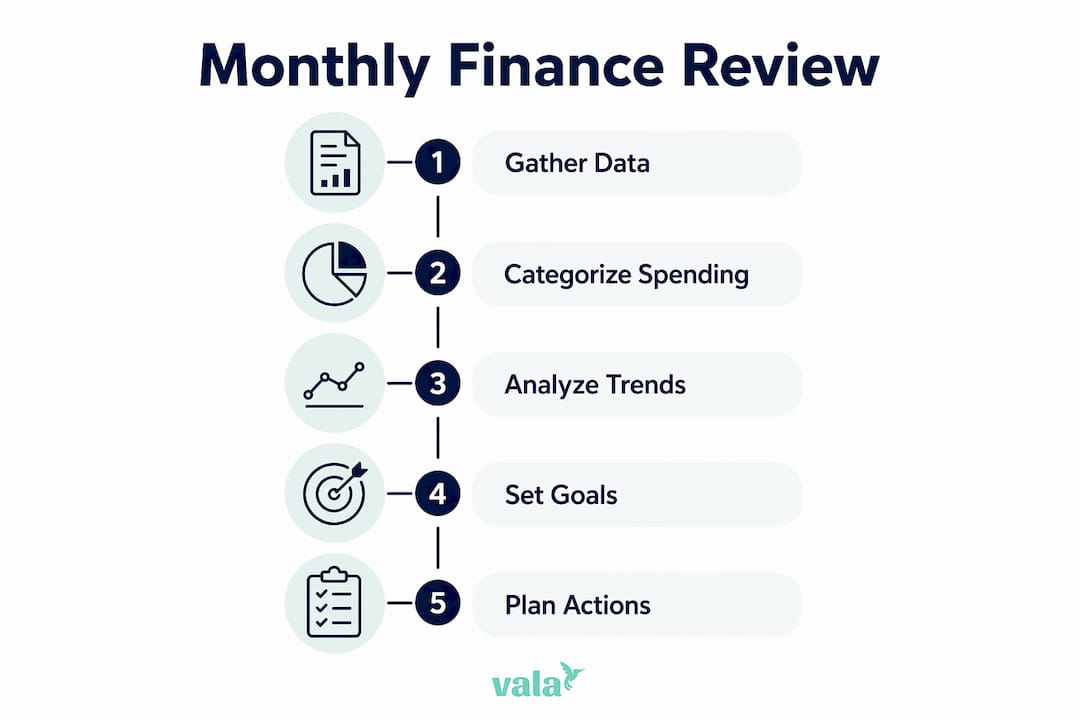
For busy months, a minimal viable review works. Spend five minutes on total spending and any new recurring charges. That’s enough to stay aware without skipping entirely.
How do you analyze income and spending step by step?
A repeatable structure makes your review faster every month. Follow this sequence:
-
Review total income by source. Add up every dollar that came in: salary, freelance payments, side income, transfers. Compare this month to the prior month and to the same month last year. Income changes are often the first signal of a bigger shift.
-
Analyze major spending categories. Look at housing, food, transportation, and discretionary spending as groups, not individual transactions. Identify any category that spiked compared to last month. A spike in dining out or online shopping is easier to spot at the category level.
-
Flag new recurring charges. Scan for any subscription or charge you don’t recognize. Auditing subscriptions helps identify forgotten or unused recurring charges that drain resources every month.
-
Calculate your savings rate. Subtract total spending from total income, then divide by income. A savings rate above 20% is solid. Above 40% is excellent. Below 10% is a warning sign worth addressing immediately.
-
Note one trend. Look at 3–6 months of data if you have it. Reviewing trends over multiple months reveals non-random patterns that a single month can hide.
Pro Tip: Track your spending ratio of needs versus wants each month. Aim for no more than 30% of after-tax income going to wants. This single ratio keeps spending aligned with your priorities without requiring a line-by-line audit.
The category approach beats transaction-by-transaction review every time. It’s faster, less stressful, and surfaces the patterns that actually matter.
How do you audit subscriptions and track financial health?
Subscription creep is one of the most common sources of financial leakage. The average household spends a significant amount monthly on subscriptions, and a meaningful portion of those charges go to services that are rarely or never used. A monthly audit takes less than five minutes and consistently pays off.
Subscription audit steps
- List every recurring charge from your bank and credit card statements
- Check each one: Did you use it this month?
- Evaluate necessity: Would you notice if it disappeared?
- Cancel anything you haven’t used in 30 days or that duplicates another service
Financial health metrics to check
Beyond subscriptions, your monthly review should confirm you’re on track with three core metrics:
- Debt-to-income ratio. Fidelity recommends keeping total debt payments, including housing, at or below 36% of gross income. Lower ratios give you more flexibility to save and invest.
- Emergency fund balance. Your target is 3 to 6 months of essential expenses in a liquid, safe account. Check your balance monthly and note progress toward that target.
- Goal progress. If you’re saving for a vacation, paying down a car loan, or building an investment account, track the balance against your target every month.
After checking these metrics, set one concrete action item. Setting one specific action after each review keeps momentum going. Examples: cancel one unused subscription, increase your savings goals transfer by $25, or pay an extra $50 toward your highest-interest debt.
You can use a budget goal tracker to log these targets and watch progress build month over month. Seeing the numbers move is one of the strongest motivators to keep the habit going.
What mistakes should you avoid during your monthly review?
Most people who quit their monthly review do so because they made it too hard or too stressful. These are the patterns that kill the habit.
- Mixing data entry with analysis. Data entry belongs in daily or weekly habits, not your monthly review. If you’re still categorizing transactions during your review, you’ll run out of time and patience before you reach the insights.
- Checking balances daily instead of monthly. Daily balance checks increase financial anxiety without improving your decisions. Monthly reviews replace that anxiety with clarity.
- Skipping months. One missed month is not a failure. Two or three in a row breaks the habit entirely. Consistency matters more than perfection, and missing a month is not a reason to stop.
- Tracking every transaction during the review. Category-level analysis is enough. Going line by line during the review wastes time and creates stress without adding insight.
“A monthly review is not about judging every purchase. It’s about seeing the full picture clearly enough to make one good decision. That decision, repeated monthly, is what changes your financial life.”
Pro Tip: Anchor your review to a recurring calendar reminder on the same date each month. Link it to a notification so it becomes automatic. Linking a review to a calendar anchor significantly improves habit consistency over time.
The goal is a sustainable practice, not a perfect one. A five-minute review on a busy month beats no review at all.
Key Takeaways
A consistent monthly financial review, completed in 15 minutes or less, is the single most effective habit for building financial clarity and reducing money-related stress.
| Point | Details |
|---|---|
| Start with the right data | Gather bank statements, credit cards, subscriptions, and prior notes before your review begins. |
| Use the savings rate as your compass | A savings rate above 20% is healthy; below 10% signals a spending pattern worth correcting. |
| Audit subscriptions every month | Unused recurring charges are the most common source of financial leakage in household budgets. |
| Track three core health metrics | Monitor debt-to-income ratio, emergency fund balance, and goal progress each month. |
| End with one action item | One specific, achievable step after each review builds momentum and improves habits over time. |
The habit that changed how I think about money
I spent years believing that financial awareness required constant attention. I checked my balance almost daily, felt anxious when it dipped, and still had no real sense of where my money was going. The monthly review fixed that, and not because it gave me more data. It gave me the right data at the right time.
What I’ve found, working with people who struggle to track their monthly budget, is that the problem is almost never motivation. It’s structure. People want to manage their money well. They just don’t have a repeatable process that fits into real life. A 15-minute review on the first Saturday of each month is a process. Checking your balance every morning is just anxiety dressed up as diligence.
The other thing I’ve learned: automation changes everything. When your transactions are already categorized and your subscriptions are already flagged, the review becomes analysis instead of housework. That shift makes the habit stick. Tools like Valapoint’s personal finance software handle the categorization automatically, so your review time goes toward decisions, not data cleanup.
Start small. Even a five-minute review is better than none. The habit builds on itself. After three months, you’ll know your spending patterns well enough that surprises become rare. That’s when financial confidence starts to feel real.
— SaverStride
Valapoint makes your monthly review faster and clearer
Valapoint’s Vala app brings your income, expenses, subscriptions, and financial goals into one dashboard. Every transaction is categorized automatically, so you walk into your monthly review with the work already done.

Vala tracks recurring charges and flags new subscriptions the moment they appear. Goal trackers show your savings and debt payoff progress in real time. Bill alerts prevent missed payments before they become fees. Most users reduce their monthly review time from 15 minutes to as little as 5. If you want a cleaner, faster way to evaluate personal finances each month, Vala’s finance tools are built for exactly that.
FAQ
How long should a monthly financial review take?
A complete monthly review takes about 15 minutes when your data is already organized. A minimal review focused on total spending and recurring charges takes as little as 5 minutes.
What is a good savings rate to aim for each month?
A savings rate above 20% of after-tax income is considered healthy. Above 40% is excellent. Below 10% signals that spending adjustments are needed.
How do I track my monthly budget without getting overwhelmed?
Review spending by category, not by individual transaction. Set a fixed review date each month, automate transaction categorization, and focus on one action item per review session.
What financial metrics should I check every month?
Check your savings rate, debt-to-income ratio, emergency fund balance, and progress toward any active financial goals. These four metrics give you a complete picture of your financial health.
How often should I audit my subscriptions?
Audit subscriptions once a month during your regular financial review. Check each charge for recent usage and cancel anything unused or duplicated.