
The best way to merge finances after marriage is the one you both agree on, not one default setup. Most couples choose one of three models: everything together, everything separate, or a joint account for shared costs plus personal accounts. Start with an honest look at income, debt and spending, then pick the structure that fits. Then automate it so it runs without constant negotiation.
This guide walks you through each model, how to split bills when you earn different amounts, a step-by-step plan, and the safeguards that keep both of you secure.
TL;DR
- There is no single right answer. Regulators describe full merging, a joint account plus individual accounts, and fully separate finances as common options.
- Start with a shared list of income, debts, credit scores and goals before you open or close any account.
- If your incomes differ, a proportional split often feels fairer than 50/50.
- Schedule a short money check-in every month or quarter so nothing builds up quietly.
- Update beneficiaries and basic legal documents after the wedding.
Table of Contents
- Three ways couples combine money
- When separate accounts make sense
- Step-by-step: how to combine finances after marriage
- How to split bills when you earn different amounts
- Deciding what goes in the joint account
- Handling debt, credit and spending-style differences
- Joint accounts: what to know before you open one
- Safeguards that keep both of you secure
- Find leaks before you merge
- A simple first-month timeline
- FAQ
- Sources
Three ways couples combine money
Before you change any accounts, know what the options look like. Fidelity describes three broad models: entirely separate, partially combined and entirely combined. Here is how they play out day to day.
| Model | How it works | Works well when | Watch out for |
|---|---|---|---|
| Fully merged | All income goes into joint accounts. All bills and spending come from them. | You share goals and similar spending habits. | One partner feeling they must justify small purchases. |
| Hybrid (“yours, mine and ours”) | A joint account covers bills and shared goals. Each person keeps personal accounts. | You want teamwork and some privacy. | Agreeing on how much goes into the joint account. |
| Fully separate | Each person keeps their own accounts and pays an agreed share of costs. | One partner has large debt or runs a business. | Ongoing work to split costs and savings fairly. |
NPR describes the hybrid idea as a “theirs, mine and ours” approach, where the joint account handles bills and shared goals and each spouse keeps personal money for discretionary purchases. For many couples it is the easiest place to start, and you can move toward more or less sharing later.
What research says about joint accounts
A study of 230 engaged or newly married couples followed for two years found less money conflict and stronger relationship quality among couples assigned to joint accounts. One of the researchers also noted that a joint account can be paired with attached individual accounts so each partner keeps privacy and autonomy. The study suggests that joint accounts reduced scorekeeping. That is useful, but it does not mean every couple must merge everything.
When separate accounts make sense
Merging is not always the right move. The California Department of Financial Protection and Innovation says separate accounts may be particularly appropriate when one spouse has significant debt, owns a business, has substantially different financial habits, or needs independence for safety. It also lists a history involving mental illness, substance abuse or spending addiction.
If any of those apply, keeping some accounts separate is a sound choice and not a sign of distrust. If you are worried about safety, talk to a qualified professional, such as a domestic violence advocate or an attorney in your state.
Step-by-step: how to combine finances after marriage
Banks and regulators give very similar advice on the order of steps. Here is a plan built from the FDIC’s consumer guidance and a bank’s ten-step guide.
- Share the full picture. Talk through income, debts, spending habits, credit scores, savings goals and worries. The FDIC suggests starting with a shared inventory of each partner’s income and expenses.
- Review credit reports together. Knowing each other’s credit history now avoids surprises when you apply for a loan or a mortgage.
- Choose your structure. Decide whether you will use individual accounts, joint accounts or both, and which account pays recurring bills or holds savings.
- Open the accounts you need. You may only need one joint checking account and one joint savings account.
- Define shared expenses. Typical examples are housing, utilities, groceries, insurance and transportation.
- Decide how each person contributes. More on this below.
- Build a household budget. List income, then essentials such as housing, food, insurance and minimum debt payments, then discretionary categories like dining and entertainment.
- Set shared goals. An emergency fund, a home down payment, a trip, or paying off debt.
- Automate. Set up automatic bill payments and transfers so the plan runs by itself.
- Update the paperwork. Review insurance, beneficiaries and credit, and consider wills and powers of attorney.
You do not have to finish all ten in one weekend. Many couples handle steps 1 to 3 in a single relaxed conversation and the rest over a month or two.
How to split bills when you earn different amounts
This is where many couples get stuck. The FDIC gives three workable structures:
- Combine all income and obligations.
- Split responsibility by agreed expenses, such as one partner paying rent and the other paying utilities and groceries.
- Allocate bills and debts by income percentage, for example 60% and 40%.
The California DFPI warns that a 50/50 split can cause problems when incomes differ substantially, and offers proportional contributions as an alternative. U.S. Bank adds that couples should also decide whether to fund the joint account with both full paychecks or fixed monthly amounts.
A worked example
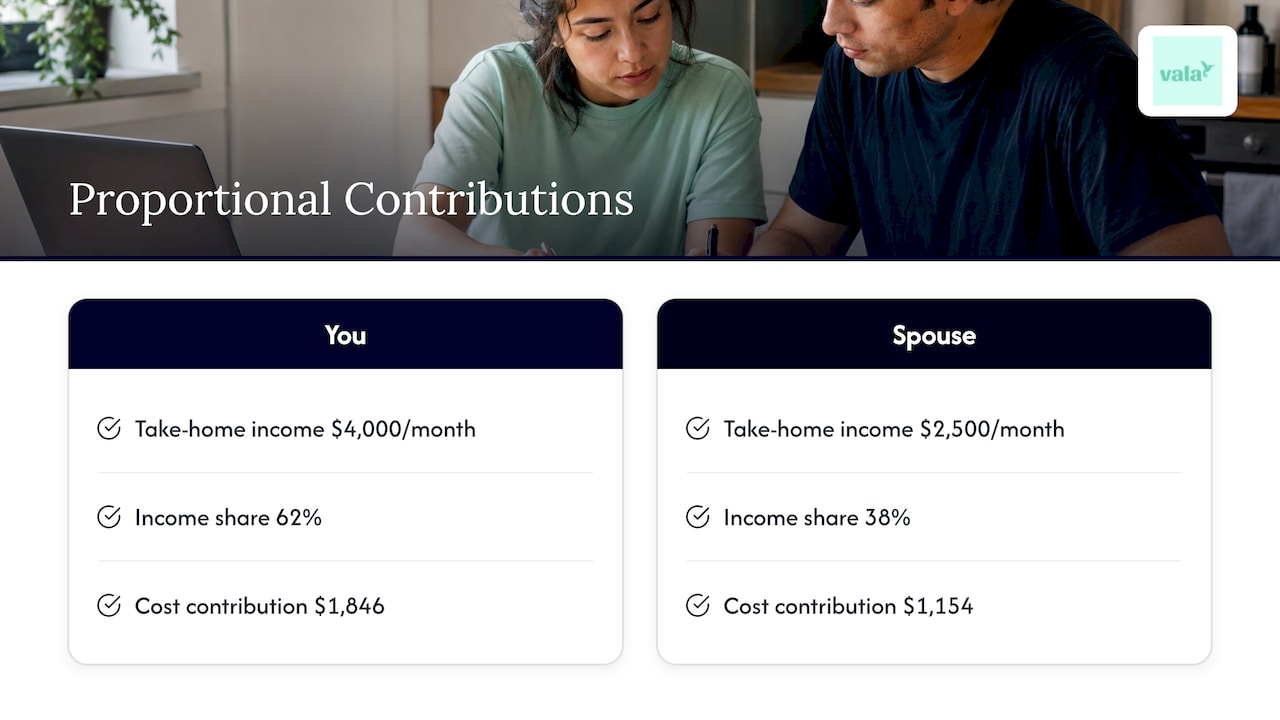
Say your take-home pay is $4,000 a month and your spouse’s is $2,500. Together that is $6,500, so you earn about 62% and your spouse about 38%. If shared costs are $3,000 a month, you would put in about $1,846 and your spouse about $1,154. (These numbers are an illustration, not a recommendation.) What is left stays in each person’s own account for personal spending.
If you want to avoid doing this math every month, a split bills app can track who owes what for shared costs.
Deciding what goes in the joint account
A simple rule: the joint account pays for what you both agreed is shared. Everything else is personal.
- Usually shared: rent or mortgage, utilities, groceries, insurance, transportation, shared subscriptions, savings goals.
- Usually personal: hobbies, gifts, personal care, nights out with friends, and anything either of you wants to buy without explaining it.
This balance matters. For ideas on how couples keep some spending separate, see why couples keep some spending separate. To understand the mechanics, what a shared budget is and how it works covers common methods.
Also agree on an account floor, a minimum balance you keep in the joint account, and a spending threshold above which you check with each other first. U.S. Bank recommends agreeing on spending categories and an account floor, and, preferably, a separate joint emergency fund in a high-interest savings account.
Handling debt, credit and spending-style differences
Different spending habits are normal. The goal is a plan both of you can live with.
Debt. Be open about every balance, including student loans and credit cards. Decide together who pays what and how existing debts will be addressed. The FDIC lists this as one of the key agreements to reach.
Credit. Getting married does not by itself merge your credit reports, but joint accounts and joint loans link you financially. Review both reports so you know what lenders will see.
Liability for debts. Who is responsible for a debt depends on your state. A Baylor law review explains that marital-property and creditor outcomes vary by state, the type of debt, when it was incurred and each spouse’s involvement. If one of you has significant debt or a business, speak with a family or estate attorney in your state before you merge assets.
Spending style. If one of you is a saver and the other a spender, personal allowances help. Each person has guilt-free money, and the joint account stays on track.
Joint accounts: what to know before you open one
Joint accounts bring transparency, and they also bring shared access. A bank’s guidance on joint accounts notes that holders can generally view transactions, withdraw funds and close the account, so opening one takes a high level of trust. The same source notes that joint access can be useful during an emergency or after a partner’s death.
Practical tips for using a joint account well:
- Name the purpose of each account, such as bills, savings or travel.
- Turn on balance and low-funds alerts for both of you.
- Keep your own emergency cushion in an account only you control if you want extra security.
- Document how you would divide the account if your situation changed.
Safeguards that keep both of you secure
Merging works best with a few habits built in.
- Monthly or quarterly check-ins. A bank guide recommends comparing spending with the budget, discussing big upcoming expenses, reviewing savings progress and adjusting the plan. Keep them to 30 minutes and put them on the calendar.
- An emergency fund. Build it jointly, and aim for a size you both feel comfortable with.
- Updated beneficiaries and documents. U.S. Bank says that, at minimum, adults should have a will, a healthcare directive and a financial power of attorney, and newly married spouses should update beneficiaries and estate documents. An estate planning attorney can tailor these to your state.
- Personal spending money. It reduces friction and keeps the joint account focused.
Our perspective
We built Vala around a simple observation: most money tension in a marriage is not about big decisions. It comes from small, recurring things that nobody is watching, like a forgotten subscription, a bill that crept up, or a shared dinner nobody settled.
That is why we think merging finances should start with visibility. When you can both see recurring charges, upcoming bills and shared expenses in one place, the conversation shifts from “who spent that?” to “what do we want to do with this?”
Vala is designed to find hidden money leaks, review recurring subscriptions, remind you about upcoming bills and connect shared expenses to a single budget view. It uses secure bank integration through Plaid. You decide how much to share, so a hybrid setup with joint and personal money works just as well as a fully merged one.
Our advice: do not wait for the perfect system. Pick a structure, automate what you can, and review it together regularly.
SaverStride
Find leaks before you merge
One smart move before you combine accounts is to see what you are both actually paying for. Two people often carry overlapping streaming services, gym memberships and app subscriptions. Merging without a review means you may carry both sets forward.
Vala’s Money Leak Check looks for hidden recurring charges and unexpected bill spikes so you can decide what to keep, cancel or share. Our SaverLite plan is $2.99 per month, and SaverPro is $5.99 per month. You can also start with the Money Leak Check.

If you want to dig in first, try our subscription cost calculator or see how to find hidden recurring charges. Once you are ready to share the budget, our budget app for couples lets you track shared expenses and goals together, and the guide to a budget app for newlyweds covers the first months of married life.
A simple first-month timeline
If the ten steps feel like a lot, here is a way to spread them out.
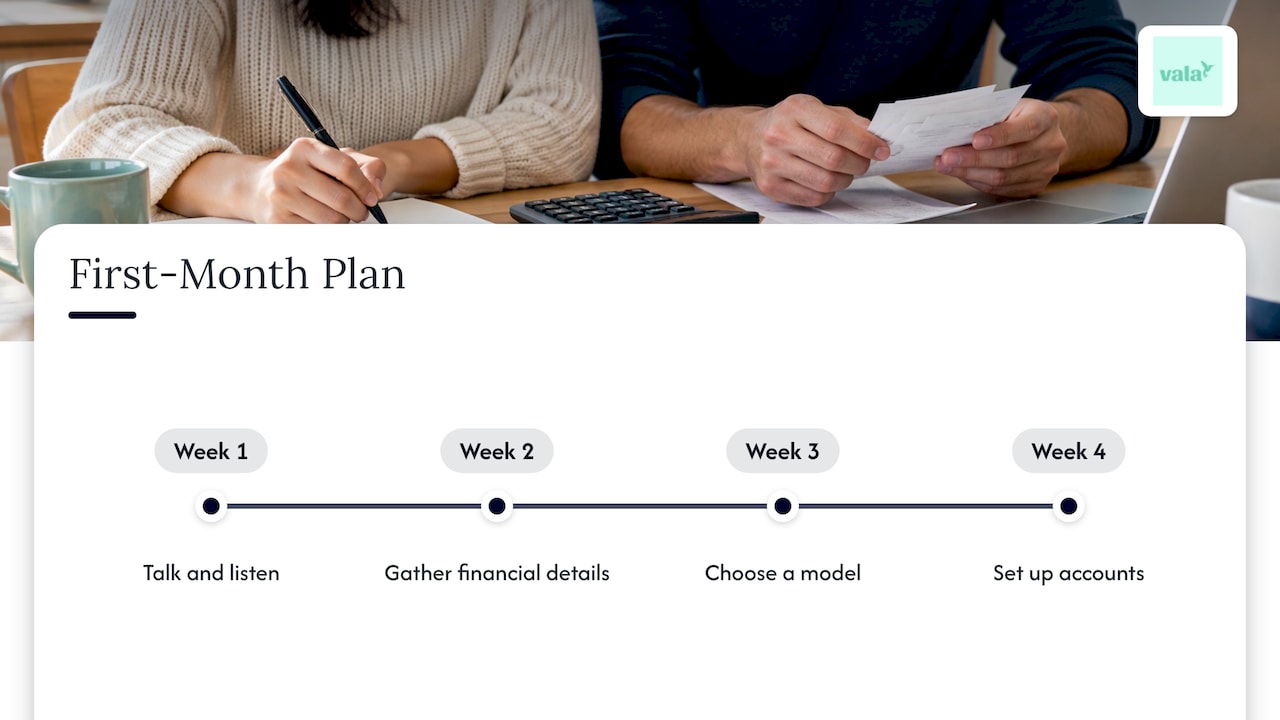
Week 1: Talk. Sit down with coffee, not a spreadsheet. Share income, debts, goals and worries. Agree on nothing yet, just listen.
Week 2: Gather. Pull your statements and list recurring bills and subscriptions. Check credit reports. Decide which expenses are shared.
Week 3: Decide. Choose a model (merged, hybrid or separate) and a contribution method (equal, proportional or by bill). Set personal allowances.
Week 4: Set up. Open any joint accounts, move over the agreed amounts, automate bills and savings transfers, and book your first check-in. Add a reminder to update beneficiaries and look at wills and powers of attorney.
After that, treat the system as adjustable. A raise, a new baby, a move or a job change are all good reasons to revisit your numbers.
FAQ
Do married couples have to combine their finances?
No. The FDIC encourages couples to discuss whether to use individual accounts, joint accounts or a combination, and to agree on which accounts pay recurring expenses or hold savings. Many couples start with a hybrid setup and adjust over time.
Should I combine finances before or after the wedding?
Talk about money before the wedding, then make account changes when you are both ready. Sharing income, debts and credit scores first means the actual merging is a set of agreed steps instead of a surprise. There is no deadline for opening joint accounts.
What if one of us earns much more?
Consider paying shared costs in proportion to income instead of splitting 50/50. The FDIC gives an example of a 60% and 40% split. Each person then keeps the remainder for personal spending and individual goals.
How often should we review our finances together?
Monthly or quarterly works for most couples. Use the time to compare spending with your budget, look at upcoming large expenses, check savings progress and adjust the plan.
Sources
- Saying “I Do” to Sharing Finances, FDIC
- Personal Finance for Couples: Managing Joint Finances, California DFPI
- How to combine finances with your partner, NPR
- Should you combine finances after marriage?, Fidelity
- Married couples who merge finances may be happier, ScienceDaily
- How much do you need to know about how your spouse spends money?
- How to Combine Finances After Marriage: Your 10 Step Plan, TD
- How to Combine Finances After Marriage, U.S. Bank
- Joint bank account: Should my partner and I get one?, Truist
- Separate Property or Community Property: An Introduction, Baylor Law