Build your trip budget around eight categories: transport, accommodation, food and drink, local transport, activities, travel essentials, shopping and extras, plus a buffer of about 10 to 15% of the total. Estimate each one before you leave, then log every purchase in an app or shared tracker as it happens. That single habit is what separates a trip that stays on budget from one that quietly bleeds cash.
TL;DR:
- Accurate budget estimates should include separate categories for groceries and restaurant meals to track daily spending habits more transparently.
- Use a buffer of 10 to 15 percent to cover unexpected costs like taxis or currency fluctuations, especially in unfamiliar destinations.
- Decide group expense splits in advance with methods such as equal, itemized, or room-based to prevent disagreements and simplify settling up.
- Logging expenses in real-time with an automated app helps avoid post-trip confusion and reduces the risk of overspending or forgotten costs.
- Fixed costs like flights, accommodation, insurance, and visas should be locked in early, while flexible expenses like food and activities can be estimated more loosely.
Table of Contents
- What Are the Main Travel Expense Categories?
- How Do You Estimate Each Travel Budget Category?
- How Should Couples and Groups Split Travel Costs?
- What’s the Best Way to Track Travel Expenses on the Go?
- Why Category Discipline Changes How a Trip Actually Feels
- Plan, Track, and Split Your Trip Budget With Vala
- Sources
- FAQ
What Are the Main Travel Expense Categories?
Every dollar you spend on a trip falls into one of a handful of buckets. Get the categories right and the math takes care of itself.
Transportation splits into two parts people often lump together. Your main transport is the flight, train, or long drive that gets you there. Separate from that is transport-to-departure: parking at the airport, the ride to the station, or a shuttle. Checked baggage fees belong here too, and on budget airlines that fee can rival the ticket price itself.
Accommodation is rarely just the nightly rate you see on the booking screen. Add platform service fees, then check for city or resort taxes, which many destinations charge per person, per night, on top of the listed price. A $100-a-night room can land closer to $115 once fees clear.
Food and drink works best split into two lines, not one. Groceries and quick lunches behave like a daily habit; sit-down restaurant meals behave like a splurge. Tracking them separately shows you exactly where a food budget actually goes.
Local transport covers everything that moves you around once you’ve arrived: metro or bus passes, rideshare fares, rental car fuel, and tolls. This category gets ignored in planning and then quietly becomes one of the bigger daily costs on the ground.
Activities and attractions is the fun bucket, but it needs its own line so it doesn’t disappear into “extras.”
Travel essentials cover the boring purchases that protect the trip: travel insurance, visa fees, and an eSIM or roaming plan for connectivity. Guides on smart travel budgeting flag insurance, connectivity, and visas as the lines travelers most often forget, right up until they need them.
Shopping, souvenirs, and tips round things out, and this is where a firm buffer matters most.
- Transportation: flights/trains, airport transfer, parking, checked baggage
- Accommodation: nightly rate, service fees, city/resort tax
- Food and drink: groceries, restaurants, coffee and snacks
- Local transport: transit passes, rideshare, fuel, tolls
- Activities: tours, tickets, museum passes
- Travel essentials: insurance, visas, eSIM/roaming
- Shopping and extras: souvenirs, gifts, tips
Pro Tip: Set up your categories in your tracker before the trip, not during it. Naming them in advance takes thirty seconds and saves you from dumping everything into a vague “miscellaneous” pile once you’re actually traveling.
How Do You Estimate Each Travel Budget Category?
Two methods work well, and you can combine them. The first is a category-first template: you fill in every line above using real prices before you go. The second is anchor-and-float, where you separate fixed costs from daily flexible ones so the budget feels realistic instead of restrictive.
- List your fixed costs first. Flights, accommodation total, insurance, and visas rarely change once booked, so lock those numbers in early.
- Set a daily food anchor. Check average restaurant and grocery prices for your destination, then multiply by trip length.
- Estimate activities conservatively. Price two or three “must-do” experiences and assume the rest will cost less.
- Add local transport as a small daily line, not an afterthought.
- Apply your buffer last, once every other category is filled in.
Combining fixed and flexible costs into daily anchors is exactly how practical travel templates turn a vague trip idea into a number you can actually track against.
Buffer sizing isn’t arbitrary. A 10 to 15% contingency covers the taxi you didn’t plan for or the exchange rate that moved against you.
Once every category has a number, divide by trip length and travelers. Say a couple budgets $2,400 total for a 6-day trip. That’s $400 per day for two people, or $200 per person, per day. Compare that daily figure against destination examples like the lean, mid, and comfort tiers many guides publish, and you’ll know quickly whether your number is realistic or optimistic.
How Should Couples and Groups Split Travel Costs?
Decide what’s shared and what’s personal before anyone books anything. A five-minute conversation before the trip prevents a tense one during it.
Run through this checklist as a group:
- Which costs are shared by default (lodging, group meals, transport)?
- Which are personal (souvenirs, individual activities, drinks)?
- Who’s fronting large upfront payments, like a nonrefundable rental deposit?
- What split method will you use?
Three splitting methods cover almost every situation. Equal split works when everyone eats, sleeps, and does the same activities. Itemized split works when spending is uneven, so each person only pays for what they actually used. Room-based split works when one person books a suite and others share a standard room. Charging everyone the same rate in that case isn’t fair, so weight the accommodation line by actual room cost.
Log the first shared expense the moment it happens, not at the end of the trip. Waiting even a day makes it harder to remember who covered what, and starting to track immediately is consistently the advice that prevents post-trip arguments over money.

Pro Tip: If one person pays for something big, like a group dinner or a shared Airbnb, don’t wait to “figure it out later.” Log it right away and let the group settle up once, at the end, with a single net transfer instead of five separate reimbursements. For more structure on setting this up before you fly, see how to organize group expense categories ahead of a trip.
What’s the Best Way to Track Travel Expenses on the Go?
Log every purchase the moment it happens, then do a two-minute nightly reconciliation to catch anything you missed. That combination beats trying to remember six days of spending on the flight home.
Look for these features in whatever app or spreadsheet you use:
- Shared expense logging with automatic per-person splits
- Category tagging that matches the framework above
- Bank or card auto-imports so you’re not typing every receipt
- Multi-currency support if you’re crossing borders
- Receipt photo storage for anything you might need to dispute later
Keep your categories consistent across the whole trip. If you tag one taxi ride as “local transport” and another as “misc,” your totals stop meaning anything. Automation helps here: apps with built-in rules and AI-driven insights can auto-tag recurring charges and flag categories running hot before you’re three days into overspending on food.
| Method | Best for | Main tradeoff |
|---|---|---|
| Spreadsheet | Solo trips, simple math | Manual entry, no auto-split |
| Shared-expense app | Couples and groups | Needs setup time upfront |
| Bank export + manual sort | Post-trip review only | No real-time visibility |
A spreadsheet works fine for a solo trip with no splitting involved. The moment more than one wallet is paying for things, an app built for shared travel earns its keep by handling automatic splits and real-time balances instead of leaving that math for the flight home. For daily habits that make this stick, this guide to expense logging covers the nightly-reconciliation routine in more detail.
Why Category Discipline Changes How a Trip Actually Feels
The biggest mistake travelers make isn’t overspending. It’s spending without knowing where the money went, which turns a normal trip into a stressful guessing game at checkout.
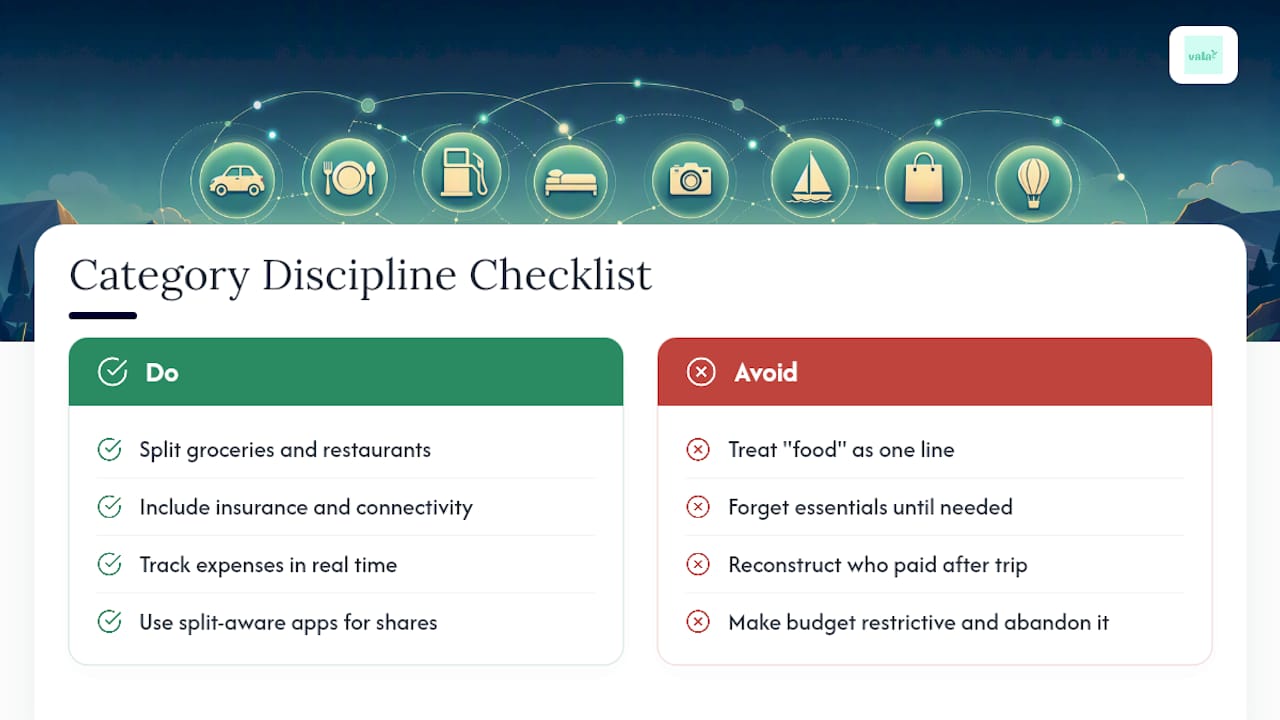
Most groups get the categories wrong from the start by treating “food” as one line instead of splitting groceries from restaurant tabs, and by forgetting travel essentials like insurance and connectivity until they’re already needed. Real-time tracking fixes half the problem. Split-aware apps fix the other half, because they remove the awkward post-trip math session where someone has to reconstruct who paid for what across six days and three cities.
Treating accommodation as your fixed anchor and letting food and activities float within a daily range keeps a budget realistic instead of restrictive. That’s the difference between a framework you actually follow and one you abandon by day three.
— SaverStride
Plan, Track, and Split Your Trip Budget With Vala
Vala turns everything above into something you don’t have to build from scratch. Instead of juggling a spreadsheet and three group chats about who owes what, you get category templates already set up for transport, accommodation, food, activities, and essentials, plus automatic splits that update in real time as your group spends.

Import your bank transactions and Vala sorts them into categories automatically, so you’re not typing every coffee and taxi ride by hand. Invite your travel companions, agree on your split method, and watch balances settle themselves as the trip goes instead of on the flight home. If you want to see how the categories and splitting actually work before you commit to a full trip, start with the personal finance app and set up your first trip budget today.
Sources
Cross-check your category estimates against real-world cost data before you finalize a number.
- Travel Budget Categories + Template | 2Wander
- Free Travel Budget Template 2026: Plan & Track Trip Costs
- Travel Budget Categories List 2026 Guide | TravelDeck
- How to Split Expenses on a Group Trip (Without the Awkward Conversations)
- How to travel on a budget | Investopedia
FAQ
What Are the Main Travel Expense Categories?
The core categories are transportation, accommodation, food and drink, local transport, activities, travel essentials, shopping and extras, and a contingency buffer.
How Big Should My Travel Budget Buffer Be?
Most guides recommend a 10 to 15% buffer on top of your total estimate, leaning toward 15% for first-time destinations or trips with many connections.
How Do I Split Travel Costs Fairly in a Group?
Decide shared versus personal costs before you leave, then use equal, itemized, or room-based splitting depending on how evenly spending is distributed across the group.
Should Groceries and Restaurants Be the Same Category?
No. Tracking groceries separately from restaurant spending under food and drink shows you far more clearly where your daily budget is actually going.
What’s the Easiest Way to Track Shared Travel Expenses?
Log every shared purchase immediately using an app with category tagging and automatic splitting, like Vala, rather than trying to reconstruct spending from memory at the end of the trip.