
Most people assume saving with others is complicated, risky, or awkward. The truth is the opposite. A group savings goal gives you built-in accountability, shared motivation, and a much faster path to the things you actually want, whether that’s a group trip to Europe, a shared holiday fund, or a big event you’ve been planning for months. This guide breaks down exactly what group savings goals are, how different collaborative savings plans work, and how to set one up that actually sticks.
Table of Contents
- Key takeaways
- What is a group savings goal
- How to set group savings goals that actually work
- Rotating circles vs pooled savings: a comparison
- Using digital tools to manage group savings
- Common challenges and how to handle them
- My take on group savings goals
- Start tracking your group savings with Valapoint
- FAQ
Key takeaways
| Point | Details |
|---|---|
| Group savings defined | A group savings goal is a shared, specific financial target with scheduled contributions from all members. |
| Rules matter most | Clear rules around contributions, due dates, and missed payments prevent conflict and keep the group on track. |
| Two main models | Rotating payout circles and pooled sinking funds serve different goals. Choose based on your group’s timeline and trust level. |
| Automate contributions | Converting your goal into a formula (goal ÷ months left) and automating payments dramatically increases success rates. |
| Digital tools help | Apps with transparent tracking and reminders reduce disputes and keep every member engaged and accountable. |
What is a group savings goal
A group savings goal is a shared, specific financial target that a defined group of people work toward together through scheduled, regular contributions. Think of it as a collective commitment. Everyone agrees on the purpose, the amount each person contributes, and the timeline. Savings clubs are one of the most common structures, where members make regular deposits toward a shared expense like a group vacation or holiday fund.
There are two broad types of group savings systems you’ll encounter.
- Savings clubs: Members contribute regularly into a shared account. The money accumulates and is either distributed for a specific purpose or used collectively when the goal is reached. Savings clubs often offer higher interest than regular accounts and use withdrawal penalties to keep members committed.
- Rotating savings circles (ROSCAs): Members pool contributions each cycle, and one member receives the full pot in rotation. Members take turns receiving payouts until everyone has received their share. This model is common in many cultures under names like “susu,” “chit fund,” or “tanda.”
Both models work for goals like group travel, event planning, or shared holiday expenses. The key difference is whether the group saves toward one collective moment or each member gets a lump sum at different points in time. Understanding this distinction is the first step in figuring out which approach fits your group best.
How to set group savings goals that actually work
Setting up a group savings goal is less about trust and more about structure. Groups with clear goals and explicit rules consistently outperform those relying on informal social pressure. Here’s how to build that structure from the start.
- Define the purpose clearly. Is this for a trip to Mexico in October? A shared birthday party fund? A holiday gift pool? The more specific the goal, the easier it is for everyone to stay motivated.
- Set the contribution amount. A practical starting point is the 5 to 10% of monthly take-home pay rule. This keeps contributions affordable without slowing progress.
- Agree on group size. Smaller groups (4 to 8 people) tend to have fewer coordination problems and higher trust levels.
- Lock in a schedule. Weekly, biweekly, or monthly. Pick one and stick to it. Inconsistency is where most groups fall apart.
- Set a due date with a short grace period. Exact due dates with a 24 to 48 hour grace period help prevent conflicts by giving everyone a shared, objective definition of “late.”
- Write down the consequences for missed payments. This sounds formal, but it protects everyone. Decide in advance whether late members pay a small penalty, skip their payout turn, or are removed after a set number of missed contributions.
Pro Tip: Put your group rules in writing and share them in a group chat or shared document before anyone contributes a single dollar. Verbal agreements fade. Written ones hold.
The benefits of group savings go beyond just the money. When everyone knows the rules upfront, the social awkwardness of chasing someone for a missed payment disappears. The rule does the work, not the friendship.
Rotating circles vs pooled savings: a comparison
Choosing the right group saving strategy depends on your group’s goal, timeline, and how well members know each other. Here’s a clear breakdown of both models.
| Feature | Rotating savings circle (ROSCA) | Pooled sinking fund |
|---|---|---|
| How it works | Members contribute each cycle; one person receives the full pot in rotation | All contributions accumulate in one shared account until the goal is reached |
| Best for | Individual financial needs at different times | A single shared goal like a trip or event |
| Trust requirement | High. Early recipients receive an advance on others’ future contributions | Moderate. Funds stay pooled until the goal date |
| Risk level | Higher if a member exits early | Lower when funds are held in a regulated account |
| Timeline | Ends when all members have received a payout | Ends when the savings target is reached |
| Ideal group size | 5 to 15 members | 2 to 10 members |
Rotating savings circles require high trust because there is no bank regulation protecting members. If someone receives an early payout and stops contributing, the remaining members absorb that loss. This is why ROSCAs work best among people with strong existing relationships.
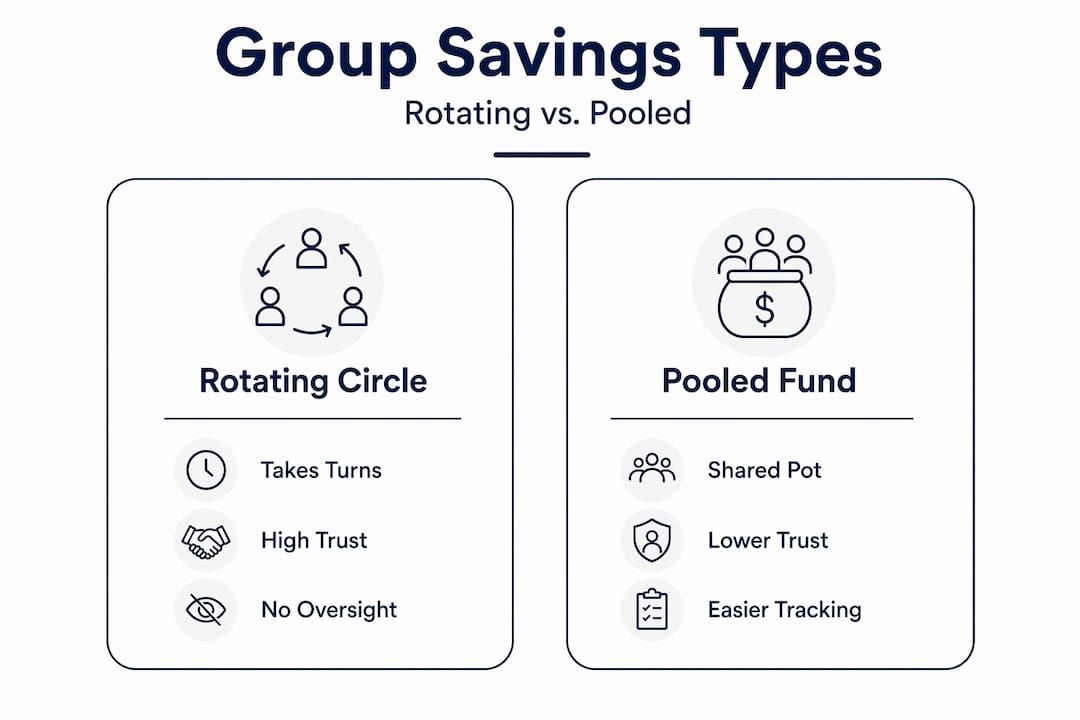
Pooled sinking funds, on the other hand, work like a planned savings approach where the group sets aside small, regular amounts toward a known future cost. This model is lower risk and easier to manage digitally, making it the better choice for most friend groups or colleagues saving for a shared experience.

Pro Tip: If your group is new or mixed in terms of financial habits, start with a pooled sinking fund. It’s easier to manage, lower risk, and builds the trust you’d need before ever trying a rotating model.
Using digital tools to manage group savings
Technology has made collaborative savings plans far easier to run. You no longer need a spreadsheet, a designated treasurer, or awkward group texts asking who paid what. Modern apps handle the tracking, reminders, and contribution scheduling automatically.
Here’s what to look for in a group savings app:
- Automated contributions: Automating savings transfers and setting measurable, timed targets significantly increases the likelihood of reaching your goal. Set it and forget it.
- Transparent tracking: Every member should be able to see the current balance, who has contributed, and how far the group is from the goal. Transparency kills disputes before they start.
- Reminders and notifications: Scheduled reminders reduce the chance of missed contributions without anyone having to personally chase a group member.
- Expense splitting: If your group is also sharing costs during the savings period (like booking deposits or event tickets), a built-in split bills feature keeps everything in one place.
- Progress visualization: A visual progress bar toward the goal keeps motivation high. Seeing the number move is more motivating than a spreadsheet cell.
Converting your goal into a formula (total goal ÷ months remaining ÷ number of members) and automating that exact amount each month is the single most effective thing your group can do. Vague savings plans fail. Timed, formulaic ones succeed.
When choosing an app, check for privacy policies, any fees for group features, and whether the platform is backed by a regulated financial institution or a trusted fintech provider. You can compare options using a finance app guide to find what fits your group’s needs.
Common challenges and how to handle them
Even well-structured groups hit bumps. Knowing what to expect makes it easier to handle problems without damaging relationships.
- Missed contributions: Address these immediately using the rules your group agreed on. Don’t let one missed payment slide without acknowledgment. It sets a precedent.
- Unequal participation: If some members contribute more enthusiasm than money, revisit the contribution amount. It may be set too high for some members’ budgets.
- Communication gaps: Use a dedicated group chat or app channel strictly for savings updates. Mixing savings reminders with general conversation leads to things getting buried.
- Goal drift: Groups sometimes lose focus when the goal feels far away. Keep the goal visible. Pin a photo of the destination or event in your group chat. Make it real.
- Member exits: Decide in advance what happens if someone needs to leave the group. Can they be replaced? Do they forfeit contributions? Having this written down prevents major conflict.
Pro Tip: Schedule a brief monthly check-in, even just five minutes, where the group reviews the balance and confirms the next contribution date. Consistency in communication keeps momentum alive.
Adapting your rules as the group evolves is not a failure. It’s good management. If your timeline shifts or a member’s financial situation changes, revisit the plan together rather than letting tension build quietly.
My take on group savings goals
I’ve seen group savings goals work brilliantly and fall apart completely. The difference almost never comes down to money. It comes down to clarity and communication.
What I’ve learned is that people underestimate how much a written rule protects a friendship. When you have to personally remind a friend they owe money, it strains the relationship. When a shared document does it, the awkwardness disappears. The rule is the messenger, not you.
I’ve also noticed that groups focused on exciting, visible goals stick together longer. Saving for a trip to Japan with six friends is far more motivating than a vague “let’s save more” plan. The goal has to feel real and worth the discipline.
My honest caution: be selective about who you save with. Financial habits are deeply personal. Joining a group savings goal with someone who has a history of unreliable financial behavior puts your money and your relationship at risk. Choose people whose commitment level matches yours.
The broader benefit of group savings that most people miss is financial inclusion. For people who struggle to save alone, a group structure provides the external accountability that makes saving possible. That’s not a small thing. That’s life-changing for a lot of people.
Keep your goals visible, your rules clear, and your group small enough that everyone feels accountable.
— SaverStride
Start tracking your group savings with Valapoint
If you’re ready to put a group savings goal into action, Valapoint’s tools make it straightforward to set up, track, and manage your shared plan.

With Valapoint’s budget goal tracker, you can set a specific savings target, assign a timeline, and watch your progress update in real time. The split bills app keeps shared expenses transparent so no one is left guessing who paid what. And if you want a full picture of your group’s financial habits, Valapoint’s personal finance tools give you calculators and trackers built for exactly this kind of collaborative planning. No spreadsheets. No confusion. Just a clear path to your shared goal.
FAQ
What is a group savings goal?
A group savings goal is a shared, specific financial target that a defined group of people work toward together through regular, scheduled contributions. Common examples include saving for group travel, events, or holiday expenses.
How do joint savings goals differ from personal savings?
Joint savings goals involve multiple people contributing toward one shared target, while personal savings are managed by one individual. The benefits of group savings include shared accountability, faster progress, and built-in motivation from the group.
What are the best group saving strategies?
The two most effective group saving strategies are rotating savings circles (ROSCAs), where members take turns receiving the pooled amount, and sinking fund pooling, where everyone contributes until a shared goal is reached. Automating contributions and setting clear rules improve success in both models.
How much should each person contribute to a group savings goal?
A practical guideline is 5 to 10% of monthly take-home pay per member. This keeps contributions sustainable while making meaningful progress toward the goal.
What happens if someone misses a contribution?
Your group should agree on consequences before saving begins, such as a small penalty, a skipped payout turn, or removal after repeated misses. Clear, objective rules set in advance prevent conflicts and protect relationships.