
A personal savings goal is a specific, measurable financial target you set for yourself, with a defined amount and a deadline to reach it. Most people intend to “save more money” without ever getting specific. That vague intention rarely leads anywhere. When you know exactly what you’re saving for, how much you need, and when you need it, saving stops feeling like a chore and starts feeling like progress. This guide breaks down what a personal savings goal really means, why it matters more than most people realize, and how to build a personal savings plan that you’ll actually stick to.
Table of Contents
- Key takeaways
- What is a personal savings goal?
- Why savings goals actually change your behavior
- How to set savings goals using the SMART framework
- Practical ways to actually reach your goals
- My honest take on saving consistently
- Start saving smarter with Valapoint
- FAQ
Key takeaways
| Point | Details |
|---|---|
| Define what you’re saving for | A goal without a specific purpose and amount rarely produces consistent saving behavior. |
| Use the SMART framework | Goals that are specific, measurable, achievable, relevant, and time-bound are far more likely to succeed. |
| Automate your transfers | Setting up automatic transfers removes willpower from the equation and builds savings as a habit. |
| Cover your emergency fund first | An emergency fund is the foundation that protects every other goal from unexpected setbacks. |
| Track progress regularly | Reviewing your goals monthly keeps you engaged and allows you to adjust before you fall too far behind. |
What is a personal savings goal?
A personal savings goal is a clear financial target tied to a specific purpose, amount, and timeline. It answers three questions: What am I saving for? How much do I need? When do I need it?
Without those three answers, you’re not setting a goal. You’re making a wish.
Goals generally fall into three time horizons. Knowing which category your goal fits into helps you plan the right monthly contribution and choose the right account type.
Short-term savings goals (under one year):
- Emergency fund starter ($1,000 to $2,000)
- A vacation or trip
- Holiday or gift spending
- New phone or laptop
Medium-term savings goals (one to five years):
- A car down payment
- A wedding fund
- Home repairs or renovations
- Relocation costs
Long-term savings goals (five or more years):
- A home down payment
- Children’s college fund
- Early retirement contributions
- Investment seed money
Here’s a quick comparison to keep the categories straight:
| Time Horizon | Typical Examples | Where to Keep It |
|---|---|---|
| Short-term (under 1 year) | Emergency fund, vacation, new tech | High-yield savings account |
| Medium-term (1 to 5 years) | Car, wedding, home renovation | High-yield savings or money market account |
| Long-term (5+ years) | Home down payment, retirement, college fund | Investment or retirement accounts |
The reason defining your goal matters this clearly is that dedicated accounts increase goal clarity, keeping your progress visible and reducing the temptation to spend money earmarked for something specific.
Why savings goals actually change your behavior
You might be thinking that setting a goal is obvious and common sense. Here’s what makes it more than that: goals change the way your brain relates to money. A stated purpose turns a dollar amount into something meaningful.

Research confirms this. Specific long-term savings goals significantly increase the likelihood of disciplined saving, with statistical significance strong enough to rule out chance. When you know the goal is real, your spending decisions shift without you having to force them.
There’s also the problem most people don’t acknowledge: 30% of U.S. adults cannot cover three months of basic expenses. That’s not a budgeting problem alone. It’s often the result of never setting a concrete goal to build that cushion.
“Financial goals aligned with personal values sustain motivation better than generic goals.” Savings Goals: How to Set and Actually Hit Them
The psychological barrier isn’t laziness. It’s vagueness. When a goal lacks a specific number or deadline, your brain treats it as optional. You end up relying on monthly willpower to transfer money, and willpower is the least reliable financial tool available.
That’s exactly where the SMART framework comes in.
Pro Tip: When writing down your goals, attach a reason to each one. “Save $5,000 for an emergency fund by December so I never have to go into debt for a car repair” works far better than “save more money.” The reason sustains the habit when motivation dips.
How to set savings goals using the SMART framework
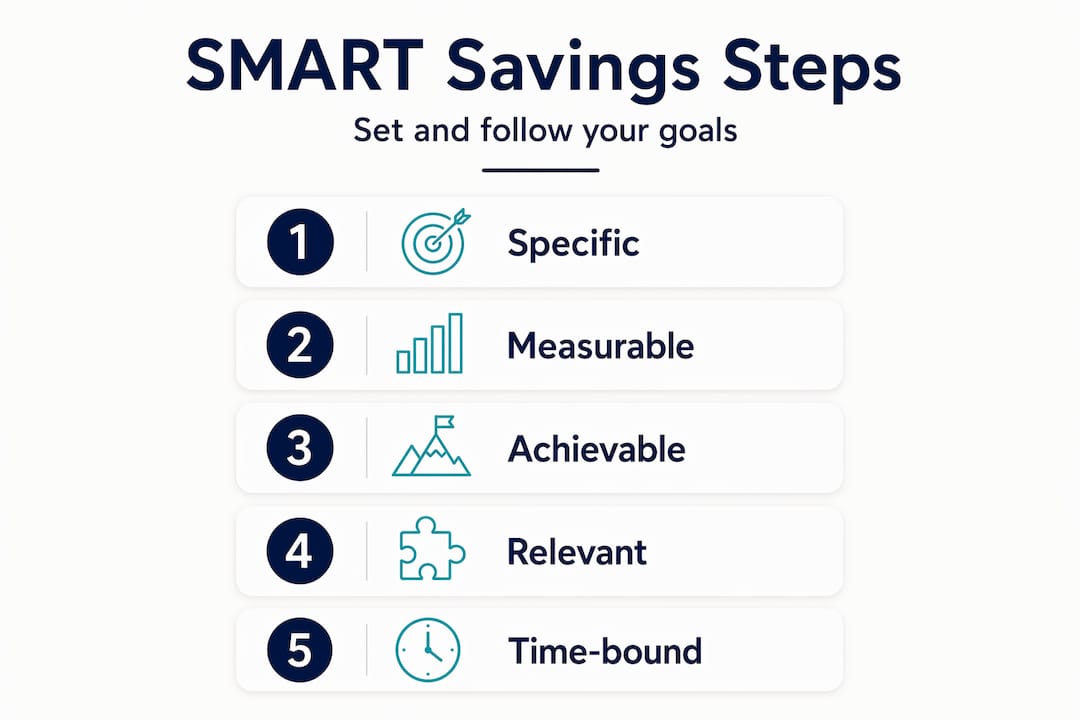
SMART stands for Specific, Measurable, Achievable, Relevant, and Time-bound. It was originally designed for business goals, but it applies directly to personal finance. Here’s how each component works in practice:
- Specific: Name the goal clearly. Instead of “save for a vacation,” say “save $3,000 for a trip to Mexico in September.”
- Measurable: Attach a dollar amount. This gives you a way to track progress and know when you’ve succeeded.
- Achievable: Calculate how much you need to save per month based on your actual income and expenses. Saving $3,000 in six months means $500 per month. Check your budget to confirm that’s realistic before committing.
- Relevant: The goal should connect to what matters to you. A goal that doesn’t reflect your real priorities will be the first one you abandon. Goals aligned with personal values consistently outperform generic financial targets.
- Time-bound: Set a specific date. Deadlines create a sense of urgency that keeps saving from slipping down your priority list.
The SMART framework for savings works because it forces you to confront whether a goal is actually realistic before you start, which prevents the frustration of falling short later.
A common mistake when applying this framework is ignoring your current baseline. Before setting a monthly savings target, look at three months of actual spending. Identify what’s flexible and what isn’t. Your goal should be ambitious but grounded in your real numbers.
Pro Tip: Try using a budget goal tracker to assign a monthly contribution to each specific goal. Seeing all your goals in one place makes it far easier to prioritize and avoid over-committing to too many goals at once.
Practical ways to actually reach your goals
Knowing what to save for is step one. The harder part is building a system that keeps you saving month after month without burning out. These strategies address that directly.
Automate your transfers. Savings goal transfers timed after payday leverage the moment when your account balance is highest and temptation to overspend is lowest. Set up a recurring transfer for the day after your paycheck lands. You won’t miss money you never touched.
Only 43% of adults believe they’ll stick to their financial resolutions. Automation explains the gap between those who hit goals and those who don’t. It removes the monthly decision entirely.
Open dedicated accounts for each goal. One savings account blurs the lines between goals and makes it easy to rationalize dipping into funds meant for something else. Name each account after its purpose: “Mexico Trip,” “Car Down Payment,” “Emergency Fund.” Visibility creates accountability.
Avoid the emergency fund trap. Building an emergency fund first is the right move. But once that fund is solid, some savers stop there. That’s a mistake. The ‘emergency fund trap’ occurs when people park everything in low-yield savings after reaching basic reserves, missing out on growth from investing or higher-yield accounts.
Here’s a useful reference for picking the right strategy at each stage:
| Savings Stage | Strategy | Tool or Account |
|---|---|---|
| Starting out | Build emergency fund first | High-yield savings account |
| Intermediate | Automate goal-specific transfers | Named savings accounts |
| Advanced | Shift surplus to investments | Brokerage or retirement accounts |
| Ongoing | Track and review monthly | Savings tracking app |
Use habit stacking. Habit stacking and automated transfers turn saving from a conscious decision into a background routine. Pair your savings transfer with something you already do automatically, like paying a monthly bill, so it fits into your existing behavior patterns.
Finally, tracking progress visually through apps or named accounts creates the kind of engagement that keeps you motivated between milestones. Seeing a progress bar move from 40% to 65% toward your vacation fund feels rewarding. That reward keeps the habit alive.
If you want a deeper look at tools that can help, check out this guide to budgeting and expense tracking apps for options built around goal-focused saving.
My honest take on saving consistently
I’ve watched plenty of people set detailed savings goals in January and quietly abandon them by March. Not because the goals were wrong, but because the system behind them was built entirely on motivation.
Motivation is real. It gets you started. But it fluctuates. It fades after a stressful week, a big social event, or an unexpected bill. Small, consistent daily habits compound over time in ways that single large efforts never match. A $50 automatic transfer every two weeks quietly builds more wealth than a sporadic $300 transfer whenever you feel inspired.
What I’ve found actually works is treating your savings system the same way you treat your rent. Non-negotiable. Automated. Gone before you can spend it.
The other thing worth saying: don’t wait until your goal is perfectly defined to start. Set a reasonable number, automate a transfer, and refine as you go. Progress is more valuable than perfection. The median American saves closer to $5,000 total, which tells you most people are working with real constraints. Start where you are and build from there.
Review your goals monthly. Not weekly, not annually. Monthly is frequent enough to stay engaged and catch drift early, but not so frequent that it becomes exhausting. Adjust the amount if your income or expenses change. Adapt the timeline if life happens. The goal doesn’t have to be rigid to be effective.
— SaverStride
Start saving smarter with Valapoint
You now know what a personal savings goal is and how to set one that works. The next step is building a system around it.

Valapoint’s Vala app is built exactly for this. With Vala, you can track and plan your savings goals in real time, automate transfers, and get intelligent insights that show you where your money is going. Vala connects your budget to your goals so nothing falls through the cracks. Whether you’re working on an emergency fund, a down payment, or a five-year plan, Vala gives you the clarity and confidence to stay on track without overhauling your lifestyle. Ready to take control of your money?
FAQ
What is a personal savings goal?
A personal savings goal is a specific financial target you set with a clear purpose, a defined dollar amount, and a deadline. It transforms vague intentions like “save more” into a concrete plan you can measure and act on.
How do you set effective savings goals?
Use the SMART framework: make your goal specific, measurable, achievable, relevant, and time-bound. Attach a monthly contribution amount based on your real budget and set up an automatic transfer to stay consistent.
What are good savings goal examples?
Strong savings goal examples include a three-to-six-month emergency fund, a vacation fund, a car down payment, a home down payment, and retirement contributions. Each goal should have a dollar target and a deadline.
How much should I save each month?
Your monthly savings amount depends on your goal total and timeline. Divide the total amount needed by the number of months until your deadline. Then check your budget to confirm the contribution is realistic before automating it.
Why do most savings goals fail?
Most savings goals fail because they’re too vague, rely on monthly willpower, or lack a deadline. Automating transfers right after payday and using dedicated accounts for each goal dramatically improves your chances of success.