
A spending category is a labeled group that organizes related expenses so you can see exactly where your money goes each month. Think of it as a filing system for your finances. Without these labels, your bank statement is just a list of numbers. With them, it becomes a clear picture of your habits. Financial experts recommend starting with 8–12 core categories to keep things manageable without losing detail. Apps like Valapoint use these categories automatically, sorting your transactions the moment they hit your account. The standard industry term for this practice is expense categorization, and it sits at the heart of every effective personal budget.
What is a spending category and why does it matter?
A spending category is defined as any label that groups similar expenses for tracking and analysis. Housing, food, transportation, and entertainment are classic examples. Spending categories transform raw bank statements into readable pictures of where money actually goes, making it far easier to find waste and hit savings targets.

The value is practical, not theoretical. When you know that $600 went to “dining out” last month, you have something to act on. Without a category label, that $600 is buried across dozens of individual transactions at restaurants, coffee shops, and food delivery apps. Categorization turns noise into signal.
Expense categories also connect your daily spending to your bigger financial goals. Categories show where money goes; goals describe why it is allocated. Both are necessary for a budget that actually works. A category without a goal is just accounting. A goal without category tracking is just wishful thinking.
What are the main types of spending categories?
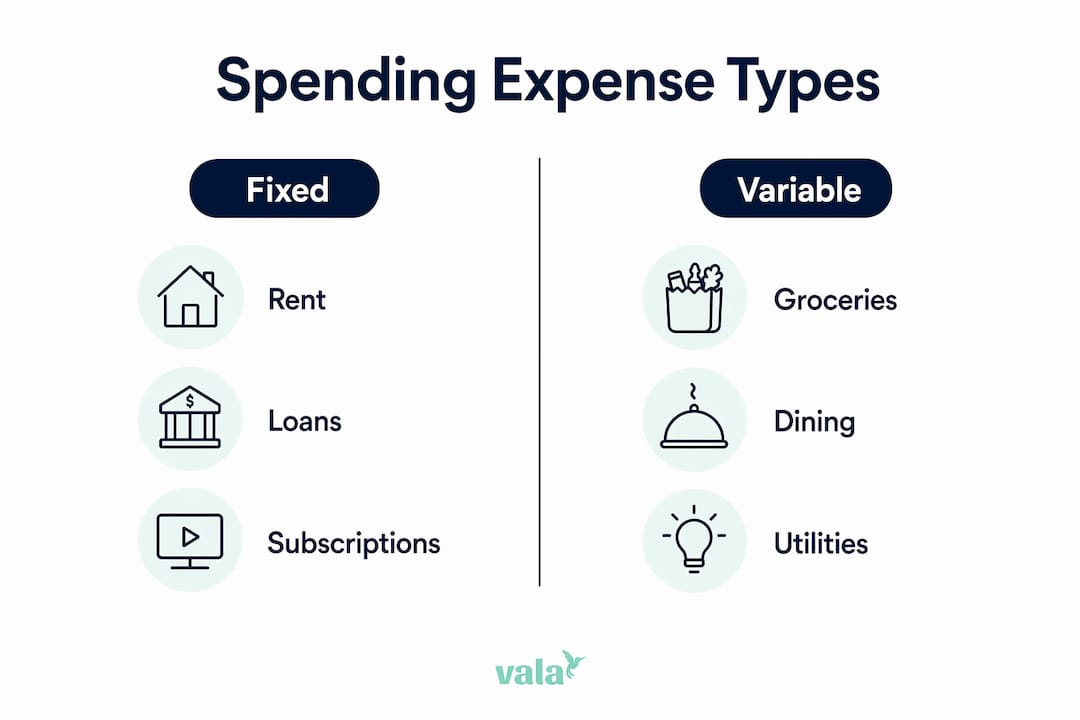
All expenses fall into two primary types: fixed and variable. Understanding the difference shapes how you budget for each one.
Fixed expenses
Fixed expenses stay the same every month. Rent, mortgage payments, car loans, and subscription services like Netflix or Spotify all qualify. These are predictable, so budgeting for them is straightforward. You know the amount in advance and can plan around it.
Variable expenses
Variable expenses change from month to month. Groceries, gas, utilities, and dining out all fluctuate based on your behavior and circumstances. These categories require closer attention because they are where most overspending happens. A $50 grocery run can quietly become $300 if you are not tracking it.
Periodic expenses
Periodic expenses are easy to forget because they do not show up every month. Annual insurance premiums, holiday gifts, car registration fees, and back-to-school supplies all fall here. The smart move is to divide the annual cost by 12 and set that amount aside monthly so the expense never catches you off guard.
Miscellaneous expenses
A miscellaneous category handles anything that does not fit neatly elsewhere. Using a buffer category for irregular expenses prevents you from getting stuck on hard-to-classify items and keeps your tracking consistent over time.
| Type | Definition | Examples |
|---|---|---|
| Fixed | Same amount every period | Rent, car loan, subscriptions |
| Variable | Fluctuates month to month | Groceries, gas, dining out |
| Periodic | Irregular, often annual | Gifts, insurance premiums, fees |
| Miscellaneous | Unclassified or one-off | Random repairs, unusual purchases |
Pro Tip: Assign every expense to a type before you assign it to a specific category. Knowing whether a cost is fixed or variable tells you immediately how much control you have over it.
Spending category examples and how to build your own list
The ten core expense categories that cover most people’s budgets are housing, food, transportation, utilities, insurance, debt payments, savings, health, personal care, and entertainment. These ten buckets handle the vast majority of what most adults spend money on each month.
Subcategories add precision where you need it. Food, for example, splits naturally into “groceries” and “dining out.” That split matters because one is a need and the other is a want. Knowing which is which helps you make faster decisions when you need to cut back.
Here is a practical starter list you can adapt:
- Housing: Rent or mortgage, renters or homeowners insurance, repairs
- Food: Groceries, dining out, coffee shops, food delivery
- Transportation: Gas, car payment, public transit, parking, rideshare
- Utilities: Electric, water, internet, phone
- Health: Insurance premiums, prescriptions, gym membership, copays
- Debt: Student loans, credit card minimums, personal loans
- Savings: Emergency fund, retirement contributions, short-term goals
- Entertainment: Streaming services, events, hobbies
- Personal: Clothing, haircuts, toiletries
- Miscellaneous: Anything that does not fit above
Beginners may start with 7–8 essential categories; advanced budgeters tracking side hustles or complex goals might use 15 or more. The right number depends on your life, not a formula.
These categories also map directly onto popular budgeting frameworks. The 50/30/20 rule, for instance, groups your categories into needs (50%), wants (30%), and savings or debt (20%). Knowing your category totals makes applying that framework a five-minute exercise instead of an hour-long calculation.
Pro Tip: Organize categories by purpose, meaning where the money goes and why, rather than by merchant or payment method. Buying cleaning supplies and snacks at Target in one trip? Split the transaction by purpose: household supplies and groceries. That keeps your data clean and your insights accurate.
How to categorize spending consistently
Consistency in categorization matters more than perfect taxonomy. A system where Amazon always maps to “household supplies” is more useful than one where you reclassify it based on what you bought that day. Reliable data requires reliable rules.
Here are six best practices that make consistent categorization a habit rather than a chore:
- Set a rule for every recurring merchant. Decide once where Starbucks, Amazon, and your gym belong. Write it down. Never revisit it unless your spending habits genuinely change.
- Limit your category count. Adding more than 15 categories often causes categorization fatigue, which leads to abandoning the budget entirely. Start lean and expand only when you have a specific reason.
- Assign by intent, not by store. Categorize purchases by purpose rather than by merchant or payment channel. A supermarket trip that includes both groceries and a birthday card should be split between “food” and “personal.”
- Keep a miscellaneous category. Do not let one confusing transaction derail your whole system. Drop it in miscellaneous, move on, and review it at the end of the month.
- Review categories monthly. Spend 10 minutes at the end of each month checking that auto-categorized transactions landed in the right place. Catching errors early prevents compounding inaccuracies.
- Adjust categories annually. Your life changes. A category that made sense at 22 may not fit at 32. Review your full list once a year and retire or rename anything that no longer reflects how you actually live.
Limiting categories reduces user burden and increases budget adherence. That is not an opinion. It is a pattern observed consistently across personal finance research. Simpler systems get used. Complex ones get abandoned.
How technology makes spending category management easier
AI and machine learning in personal finance apps improve the accuracy of spending category assignments and help link expenses directly to financial goals. That means less manual work and more reliable insight into where your money actually goes.
Valapoint’s AI expense tracker reads your transactions in real time and assigns them to the correct category automatically. It also flags unusual spending patterns, so you notice a problem before it becomes a real financial setback. Apps like Valapoint also link spending categories to savings goals, so every dollar you track is connected to something you are working toward.
Key advantages of using technology for expense categorization:
- Auto-classification removes the need to manually sort every transaction
- Pattern detection surfaces spending trends you would not notice on your own
- Goal linking connects your category totals to debt payoff or savings targets
- Real-time alerts notify you when a category is approaching its limit
- Historical data lets you compare this month’s spending to last month or last year
One caution: always review auto-categorized transactions regularly. Machine learning improves over time, but no algorithm is perfect on day one. A quick monthly review, as described in expense tracking best practices, keeps your data accurate and your budget trustworthy.
Key takeaways
Spending categories are the foundation of any budget that actually works. Without them, you are guessing. With them, you are deciding.
| Point | Details |
|---|---|
| Core definition | A spending category is a label that groups related expenses for clear tracking and analysis. |
| Four main types | Fixed, variable, periodic, and miscellaneous categories cover every expense you will encounter. |
| Right category count | Start with 7–12 categories to avoid fatigue; expand only when your financial life requires it. |
| Consistency over perfection | Assign the same merchant to the same category every time for reliable, usable data. |
| Technology as a partner | AI tools like Valapoint auto-classify transactions and link spending data to your financial goals. |
Why i think most people overcomplicate spending categories
The most common mistake I see is building a category system that looks impressive on paper but falls apart by week three. People create 20 subcategories, color-code everything, and then stop tracking entirely because it takes too long. That is not a budgeting problem. That is a design problem.
The best category system is the one you will actually use six months from now. For most people, that means starting with eight categories and resisting the urge to add more until the habit is solid. Perfection is the enemy of consistency here. A rough system you maintain beats a perfect system you abandon.
I have also noticed that people underestimate how much clarity comes from just naming things. When you label a transaction “dining out” instead of letting it sit as a raw charge from a restaurant, something shifts. You start to see patterns. You start to make different choices. The category does not change your spending automatically. But it makes your spending visible, and visibility is where change begins.
My honest recommendation: start with Valapoint’s auto-categorization, let it do the heavy lifting for the first 30 days, and then review what it found. You will learn more about your spending habits in one month of tracked data than in years of vague awareness. Then adjust your categories to match your real life, not some idealized budget template.
— SaverStride
Take control of your spending with Valapoint
Understanding expense categories is the first step. Tracking them consistently is where the real progress happens.

Valapoint’s personal finance app automatically categorizes your transactions the moment they occur, links your spending data to your savings and debt goals, and surfaces the patterns that cost you money without you realizing it. You do not need to build a spreadsheet or manually sort receipts. Valapoint handles the classification so you can focus on the decisions. Whether you are just starting to budget or refining a system you already have, Valapoint gives you the clarity to move forward with confidence. Start tracking your spending and see exactly where your money goes.
FAQ
What is a spending category in simple terms?
A spending category is a label that groups similar expenses together, such as housing, food, or transportation, so you can see exactly where your money goes each month.
How many spending categories should i use?
Financial experts recommend 8–12 categories for most budgeters. Beginners can start with as few as 7–8, while advanced users tracking complex goals may use 15 or more.
What are the main types of expense categories?
The four main types are fixed (consistent costs like rent), variable (fluctuating costs like groceries), periodic (irregular costs like annual fees), and miscellaneous (unclassified expenses).
How do i categorize spending consistently?
Assign the same merchant to the same category every time, organize by purchase purpose rather than store name, and review your auto-categorized transactions at least once a month.
Does technology help with spending category management?
Yes. AI-powered apps like Valapoint automatically classify transactions into spending categories, detect unusual patterns, and link your expense data to savings and debt payoff goals.