The biggest everyday financial leaks are unused subscriptions, delivery fees, daily coffee, impulse mobile purchases, overlapping streaming services, auto-renewals, bank fees, and convenience buys. Two fixes you can do right now: pull up your bank app and cancel one subscription you haven’t used this month, then switch your next food order to pickup. Those two moves alone can free up some extra cash before the week ends.
Small costs compound fast. One $4 daily drink adds up to roughly $1,020 a year, and most people have several habits running at that scale simultaneously. The math is the motivation.

Quick-action table — do these in the next 60 minutes:
| Action | Time needed | Likely savings |
|---|---|---|
| Cancel one unused subscription | 5 minutes | a modest monthly amount |
| Switch one delivery order to pickup | 2 minutes | a modest saving per order |
| Turn off auto-renew on unused apps | 10 minutes | a modest monthly saving |
| Search statements for recurring charges | 20 minutes | Varies |

Table of Contents
- 1. Zombie subscriptions you forgot you signed up for
- 2. Overlapping streaming services
- 3. Food delivery fees and tips
- 4. Daily coffee and bottled drinks
- 5. Impulse mobile purchases
- 6. Buy-now-pay-later traps
- 7. Shipping and fast-delivery upgrades
- 8. Bank fees, ATM fees, and overdraft charges
- 9. Convenience purchases — vending machines and grab-and-go snacks
- 10. Frequent rideshares for short trips
- 11. Gym memberships and recurring memberships you don’t use
- 12. Premium app tiers and software upgrades
- How to find your own spending leaks in one session
- Practical fixes that actually stop leaks for good
- The math that makes small habits feel real
- When leaks keep coming back — and what that signals
- Key Takeaways
- Saving is a habit problem, not just a math problem
- Valapoint helps you spot and stop everyday leaks automatically
- Useful sources and further reading
1. Zombie subscriptions you forgot you signed up for
You signed up for a free trial, the trial ended, and the charge quietly started. Survey evidence shows many adults carry at least one paid subscription they no longer use. Forgotten subscriptions can add up to a significant annual cost. Fix: search your bank statement for the word “subscription” and cancel anything you wouldn’t sign up for again at full price today.
2. Overlapping streaming services
Three streaming services at typical prices amount to a notable monthly cost. Most households actively watch one or two at a time. Rotate services: subscribe to one, finish what you want, cancel, then pick up the next. You lose nothing and save a modest amount monthly.
3. Food delivery fees and tips
Delivery fees and tips typically add a substantial percentage to the base restaurant price. A $20 meal can become notably more expensive after platform fees, service fees, and tips. Two deliveries a week at that markup cost significantly more per month compared to pickup. Switching even one of those orders to pickup each week yields meaningful savings.
4. Daily coffee and bottled drinks
A $4–$6 coffee every workday costs a notable monthly and annual amount source. Add a $2 bottled water or soda and the number climbs further. Brewing at home costs roughly $0.25–$0.50 per cup. You don’t have to quit coffee. Cutting from five days a week to two saves $40–$60 a month without much sacrifice.
5. Impulse mobile purchases
One-tap checkout on shopping apps removes almost all friction between wanting something and buying it. Small individual purchases feel insignificant alone, but multiple purchases each month can add up noticeably. Fix: log out of shopping apps after each session. The extra login step creates just enough pause to ask whether you actually need the item.
6. Buy-now-pay-later traps
Buy-now-pay-later plans feel free because the first payment is small. But stacking multiple plans means carrying a notable amount in automatic monthly deductions you’ve mentally filed as “already paid for.” Miss a payment and late fees apply. Treat each installment plan as a recurring charge and list them all in one place so you can see the real monthly total.
7. Shipping and fast-delivery upgrades
Paying a few dollars for two-day shipping on items you don’t urgently need is a common premium-tier habit that quietly raises your monthly baseline. Done multiple times a month, these fees add up for convenience you probably didn’t need. Batch your online orders and choose free standard shipping — most items arrive in three to five days anyway.
8. Bank fees, ATM fees, and overdraft charges
Out-of-network ATM fees and overdraft fees can be significant per occurrence. Bank fees quietly erode budgets for many consumers. Frequent ATM withdrawals from the wrong machine can cost a notable amount monthly. Fix: use your bank’s app to find in-network ATMs, or switch to an account with no ATM fees.
9. Convenience purchases — vending machines and grab-and-go snacks
A modestly priced vending machine snack twice a day at work can add up to a significant monthly expense. Packing snacks from home cuts that to nearly zero. Extension-based budgeting resources consistently flag convenience food as one of the most underestimated daily spending leaks because each purchase feels too small to matter.
10. Frequent rideshares for short trips
Rideshares for short trips, taken multiple times per week, can amount to a notable monthly expense. For trips under two miles, walking or biking is free. For regular commutes, a monthly transit pass is almost always cheaper. Reserve rideshares for trips where no alternative exists.
11. Gym memberships and recurring memberships you don’t use
A gym membership with infrequent visits results in a high effective cost per visit. That’s not a fitness expense — it’s a guilt subscription. Either commit to a schedule or cancel and use free outdoor workouts or a pay-per-visit facility. The same logic applies to professional memberships, club dues, and loyalty programs with annual fees.
12. Premium app tiers and software upgrades
Paying a monthly fee for a premium tier of an app you use for one feature is a common budgeting mistake. Cloud storage upgrades, premium news subscriptions, and productivity app tiers all follow the same pattern. Audit each one: if you use only the basic features, downgrade. Most apps let you re-upgrade instantly if you need to.
How to find your own spending leaks in one session
The six-step audit: gather three months of statements, search for recurring charges, group food and delivery costs, flag frequent small items, check for bank fees, then annualize everything you flagged. Here’s how to move through each step.
Step 1 — Gather three months of statements (10 minutes). Download or print your bank and credit card statements for the past three months. You need all accounts, not just one card.
Step 2 — Search for recurring charges (15 minutes). Look for any charge that appears more than once. Search terms like “subscription,” “monthly,” “annual,” and merchant names help. Flag every charge you didn’t actively re-verify this month. Anything you wouldn’t sign up for again at full price today is a candidate for cancellation.
Step 3 — Group food, delivery, and convenience costs (10 minutes). Add up every restaurant, delivery app, coffee shop, and convenience store charge. Most people are surprised by the monthly total. This is your clearest quick-win category.
Step 4 — Flag frequent small items (10 minutes). Look for charges under $15 that appear four or more times a month. These are your habit leaks — the ones that feel trivial but compound fast. The spending insights guide on the Valapoint blog walks through how to interpret these categories.
Step 5 — Check bank and ATM fees (5 minutes). Search for “fee,” “overdraft,” and “ATM” in your statements. Any fee you paid in the last three months is likely recurring.
Step 6 — Annualize everything you flagged (10 minutes). Multiply each monthly charge by 12. This single step is what makes the math feel real. A $14 charge becomes $168; three of them become $504.
Total time: roughly an hour. Realistic first-month savings for most people who complete this audit and cancel a few items can be significant, based on practitioner guidance recommending targeted cancellations produce measurable monthly results. Valapoint’s app can auto-detect recurring charges and surface them in one view, which cuts the audit time significantly. You can also explore hidden monthly spending leaks with Valapoint’s step-by-step guide.
Practical fixes that actually stop leaks for good
Three anchor fixes address the root causes of most everyday spending leaks:
- Remove autopay from services you wouldn’t proactively re-subscribe to. Auto-renewals shift spending to autopilot and remove conscious choice. Turning them off forces a real decision each cycle.
- Replace delivery with pickup or batch cooking at least once a week. Pickup removes platform fees, service fees, and tip requirements entirely.
- Add a 24-hour wait rule for any unplanned purchase over $20. Most impulse buys feel unnecessary the next morning.
Behavioral fixes that stick:
- Label a “habit cost” category in your budget and track it separately from planned spending.
- Use commitment devices: a prepaid coffee card limits daily spend without requiring willpower each morning.
- Log out of shopping apps after every session to restore friction before purchases.
- Schedule a 15-minute subscription review on the first of every month as a recurring calendar event.
Technical fixes:
- Turn off auto-renew on every subscription. Re-subscribe manually when you actually want to continue.
- Set price-tracking alerts on items you plan to buy so you stop paying full price on impulse.
- Call or chat your internet, phone, or insurance provider once a year and ask for a loyalty rate. Many providers offer one without advertising it.
- Downgrade premium app tiers to free or basic when you use only standard features.
Pro Tip: When canceling a subscription by phone, use this script: “I’d like to cancel my account. I’m not using it enough to justify the cost.” If they offer a discount, ask for it in writing before agreeing. If they don’t, confirm the cancellation date and ask for a confirmation email.
Switching a few food deliveries a month to pickup saves a modest amount in fees and tips alone, based on the typical markup that delivery platforms add to base prices. This adds up to meaningful annual savings from one habit change.
Spending triggers — emotional states, boredom, social cues — drive many of these purchases. Recognizing your personal triggers is the first step to interrupting the pattern. Finance automation can also help by removing the manual effort from good habits like saving and bill tracking.
The math that makes small habits feel real
Two deliveries a week plus a daily coffee totals a substantial amount annually. Here’s the breakdown:
| Habit | Monthly cost | Annual cost |
|---|---|---|
| $5 coffee, 20 workdays/month | $100 | $1,200 |
| Food delivery x2/week (fees + tip included) | a considerable monthly and annual cost | |
| 3 streaming services at $14/month each | $42 | $504 |
| 2 forgotten subscriptions at $12/month each | $24 | $288 |
| ATM fees, 2x/week out-of-network | a moderate monthly and annual cost |
The daily habit cost calculator shows that delivery fees and tips alone can add 40–60% to the base meal price, which is why delivery frequency is the highest-leverage habit to change.
Simple rule of thumb: unit cost × times per week × 52 = annual cost. For example, a $5 daily coffee across 20 workdays a month equals $1,200 a year, and a $6 coffee three times a week costs $936 a year. A $4 vending snack twice a day at work costs $2,080 a year. Run this formula on your top three habits and the number usually surprises you.
For a deeper look at how these patterns interact, the spending insights guide explains how categorizing habits reveals which ones are actually driving your monthly total.
When leaks keep coming back — and what that signals
Two clear signals that your leaks point to something bigger than a subscription problem:
- Leaks return within weeks of fixing them. You cancel three subscriptions, then sign up for two new ones the following month. The behavior pattern is the issue, not the specific charges.
- Debt is growing even after you’ve made fixes. If your balance is climbing despite cutting costs, your income and expenses are misaligned at a structural level.
What to do next:
- Build a $500–$1,000 emergency buffer first. Without one, unexpected expenses force you back into debt or overdraft, which creates new fees and undoes your progress.
- Set a 30-day behavior challenge: pick two specific leaks and track them daily for one month. Short, focused challenges work better than broad resolutions.
- If debt is rising, get a free credit counseling session. The National Foundation for Credit Counseling (NFCC) connects U.S. consumers with nonprofit counselors at no cost.
- If income is the core problem, a spending audit alone won’t solve it. A counselor can help you build a realistic plan that accounts for both sides of the equation.
Behavioral finance research shows that emotional and habit-driven purchases bypass deliberate cost-benefit thinking. That’s why the same leaks reappear: the trigger hasn’t changed, only the specific charge. Addressing the trigger — boredom, stress, social pressure — is what produces lasting change.
This article is general financial information, not professional advice. For debt, credit, or tax situations specific to your circumstances, consult a qualified financial professional or visit NFCC.org.
Key Takeaways
Fixing everyday financial leaks is primarily a habit problem: identifying and canceling three to five recurring charges after a one-session audit produces measurable savings within the first month.
| Point | Details |
|---|---|
| Top leaks to fix first | Unused subscriptions, delivery fees, and daily coffee are the highest-frequency, easiest-to-cut leaks. |
| Coffee and delivery math | A daily $5 coffee totals $1,200 a year; combined with two weekly deliveries, yearly costs can easily surpass $2,000. |
| Audit method | A 60-minute, three-month statement review surfaces the biggest leaks and realistic cancellation targets. |
| Behavioral root cause | Leaks that return after fixes signal a spending trigger, not just a budget gap — address the habit, not just the charge. |
| Valapoint for faster audits | Valapoint auto-detects recurring charges and habit categories, cutting audit time and surfacing leaks you’d likely miss manually. |
Saving is a habit problem, not just a math problem
Most budgeting advice treats financial leaks as a calculation error. Fix the numbers, problem solved. But the math is rarely the hard part. You already know that daily coffee adds up. The reason it keeps happening is that spending decisions are made on autopilot, not after deliberate thought.
Behavioral finance has a name for this: present bias. Small, immediate pleasures feel more real than abstract future savings. A $5 coffee right now is concrete. The $1,200 it costs annually is theoretical. The brain consistently chooses concrete over theoretical, which is why willpower-based budgeting fails so often.
What actually works is changing the environment, not the intention. Remove the friction from saving and add it back to spending. Log out of shopping apps. Turn off auto-renew. Set a 24-hour rule. These aren’t deprivation strategies — they’re decision-architecture adjustments that make the default behavior the better one.
Pick two leaks from this list, not twelve. Address them for 30 days. That’s a realistic, sustainable starting point. The psychology behind everyday spending confirms that labeling habit spending and scheduling deliberate reviews reintroduces conscious choice into decisions that have become automatic. Your financial DNA — your personal spending style — shapes which leaks hit you hardest, and knowing that pattern is half the fix.
Valapoint helps you spot and stop everyday leaks automatically
Valapoint’s highest-value capability for this reader is simple: it automatically detects recurring charges and surfaces high-frequency spending habits in one clear view, so you don’t have to spend an hour combing through statements.
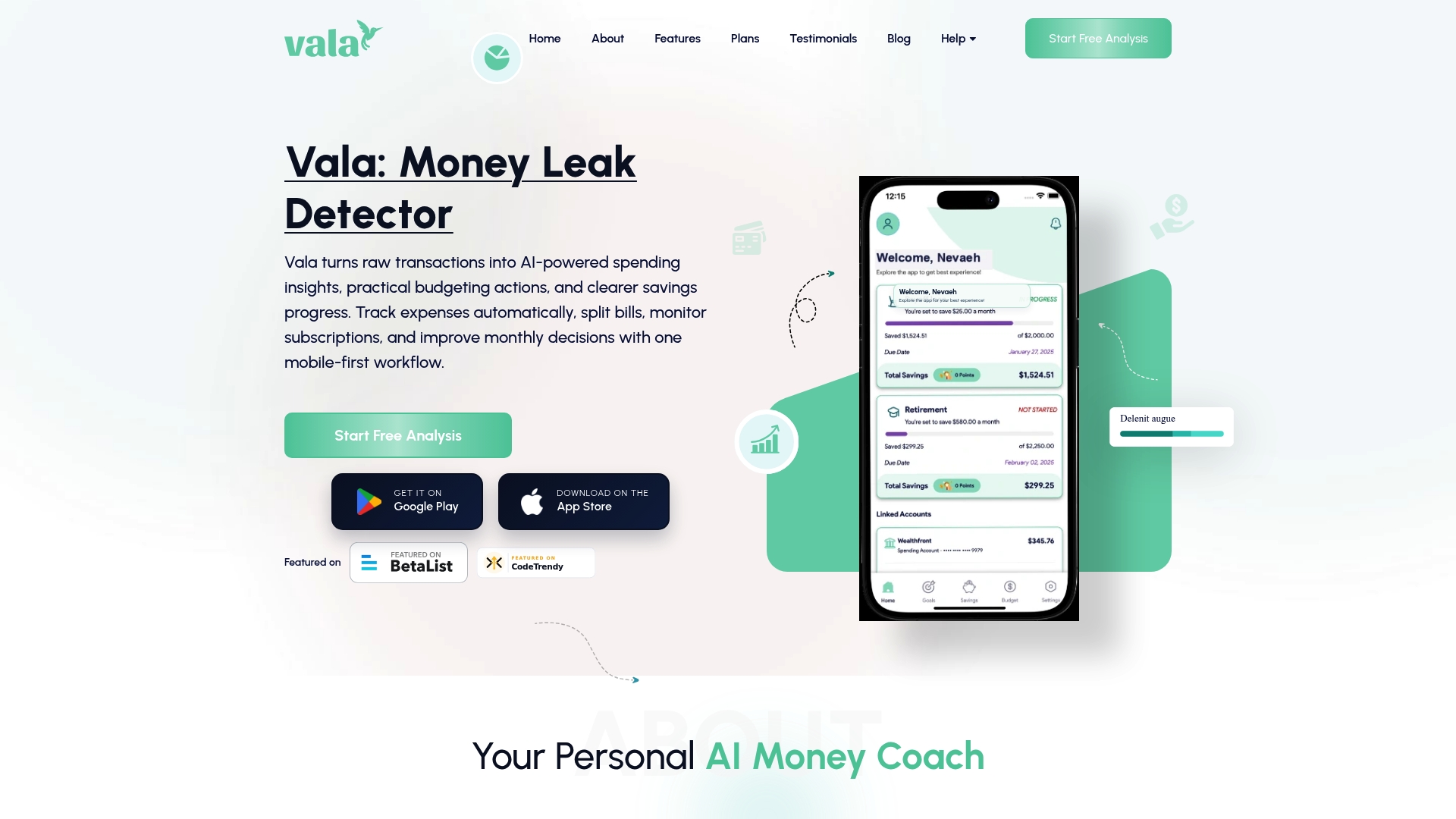
Here’s how Valapoint’s features map directly to the audit and fixes in this article:
- Recurring charge detection — flags every subscription and auto-renewal across connected accounts, including ones you’ve forgotten about.
- Subscription review — groups all recurring charges in one place so you can cancel or downgrade without hunting through multiple statements.
- Habit-category tracking — automatically tags coffee shops, delivery apps, and convenience purchases so you can see your monthly total at a glance.
- Delivery and merchant tagging — identifies high-fee merchants and delivery platforms so you can see exactly how much the markup is costing you.
- Bill reminders — alerts you before charges hit so you can cancel before the next billing cycle instead of after.
- Savings goal automation — moves money toward a goal automatically, so the savings happen before you have a chance to spend it.
To run the six-step audit faster, connect your accounts in Valapoint and let the recurring-charge detection do steps two and five for you. The habit categories handle step three. You’re left with the decisions, not the digging.
Ready to see where your money is actually going? Try the Valapoint personal finance app and get a clear picture of your spending leaks in minutes.
Useful sources and further reading
- Plugging Spending Leaks — UF/IFAS Extension Wakulla County — Community-level budgeting guide covering daily coffee, takeout, and forgotten subscriptions as top everyday leaks.
- These 8 Hidden ‘Money Leaks’ Could Be Draining Thousands — AARP — Consumer-facing overview of unused subscriptions and bank fees, with prevalence data for U.S. adults.
- The Top Spots Where Your Money Is Leaking Each Month — Yahoo Finance — Expert-sourced guide on auto-renewals, zombie subscriptions, and the three-month retrospective audit method.
- Top Spots Your Money Is Leaking — GoBankingRates — Credit industry expert commentary on how premium tiers and incremental upgrades raise monthly baselines over time.
- What Do Your Daily Habits Actually Cost You? — UseACalculator — Habit cost calculator and examples showing delivery fee markups and 10-year projections for common daily purchases.
- 6 Bad Spending Habits to Avoid — Nationwide — Practical examples including the $4 daily coffee calculation ($1,020/year) and home-brew cost comparisons.
- The Psychology Behind Everyday Money Decisions — Kalkine Education — Behavioral finance review covering present bias, emotional triggers, and how habit spending bypasses deliberate decision-making.
- Managing Your Money — Stop Spending Leaks? — NMSU Extension — University extension circular with structured guidance on identifying and reducing spending leaks for U.S. households.
- 5 Budgeting Apps Compared by Bank-Data Privacy — Obsidian Ridge Labs — Third-party analysis of privacy considerations when choosing a personal finance app; useful for readers evaluating secure tools.