
The fix for irregular income is a system, not a forecast: set a conservative baseline from your last 6 to 12 months of earnings, route every payment into labeled accounts, hold a buffer, and pay yourself a steady salary from it. This stabilizes your monthly cash flow and keeps tax money separate from spending money. Your first move is simple: pull up your last 6 to 12 months of net income before you touch a single budget category.
TL;DR:
- Setting a conservative income baseline from your lowest month over six to twelve months ensures stable pay regardless of variable client payments.
- Automating income split into tax, buffer, and spending accounts helps prevent misallocation and maintains system integrity during busy or slow periods.
- Building a buffer of one to three months of salary and an emergency fund of six or more months provides day-to-day security and protection against larger shocks.
- Prioritizing essential bills and savings in a tiered system allows for flexibility during slow months without risking crucial expenses.
- Recalculating your baseline every six months and adjusting your buffer and emergency funds accordingly prevents recurring financial shortfalls.
Table of Contents
- Why Forecasting Fails (and Systems Win) for Variable Pay
- How Do You Calculate a Safe Income Baseline?
- Buffer vs. Emergency Fund: What’s the Difference?
- How Should You Split Every Payment You Receive?
- Build a Priority-Based Budget That Funds Essentials First
- What’s the Right Way to Set Aside Money for Taxes?
- What Weekly and Monthly Habits Keep This System Accurate?
- What Should You Do the Moment a Month Falls Short?
- What I’ve Learned Watching Irregular Earners Build Real Stability
- Get Your System Running with Vala
- Sources
- FAQ
Why Forecasting Fails (and Systems Win) for Variable Pay
Predicting next month’s income when you freelance, work commission, or drive for a gig platform is close to guessing. Clients pay late, projects fall through, and seasonal demand swings your paycheck by hundreds or thousands of dollars. A budget built on a forecast breaks the moment reality misses the number, and it usually misses.
Systems solve a different problem. Instead of asking “how much will I earn this month,” you ask “how much do I need to pay myself, regardless of when the money lands.” That shift is the whole trick.
A one-month buffer, sometimes called living on last month’s income, is the mechanism that makes it work. You spend this month using money you already earned last month, so a late invoice or a slow week never touches your rent payment. This is why the Consumer Financial Protection Bureau’s research matters: nearly a quarter of U.S. consumers report month-to-month income swings, and those households face a higher risk of falling behind on essential bills. A buffer directly targets that risk.
What a baseline-buffer system gives you:
- A predictable “paycheck” even when client payments arrive on their own schedule
- One month of breathing room between a missed payment and a missed bill
- A separation between tax money, business costs, and what you actually spend
How Do You Calculate a Safe Income Baseline?
Your baseline is the number you can count on every month, not the number you hope for. It should represent the floor, not the average.
- Pull your last 6 to 12 months of net income. Nebraska’s Department of Banking and Finance recommends this window specifically because it captures a full seasonal cycle for most freelancers and gig workers.
- Identify your lowest consistent month. Exclude a true outlier (a month you were sick, a one-time bonus) but keep every normal slow month in the data.
- Choose your baseline method. Use the lowest month directly if your income is highly volatile, or use a floored average (take your 6 to 12 month average, then apply roughly 80% of it) if your income is moderately variable.
- Adjust for known non-monthly costs. Divide annual bills like car registration or software renewals into monthly amounts and fold them into the baseline.
- Set your personal salary at or below this number. This is the amount you pay yourself from the buffer every month, no matter what came in.
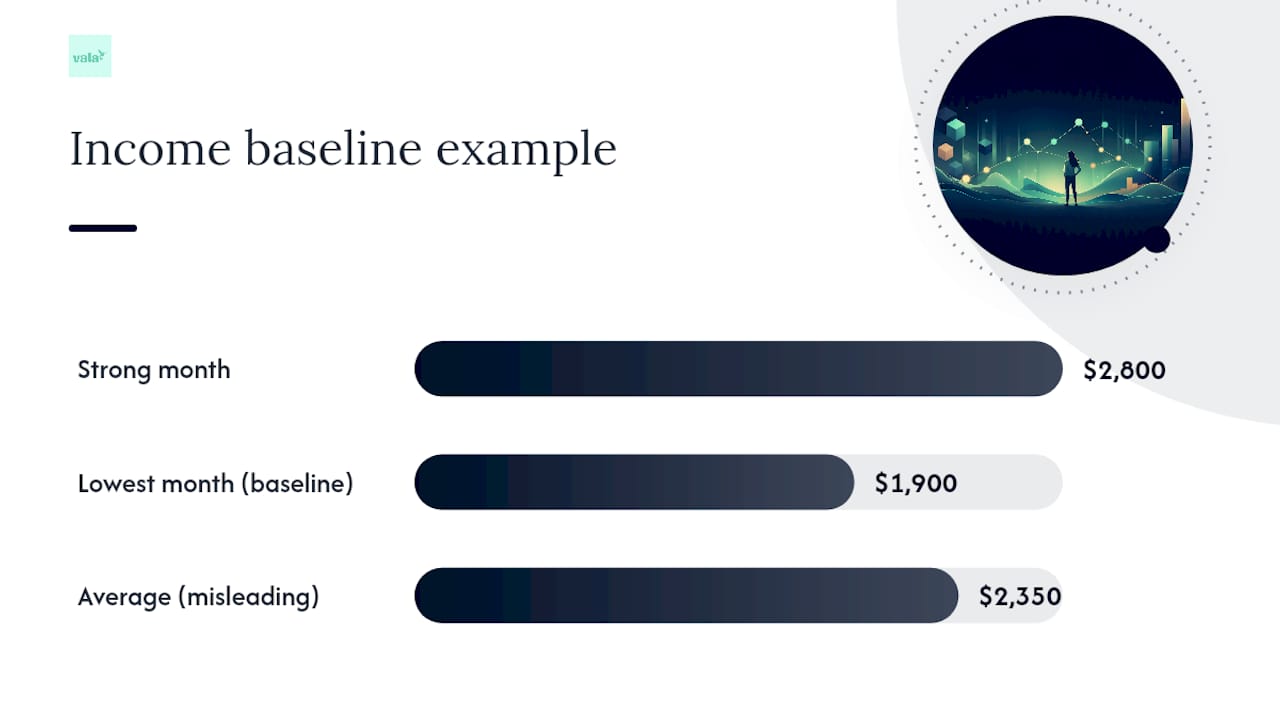
A driver earning $2,800 in a strong month and $1,900 in a slow one should not budget off $2,350. The lowest consistent month, $1,900, is closer to the real floor.
Pro Tip: Recalculate your baseline every 6 months. Rising income should eventually raise your salary, but only after two or three strong quarters confirm it is not a fluke.
Buffer vs. Emergency Fund: What’s the Difference?
A buffer and an emergency fund solve different problems, and confusing them is the most common mistake variable earners make.
The buffer smooths timing. It is the account that lets you pay yourself last month’s income this month, absorbing the normal lag between invoicing and getting paid. The emergency fund absorbs shocks: a lost client, a medical bill, a broken laptop that halts your work entirely.
- Buffer target: 1 to 3 months of your salary amount, built first since it is what makes the whole system function day to day.
- Emergency fund target: 6 or more months of living expenses. Guidance on cash buffers points variable earners toward the high end of standard advice, since a slow season and a personal emergency can hit at the same time.
- Where to keep both: a high-yield savings account that’s separate from checking, easy to transfer from, but annoying enough to access that you won’t dip in on impulse.
Fund the buffer before the emergency fund. A one-month buffer eliminates most day-to-day stress; the emergency fund is your protection against the bigger, rarer hit. Once the buffer covers a full month of salary, split new savings between the two until the emergency fund reaches its target.
Roughly one in four Americans deals with income that moves month to month, according to the CFPB’s financial well-being data, and those households report more difficulty covering bills than steady-income households. A funded buffer is the single change that closes most of that gap.
How Should You Split Every Payment You Receive?
Every dollar that lands in your account needs a job before it ever reaches your spending money. Waiting until month’s end to figure out where money goes is how buffers stay empty and tax bills come as a surprise.
- Set aside 25 to 30% for taxes first. This range covers both self-employment tax and income tax for most freelancers, according to NerdWallet’s guide to irregular income.
- Cover business costs next, using whatever percentage matches your actual overhead (software, mileage, supplies).
- Route a fixed percentage to your buffer until it reaches your target.
- Pay yourself your set salary, the number from your baseline calculation.
- Send anything left to goals, savings, extra debt payments, or your emergency fund.
The account structure that makes this run on autopilot has four roles: a holding account where every payment lands first, a tax account, a buffer account, and your personal spending account. Penn State Extension’s guide to irregular income recommends exactly this setup, and it works because no single account ever mixes purposes.
Pro Tip: Set up automated transfers that trigger the moment a deposit hits your holding account. If you have to move the money manually, you will eventually skip it during a busy week, and that’s how tax money quietly becomes rent money.
Build a Priority-Based Budget That Funds Essentials First
A priority-based budget answers one question before any other: what gets paid no matter what? Building your spending in tiers, rather than category by category, means a slow month still covers rent even if it means discretionary spending hits zero.
A workable priority order looks like this:
- Housing and utilities
- Food (a real grocery number, not a guess)
- Transportation and insurance
- Minimum debt payments
- Taxes (already set aside from each payment, not budgeted separately)
- Buffer contribution
- Emergency fund contribution
- Retirement savings
- Discretionary spending, last
Fund each tier from your baseline salary, top to bottom, before moving to the next one. In a low month, you might only clear housing, food, transportation, and minimum debt, leaving retirement and discretionary spending at zero. That’s the system working as designed, not a failure.
In an average month, everything through emergency fund contributions gets funded and a little discretionary spending survives. In a high month, the surplus above your fixed salary should go somewhere specific, extra debt payoff, a bigger retirement contribution, or a goal you’re funding, rather than sitting unassigned in your checking account where it quietly disappears.
What’s the Right Way to Set Aside Money for Taxes?
Underpaying taxes is the most expensive mistake irregular earners make, mostly because it’s invisible until it isn’t. A strong year of freelance income can turn into a shock at tax time if you spent what should have gone to the IRS.
- Set aside 25 to 30% of every payment for taxes, covering both self-employment tax and regular income tax; your exact rate depends on total income and state.
- Use the IRS Tax Withholding Estimator to check whether your set-aside percentage matches your real liability.
- File estimated quarterly payments using Form 1040-ES if you receive 1099 income with no withholding.
- Keep tax money in its own account, completely separate from your buffer and spending accounts.
- Never borrow from your tax account to cover a slow month. That’s the fastest way to turn one problem into two.
Treating taxes as a first-priority category, something you set aside the moment money lands rather than something you calculate later, removes most of the anxiety around quarterly payments. The money is already gone from your spendable balance before you’re tempted to use it.
What Weekly and Monthly Habits Keep This System Accurate?
A system only works if you check it. Nebraska’s budgeting guide for irregular income recommends a short weekly review, and ten minutes is genuinely enough once your accounts are set up correctly.
Your weekly checklist:
- Confirm every payment received got split into its labeled accounts
- Check your buffer balance against your target
- Review upcoming bills for the next two weeks
- Flag any client payment that’s running late
Monthly, reconcile your actual salary payment against your baseline, and confirm your tax account balance is tracking with your income so far this year.
For the tools themselves, a cash-flow calendar helps you see slow weeks coming, and split-rule automation removes the manual work of dividing each deposit. Some personal finance apps automate this structure by splitting incoming payments by your set percentages, tracking your buffer against a target you set, and flagging recurring subscriptions or spending drift that quietly eats into your salary. The Monthly Expense Calculator helps you nail down your essential spending number before you set your baseline salary.
Pro Tip: Label every transfer the moment you set it up, not later. “Tax,” “Buffer,” and “Salary” as transfer names sound obvious, but six months in, unlabeled transfers become a guessing game.
What Should You Do the Moment a Month Falls Short?
A slow month is not a crisis if your system is already built for one. Here’s the order of operations the moment income drops below your baseline:
- Cut discretionary spending immediately. This tier goes to zero first because it’s designed to.
- Pause transfers to non-essential goals, retirement contributions and extra debt payments included, until income recovers.
- Draw from your buffer to keep your salary payment steady. This is exactly what the buffer exists for.
- Leave tax money untouched. No matter how tight the month, that account is off-limits.
- Contact creditors early if a bill genuinely won’t get covered. Most lenders offer more flexibility to someone who calls before a missed payment than after.
Once income recovers, rebuild in this order: refill the buffer back to its target first, since it’s what protects you from the next slow stretch. Then rebuild the emergency fund if you dipped into it. Only after both are back to target should extra income go toward goals or increased discretionary spending. Skipping straight to celebration spending after a good month is how the same shortfall repeats itself three months later.
What I’ve Learned Watching Irregular Earners Build Real Stability
The freelancers and gig workers who stop stressing about money aren’t the ones who land bigger clients or higher commission rates. They’re the ones who stop budgeting off hope and start budgeting off a number they already have in the bank. That shift, from forecasting to systems, is where the anxiety actually lifts.
Start with one piece this week: pull your last six months of net income and find your real floor. You don’t need the whole system running by Friday. You need one honest number to build on.
— SaverStride
Get Your System Running with Vala
Building a baseline-buffer system by hand works, but it takes real discipline to keep every payment split correctly week after week. Vala closes that gap by automating the parts that usually break down first, the splits, the buffer tracking, and the drift that quietly eats into your salary before you notice it.

Set up a holding account, tell Vala your split percentages for taxes, buffer, and salary, and every incoming payment routes itself the moment it lands. The app tracks your buffer against the target you set, flags subscriptions and spending patterns that pull money away from your goals, and gives you a real-time view of where you actually stand between paychecks. If you’re still working out your baseline number, the Monthly Expense Calculator helps you nail down your essential spending before you commit to a salary amount.
Start with the Vala personal finance app on its free plan, set up your accounts, and turn on split rules today. You’ll see your first automated payment split within minutes of connecting your bank.
This article is general information, not a substitute for advice from a qualified financial advisor. Consult a qualified financial professional about your own circumstances before acting on anything here.
Sources
- How to Budget Effectively with an Irregular Income
- CFPB data spotlight on financial well-being
- Tax Withholding Estimator
- Budgeting with irregular income (Penn State Extension)
FAQ
What Is the 70/10/10/10 Budget Rule?
For irregular earners, it works better applied to your baseline salary than to raw monthly income, since raw income swings too much to hold a fixed percentage steady.
What Percentage of People Earning $100,000 Live Paycheck to Paycheck?
Specific figures vary by survey and year, so no single number holds up as definitive across all sources. What is well documented is that income level alone doesn’t prevent cash-flow stress; irregular timing and inconsistent monthly amounts, tracked by the CFPB, drive bill-payment difficulty regardless of total income.
What Is the Best Budget App for People with Fluctuating Income?
The best fit is an app that automates payment splitting and buffer tracking rather than one built only for fixed monthly budgets. Vala automates the exact split-and-buffer structure this guide describes, routing each deposit to labeled accounts and tracking your buffer against a target automatically.
What Is the 3/6/9 Rule in Finance?
This isn’t a standardized financial planning framework, and definitions vary depending on the source. If you’ve seen it referenced for savings targets, treat any specific claim with caution and rely instead on the well-documented emergency fund guidance of 6 or more months of expenses for irregular earners.
How Much Should Freelancers Set Aside for Taxes?
A conservative rule of thumb is 25 to 30% of each payment, covering both self-employment tax and income tax, though your exact rate depends on total income and state. Confirm your number using the IRS Tax Withholding Estimator and file quarterly with Form 1040-ES if you receive unwithheld income.