
The real trade-off comes down to this: joint budgeting builds togetherness and transparency, while separate budgeting protects autonomy and privacy. Research links pooling money to higher relationship satisfaction, but a hybrid approach, part joint and part personal, fits most couples best. The right choice depends on your goals, trust level, and how you both like to manage money.
TL;DR:
- When incomes differ, split shared bills in proportion to earnings; a $4,000 and $2,000 income pair suggests roughly two thirds and one third.
- Either joint account holder can typically withdraw or close the account without consent, so confirm your bank’s rules before depositing shared savings.
- FDIC insurance covers eligible joint accounts up to $250,000 per owner at one institution, provided both owners have equal withdrawal rights.
- Choose separate accounts when privacy or independence matters most; when preferences fall between extremes, test a hybrid arrangement and review it after three months.
- Pooling’s reported relationship benefit appeared stronger among couples with limited financial resources, but observational and experimental findings do not guarantee results for every couple.
Table of Contents
- The three budgeting models: fully shared, separate, and hybrid
- Pros and cons: what joint and separate budgeting trade off
- Practical methods to split bills and allocate shared budget
- What the evidence says about pooling finances and relationship outcomes
- How to choose the right approach: checklist and questions to ask
- Step-by-step setup for each model (accounts, automation, and documentation)
- A nudge toward communication over perfect math
- Let Vala support whichever budget model you choose
- FAQ
- Sources
The three budgeting models: fully shared, separate, and hybrid
Before you pick an approach, it helps to know your options.
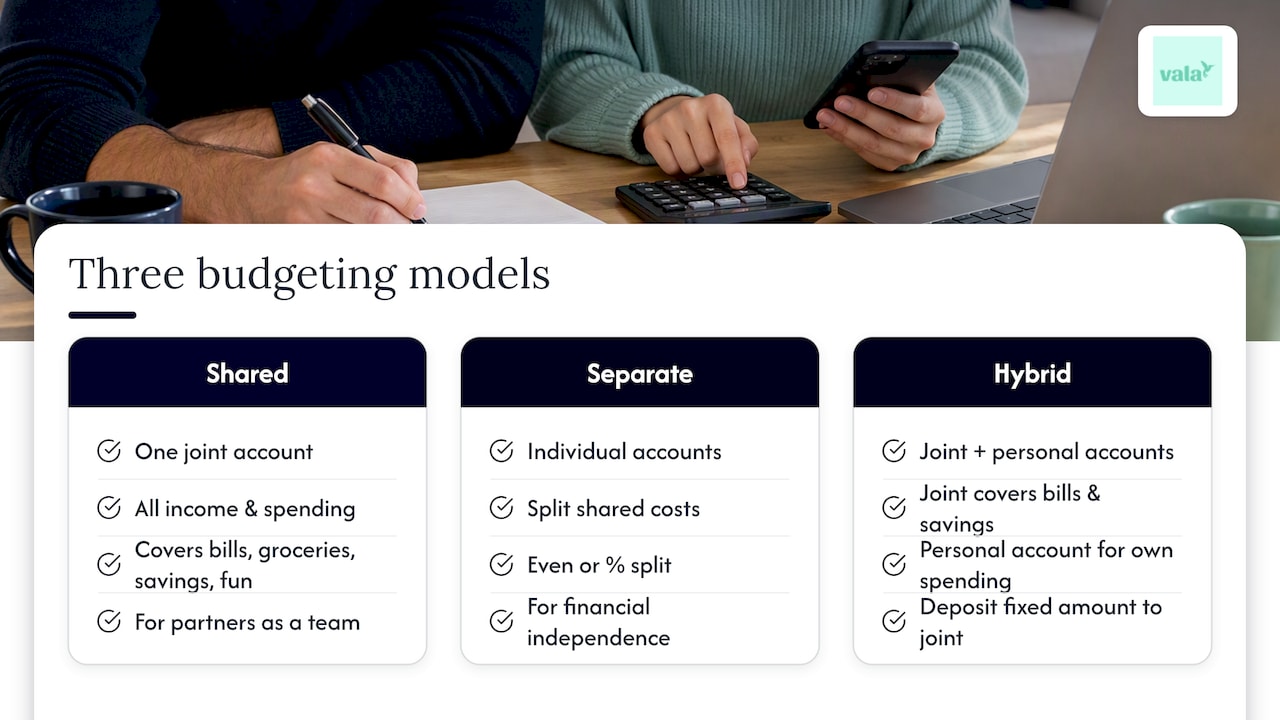
Fully shared means one joint account holds most or all household income, and both partners spend from it for everything, bills, groceries, savings, and fun money. This works well for couples who see their finances as one team effort.
Separate means each partner keeps individual accounts and splits shared costs, like rent or utilities, using an agreed method such as an even split or a percentage of income. This suits couples who value financial independence or who merged households later in life.
Hybrid combines both: a joint account covers shared bills and savings goals, while each partner keeps a personal account for individual spending. A couple might deposit a fixed amount into the joint account each month and keep the rest for themselves. For many couples, this structure offers the clearest balance between shared responsibility and personal freedom.
Pros and cons: what joint and separate budgeting trade off
Each model solves different problems, and each creates its own friction points.
- Joint accounts simplify bill paying, create full transparency, and make it easier to save toward shared goals like a house or vacation.
- Joint accounts reduce personal spending autonomy, and any co-owner can typically withdraw or close the account without the other’s consent, so confirm your bank’s specific rules.
- Separate accounts preserve independence, protect privacy around personal purchases, and keep individual spending habits from becoming a shared issue.
- Separate accounts require more coordination to track shared costs and can create friction if one partner feels the split isn’t fair.
If you combine accounts, know how deposit insurance works. FDIC guidance confirms joint accounts are insured up to $250,000 per co-owner at the same institution, as long as both owners are natural persons with equal withdrawal rights.
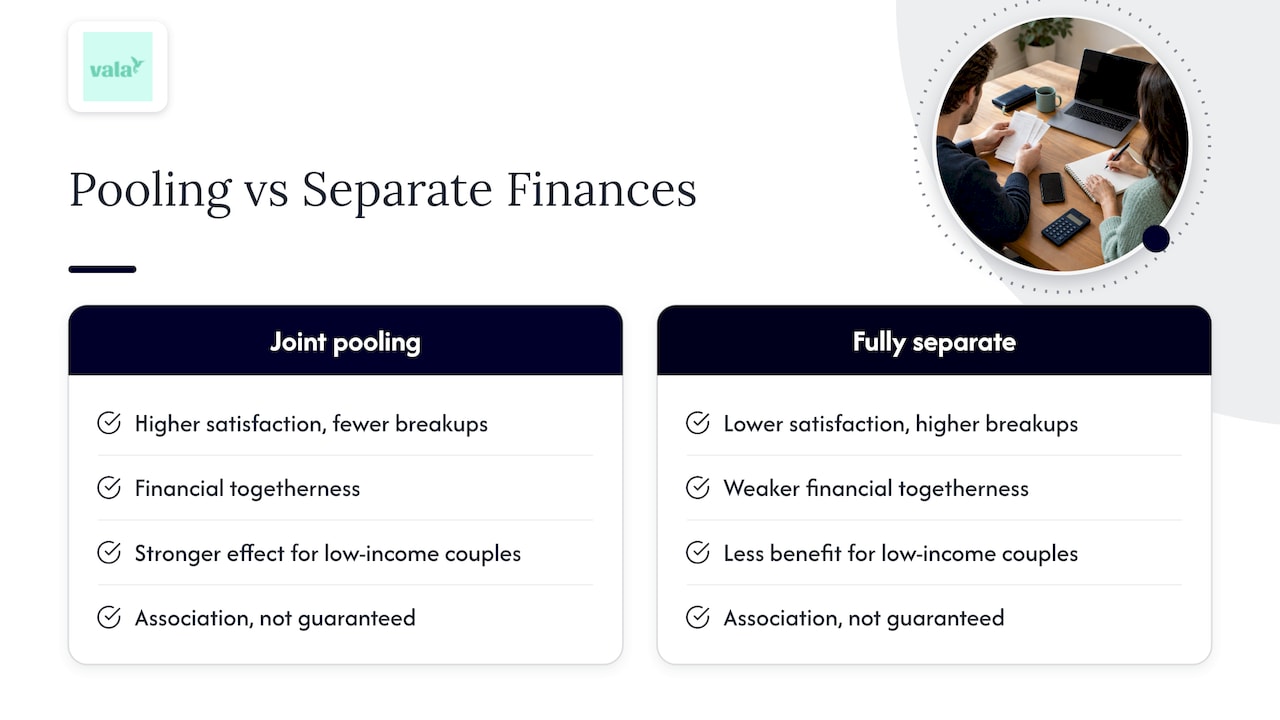
A large body of research backs the togetherness argument for joint accounts. Combined data from multiple studies, covering roughly 38,534 participants, found that couples who pool their money report higher relationship satisfaction and are less likely to break up than couples who keep finances separate.
Practical methods to split bills and allocate shared budget
Once you know your model, you need a formula that feels fair.
- Equal split (50/50): works well when both partners earn similar incomes and want simplicity.
- Proportional split by income: divide bills based on each partner’s share of combined income. If one partner earns $4,000 a month and the other earns $2,000, the first covers about two-thirds of shared expenses, the second about one-third.
- 50/30/20 for couples: the CFPB’s budgeting framework allocates 50% to needs, 30% to wants, and 20% to savings, and couples can apply it to pooled funds, personal funds, or both.
- Automate the routine: set scheduled transfers into the joint account, put recurring bills on autopay, and reconcile spending weekly or biweekly.
Pro Tip: Keep a running list of recurring expenses, subscriptions, rent, insurance, so nothing slips through when you divide costs.
What the evidence says about pooling finances and relationship outcomes
The research on joint finances is more consistent than most couples expect. Across experimental, cross-sectional, and longitudinal data, combined pooling-finances research found that couples who merge all their money into joint accounts report greater relationship satisfaction and lower breakup rates than those who keep finances fully separate. The effect appeared to work through a sense of “financial togetherness,” the feeling that both partners are working from the same resources toward the same future.
The benefit showed up more strongly among couples with limited financial resources, where shared visibility into money may reduce stress and conflict. It’s worth noting this evidence blends observational findings with controlled experiments, so it points to a strong association rather than a guarantee for every couple. For the practical mechanics of how joint accounts work, including insurance limits and withdrawal rights, the FDIC remains the most reliable source.
How to choose the right approach: checklist and questions to ask
Before committing to a model, talk through these questions together.
- Do you share major financial goals, like buying a home or retiring early?
- How much do you trust each other with full financial visibility?
- Does either of you have irregular income, debt, or a strong need for privacy?
- Do you have a plan for emergencies or one partner’s sudden inability to manage money?
Match your answers to a model: shared goals and high trust point toward joint; strong privacy needs or very different incomes point toward separate; anything in between usually points toward hybrid.
Pro Tip: Try a hybrid setup for three months, then sit down together and review what worked and what didn’t before making it permanent.
If debt, major income gaps, or repeated disagreements come up, a financial counselor can help you structure an approach that fits your specific situation.
Step-by-step setup for each model (accounts, automation, and documentation)
Here’s how to put each model into action without the usual pitfalls.
- Joint account setup: choose a bank with no-fee joint checking, confirm signatory rules, set a recurring transfer schedule, and put shared bills on autopay.
- Separate account workflow: agree on your split method, set up standing transfers or manual payments for shared costs, and use a shared ledger or app to reconcile who paid what. Our 6-step ledger system walks through exactly this process for shared credit card expenses.
- Hybrid implementation: set clear rules for what the joint account covers, schedule a monthly reconciliation to review spending, and agree on “fun money” amounts each partner can spend freely.
- Security checklist: keep a shared inventory of accounts, passwords, and beneficiaries, and talk through a plan for incapacity or separation before you need one.
For couples weighing values alongside logistics, this biblical budgeting guide offers family discussion prompts worth considering during setup.
A nudge toward communication over perfect math
No formula replaces an honest conversation about money. Pick an approach that fits where you are now, not where you think you should be, and revisit it every few months as income, goals, or life circumstances shift. If you’re unsure, start with hybrid and schedule a three-month check-in. Relationship goals, not spreadsheet precision, should guide the decision.
— SaverStride
Let Vala support whichever budget model you choose
Whatever structure you land on, joint, separate, or hybrid, the daily work is the same: tracking spending, splitting costs fairly, and catching leaks before they add up. We built Vala to handle that part for you, whether you’re managing one shared account or juggling contributions from two.

With Vala, you can:
- Automate proportional transfers based on each partner’s income share.
- Reconcile shared spending across joint and personal accounts in one place.
- Track progress toward shared savings goals without manual spreadsheets.
- Run a Money Leak Check to spot forgotten subscriptions or recurring charges draining your joint budget.
Our subscription plan unlocks the full set of shared budgeting tools; see our website for current pricing details. Explore how Vala handles expense splitting and see which setup fits your household.
This article is general information, not a substitute for advice from a qualified financial advisor. Consult a qualified financial professional about your own circumstances before acting on anything here.
FAQ
Is it better to have joint or separate accounts for couples?
Research suggests couples who pool their money into joint accounts report higher relationship satisfaction and lower breakup rates than those who keep finances fully separate. That said, separate or hybrid accounts can work well for couples who prioritize independence or have very different financial habits.
What is the 50/30/20 rule for couples?
The 50/30/20 rule allocates 50% of income to needs, 30% to wants, and 20% to savings or debt repayment. Couples can apply this split to a joint account, individual accounts, or a hybrid combination, adjusting the percentages to fit their own income and priorities.
What is a fair way to split household bills between couples?
A common approach is splitting bills evenly when incomes are similar, or proportionally based on each partner’s share of combined income when they differ. For example, a partner earning two-thirds of household income would cover roughly two-thirds of shared expenses under a proportional split.
Can one partner withdraw all the money from a joint account?
Typically, yes. Any co-owner on a standard joint account usually has full withdrawal rights, and account rules vary by bank and state, so it’s worth confirming your specific bank’s terms before relying on shared assumptions.
How much of a joint account is covered by deposit insurance?
FDIC rules insure joint accounts up to $250,000 per co-owner at the same institution, provided both owners are natural persons with equal withdrawal rights. Couples holding larger balances may want to spread funds across institutions or account types to stay fully covered.
Sources
- Pooling finances and relationship satisfaction (multiple studies summary)
- FDIC: Joint accounts deposit insurance guidance
- CFPB: Analyzing budgets and the 50/30/20 rule