
If you are riding Uber, you can split the fare inside the app while the trip is underway. If you are riding Lyft, you pay the full fare on one account and settle up with your friends afterward. Either way, a few details decide whether the split goes smoothly: who requests the ride, who pays the tip, and whether you divide the estimate or the final receipt.
This guide covers both apps step by step. It also covers taxis, the $0.25 fee, and how to stop a one-time ride from turning into a month-long “you still owe me” thread.
TL;DR
- Uber: request the ride, tap your payment method, choose Split Fare, and invite friends. Each rider who accepts is charged an equal share plus a $0.25 fee.
- Lyft: we found no general built-in equal split. One person pays, then everyone settles from the final receipt through a payment app or an expense-splitting tool.
- Split the receipt, not the estimate. Tolls, fees, waiting time, and route changes can move the final total.
- Tips are separate. On Uber, the original requester sets the tip, and it is not divided among passengers.
- Compare both apps before you book. Consumer Reports found large price gaps for similar rides, so check live quotes first.
Table of Contents
- How to split an Uber fare
- How to split a Lyft ride
- Split the receipt, not the estimate
- Lower the total before you split it
- What about taxis?
- Settling up without the awkward follow-up
- Our perspective: rides are one small leak among many
- The same method works for streaming and other subscriptions
- Keep every shared cost in one place
- FAQ
- Sources
How to split an Uber fare
Uber is the simplest case, because the feature is part of the app. Uber’s rider instructions describe the flow, and it takes under a minute:
- Open the latest version of the Uber app and request your ride as usual.
- After you are matched, swipe up from the bottom of the screen.
- Tap your selected payment method, then tap Split Fare.
- Enter each friend’s name or phone number.
- Each friend gets an invitation and accepts it in their own app.
The fare is divided equally among the riders who accept. Nobody has to hand over cash, and each person is billed directly.
What it costs
Uber charges each participating rider a fee of 25 cents, and the receipt shows the total Split Fare fee for everyone. Here is a hypothetical example. A ride totals $36.00 and three friends split it:
| Item | Per person |
|---|---|
| Equal share of $36.00 | $12.00 |
| Split Fare fee | $0.25 |
| Total each | $12.25 |
The fee is small, but it is real. If you would rather pay nothing extra, one person can pay the whole fare and collect from the others afterward. We cover that route below.
Limits to know before you rely on it
The same Uber page and our research point to a few practical limits:
- Start it during the ride. You cannot add a split after the trip ends.
- Everyone needs the latest app. The requester also needs the latest version.
- It may not work on every ride type. Options vary by city and region.
- Apple Pay may not work for splitting. Uber says you may need another payment method for that trip and can switch back on your next ride.
- If someone declines, you cover them. When a rider does not accept or has no valid payment method, the original requester is charged for that person’s portion too.
That last point matters most. Before the car pulls away, glance at the invitation status and confirm everyone accepted. Keep a backup payment method in case a friend’s card fails.
Tipping when you split
Equal splitting does not mean an equal tip. Uber explains that the rider who originally requested the trip selects the tip, and a tip they add is not split with the other passengers. So if you want the tip shared, tell your friends the amount and ask for their part afterward.
How to split a Lyft ride
Lyft works differently. As of 2026, Lyft’s pricing guidance explains fare calculation and Shared rides, but we could not find a general in-app workflow that divides one fare equally among friends the way Uber’s does. Plan on one person paying and the rest settling up.
Here is a clean way to do it:
- Pick one payer before you request the ride.
- Wait for the final receipt. Do not settle until the trip is over.
- Divide the receipt total, including the tip if the group agreed to share it.
- Send requests through a payment app or an expense-splitting tool, and ask friends to pay within a day or two.
Lyft’s payment-app integration can make step 4 smoother. Riders connect the payment app under Payment in the Lyft app, authorize Lyft, and then use it to pay for rides and split ride payments with friends. Keep in mind that this is a settlement route. It is not an equal split built into Lyft’s fare calculation.
Do not confuse Afterpay with splitting
Lyft’s Afterpay option is a different kind of split. In the US, eligible rides of $40 or more can be divided into four equal payments over six weeks, with the first due at checkout. That spreads one person’s cost over time. It does not divide a ride among friends.
Split the receipt, not the estimate
The upfront price is a planning number. Lyft’s pricing page says the price can change if you wait, change the destination, add stops, or hit different trip conditions. It also lists the parts of the rider price: a base rate, tolls, a service fee, and third-party fees such as local taxes, surcharges, and airport fees.
That has two practical consequences:
- Agree on the rule first. Decide whether you are splitting the final receipt or an agreed estimate. The receipt is fairer, and it is also your record if anyone asks later.
- Compare totals, not base fares. When you check prices across apps or ride types, look at the full upfront total.
A quick example. Four friends leave a concert. The quote is $44, but the group adds a stop for a friend’s drop-off and the final receipt is $51.50. Splitting the original estimate would have left the payer $7.50 short. Splitting the receipt gives each person $12.88, rounded up, and nobody argues.
Lower the total before you split it
Splitting only helps if the starting number is reasonable. Two moves can bring it down.
Compare both apps right before you book
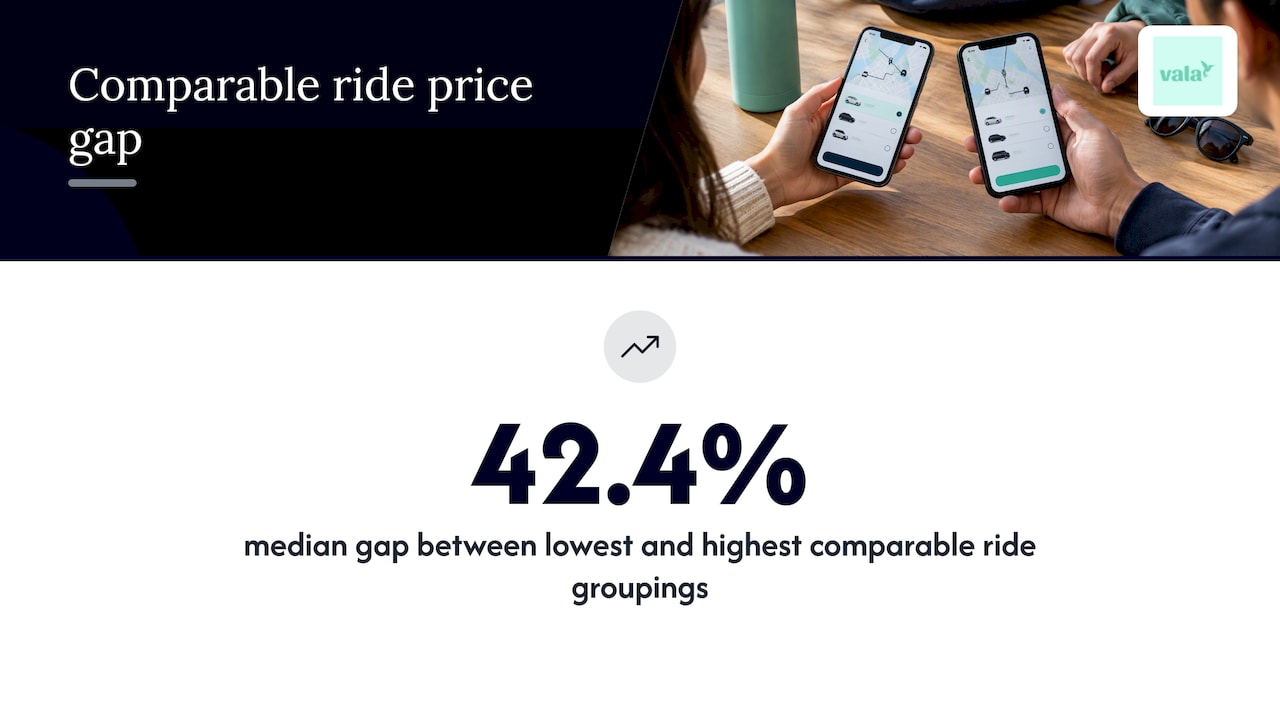
There is no permanent winner between the two big apps. A Consumer Reports investigation published in June 2026 tested rides in 18 states. It found the median gap between the lowest and highest price groupings for comparable rides was 42.4%. Both companies cited demand, driver supply, location, time, trip duration, weather, promotions, and traffic as pricing factors.
The takeaway: open both apps at the same moment, compare the full totals, and book the lower one. A discount label does not guarantee the lowest price for your route.
Consider a shared ride mode if your group is small
Both companies offer a cheaper shared option in eligible markets. Uber says UberX Share prices are always lower than UberX, and Lyft says a Shared ride is always cheaper than a standard Lyft ride. The tradeoff is that you are matched with other riders along your route, so there may be extra pickups and a less direct path. That is a different thing from splitting a private ride with friends. It works well for one or two people on a budget and poorly when you need to arrive together on time.
What about taxis?
Taxis have no standard split feature. Some drivers and some payment terminals let you run more than one card, but you should ask before the ride starts, not at the curb. The reliable approach is the same as Lyft’s: one person pays the metered fare plus tip, and the group settles from the receipt. Ask for a printed or emailed receipt so you have the exact total.
Settling up without the awkward follow-up
The ride itself is easy. Collecting is where friendships get tested. These habits help:
- Settle the same night. A request sent while everyone is still together gets paid. One sent a week later gets ignored.
- Round in a way everyone accepts. If the total is $51.50 for four people, ask for $13 each and let the payer keep the extra 50 cents toward the tip.
- Use one running tally for a whole trip. Five rides over a weekend is easier to settle once than five separate times.
- Decide uneven splits up front. If one person rode half the route, say so before the ride. Our guide on splitting expenses unevenly shows how to do it without a fight.
For trips and nights out with several shared costs, a tool that tracks who paid for what beats a pile of one-off requests. Our walkthrough on how to split expenses with friends covers a simple three-payment settlement, and how shared costs are settled explains the logic for roommates, couples, and groups.
Our perspective: rides are one small leak among many
We built Vala to find money leaks: the small, repeated charges that add up without anyone deciding to spend them. Shared rides fit that pattern in a quiet way. One person puts a $40 ride on their card, intends to collect, and never quite does. Or the $0.25 fee shows up on every split trip and nobody notices.
Our view is simple:
- A split is only finished when the money moves. Until then, it is a loan to a friend that sits in your balance.
- Fees are worth knowing, not worrying about. A $0.25 fee is cheaper than a day of chasing payments. Just make the choice on purpose.
- Recurring shared costs deserve more attention than one-off rides. A streaming plan split four ways, paid from one account, is the same problem repeated every month.
That is why we connect shared expenses and subscriptions to one budget view rather than treating them as separate chores. If you want to see what your own shared spending looks like, start with our Money Leak Check.
— SaverStride
The same method works for streaming and other subscriptions
Many readers who ask how to split a ride also want to split streaming plans and other subscriptions. The rules are close to identical:
- Name one account holder who pays the provider.
- Divide the full monthly price by the number of people who actually use it.
- Settle on a fixed date each month, not whenever someone remembers.
- Review it every few months. If someone stopped watching, they should stop paying, and the plan may no longer be worth keeping.
For step 2, our free subscription cost calculator shows what a plan really costs per person across a year. The subscription audit checklist walks you through which ones to keep or cancel.
Keep every shared cost in one place
If you split rides, dinners, and subscriptions with the same people, a single tracker saves a lot of back and forth. Vala connects through Plaid with bank-level encryption, shows your recurring charges, and helps you split shared expenses with friends. You can explore our split expenses tools first. The SaverPro plan is $2.99 per month, and you can start with a Money Leak Check to see where your money goes.
FAQ
Can I split a ride on Uber?
Yes. Request the ride, swipe up, tap your payment method, choose Split Fare, and invite friends by name or phone number. The fare is divided equally among those who accept. Each participating rider pays a $0.25 fee, and you must do it before the trip ends.
How do I split a ride fare on Lyft?
We found no general built-in equal split on Lyft. The practical method is for one person to pay and collect from the others using the final receipt. Lyft’s payment-app integration can make the collection step easier for riders who use it.
What happens if a friend does not accept the Uber split?
The original requester is charged for that person’s portion as well. Check that every invitation shows as accepted before the ride ends. Keep a backup payment option and settle with the friend directly if needed.
Is the tip split too?
Not automatically. On Uber, the original requester selects the tip, and it is not divided among the other passengers. Agree on the tip with your group and ask for each person’s share afterward.
Which is cheaper, Uber or Lyft?
It changes by route and by minute. Consumer Reports found a median 42.4% gap between the lowest and highest price groupings for comparable rides in its 2026 testing. Check both apps right before you book and compare the full totals.
Sources
- Uber: How to Split Fare
- Uber: How to Tip Your Driver
- Uber: Ride for less
- Lyft Help: Ride pricing and charges
- Lyft Help: Lyft Shared ride pricing
- Lyft Help: Afterpay
- Lyft: Paying rides with a payment app
- Consumer Reports: How Uber and Lyft Use Artificial Intelligence to Price Rides