
Financial success means having enough security and freedom to cover your needs, handle surprises, and spend on what matters to you, without debt or anxiety running the show. It is not one number. Most people operationalize this feeling through a handful of measurable KPIs, like net worth or savings rate, that turn a vague sense of “doing okay” into something you can actually track.
Nearly 60% of Americans say “being able to live comfortably” defines financial success, while fewer than 20% tie it to becoming a millionaire. That gap tells you something important: success is personal, not a fixed price tag.
When people describe what financial success feels like, three outcomes come up again and again:
- Peace of mind about bills and emergencies
- The ability to afford essentials and occasional extras without guilt
- Confidence that retirement will actually work out
Key Takeaways
Financial success is best defined through personal values translated into a small set of trackable KPIs, not through a single income or net-worth number borrowed from someone else.
| Point | Details |
|---|---|
| Definition beats dollar figure | Most people define success as living comfortably, not hitting a specific net worth. |
| Behaviors predict outcomes | Living below your means and managing debt matter more than income size. |
| Pick two to four KPIs | Track savings rate, emergency fund months, debt-to-income, and net worth. |
| Review on a cadence | Check cash flow monthly, savings rate quarterly, net worth yearly. |
| Recalibrate as life changes | Adjust targets after a new job, move, dependent, or paid-off debt. |
Table of Contents
- How Do You Define Financial Success for Yourself?
- What KPIs Should You Track to Measure Financial Success?
- Which Habits and Milestones Signal Financial Success?
- How Do You Build a Personal Definition of Financial Success?
- How Often Should You Check Your Financial Progress?
- How Valapoint Helps You Track What Success Means to You
- Why Does Mindset Matter as Much as the Numbers?
- What Do People Get Wrong About Financial Success?
- How Does Culture Shape What Financial Success Means?
- A Practical, No-Nonsense Take on Financial Success
- Frequently Asked Questions
- Sources
How Do You Define Financial Success for Yourself?
Financial success isn’t a single archetype. People tend to gravitate toward one of five common definitions, and knowing which one fits you changes how you measure progress.
- Income target. You define success by hitting a specific take-home pay number after taxes. This works for people early in their careers who are still climbing.
- Net-worth target. Success means total assets minus liabilities crossing a threshold, like $500,000 or $1 million. This suits people focused on long-term wealth building over income growth.
- Financial independence. You aim for enough passive income or invested assets to cover living expenses without a paycheck. The relevant KPI here is your withdrawal-rate coverage, not your salary.
- Lifestyle security. You just want to live comfortably: bills paid, savings growing, no debt stress. This is the most common definition, and it explains why 60% of Americans point to comfort rather than a millionaire milestone.
- Legacy or impact. Success means having enough to support family, give back, or leave something behind. Advisors increasingly frame this as part of true financial success, alongside fulfillment and relational health.
Pro Tip: Dollar thresholds shift by geography and life stage. A $75,000 income feels different in rural Ohio than in San Francisco. Pick a KPI, not a copied number.
What KPIs Should You Track to Measure Financial Success?
Vague goals stay vague until you attach numbers to them. Klipfolio’s personal finance KPI framework argues that metrics turn subjective goals into objective, checkable targets, and a handful of core numbers cover most of what matters.
Net worth is assets minus liabilities. Add up your cash, investments, and property, then subtract everything you owe.
Savings rate is savings divided by gross income, multiplied by 100. If you save $600 out of a $4,000 paycheck, your savings rate is 15%.
Emergency fund coverage is your cash reserve divided by monthly essential expenses. Three months of coverage is a starting point; six is more resilient.
Debt-to-income ratio compares monthly debt payments to monthly gross income, with high-interest debt (credit cards especially) deserving the most urgent attention.
| KPI | What it measures | Type |
|---|---|---|
| Net worth | Total assets minus liabilities | Long-run outcome |
| Savings rate | % of income saved each month | Leading indicator |
| Emergency fund months | Cash reserve ÷ monthly expenses | Leading indicator |
| Debt-to-income ratio | Monthly debt payments ÷ gross income | Leading indicator |
| Consecutive positive cash flow months | Streak of months where income exceeds spending | Behavioral KPI |
- Behavioral KPIs (percent of income auto-saved, consecutive months of positive cash flow) predict trouble before it shows up in net worth.
- Long-run outcomes like net worth confirm whether the behaviors are actually working.
Which Habits and Milestones Signal Financial Success?
Metrics only move when behavior changes first. A 2024 Forbes analysis found that wealth-building habits, not income size, predict financial success most reliably.
High-impact habits worth building:
- Living below your means, consistently, not just during lean months
- Automating savings so it happens before you see the money
- Paying off high-interest debt before investing aggressively
- Investing regularly, even in small amounts, rather than waiting for a “better time”
Common milestones people cite as proof they’re on track:
- Three to six months of expenses saved in an emergency fund
- Credit card balances paid off and staying at zero
- Retirement contributions happening automatically, every paycheck
- A mortgage payment that fits comfortably within the budget, not stretches it
A young professional might prioritize the emergency fund first. A mid-career family often focuses on debt payoff and retirement catch-up. A near-retiree shifts attention to income replacement and healthcare costs.
Pro Tip: Every raise is a decision point. Direct at least half of it to savings before your spending habits absorb it, or lifestyle inflation will quietly erase the progress.
How Do You Build a Personal Definition of Financial Success?
Turning a feeling into a plan takes four steps. This works whether you’re starting from zero or refining a goal you’ve had for years.
- Answer three values prompts in writing. What does money let you do that matters most? What would financial stress look like if it disappeared? What would you regret not doing with your money in five years?
- Choose your archetype. Pick from income target, net worth, financial independence, lifestyle security, or legacy, and write down why it fits your current stage of life.
- Select two to four KPIs with numbers and a timeline. For example: savings rate of 20% within six months, emergency fund at six months of expenses within eighteen months.
- Build habits and automations around those KPIs. Set up automatic transfers on payday, allocate raises before they hit your checking account, and automate high-interest debt payments first.
A single person earning $4,500 a month wants six months of expenses saved within a year. Monthly essentials run $2,800, so the target is $16,800. Saving $1,400 a month gets there in twelve months, so they automate a $1,400 transfer every payday into a separate savings account.
Writing the plan down matters more than most people expect. A budgeting app built around shared and personal goals makes it easier to keep the numbers visible instead of buried in a spreadsheet you forget to open.
How Often Should You Check Your Financial Progress?
Different KPIs need different check-in schedules. Checking net worth weekly is exhausting and mostly meaningless; checking cash flow monthly is essential.
- Monthly: review cash flow, since this is where overspending shows up first.
- Quarterly: review savings rate trend and debt balances, since these move slower but reveal direction.
- Yearly: review net worth and retirement readiness against the DOL’s retirement plan guidance, since these are long-run outcomes, not weekly signals.
Watch for early warning signs: a declining months-of-expenses number, a savings rate that’s quietly dropping, or discretionary spending that keeps creeping upward. Automated transfers and expense-tracking tools catch these shifts faster than manual review, since tracking apps flag category drift before it becomes a habit.
Recalibrate targets whenever life changes materially: a new job, a move, a new dependent, or a paid-off debt that frees up cash flow. Static targets stop working the moment your life does.
How Valapoint Helps You Track What Success Means to You
Valapoint’s expense tracking, budget automation, and money-leak detection map directly onto the KPIs above. You can set a savings-rate target, automate the transfer, and let the app flag subscription creep or category overspend before it erodes your emergency fund.
Three ways this plays out in practice:
- Setting KPI targets. Use budgeting tools and calculators to translate a vague goal like “save more” into a specific savings-rate number.
- Automating contributions. Paycheck allocations move to savings and debt payoff automatically, supporting the habits tied to lifestyle security and net-worth growth.
- Running monthly diagnostics. Shared expense tracking for couples and groups makes it easy to catch cash-flow dips early, the same early-warning signal advisors recommend.
| KPI | Valapoint feature |
|---|---|
| Savings rate | Automated paycheck allocations |
| Emergency fund months | Savings goal tracking |
| Debt-to-income ratio | Money-leak and spending detection |
| Consecutive positive cash flow | Shared and personal budget automation |
Why Does Mindset Matter as Much as the Numbers?
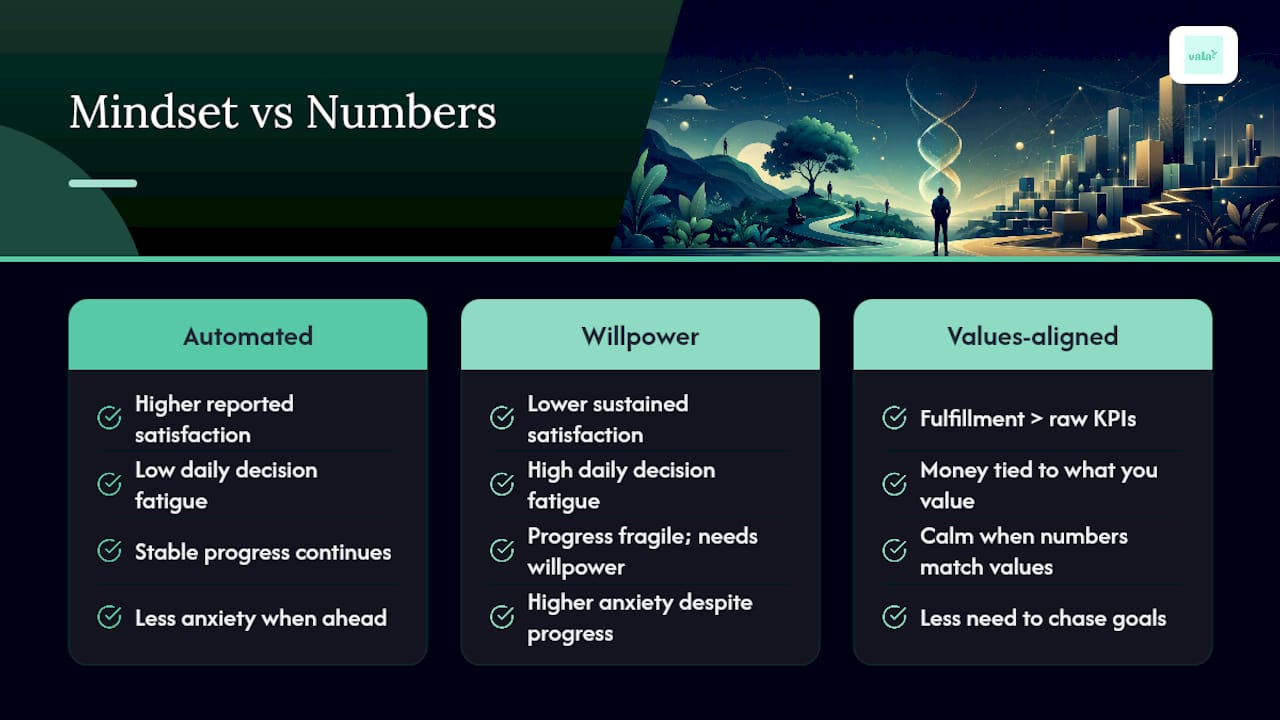
Hitting a savings-rate target feels different depending on what drove you there. Someone who automated their way to financial stability generally reports more satisfaction than someone who got there through constant willpower and anxiety, because the habit runs without daily decision fatigue.
Financial success also carries an emotional ceiling problem: hedonic adaptation means that hitting a goal often produces a short burst of satisfaction that fades, prompting people to move the goalposts again. This is why advisors recommend baking friction into targets, like automatic increases to your savings rate, so progress keeps happening even after the initial motivation wears off.
Fulfillment and stability are not the same thing, either. You can hit every KPI on this list and still feel unsettled if the money isn’t connected to something you value, whether that’s family time, creative freedom, or reduced stress. That’s part of why advisory research increasingly frames financial success as a blend of financial metrics and human measures like relationships and personal fulfillment. The numbers are the scoreboard, not the whole game.
Anxiety around money doesn’t always track with income, either. People earning six figures report financial stress when spending outpaces income, while people earning far less report calm when their numbers align with their values. The KPI matters less than whether you’re consistently ahead of your own targets.
What Do People Get Wrong About Financial Success?
The biggest myth is that financial success requires a specific dollar amount, usually a big one. In reality, fewer than 20% of Americans equate success with being a millionaire, and most people define it through comfort and stability instead.
A second myth: that a high income guarantees financial success. Income without behavior change doesn’t build wealth. The Forbes analysis on wealth-building behaviors makes this explicit: living below your means and managing debt predict outcomes better than salary size alone. High earners with high spending can feel just as financially stuck as lower earners with disciplined habits.
A third myth: that financial success is permanent once achieved. It isn’t. Life changes, income shifts, and lifestyle inflation erodes progress quietly if you’re not watching your savings rate. Treating financial success as a one-time finish line, rather than an ongoing set of habits, sets people up to feel like failures when circumstances shift.
Finally, many people assume tracking every dollar is required for success. In practice, a few well-chosen KPIs, checked on a regular cadence, usually beat obsessive daily tracking that burns out within weeks.
How Does Culture Shape What Financial Success Means?
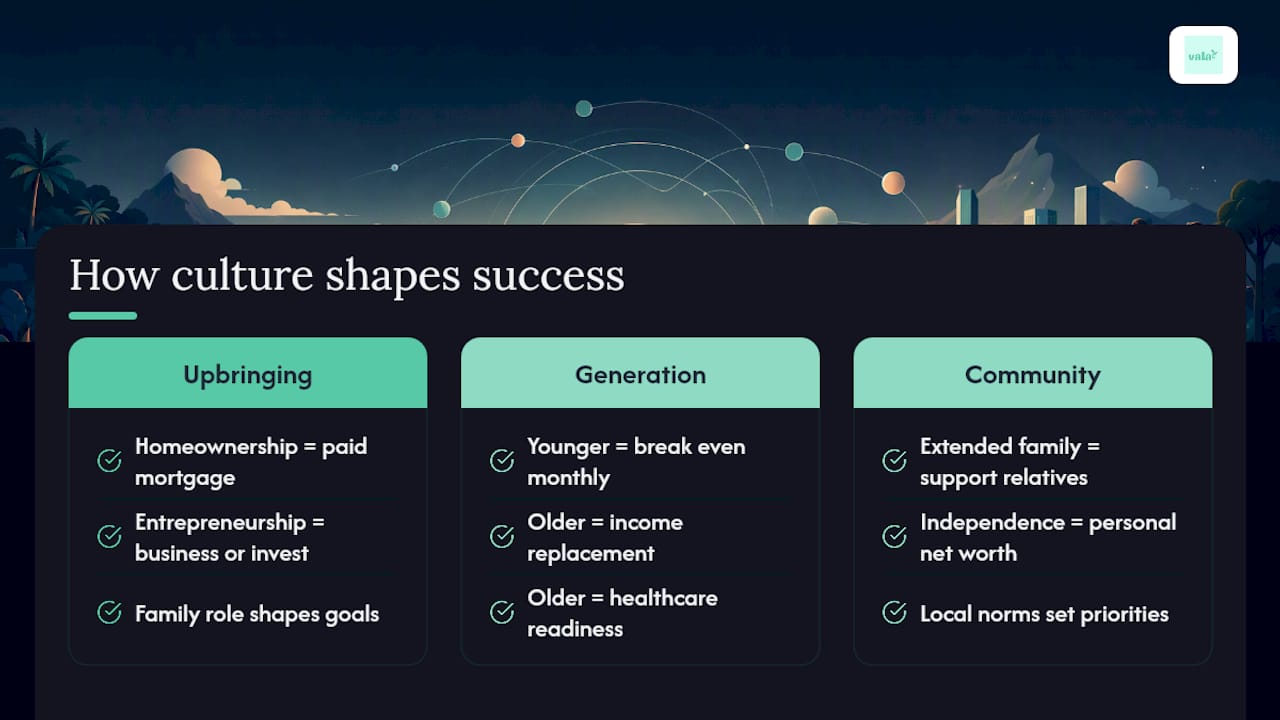
Financial success looks different depending on where you grew up, what generation you belong to, and what your family modeled for you. Someone raised in a household that valued homeownership above all else may define success as a paid-off mortgage, while someone raised around entrepreneurship might define it as business ownership or investment income.
Generational differences show up clearly, too. Younger adults navigating student debt and a difficult housing market often define success as simply breaking even each month without debt growing. Older adults closer to retirement tend to define it through income replacement and healthcare readiness, informed by resources like the DOL’s overview of retirement plan types.
Family and community expectations matter, too. In cultures where extended family support is the norm, financial success might include the ability to help relatives, not just personal savings goals. In cultures that emphasize independence, success may lean more toward individual net worth or early retirement.
None of these definitions is more “correct” than another. What matters is that your definition reflects your actual values and obligations, not a borrowed standard from a magazine list or a coworker’s spending habits. A credit-focused approach to controlling recurring spending can look completely different depending on whether you’re supporting a household or building independence, and both are legitimate paths.
Ready to put a number on your own definition? Vala’s personal finance app helps you track net worth, automate savings, and catch money leaks so your KPIs move in the right direction without extra manual work.
A Practical, No-Nonsense Take on Financial Success
Most advice on this topic either drowns you in generic tips or hands you a random dollar figure to chase. Both miss the point. The research is fairly clear that behavior, not income, drives outcomes, and yet most people still default to income as their scoreboard because it’s the easiest number to compare against a neighbor’s.
The bigger blind spot is treating financial success as a destination instead of a maintenance habit. Hitting six months of emergency savings doesn’t mean you’re done. It means your next KPI, maybe debt payoff or retirement contributions, needs attention now. Advisors who push clients toward automatic savings-rate increases understand this better than most personal finance content does: friction against your own future spending is what keeps the goalposts from drifting every time you get a raise.
If there’s one thing to prioritize first, it’s picking your archetype honestly, not aspirationally. Chasing “financial independence” when your values actually point toward lifestyle security just sets up a KPI mismatch that quietly demoralizes you for years.
Frequently Asked Questions
What is the simplest way to define financial success?
Financial success means having enough security and freedom to cover your needs and goals without ongoing debt stress, measured through KPIs like net worth and savings rate rather than a single dollar figure.
Is financial success the same as being wealthy?
No. Wealth is one possible input, but financial success is broader, covering security, stability, and alignment with personal values, which is why most Americans define it as living comfortably rather than accumulating a large net worth.
What income counts as financially successful?
There’s no universal number. Income needs vary by location, family size, and life stage, so a KPI like savings rate or debt-to-income ratio matters more than the raw income figure itself.
How do I start measuring my own financial success?
Pick two to four KPIs (net worth, savings rate, emergency fund months, debt-to-income ratio), set specific numeric targets with a timeline, and automate the habits that move those numbers, like automatic transfers on payday.
How often should I check my financial progress?
Review cash flow monthly, savings rate and debt trends quarterly, and net worth and retirement readiness yearly, adjusting targets whenever a major life change happens.
This article is general information, not a substitute for advice from a qualified financial advisor. Consult a qualified financial professional about your own circumstances before acting on anything here.
Sources
- 60% of Americans say reaching this milestone makes them financially successful—it’s not becoming a millionaire
- The Real Path To Financial Success: What It Takes Beyond The Basics
- Types of retirement plans (DOL)