
Budget accountability is defined as the principle that anyone responsible for managing a budget must answer for their financial decisions, spending choices, and outcomes. This applies equally to a household tracking monthly expenses and a team managing a departmental budget. The role of budget accountability goes beyond simple record keeping. It creates a system where clear ownership, real authority, and regular review combine to produce transparent, trustworthy financial management. Frameworks like the IMF Fiscal Transparency Code and the Public Expenditure and Financial Accountability (PEFA) assessment reinforce this principle at every level of financial governance.
What is the role of budget accountability in financial management?
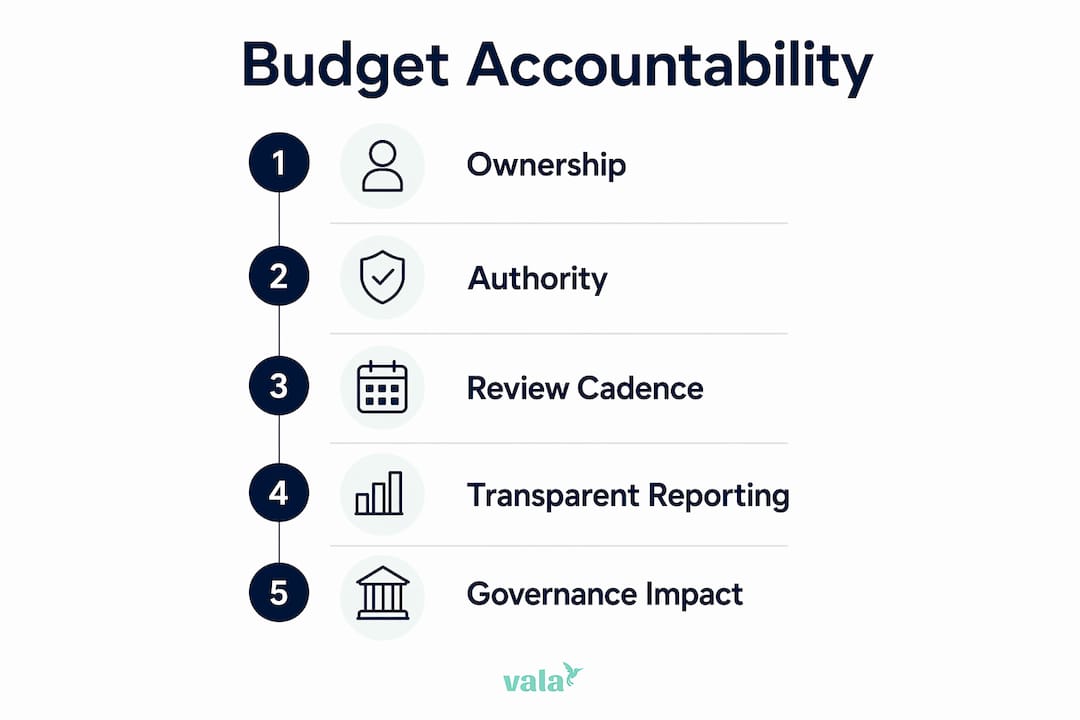
Budget accountability is built on three core components: ownership, authority, and review. Each one fails without the others. A person who owns a budget but cannot approve spending has no real power to manage it. A team that reviews budgets only once a year loses touch with what the numbers actually mean.
The importance of budget accountability starts with clear ownership. Every budget line needs a named person responsible for it. That person must understand what they control, what they can approve, and what requires escalation. Without that clarity, accountability becomes a vague expectation rather than a real commitment.

Authority must accompany responsibility to make accountability meaningful. Assigning someone ownership of a budget without giving them the power to make spending decisions creates a structural failure. The result is learned helplessness, where budget holders stop engaging because they know their input does not change outcomes.
Review cadence is the third pillar. Monthly operational reviews keep spending on track against short-term targets. Quarterly strategic reviews assess whether the budget still reflects current priorities. Both are necessary. Skipping either turns a budget into a static document rather than a living management tool.
Key budget accountability best practices
Strong budget accountability follows a consistent set of practices:
- Assign named owners to every budget category, not just departments as a whole.
- Define approval thresholds so budget holders know exactly what they can authorize without escalation.
- Schedule reviews in advance and tie them to performance objectives so they actually happen.
- Treat variance as information, not failure. A budget that never shows variance is a budget no one is watching honestly.
- Separate controllable from uncontrollable variance. A team that overspends because of a supplier price increase should not be judged the same way as one that overspends due to poor planning.
Pro Tip: Set up a shared budget dashboard that shows real-time variance by category. When everyone sees the same numbers at the same time, conversations shift from blame to problem solving.
How does budget accountability enhance performance and governance?
Budgetary control reduces information asymmetry and improves reporting quality. That finding comes from a decade of peer-reviewed research. It means that when people know they are accountable for a budget, they report more accurately and manage more carefully.
“Embedding accountability at all levels drives trust and consistent financial discipline within organizations. Without it, financial data loses credibility and decision-making suffers.”
The impact of budget accountability on governance shows up in several concrete ways. Transparent reporting builds trust with stakeholders, whether those are executives reviewing a team budget or a partner reviewing household finances. Timely audits and tracking audit recommendations are recognized by the PEFA framework as direct indicators of accountability strength.
Resource allocation also improves. When budget holders are genuinely accountable, they prioritize spending that delivers results. Waste shrinks not because of top-down pressure but because the person closest to the spending has both the incentive and the authority to manage it well.
The table below shows how strong accountability practices translate into measurable governance outcomes.
| Accountability practice | Governance outcome |
|---|---|
| Named budget ownership | Faster decision-making and clearer escalation paths |
| Regular variance review | Earlier identification of fiscal risk |
| Authority aligned with responsibility | Higher engagement from budget holders |
| Transparent reporting | Improved trust with internal and external stakeholders |
| Separating controllable variance | Fairer performance assessment and honest reporting |
Preventing a punitive blame culture is one of the most underrated governance benefits. When budget holders fear punishment for honest reporting, they pad budgets and hide problems. When accountability is designed to support proactive management, people surface issues early and fix them before they grow.
What are the common pitfalls in budget accountability?
Only 20–25% of executives report satisfaction with their budgeting process. The primary cause is ownership gaps, not technical failures. The most common pitfalls follow a predictable pattern.
- Responsibility without authority. A budget holder who cannot approve spending cannot manage a budget. This is the single most common structural failure in both organizational and personal finance contexts.
- Ownership without review. Assigning a budget owner and then never reviewing performance together turns the budget into shelfware. The owner disengages because nothing happens with the numbers.
- Punitive accountability. Blame cultures reduce data quality and honest communication. Budget holders start padding their numbers to create a buffer against criticism rather than reporting what is actually happening.
- No action plan after variance. Reviewing a budget and noting that spending is off target without assigning a corrective action and a deadline is a review in name only.
- Failing to distinguish variance types. Holding a team accountable for a cost increase driven entirely by external market conditions is unfair and counterproductive. Separating controllable from uncontrollable variance is a non-negotiable practice for fair performance management.
Pro Tip: After every budget review, write down one specific action, one owner, and one deadline. If you cannot do that, the review has not produced accountability. It has produced a conversation.
How to implement budget accountability in teams and personal finance
Practical implementation starts with structure. The ownership triad framework assigns three roles to every budget: a budget holder who manages day-to-day spending, a finance partner who provides analysis and support, and an executive sponsor who removes barriers and escalates decisions. This distributes responsibility without fracturing accountability.
For personal finance, the same logic applies. One person tracks daily spending. A partner or accountability contact reviews monthly totals. A shared goal, like a vacation fund or debt payoff target, acts as the executive sponsor by giving the whole effort a clear purpose.
The following practices build a system that sustains itself:
- Set authority limits in writing. Define exactly what each budget holder can approve without asking. This speeds up decisions and removes ambiguity.
- Embed reviews in your calendar. A budget review that is not scheduled does not happen. Monthly check-ins take 30 minutes. Quarterly reviews take 90 minutes. Both are worth the time.
- Use budget tracking tools that show variance by category in real time. Waiting for a monthly report to discover a problem means the problem has already grown for four weeks.
- Assign variance owners. When spending goes off track, name the person responsible for the correction and set a deadline. Unowned problems stay unsolved.
- Reward early warnings. Good accountability design recognizes people who surface problems early, not just those who hit targets. This shifts the culture from hiding issues to managing them.
The comparison below shows how reactive and proactive accountability approaches differ in practice.
| Approach | Reactive accountability | Proactive accountability |
|---|---|---|
| Variance response | Investigate after the period closes | Flag and correct during the period |
| Reporting culture | Minimize bad news | Surface issues early |
| Performance measure | Year-end results only | Early warning signals valued |
| Budget relevance | Annual document | Active management tool |
Key Takeaways
Budget accountability works when ownership, authority, and regular review operate together as a system, not as separate tasks.
| Point | Details |
|---|---|
| Ownership requires authority | Assigning a budget without spending power creates disengagement, not accountability. |
| Review cadence matters | Monthly and quarterly reviews keep budgets active and relevant throughout the year. |
| Variance is information | Treat budget deviations as data to act on, not failures to punish. |
| Separate variance types | Distinguish controllable from uncontrollable variance for fair performance assessment. |
| Reward early warnings | Recognizing early problem reporting builds a culture of honest, proactive management. |
Budget accountability is a culture, not a calendar event
Most budget processes fail for the same reason: they treat accountability as a once-a-year exercise. The budget gets built in december, approved in january, and then largely ignored until the year-end review reveals a gap that nobody addressed in time. I have seen this pattern repeat across teams of every size.
The fix is not a better spreadsheet. It is a shift in how you think about the budget’s role. A budget is not a prediction. It is a commitment. And commitments need regular check-ins to stay alive. When I started treating monthly reviews as non-negotiable, the quality of financial conversations changed immediately. People stopped defending variances and started explaining them. That distinction matters more than any reporting format.
The other thing most articles miss is the emotional side of accountability. When people fear being blamed, they hide problems. When they feel supported, they surface them. Building a culture where early warnings are valued over clean numbers is the single highest-leverage change any team or household can make. It does not require new software. It requires a decision about what behavior you reward.
The free budgeting tools available today make the mechanical side of accountability easier than ever. But the culture has to come first. Technology supports accountability. It does not create it.
— SaverStride
How Valapoint supports your budget accountability practice
Valapoint’s personal finance app, Vala, gives you the structure that budget accountability requires without the complexity that makes most people give up.

Vala lets you assign spending categories, set approval alerts, and track variance in real time. You see exactly where your money is going, and you get notified before a small overspend becomes a big problem. For teams and couples, Vala’s group expense features make shared budget ownership clear and transparent. Every member sees the same numbers, which means reviews are faster and more honest. Start building real financial accountability with the Vala personal finance app and see how much easier it is to stay on track when the system works with you.
FAQ
What is budget accountability?
Budget accountability is the principle that anyone managing a budget must answer for their spending decisions and financial outcomes. It requires clear ownership, real authority, and regular review to be effective.
Why does budget accountability matter for individuals?
Budget accountability gives individuals a clear picture of where their money goes and why. It reduces financial leaks, builds saving habits, and creates the transparency needed to reach financial goals.
What are the most common questions on budget accountability?
The most common questions focus on who owns the budget, what they are allowed to approve, and how often performance is reviewed. Answering all three clearly is the foundation of any working accountability system.
How does accountability prevent budget padding?
Punitive accountability causes budget holders to inflate their numbers as a buffer against blame. Replacing blame with a culture that rewards honest reporting removes the incentive to pad budgets.
How often should you review a budget for accountability?
Monthly operational reviews and quarterly strategic reviews are the standard cadence recommended by practitioners. Monthly reviews catch short-term issues early, while quarterly reviews assess whether the budget still fits current priorities.