
Zero-based budgeting is defined as a method where your total monthly income minus every planned expense equals exactly zero. That formula, income minus expenses equals $0, means every dollar you earn gets a specific job before the month begins. Savings, debt payments, and groceries all count as expenses. Nothing floats unassigned. This approach gives you complete visibility into where your money goes, which is exactly why financial planners recommend it for families and individuals who want to stop wondering where their paycheck disappeared.
What is zero based budgeting explained step by step?
The zero-based budgeting process starts with one number: your total monthly take-home pay. Add every income source, including your salary, freelance work, side income, and any government benefits. Use the net figure, meaning what actually lands in your bank account after taxes.
From there, follow these steps:
- List your fixed expenses first. Rent, mortgage, car payments, insurance premiums, and loan minimums do not change month to month. Write them down with their exact amounts.
- List your variable expenses. Groceries, gas, utilities, dining out, clothing, and entertainment all shift each month. Estimate based on your last two to three months of spending.
- Set your financial goals as line items. Experts recommend allocating at least 20% of your budget toward savings, investments, or debt reduction. Treat your emergency fund contribution and retirement deposit as non-negotiable expenses.
- Add a sinking fund category. Car repairs, annual subscriptions, holiday gifts, and medical copays are predictable but irregular. Sinking funds prevent mid-month shortfalls by saving a small amount each month for these costs.
- Assign every remaining dollar. Keep subtracting categories from your income until you reach zero. If you have money left over, move it to savings or debt payoff rather than letting it sit unassigned.
- Track spending throughout the month. Check your budget weekly. When a category runs low, adjust another category to compensate. Mid-month adjustments are normal and expected.
Pro Tip: If you consistently have money left over at month’s end, do not inflate your spending categories to chase zero. Instead, increase your savings or debt payments to meet the balance. That is the correct move.

How does zero-based budgeting differ from traditional budgeting?
Traditional budgeting uses last month’s numbers as a starting point. You look at what you spent, add a small adjustment, and call it a plan. Zero-based budgeting rejects that entirely. You start from scratch every single month, justifying each category from zero.
The practical difference is significant. Traditional budgets often carry waste forward without anyone noticing. A streaming service you forgot about, a gym membership you stopped using, a grocery budget that crept up by $50 without explanation. Zero-based budgeting forces you to confront every line item monthly.
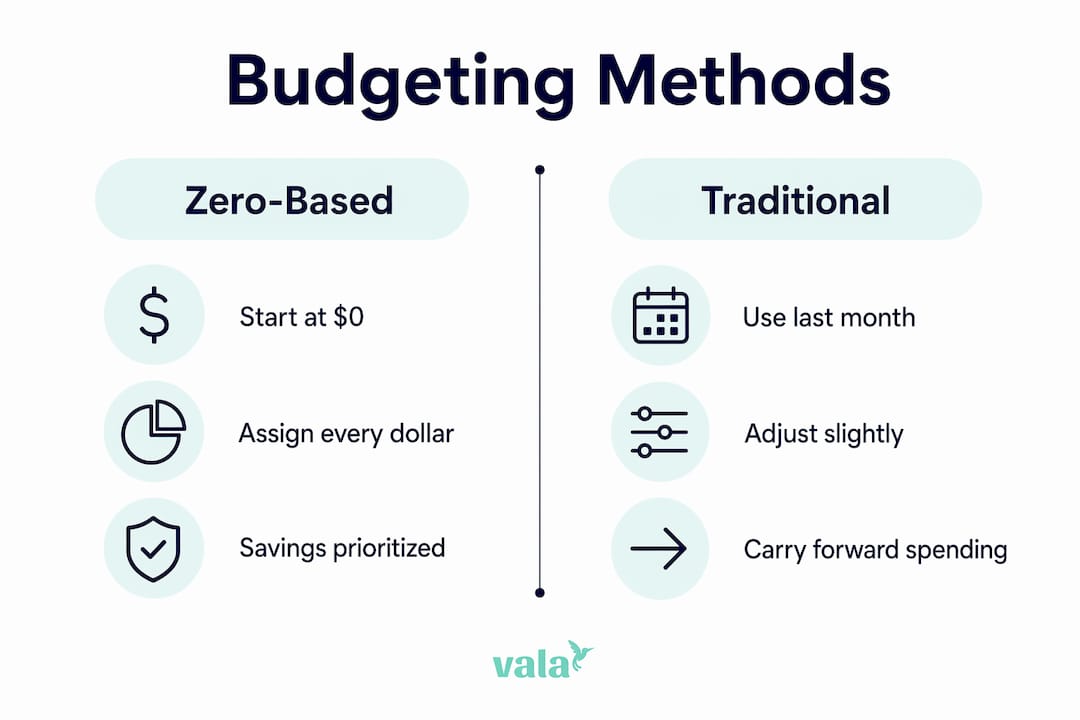
Here is how the two methods compare:
| Feature | Zero-based budgeting | Traditional budgeting |
|---|---|---|
| Starting point | $0 each month | Prior month’s budget |
| Expense justification | Required for every category | Rarely reviewed |
| Savings treatment | Assigned upfront as an expense | Often whatever is left over |
| Flexibility | Adjusts to income changes | Can lag behind real life |
| Time required | Higher, especially at first | Lower ongoing effort |
| Accountability | High, 100% of dollars tracked | Moderate |
The most meaningful difference is how savings gets treated. In a traditional budget, savings is what remains after spending. In zero-based budgeting, savings is the first thing you assign. That single shift changes your financial behavior more than any other adjustment.
Zero-based budgeting also handles variable income better than most people expect. If your income drops one month, you rebuild the budget from that lower number. Nothing carries over automatically, so you cannot accidentally overspend based on a prior month’s higher earnings.
What are the benefits and challenges of zero-based budgeting?
Zero-based budgeting delivers clear advantages, but it also comes with real demands. Knowing both sides helps you commit with realistic expectations.
The benefits:
- Full financial visibility. Tracking 100% of outflows means you always know where your money is going. Nothing hides in a vague “miscellaneous” category.
- Reduced waste. When you must justify every expense monthly, subscriptions and habits you no longer value get cut.
- Savings treated as a priority. Assigning savings before discretionary spending means it actually happens.
- Adaptable to income changes. Freelancers, gig workers, and anyone with irregular income can rebuild the budget each month to match actual earnings.
- Improved goal achievement. People who track every dollar report stronger progress toward long-term financial goals.
The challenges:
- Time investment upfront. The initial setup takes real effort, and most new budgeters need two to three months before the process feels natural.
- Requires consistent tracking. A zero-based budget falls apart if you stop checking it mid-month.
- Irregular expenses catch people off guard. Underestimating car repairs or annual fees is the most common reason budgets fail.
- Can feel restrictive at first. Assigning every dollar feels rigid until you realize you are the one deciding where each dollar goes.
“Zero-based budgeting is a tool for intentional money use, not austerity. Assign some surplus to fun and discretionary categories. A budget that has no room for enjoyment will not survive contact with real life.”
Pro Tip: Build a “buffer” category of $50–$100 each month for genuinely unexpected costs. This is not the same as a sinking fund. It is a small cushion that keeps your budget from breaking when something minor and unpredictable comes up.
How to apply zero-based budgeting in real life
Theory is useful. A concrete example is better. Here is a sample monthly budget for a family bringing home $5,000 after taxes:
| Category | Monthly amount |
|---|---|
| Rent or mortgage | $1,400 |
| Groceries | $600 |
| Utilities | $200 |
| Transportation | $350 |
| Insurance | $250 |
| Emergency fund | $300 |
| Retirement savings | $400 |
| Debt payments | $300 |
| Sinking funds (car, gifts, medical) | $200 |
| Dining and entertainment | $300 |
| Clothing and personal care | $150 |
| Buffer | $100 |
| Subscriptions | $50 |
| Miscellaneous | $100 |
| Total | $4,700 |
That leaves $300 unassigned. The correct move is to add it to the emergency fund or debt payoff, not to create new spending. Reallocating surplus to financial goals is what separates a zero-based budget from a spending free-for-all.
A few practical tips for making this work month after month:
- Review your budget every Sunday. A five-minute weekly check catches overspending before it becomes a problem.
- Use a budgeting app for real-time tracking. Manual spreadsheets work, but apps that sync with your bank accounts catch transactions you might miss.
- Rebuild from scratch each month. Do not copy last month’s budget. Spend five minutes reviewing what changed in your income or expenses first.
- Give yourself a “fun money” line. Zero-based budgeting works best when it includes guilt-free discretionary spending. Assign it deliberately rather than letting it happen by accident.
For families with variable income, use your lowest expected monthly income as the base. If you earn more, assign the extra to savings or debt. This approach keeps the budget conservative and prevents overspending in high-earning months.
Pro Tip: Set up separate expense tracking categories for each sinking fund goal. Seeing “car repairs: $80 saved of $300 target” is far more motivating than a single lump savings number.
Key Takeaways
Zero-based budgeting works because it assigns every dollar a purpose before you spend it, making savings a priority and waste nearly impossible to hide.
| Point | Details |
|---|---|
| Core formula | Income minus all expenses, savings, and debt payments must equal zero each month. |
| Savings comes first | Treat savings and debt payments as fixed expenses, not leftovers from discretionary spending. |
| Sinking funds prevent surprises | Set aside money monthly for irregular costs like car repairs, gifts, and annual subscriptions. |
| Rebuild every month | Start from zero each month rather than copying the prior budget to stay accurate. |
| Surplus goes to goals | When money is left over, increase savings or debt payments rather than creating new spending. |
Why I think most people give up on budgeting too soon
Most people quit a zero-based budget in the first six weeks. Not because the method is flawed. Because they expected it to feel easy immediately, and it does not. The upfront time commitment is real, and the first month’s budget will be wrong in at least three categories. That is not failure. That is data.
The mistake I see most often is treating the budget as a test you pass or fail. You overspend on groceries by $40, and you decide the whole system is broken. The system is not broken. You just learned that your grocery estimate was too low. Adjust it next month and move on.
The other thing most articles will not tell you: the psychological shift takes longer than the financial one. You can set up a technically correct zero-based budget in an afternoon. Getting comfortable with the idea that every dollar has a job, and that you are the one giving it that job, takes two to three months of practice. Adapting the budget each month to your actual life is what builds the habit, not perfecting the spreadsheet on day one.
My honest advice: start simpler than you think you need to. Use eight to ten categories in your first month, not twenty-five. Add detail as you get comfortable. A budget you actually use beats a perfect budget you abandon.
— SaverStride
How Valapoint makes zero-based budgeting easier
Maintaining a zero-based budget manually takes real effort. Valapoint’s personal finance app handles the heavy lifting by automatically categorizing your transactions, tracking spending in real time, and showing you exactly how much remains in each budget category.

You can assign every dollar directly inside the app, set up sinking fund goals, and get alerts before a category runs over. Valapoint also surfaces hidden spending patterns that most people never notice until they review three months of data at once. For families and individuals who want the discipline of zero-based budgeting without the spreadsheet grind, Valapoint’s budget tracking tools give you a clear, real-time picture of your money every single day.
FAQ
What does zero-based budgeting mean?
Zero-based budgeting is a method where every dollar of your monthly income is assigned to a specific category so that income minus all expenses, savings, and debt payments equals exactly zero. No money is left unallocated.
How is zero-based budgeting different from the 50/30/20 rule?
The 50/30/20 rule divides income into three broad buckets: 50% needs, 30% wants, and 20% savings. Zero-based budgeting assigns every dollar to a specific named category, giving you more detailed control and accountability than broad percentage splits.
How long does it take to learn zero-based budgeting?
Most people need two to three months before the process feels natural. The first month requires the most effort, but the time investment decreases significantly once you have a working template to adjust each month.
What happens if I have money left over at the end of the month?
Move any surplus to savings, an emergency fund, or extra debt payments rather than spending it. The goal is to account for every dollar with purpose, not to spend down to zero.
Can zero-based budgeting work with irregular income?
Yes. Build your budget using your lowest expected monthly income as the base. When you earn more than expected, assign the extra to savings or debt payoff before spending it.