
Your savings rate is defined as the percentage of your income you set aside rather than spend. It is the single most controllable variable in your financial life, and it matters more than your salary or your investment returns. The average US personal savings rate sits at just 3.5% in early 2026, well below the long-term historical average of 8.4%. That gap explains why so many working professionals feel financially stuck despite earning decent incomes. Fidelity recommends a combined 25% savings target for young professionals, covering both retirement and emergency funds. The role of savings rate in your financial plan is not a background detail. It is the engine.
How does the savings rate influence your timeline to financial independence?
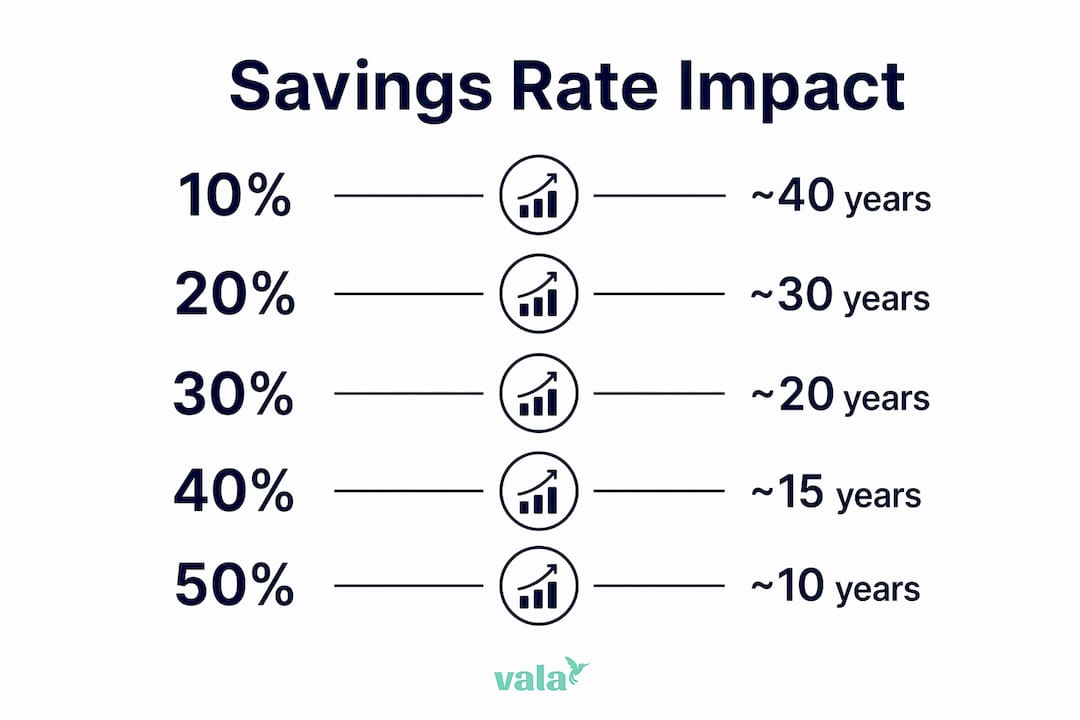
Your savings rate directly controls how fast you reach financial independence. The math is not subtle. Moving from a 10% to a 50% savings rate cuts your time to financial independence from roughly 40 years to just 17 years. That is not a small adjustment. That is a different life.
The effect is non-linear. Compounded benefits accelerate as your savings rate rises, especially once you push past 30–40%. A small increase early produces a large difference later. Every 5-point increase in your savings rate typically shortens your timeline by 1–3 years. Those years add up fast.

There is also a dual effect at work. Saving more means you invest more capital. At the same time, spending less means you need a smaller retirement portfolio to sustain your lifestyle. A higher savings rate lowers your required retirement corpus by reducing the expenses your portfolio must cover. You win on both sides of the equation.
| Savings Rate | Estimated Years to Financial Independence |
|---|---|
| 10% | ~40 years |
| 20% | ~30 years |
| 30% | ~23 years |
| 40% | ~19 years |
| 50% | ~17 years |
Pro Tip: If you can raise your savings rate by just 5% this year, you could shave 1–3 years off your working life. Start with one fixed expense you can cut or one income stream you can add.
Why savings rate matters more than investment returns early on
Your savings rate outweighs investment returns during the first decade of wealth building. The reason is simple: returns on a small portfolio produce limited absolute growth. A 10% return on $5,000 is $500. A 10% return on $50,000 is $5,000. The size of your capital base determines how much compounding can actually do for you.
During the first 10–15 years, raw contribution amounts dominate returns in driving portfolio growth. This means the hours you spend chasing the next hot stock are less productive than the hours you spend finding ways to save more. The capital base you build through consistent saving is what compounding multiplies later.
Here are four reasons your savings rate beats returns in the early years:
- Small portfolios limit compounding. A higher return percentage on a small balance still produces a small dollar gain. More savings fixes this faster than better returns.
- Savings rate is fully in your control. Market returns are not. You cannot control what the S&P 500 does next year. You can control how much you save this month.
- Consistent contributions reduce sequence risk. Regular saving smooths out market volatility by buying at multiple price points over time.
- Higher savings builds discipline. The habit of saving a larger share of income creates financial behaviors that compound beyond just the numbers.
“Chasing high investment returns early is less impactful than raising your savings rate. Building the capital base is the prerequisite for compounding to work in your favor. Without a meaningful base, even exceptional returns produce modest absolute gains.”
Young investors should prioritize consistent contributions before chasing higher returns. Get the base right first. The returns will do their job once the foundation is solid.
What is the impact of savings rate on spending habits and economic growth?
At the personal level, your savings rate shapes every spending decision you make. When you commit to saving 20% of your income, you naturally scrutinize where the other 80% goes. That scrutiny is the mechanism. It forces you to distinguish between spending that adds real value and spending that just happens.
Lifestyle inflation is the primary threat to a healthy savings rate. When income rises but spending rises proportionally, your savings rate stays flat. You earn more but get no closer to financial independence. Recognizing this pattern is the first step to breaking it.
At the macro level, aggregate savings fuel investment and economic growth. When households save, those funds flow into banks, capital markets, and businesses that create jobs and productivity. A population with a low savings rate depends heavily on debt to fund consumption, which creates fragility in downturns.
Practical spending habits that protect your savings rate:
- Automate your savings first. Transfer your target savings amount the day your paycheck arrives. Spend what remains.
- Track every category. You cannot control what you cannot see. Knowing where your money goes is the foundation of any savings improvement.
- Delay discretionary purchases by 48 hours. Most impulse spending disappears with a short waiting period.
- Review subscriptions monthly. Recurring charges are the most common source of invisible spending leaks.
- Set a lifestyle cap. When income increases, direct at least half of the raise to savings before adjusting your spending.
How to calculate, track, and improve your savings rate
Calculating your savings rate is straightforward. Divide the amount you save each month by your gross monthly income, then multiply by 100. If you earn $5,000 per month and save $750, your savings rate is 15%.
The most common mistake is counting money saved but not invested. Holding savings in low-yield cash accounts delays real wealth accumulation. Real growth requires your savings to work in growth-oriented assets that beat inflation. Saving and investing are not the same action. Both are required.
Follow these steps to build and improve your savings rate consistently:
- Calculate your current rate. Use your last three months of income and savings data to get an accurate baseline. A savings rate calculator removes the guesswork.
- Identify your biggest spending categories. Rank them by size. The top three categories almost always hold the most room for adjustment.
- Set a target rate. Fidelity’s 25% combined savings guideline is a strong benchmark. If you are far below it, aim to close the gap by 2–3 percentage points every six months.
- Automate contributions. Set up automatic transfers to savings and investment accounts. Automating your savings goals removes the decision from your monthly routine and prevents spending what you intended to save.
- Review and adjust quarterly. Your income and expenses change. Your savings rate target should reflect those changes. A quarterly review keeps you on track.
Pro Tip: Treat your savings contribution like a fixed bill. Schedule it as a non-negotiable payment to yourself on payday. This single habit change is more effective than any budgeting spreadsheet.
The benefits of personal finance automation for young adults go beyond convenience. Automation removes the emotional friction from saving. When the transfer happens automatically, you never have to choose between saving and spending in the moment.
My honest take on savings rate after years of watching people get this wrong
Most young professionals I have observed make the same mistake. They focus on earning more and assume the savings will follow naturally. They rarely do. Income growth without a deliberate savings rate target almost always produces lifestyle inflation instead of wealth.
The misconception I see most often is that a higher salary solves the savings problem. It does not. A person earning $120,000 and saving 5% builds wealth more slowly than a person earning $70,000 and saving 25%. The math is unambiguous. The savings rate is the lever, not the income number.
What actually changes outcomes is treating your savings rate as a non-negotiable percentage, not a leftover. The people who reach financial independence early are not always the highest earners. They are the ones who decided early that their savings rate was a fixed commitment, not a variable that adjusted with their mood or their month.
The mindset shift that matters most is this: your savings rate is a measure of financial efficiency, not deprivation. A high savings rate does not mean you live poorly. It means you have decided what actually matters to you and you fund that deliberately. Everything else gets cut.
Start by measuring your current rate honestly. Then raise it by one percentage point. Then another. The compounding effect of that discipline, applied consistently over a decade, produces outcomes that feel disproportionate to the effort. That is exactly the point.
— SaverStride
How Valapoint helps you track and grow your savings rate
Knowing your savings rate matters. Tracking it consistently is what produces results.

Valapoint’s personal finance app gives you a clear, real-time view of your income, expenses, and savings rate in one place. You can set savings goals, automate contributions, and see exactly which spending categories are holding your rate back. Valapoint’s AI-powered insights surface hidden spending patterns that most people miss entirely. The app is built for working professionals who want clarity without complexity. If you are ready to move your savings rate from where it is to where it needs to be, Valapoint gives you the tools to do it confidently.
Key takeaways
Your savings rate is the most controllable and impactful variable in your financial plan, and raising it consistently produces compounding results that income growth alone cannot match.
| Point | Details |
|---|---|
| Savings rate defines your timeline | Moving from 10% to 50% savings cuts time to financial independence from 40 years to 17 years. |
| Early years favor saving over returns | Raw contributions matter more than investment returns during the first 10–15 years of wealth building. |
| Lifestyle inflation is the main threat | Spending rising with income keeps your savings rate flat and stalls financial progress. |
| Automate to stay consistent | Scheduling automatic transfers removes the decision and prevents spending what you planned to save. |
| Invest what you save | Savings held in low-yield accounts lose to inflation; growth requires investing in assets that outperform it. |
Perspective
The savings rate conversation often gets reduced to a number on a spreadsheet. The real insight is that it reflects your financial priorities in concrete terms. Every percentage point you raise your savings rate is a vote for your future self over your present impulses. That is not a financial concept. It is a values decision.
FAQ
What is a good savings rate for young professionals?
Fidelity recommends a combined savings rate of 25%, split between 15% pre-tax for retirement and 10% after-tax for emergency funds. This benchmark gives young professionals a clear, achievable target for both long-term and short-term financial security.
How does savings rate affect time to financial independence?
A 10% savings rate requires roughly 40 years to reach financial independence, while a 50% savings rate cuts that timeline to approximately 17 years. The relationship is non-linear, meaning each percentage point increase produces a larger benefit as your rate rises.
Why does savings rate matter more than investment returns early on?
Early-stage portfolios are too small for returns to produce meaningful absolute growth. Increasing your savings rate builds the capital base that compounding later multiplies, making contributions far more impactful than return percentages in the first decade.
What is the biggest mistake people make with their savings rate?
The most common mistake is saving money but keeping it in low-yield cash accounts. Real wealth building requires savings to be invested in growth-oriented assets that outpace inflation over time.
How do I calculate my savings rate?
Divide your monthly savings amount by your gross monthly income and multiply by 100. For example, saving $750 from a $5,000 monthly income produces a 15% savings rate.