
Split uneven costs proportionally by what each person ordered or used, and lean on income- or room-value weighting for recurring bills like rent. Calculators and apps handle the tax, tip, and settlement math automatically, which removes most of the friction. If you want that automation built into a tool you already use for budgeting, Vala is a solid default.
TL;DR:
- Proportional-by-amount splits are ideal for restaurant bills and event costs, where each person pays based on their actual order or usage.
- Income-based splits work best for long-term household expenses like rent, requiring regular recalibration to reflect income changes.
- Digital tools such as Vala automate uneven calculations, apply tax and tip, and easily settle payments, reducing errors and manual effort.
- Netting following expense calculations minimizes the number of individual transactions, simplifying settling up among multiple people.
- Clear, written agreements on tracking, review frequency, and payment consequences help prevent conflicts over uneven expense sharing.
Table of Contents
- Which Split Method Fits Your Situation?
- How Do You Calculate an Uneven Split Step by Step?
- What Tools Actually Handle Uneven Splits Well?
- How Do You Settle Up Without Ten Venmo Requests?
- How Do You Propose an Uneven Split Without Starting a Fight?
- Real Examples You Can Copy This Week
- How I Actually Use These Methods
- Let Vala Handle the Uneven Math for You
- Practical Resources and Calculators
- Sources
Which Split Method Fits Your Situation?
Five practical methods cover almost every shared-expense situation you’ll run into.
- Equal split: divide the total by headcount. Use it when everyone ordered or used roughly the same amount, like a coffee run. Fast, but unfair the moment orders vary.
- Proportional-by-amount: each person pays for exactly what they ordered or consumed. Best for restaurant bills, event tickets, or anything with a clear per-person cost. Requires a bit more tracking.
- Income-based: each person contributes a share proportional to their income. Works well for couples or long-term roommates with different earnings. Needs trust and occasional recalibration.
- Usage-based: costs split by how much someone actually used a shared resource, like utilities tied to room size or data usage on a family phone plan. Fair, but only if usage is easy to measure.
- Hybrid/custom: a blend, such as room-value weighting plus a small income adjustment for rent. Takes more setup but tends to feel fairest for the people involved.
Proportional splits work best for one-off events; income-based splits tend to dominate recurring household costs, according to guides that track how groups actually settle bills.
How Do You Calculate an Uneven Split Step by Step?
For a restaurant bill, follow this sequence:
- List each person’s subtotal before tax and tip.
- Add up the full pretax total.
- Divide each person’s subtotal by the total to get their percentage share.
- Apply that percentage to the tax and tip, so each diner covers their proportional slice rather than splitting those extras evenly.
- Add each person’s item cost plus their share of tax and tip for their final total.
For income-proportional splits (rent, subscriptions, joint bills):
- Add both incomes together.
- Divide each person’s income by the combined total to get their percentage.
- Multiply that percentage by the total bill.
Statistic Callout: A widely cited restaurant field experiment found that diners order significantly more food when they know the bill will be split evenly, compared to when they know they’ll pay for exactly what they order. Proportional splitting isn’t just fairer on paper. It changes behavior before the check even arrives.
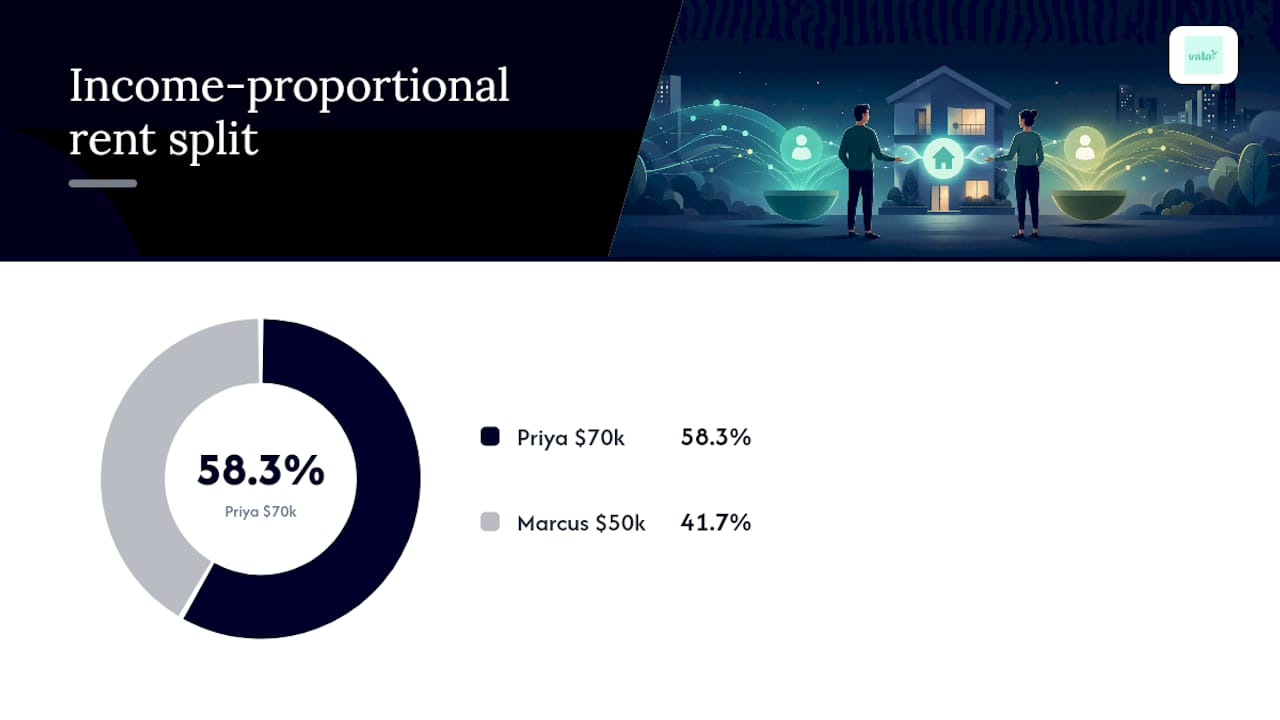
Say Priya earns $70,000 and Marcus earns $50,000. Combined income is $120,000. On a $1,000 rent bill, Priya pays $580 and Marcus pays $420.
What Tools Actually Handle Uneven Splits Well?
Three categories of tools exist, and they’re not interchangeable.
- One-off calculators: fine for a single dinner or trip. No memory, no history, no pattern tracking.
- Group-expense apps: built specifically for splitting, often with itemized “plates” for restaurant bills and settlement links to pay instantly.
- Personal finance apps with shared-ledger features: track ongoing shared costs alongside your budget, so recurring uneven splits (rent, subscriptions, groceries) don’t require a separate app every month.
When comparing options, check for itemized plate support, proportional tax and tip handling, receipt scanning, and direct settlement links that minimize the number of transfers needed to close out a balance. For anything recurring, an integrated app that already sees your budget and spending patterns beats a standalone calculator you have to remember to open every time.
How Do You Settle Up Without Ten Venmo Requests?
Settling up gets messy fast when four people all owe each other different amounts. The fix is netting: calculate each person’s overall balance first, then have only the people who owe money pay the people who are owed, skipping the in-between transfers entirely.
- Sum every expense and every payment made per person to get one net number for each participant.
- Have the person with the largest deficit pay the person with the largest surplus first, then work down the list.
- Use instant P2P transfers for one-time events and scheduled pulls from a shared account for recurring bills like rent.
- For a missed payment, set a short grace window (48 to 72 hours) before flagging it, rather than letting it quietly become someone else’s problem.
This O(n) settlement-netting approach can shrink a tangle of six or seven payments down to two or three.
How Do You Propose an Uneven Split Without Starting a Fight?
Before you finalize anything, agree on three things: who tracks the numbers, how often you’ll review the arrangement, and what happens if someone can’t pay their share on time. Guides on fair bill splitting consistently recommend revisiting the agreement whenever income or household composition changes, not just once a year on autopilot.
Pro Tip: Write the agreement down, even if it’s just a shared note. “He said, she said” is where most roommate and couple money fights actually start.
Real Examples You Can Copy This Week
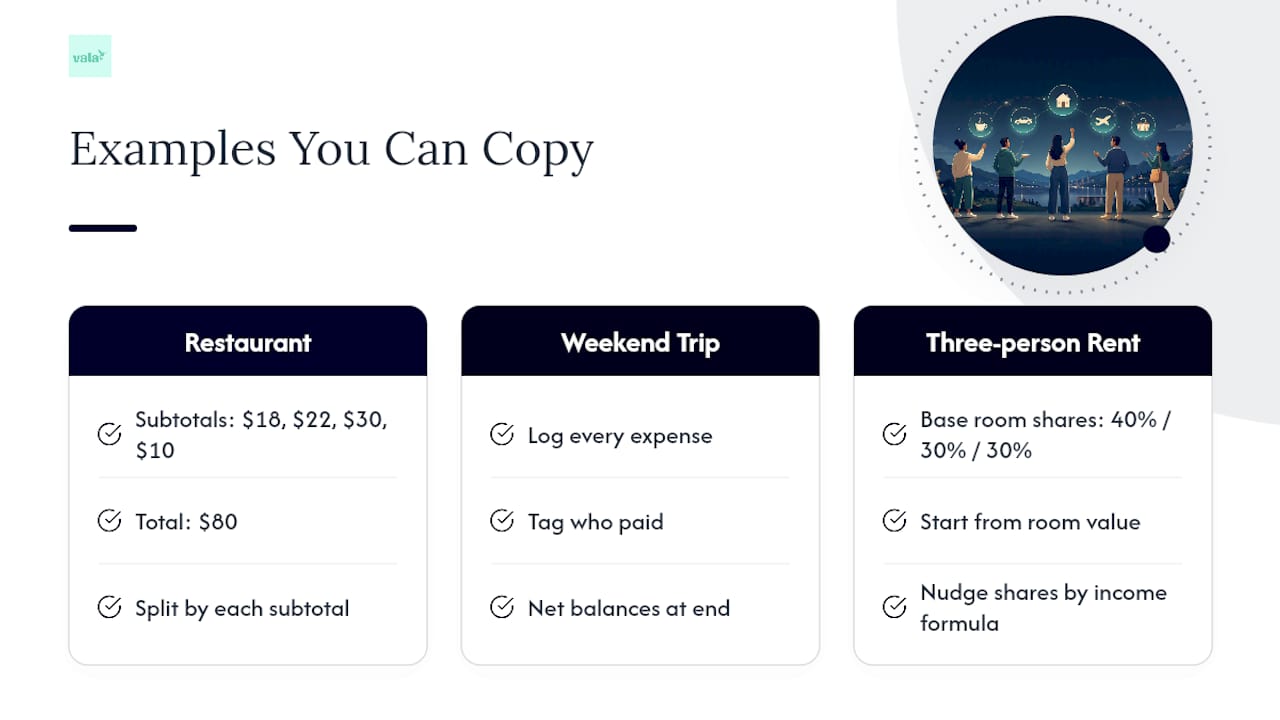
Restaurant with four friends: subtotals are $18, $22, $30, and $10 ($80 total).
Weekend trip with three people: log every expense the moment it happens, tag who paid, and assign participants to each cost (not everyone joins every meal). At the end, net the balances instead of settling each expense individually.
Three-person rent split: combine room value and income. If Room A is worth 40% of the unit’s value and Room B and C are each worth 30%, start there, then nudge each share up or down slightly based on income differences using the income-proportional formula.
How I Actually Use These Methods
I split a lake house week with five people using a hybrid: proportional-by-amount for groceries and restaurant runs, straight equal split for the shared cabin rental. It cut arguments to almost zero because nobody had to negotiate every transaction.
The lesson: keep the rules simple enough that you can explain them in one sentence. Complicated fairness formulas fall apart the moment someone’s tired or distracted. Vala’s roommate splitting guide has templates if you want a starting point instead of building one from scratch.
— SaverStride
Let Vala Handle the Uneven Math for You
Vala is built for exactly the situations covered here: uneven restaurant bills, income-weighted rent, and shared trip costs that don’t split evenly by headcount. It calculates proportional shares automatically, applies tax and tip based on what each person actually ordered, and generates settlement links so nobody has to do mental math at the table.

Beyond one-off splits, Vala tracks recurring shared costs inside your regular budget, so income-based rent shares or hybrid roommate arrangements update automatically instead of requiring a fresh calculation every month. That’s the real advantage over a standalone calculator: Vala already knows your spending patterns, so uneven splits stay accurate as incomes or living situations change.
If you’re managing shared costs with a partner, roommates, or a travel group, try the split bills app with your group this week and see how much time it saves at settlement.
Practical Resources and Calculators
- Uneven Split Calculator for quick proportional restaurant math.
- Split Expenses by Income for a step-by-step income-weighted formula.
- Benefits of Digital Expense Splitting Apps for a deeper look at app features worth comparing.
Sources
- The Complete Guide to Splitting Expenses Fairly (2026) | SplitGenius AI
- How to Split Shared Expenses Fairly: Methods and Apps for Roommates, Trips, and Families | Spark
- 4 Ways to Split Bills Fairly in 2026 | Gerald