
Saving money is hard because your brain is wired to favor immediate rewards while modern expenses and invisible spending quietly drain your ability to plan ahead. Behavioral scientists call this scarcity of attention: when your mental bandwidth is consumed by daily survival, long-term goals lose the fight every time. Add in the fact that consumer prices rose 3.0% year over year as measured by the Bureau of Labor Statistics, and you get a squeeze that has nothing to do with your willpower.
The single highest-leverage fix isn’t a budgeting app you check daily or a New Year’s resolution. It’s automation. Treat savings like a fixed bill using a version of the 50/30/20 rule, where a set percentage leaves your checking account the moment you get paid, before you ever see it.
Here’s what we’ll cover:
- Why your brain and the economy both work against you
- The exact strategies that counter each barrier
- A 30 and 90 day plan to make saving automatic, not effortful
Key Takeaways
Saving money is hard because present bias, economic pressure from inflation, and the absence of automated systems combine to make future-focused choices consistently lose to immediate ones.
| Point | Details |
|---|---|
| Automate first | Set a savings transfer to trigger the day you get paid, removing the decision entirely. |
| Treat savings as a bill | Use a framework like 50/30/20 so savings gets a fixed slot, not the leftovers. |
| Attack the Big Three | Housing, transportation, and food offer far bigger savings than trimming small purchases. |
| Sequence debt correctly | Pay down high-interest debt first, but keep a small starter emergency buffer. |
| Use tools that close the attention gap | Apps like Vala automate transfers, detect subscription leaks, and track goals visually so the system runs without daily willpower. |
Table of Contents
- Why Is Saving Money So Hard? The Psychological, Economic, and Practical Barriers
- How to Overcome the Biggest Obstacles to Saving Money
- Your 30 and 90 Day Plan to Start Saving Automatically
- What to Look for in Savings Tools and Accounts
- How Automation Closes the Attention Gap
- Why Financial Literacy Still Matters When You Automate Everything
- How Stress and Mental Health Shape Your Spending Habits
- How to Curb Impulse Spending and Build Self-Control
- How Family and Culture Shape the Way You Save
- Why Your Savings Goals Need to Be Specific to You
- A Note on Why This Advice Works
- Let Vala Handle the Automation While You Keep the Progress
- Frequently Asked Questions About Why Saving Money Is So Hard
- Sources
Why Is Saving Money So Hard? The Psychological, Economic, and Practical Barriers
Three different forces are working against you at once, and most advice only addresses one of them. That’s why so much of it fails.
The psychological traps
Your brain didn’t evolve for direct deposits and 401(k)s. It evolved to grab resources now, because “later” used to mean “maybe never.” This shows up in a few specific, well-documented ways.
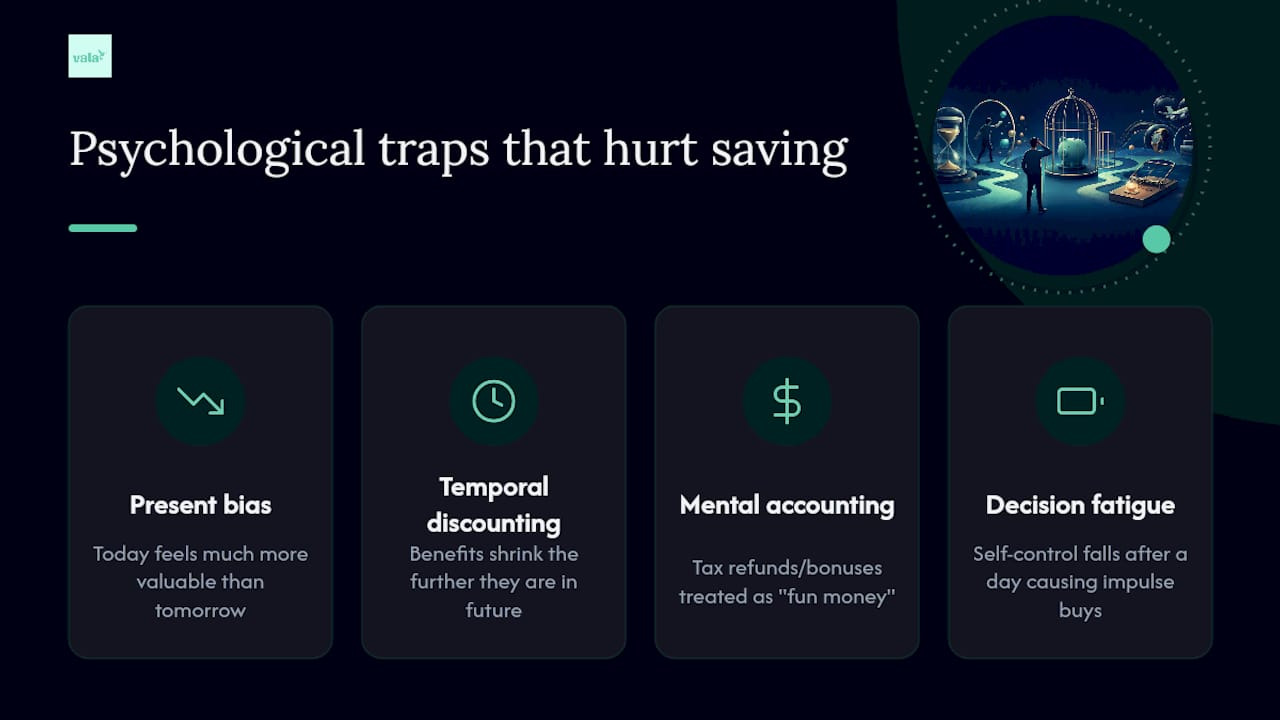
Present bias makes a reward today feel disproportionately more valuable than the same reward next month, even when the math says otherwise. Temporal discounting is the mechanism behind it: the further away a benefit sits on the calendar, the smaller it feels in your head, which is why “future you” always seems to get shortchanged by “today you.” Add mental accounting, where you treat a tax refund or a bonus as “fun money” instead of real money simply because of where it came from, and you’ve got a brain that sabotages its own long-term interests on a near-daily basis. Layer on decision fatigue, the well-known drop in self-control that hits after a full day of choices, and you get the classic 9 p.m. online-shopping cart that seemed like a great idea in the moment. Behavioral research on saving psychology confirms these four mechanisms explain much of why people who genuinely want to save still don’t.
The economic pressure
Even a disciplined saver is fighting a headwind that has nothing to do with mindset. Wage growth has lagged behind inflation in recent years, meaning the same paycheck buys less than it used to. That gap shows up hardest in three categories: housing, transportation, and food, sometimes called the “Big Three.” These aren’t discretionary line items you can trim with a coupon. They’re structural, and they eat the largest share of most household budgets before anything else gets a chance.
By the numbers: Consumer prices climbed 3.0% between June 2023 and June 2024, according to the Bureau of Labor Statistics. That’s not a one-time spike. It’s the kind of steady erosion that makes “just spend less” feel like advice from a different decade.
The practical gaps
Beyond psychology and economics, most people are also missing basic infrastructure. Consider what’s usually absent:
- No written budget, so spending decisions happen in the moment with no reference point
- No emergency fund, which turns every minor crisis into a credit card balance
- High-interest debt already eating whatever margin exists in the monthly budget
- Recurring subscriptions still charging for services nobody remembers signing up for
- No specific savings goal, which makes “saving” feel abstract instead of urgent
None of these gaps are moral failures. They’re the predictable result of systems that were never built in the first place. A household without an emergency fund isn’t undisciplined; it’s unprotected. And once you see the problem that way, the fix stops being “try harder” and starts being “build the system.”
How to Overcome the Biggest Obstacles to Saving Money
Each barrier above has a specific, evidence-based countermeasure. You don’t need to fix everything simultaneously. You need to sequence it correctly.
1. Automate the transfer before you can spend the money.
This is the countermeasure to present bias, and it’s not optional advice, it’s the core mechanism. Automating savings removes the moment of decision entirely, which means willpower never gets a vote. Time the transfer to hit your account the same day you get paid, not three days later. Waiting even a few days gives decision fatigue and mental accounting a window to spend the money first.
2. Choose a percentage you can actually sustain, then raise it slowly.
Behavioral guidance suggests starting small and increasing gradually, routing a portion of every raise straight into savings before your lifestyle adjusts to the new number.
3. Pick the right account for the right goal.
A high-yield savings account works for your emergency fund because it needs to stay liquid but shouldn’t sit in a checking account tempting you. Longer-term goals can tolerate less liquidity in exchange for better growth. The mistake most people make is using one account for everything, which makes it impossible to tell “emergency money” from “vacation money” from “just sitting here.”
4. Treat your savings transfer as a bill, not a leftover.
The 50/30/20 framework works because it assigns savings a fixed slot in your budget instead of hoping something is left over at the end of the month. Nothing is ever left over at the end of the month. That’s not a character flaw, it’s just how spending works when savings comes last.
5. Sequence your debt payoff correctly.
That said, debt guidance from consumer credit counselors consistently recommends keeping a small starter buffer, even just a few hundred dollars, so a flat tire doesn’t send you right back to the card you’re trying to pay off.
6. Attack the Big Three before you touch your coffee budget.
Housing, transportation, and food dwarf every discretionary category combined, and cutting fixed costs in these areas produces bigger, more durable savings than trimming small purchases ever will. Refinancing a car loan or negotiating rent renewal terms moves the needle in a way that skipping lattes simply cannot.
7. Hunt down subscription leakage once a quarter.
Streaming services, app trials, and forgotten memberships bleed money silently because they never require a new decision, they just renew. Set a recurring reminder to scan your statements and cancel anything you can’t immediately justify.
8. Use commitment devices and visualization to support future-you.
Naming your savings account “House Down Payment” instead of “Savings 2” makes the goal concrete. Some people set phone lock screens with a savings target, or use apps that visualize the goal directly. These are small nudges, but they consistently outperform vague intentions.
Pro Tip: Set your automated transfer to trigger the same morning your paycheck lands, not on a set date later in the month. Decision fatigue tends to spike in the evening, so money that’s already moved by breakfast never gets the chance to compete with an impulse purchase at 9 p.m.
Your 30 and 90 Day Plan to Start Saving Automatically
You don’t need a five-year plan to start. You need the first seven days mapped out clearly, and a checkpoint to catch problems early.
First 7 days:
- Open a high-yield savings account separate from your checking account.
- Set up one automated transfer, even a small one, timed to your next payday.
- Identify one recurring subscription you don’t use and cancel it.
First paycheck after setup:
- Confirm the automated transfer actually triggered on payday, not days later.
- Label your savings account with a specific goal instead of a generic name.
- Set a visible target balance you can check weekly, not just at month end.
30-day checkpoint:
Review where your money actually went against what you expected. Confirm the automation ran without you having to think about it, and adjust the transfer amount up or down based on what felt sustainable versus what felt punishing.
90-day outcomes to expect:
- A starter emergency buffer in the range of $500 to $1,500, depending on your transfer size
- Measurably fewer recurring charges than when you started
- A transfer habit that no longer requires active attention, which is the actual goal
The point of the 90-day marker isn’t a finish line. It’s proof that the system runs without you white-knuckling it every week.
What to Look for in Savings Tools and Accounts
The right account and app combination does the heavy lifting your willpower shouldn’t have to. A high-yield savings account handles your emergency fund, while separate labeled “bucket” accounts keep individual goals like travel or a down payment from blending into one anonymous pile of money.
When evaluating an app, prioritize features that close the attention gap rather than ones that just display more charts:
- Automatic recurring transfers you set once and forget
- Subscription detection that flags charges you forgot existed
- Spending-insight dashboards that surface patterns, not just totals
- Visual goal tracking that shows progress toward a named target
Vanguard’s guidance on building savings habits emphasizes tracking spending and automating transfers as the two moves that consistently move the needle, more than any single budgeting philosophy.
Before opening any new account, confirm it carries FDIC insurance (or NCUA for credit unions), and check that any investment component is covered under standard FINRA and SIPC protections.
How Automation Closes the Attention Gap
Attention is the scarcest resource in personal finance, not money itself. Every recurring decision, whether to transfer, whether to cancel a subscription, is a chance for present bias to win. Automation removes the decision entirely.
Look for tools that combine:
- Automatic, rule-based transfers tied to payday
- Subscription detection that flags forgotten charges
- Group and shared expense splitting for couples or roommates
- Visual goal tracking tied to specific targets
Pro Tip: The fewer decisions your savings plan requires each month, the longer it survives contact with real life. For a deeper walkthrough, see how to automate personal savings goals or how AI insights uncover hidden spending leaks.
Why Financial Literacy Still Matters When You Automate Everything
Automation handles behavior, but financial education shapes the decisions behind the automation. Someone who understands how credit utilization affects their score makes a smarter call about which debt to pay down first.
This isn’t about becoming a spreadsheet expert. It’s about understanding enough to set the right transfer amount, choose the right account type, and recognize when a “great deal” on a financing offer is actually a trap. Financial literacy also changes how people interpret setbacks. A saver who understands that markets and expenses fluctuate treats a bad month as noise, not failure, and stays on track instead of abandoning the plan entirely.
Schools rarely teach this material in depth, which means most adults build their financial knowledge reactively, usually after a costly mistake. That gap is exactly why pairing automation with even basic financial education produces better outcomes than automation alone: the system runs itself, but an informed person adjusts it intelligently when circumstances change. Reading a few reputable sources, checking a savings calculator before committing to a number, or understanding your own spending categories all count as literacy in action, not just theory.
How Stress and Mental Health Shape Your Spending Habits
Stress doesn’t just make saving harder emotionally, it changes financial behavior directly. Elevated stress narrows decision-making toward short-term relief, which is precisely the kind of thinking present bias thrives on. A stressful day makes a $40 impulse purchase feel like self-care instead of a budget hit, because in that moment, it genuinely is providing relief.

Chronic financial stress also creates a feedback loop: money worry causes stress, stress causes avoidance (unopened bills, unchecked account balances), and avoidance causes more financial problems, which causes more stress. Breaking that loop rarely happens through willpower alone. It usually requires removing the need for a stressed brain to make a good decision in the first place, which circles back to automation.
Anxiety around money can also cause the opposite problem: excessive checking, obsessive budgeting that never feels like enough, or paralysis where no financial decision gets made at all because every option feels risky. If checking your balance triggers dread rather than curiosity, that’s a signal to simplify your system, not add more manual tracking to it. Fewer decisions, not more vigilance, is usually the answer when stress is already high.
How to Curb Impulse Spending and Build Self-Control
Impulse spending isn’t a willpower problem so much as a friction problem. The easier it is to buy something in the moment, the more often you will, regardless of how disciplined you consider yourself.
A few tactics consistently outperform “just try harder”:
- Add friction deliberately. Remove saved payment methods from shopping apps so checkout requires manually entering card details every time.
- Use a 24-hour rule for non-essential purchases over a set amount. Present bias fades fast once the “now” moment passes.
- Reroute the impulse, not just block it. Some people transfer the exact dollar amount of a resisted purchase straight into savings, turning restraint into visible progress.
- Avoid decision fatigue windows. Shopping while tired, hungry, or late at night reliably produces worse financial choices, so build in a personal rule against browsing during those hours.
None of these require becoming a different person. They require making the impulsive choice slightly harder and the disciplined choice slightly easier, which is basic behavioral design, not moral improvement.
How Family and Culture Shape the Way You Save
The way you relate to money was largely set before you ever earned a paycheck. Households that talked openly about budgeting tend to raise adults who see saving as routine rather than aspirational. Households where money was a source of secrecy or conflict often raise adults who either avoid financial planning entirely or overcorrect into anxious over-control.
Cultural context adds another layer. Some cultures emphasize collective financial support, where saving individually competes with an expectation to support extended family. Others treat visible spending as a status marker, which puts direct social pressure against saving. Neither pattern is a flaw to fix; they’re context that shapes what “realistic” saving actually looks like for a given household.
Recognizing where your own habits came from is useful, not as therapy, but as diagnosis. If you avoid checking your bank balance, that avoidance likely has a history. Naming it makes it easier to build a system, like automation, that doesn’t depend on you confronting that discomfort every single day.
Why Your Savings Goals Need to Be Specific to You
A generic goal like “save more” fails almost immediately because it gives your brain nothing concrete to weigh against today’s spending temptation. A specific goal, like $3,000 for a security deposit by October, gives future-you a tangible reason to win the argument against present-you.
Realistic also means personalized. A savings rate that works for a dual-income household with no debt will crush a single earner carrying student loans. Setting your target based on your own numbers, not a generic percentage from an article, is what makes the goal survive contact with a real month. Tools that help you set targets that actually stick tend to break big goals into smaller milestones for exactly this reason: a $10,000 goal is abstract, but $833 a month for a year is a number you can actually hit.
A Note on Why This Advice Works
Most saving advice fails because it asks you to out-argue your own brain every single day, and your brain has a home-field advantage. The conventional wisdom, track every purchase, feel guilty about the coffee, review your budget nightly, treats saving as a discipline problem. It isn’t. It’s a design problem.
What actually works is removing the decision, not winning it. That’s the uncomfortable part of this article for anyone who’s been told that saving is about character: it mostly isn’t. It’s about whether your system requires you to be strong at 9 p.m. on a stressful Tuesday, or whether the money already moved that morning while you were still deciding what to have for breakfast.
If you take away one thing, let it be this: start with a transfer so small it’s almost insulting, $10, $20, and automate it today. The amount matters less than proving to yourself the system works before you try to scale it.
Let Vala Handle the Automation While You Keep the Progress
You’ve just read exactly what needs to happen: automate the transfer, kill the subscription leaks, and track goals visually so future-you doesn’t have to fight present-you every day. Vala is built to do precisely that, without asking you to change how you already spend.

Inside the app, Vala automates transfers around your payday, scans your recurring charges to flag subscriptions you forgot about, and shows spending patterns you’d otherwise miss entirely. Couples and roommates can split shared costs without the group chat math, and goal tracking turns an abstract number into a visible target you actually watch grow. If you’re not sure where your money leaks first, the Financial DNA Test gives you a clear read on your spending style before you set a single automation rule.
In your first week, expect to see your recurring charges laid out plainly and your first automated transfer already scheduled. Start with the Vala personal finance app and set up your first automatic transfer today.
Frequently Asked Questions About Why Saving Money Is So Hard
Why is saving money so hard even when I have a decent income?
Income level matters less than automation. Present bias and decision fatigue affect high earners just as much as anyone else, and without a fixed, automatic transfer, discretionary spending tends to expand to match whatever is available in checking.
Why is it so hard to save money during periods of high inflation?
Rising prices on essentials like housing, food, and transportation shrink the margin left over after fixed costs, even when your paycheck stays the same. That’s a structural pressure, not a spending habit, and it responds better to cutting the Big Three than trimming small purchases.
What’s the fastest way to fix struggles with saving money?
Set up one automated transfer timed to your payday and choose a percentage you can sustain without feeling punished. Consistency over months matters more than the size of any single transfer.
Should I pay off debt or save money first?
High-interest credit card debt usually comes first because its interest rate outpaces what a savings account can earn, but keep a small starter buffer of a few hundred dollars so an unexpected expense doesn’t send you back to the card.
How does the 50/30/20 rule help with saving strategies for success?
Sources
- Why saving money is so hard — Harvard Growth Policy Center (Sendhil Mullainathan commentary)
- Consumer prices up 3.0 percent from June 2023 to June 2024 — BLS
- The psychology of saving money: why we struggle and how to change — Simply Psychology
- 50/30/20 rule — UNFCU financial wellness guidance