
A financial goal timeline is a structured schedule that assigns specific deadlines and saving targets to each of your money goals, turning vague intentions into a measurable saving schedule. Without a timeline, goals like “save more” or “pay off debt” stay abstract. With one, you know exactly how much to set aside each month and when you expect to reach each milestone. This guide covers how to build a financial goal timeline from scratch, which accounts to use, and how to keep your plan on track as life changes. Whether you are 22 or 42, the framework is the same.
What is a financial goal timeline and why does it matter?
A financial goal timeline is the time-bound framework that connects your money goals to specific deadlines and saving strategies. Fidelity describes this as giving each goal a “due by” date that makes it quantifiable and trackable. That shift from “someday” to “by March 2028” changes how you budget, save, and prioritize.
Financial timelines also reduce decision fatigue by helping you sequence goals across short, medium, and long-term horizons. Instead of trying to fund everything at once, you work through a logical order. Emergency fund first, then a car, then a home down payment, then retirement. Each milestone builds on the last.

The importance of financial timelines goes beyond motivation. A timeline forces you to calculate a real saving rate. Fidelity illustrates this clearly: “save for a down payment” is a wish, but “$24,000 in 4 years at $500 per month” is a plan. That specificity is what separates people who reach their goals from those who keep postponing them.
What are the common financial goal timeline horizons?
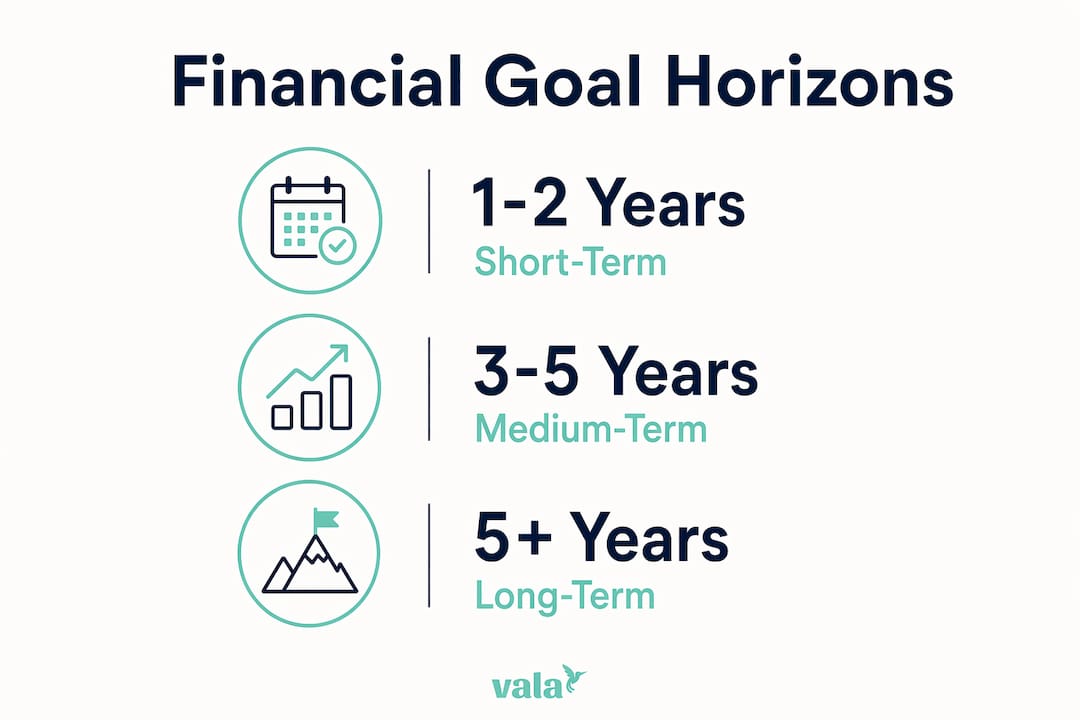
Financial goals are organized into three standard horizons: short-term (up to 1 to 2 years), medium-term (3 to 5 years), and long-term (5 or more years). Each horizon calls for a different savings approach, account type, and level of urgency.
Short-term goals are immediate priorities. Building a $1,000 starter emergency fund, paying off a credit card, or saving for a vacation all fit here. These goals need liquid accounts because you will access the money soon. Medium-term goals require more planning. Buying a car, funding a home down payment, or covering a wedding typically take 3 to 5 years of consistent saving. Long-term goals, like retirement or funding a child’s college education, benefit from investment growth over decades.
The table below maps each horizon to typical examples and the saving approach that fits best.
| Timeline horizon | Typical examples | Recommended approach |
|---|---|---|
| Short-term (1 to 2 years) | Emergency fund, credit card payoff, vacation | High-yield savings account, money market |
| Medium-term (3 to 5 years) | Car purchase, home down payment, wedding | CDs, short-term bond funds, high-yield savings |
| Long-term (5+ years) | Retirement, college funding, financial independence | 401(k), IRA, index funds, brokerage accounts |
Understanding these categories is the first step in creating a financial roadmap that actually works. You stop treating all goals as equally urgent and start funding them in the right order with the right tools.
How to create a financial goal timeline using SMART goals
Building a financial planning timeline is a step-by-step process. The SMART framework, which stands for Specific, Measurable, Achievable, Relevant, and Time-bound, is the most widely recommended structure. NerdWallet and Fidelity both suggest SMART-style goal setting as the foundation for clear tracking and realistic planning.
Here is how to build your timeline from the gtrack savings goals:
- List every financial goal you have. Write them all down without filtering. Include small goals like a new laptop and large ones like buying a home.
- Assign a target amount to each goal. Vague goals cannot be funded. “Save for retirement” becomes “accumulate $800,000 by age 65.”
- Set a specific deadline for each goal. Use a month and year, not just “in a few years.” This creates the time-bound element that makes SMART goals work.
- Calculate the monthly saving rate required. Divide the total amount by the number of months until your deadline. This tells you exactly what each goal costs per month.
- Prioritize goals by urgency and importance. An emergency fund comes before a vacation fund. Retirement saving starts before a luxury purchase.
- Link each goal to a budget category. Fidelity’s 60/30/10+15 budgeting framework allocates income across essentials, nonessentials, near-term goals, and retirement. Plugging your goals into a budget structure keeps them funded consistently.
- Schedule quarterly check-ins. Set a recurring calendar reminder every three months to review progress and adjust contributions if needed.
Pro Tip: Automate your contributions the day after your paycheck lands. Tools like Valapoint’s goal planning features remove the temptation to spend first and save what is left. Automation is the single most reliable way to stay on schedule.
Why regular reviews keep your timeline on track
A financial goal timeline is not a contract. It is a living plan that needs regular attention. Ann Dowd, CFP, frames financial planning as an ongoing, adaptable process that must be revisited as life events occur. A job change, a new baby, or an unexpected expense can all shift your priorities overnight.
The right review cadence depends on your goal horizon:
- Monthly: Check your spending against your budget and confirm contributions are hitting each goal account.
- Quarterly: Review short-term goal progress. Catch drift early before it compounds into a missed deadline.
- Semiannually: Assess medium-term goals. Adjust contribution amounts if your income or expenses have changed.
- Annually: Conduct a full review of all goals. Fidelity recommends annual reviews that include rebalancing risk, reassessing priorities, and updating deadlines.
Common mistakes include treating timelines as rigid schedules that cannot flex, ignoring cash flow changes until a goal falls apart, and skipping reviews entirely because progress feels slow. Frequent milestone checks prevent goals from drifting behind even when contributions continue. The numbers can look fine on paper while the timeline quietly slips.
Pro Tip: Use a budget goal tracker that sends automated reminders for your review dates. Valapoint’s app lets you set milestone alerts so you never miss a scheduled check-in.
How to match your timeline to the right accounts
Choosing the right account for each goal is as important as setting the deadline. Separating goals by account liquidity prevents two costly problems: paying penalties for early withdrawal and missing growth opportunities by keeping long-term money in low-yield accounts.
Short-term goals need accounts you can access quickly without penalty. A high-yield savings account or money market account works well here. These options offer better interest than a standard checking account while keeping your money available. Certificates of deposit, or CDs, work for medium-term goals when you know you will not need the money for 12 to 36 months. The fixed rate and term structure match the predictable nature of medium-term saving.
Long-term goals belong in investment accounts. A 401(k) or IRA gives your money decades to grow through compound returns. The risk tolerance is higher because you have time to recover from market dips. Keeping retirement money in a savings account, by contrast, costs you years of compound growth.
The table below maps goal types to the accounts that fit each timeline best.
| Goal type | Recommended account | Key benefit |
|---|---|---|
| Emergency fund (short-term) | High-yield savings account | Liquid, no penalty, earns interest |
| Vacation or car fund (short-term) | Money market account | Accessible with slightly higher yield |
| Home down payment (medium-term) | CD or short-term bond fund | Fixed growth, predictable timeline |
| Retirement (long-term) | 401(k) or IRA | Tax advantages, compound growth |
| College funding (long-term) | 529 plan or brokerage account | Tax-free growth for education expenses |
Mismatching accounts to timelines is one of the most common and costly planning errors. Pulling money from a 401(k) early triggers a 10% penalty plus income tax. Keeping a 20-year goal in a savings account means leaving significant growth on the table. Connecting your timeline goals to specific accounts is what turns a good plan into one that actually delivers.
You can use Valapoint’s financial planning tools to calculate how much each goal requires and which account structure fits your timeline.
Key takeaways
A financial goal timeline works because it converts abstract goals into specific amounts, deadlines, and monthly contributions tied to the right accounts and reviewed on a consistent schedule.
| Point | Details |
|---|---|
| Define goals with deadlines | Assign a specific amount and target date to every goal to make it fundable and trackable. |
| Use the three-horizon model | Organize goals as short-term (1 to 2 years), medium-term (3 to 5 years), and long-term (5+ years). |
| Apply SMART goal structure | Time-bound, measurable goals with monthly contribution targets prevent underfunding and missed deadlines. |
| Match accounts to timelines | Use liquid accounts for short-term goals and investment accounts for long-term growth to avoid penalties. |
| Review on a regular cadence | Monthly spending checks, quarterly goal reviews, and annual full assessments keep your timeline realistic. |
My honest take on financial goal timelines
I have seen a lot of people build detailed financial timelines and then abandon them within three months. The reason is almost never a lack of discipline. It is that the timeline was built as a rigid contract instead of a flexible framework.
The most important shift you can make is treating your timeline as a guide, not a grade. Missing a monthly contribution because of an unexpected car repair does not mean your plan failed. It means you adjust the deadline by a month and keep moving. Treating timelines as adjustable frameworks rather than fixed contracts is what separates people who eventually reach their goals from those who give up after the first setback.
I also believe most people underestimate how much the emergency fund changes everything. Fidelity recommends starting with $1,000 and building toward 3 to 6 months of expenses. That first milestone is not just a financial cushion. It is the gate that protects every other goal on your timeline. Without it, one bad month wipes out months of progress on your other goals.
Start simple. One goal, one account, one automated transfer. Add complexity as your confidence grows. The timeline is there to support you, not stress you out.
— SaverStride
Track your financial goal timeline with Valapoint
Building a timeline is the first step. Sticking to it is where most people need support.

Valapoint’s personal finance app gives you the tools to set goals, assign deadlines, and track progress in real time. You can link each goal to a budget category, set automated contribution reminders, and get alerts when a milestone is approaching or at risk. The app surfaces spending patterns that quietly drain your goal funds, so you can redirect that money where it actually matters. Whether you are saving for an emergency fund or planning for retirement, Valapoint keeps your financial goal timeline visible and on track every single day.
FAQ
What is a financial goal timeline?
A financial goal timeline is a structured plan that assigns specific deadlines and saving targets to each financial goal, turning intentions into a measurable schedule. Fidelity defines this as giving each goal a “due by” date that makes progress quantifiable and trackable.
What are short-term vs long-term financial goals?
Short-term goals cover a 1 to 2 year horizon and include things like building an emergency fund or paying off a credit card. Long-term goals span 5 or more years and typically include retirement savings, college funding, or financial independence.
How often should I review my financial goal timeline?
Fidelity recommends reviewing your full financial plan at least annually, with more frequent checks quarterly for short-term goals and semiannually for medium-term ones. Regular reviews catch drift early and keep your timeline realistic as income or expenses change.
What accounts should I use for different financial goals?
Short-term goals belong in high-yield savings or money market accounts for easy access without penalties. Long-term goals like retirement are best held in a 401(k) or IRA where compound growth and tax advantages work in your favor over decades.
How do I start building a financial goal timeline?
List every goal, assign a specific dollar amount and deadline to each, calculate the monthly saving rate required, and link each goal to a budget category. Starting with a monthly budget planner helps you see exactly how much room you have to fund each goal on your timeline.