
A spending limit is a maximum cap on spending for a specific category, transaction, or time period, designed to prevent overspending and build budget discipline. Most people confuse it with a credit limit, but the two are fundamentally different tools. Understanding spending limits gives you direct control over your money, whether you use PayPal, Discover, a digital banking app, or a personal finance tool like Valapoint. The average U.S. credit limit reached approximately $29,855 in 2023. That number shows how much borrowing power most Americans carry, and why a personal spending limit matters even more.
How do spending limits differ from credit limits?
A credit limit is the maximum amount a card issuer allows you to borrow. A spending limit is the maximum you allow yourself to spend, and it sits below that issuer-assigned ceiling. The spending limit definition, in practical terms, is a self-imposed or app-enforced guardrail that keeps your actual charges well under your credit ceiling.
Credit limits vary widely, from $300 for first-time cardholders to $20,000 or more for premium cards. Spending limits, by contrast, are set by you based on your budget, not your borrowing capacity. That distinction matters because your credit utilization ratio, the percentage of your credit line you actually use, directly affects your credit score.

Requesting a lower credit limit from your issuer can actually hurt your credit utilization ratio. A better approach is to keep your issuer-assigned limit intact and set a personal spending cap well below it. Discover’s financial experts recommend this strategy specifically to protect credit health.
Here is a clear comparison of the two concepts:
| Feature | Credit Limit | Spending Limit |
|---|---|---|
| Set by | Card issuer | You or your app |
| Purpose | Defines max borrowing | Controls actual spending |
| Effect on credit score | Directly tied to utilization | Indirect, protects utilization |
| Flexibility | Requires issuer approval | Adjustable anytime |
| Example | $10,000 Discover card limit | $500 monthly grocery cap |
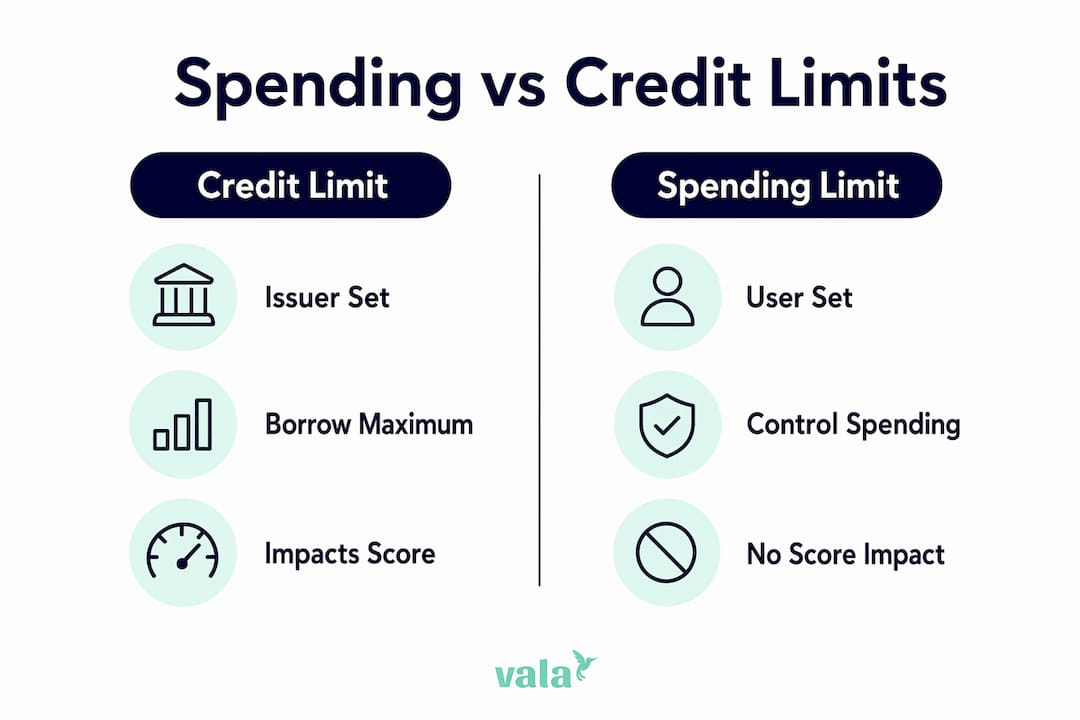
Keeping your spending limit at or below 30% of your credit line is the standard recommendation for maintaining a healthy credit score. That means on a $10,000 credit line, your personal spending cap should stay at or under $3,000 per billing cycle.
What are the common types of spending limits?
Spending limits come in several forms, and each serves a different budgeting need. Knowing which type fits your situation helps you apply them correctly.
- Per-transaction limits cap a single purchase at a set dollar amount. For example, you might block any single charge above $200 without a secondary approval step.
- Daily limits restrict total spending within a 24-hour window. Many digital banking apps let you set a $150 daily cap on debit card purchases.
- Weekly limits divide your monthly budget by approximately 4.3 weeks. This approach gives you more frequent checkpoints than a monthly budget.
- Monthly limits are the most common personal budget limits. They align with billing cycles and income schedules.
- Merchant category limits restrict spending by type, such as capping restaurant charges at $200 per month while leaving grocery spending unrestricted.
- Authorized user limits let account holders assign a lower spending cap to a partner, family member, or employee on the same account.
Offline chip transactions create a specific challenge called “limit drift.” When a card reader processes a transaction offline, the charge does not hit your account in real time. Small offline transactions can temporarily push you past your set limit before the system reconciles. This is a known gap in spending limit enforcement that most budgeters do not anticipate.
Pro Tip: Set your per-transaction alert threshold lower than your actual limit. If your daily cap is $100, set an alert at $75. That buffer gives you time to pause before you hit the ceiling.
How to set a spending limit that actually works
Setting a spending limit takes more than picking a number. A limit that is too tight breaks down under real-life pressure. A limit that is too loose does nothing. Here is a practical process for getting it right.
- Calculate your baseline. Review the last 60–90 days of spending in each category. Use an automated expense tracker to pull this data without manual work.
- Set limits at 30–40% of your periodic income or credit line. This range protects your credit utilization and leaves room for irregular expenses. Experts recommend building sinking funds alongside your limits to cover costs like car repairs or annual subscriptions.
- Choose weekly over monthly limits when possible. Weekly limits give you roughly four recalibration points per month instead of one. If you overspend on Tuesday, you correct by Friday rather than scrambling at month-end.
- Enable alerts before you hit the limit. Most mobile banking apps and personal finance tools let you set a notification at 70–80% of your cap. That warning gives you a decision window, not a crisis moment.
- Use structural enforcement for high-risk categories. Dedicated prepaid accounts or separate checking accounts stop spending mechanically when funds run out. This method removes the need for willpower entirely.
- Adjust limits after major life changes. A new job, a move, or a growing family changes your spending baseline. Review your limits every 90 days and after any significant financial event.
Digital spending limits can be adjusted instantly through your bank’s mobile app or security settings, often with secondary authentication for protection. Most major banks and apps also allow temporary limit increases for planned large purchases, so you are not locked in permanently.
Pro Tip: Couples should set shared category limits in addition to individual ones. A joint grocery cap of $600 per month, tracked in a shared app, prevents the common problem of both partners spending independently without awareness of the combined total.
What are the benefits and limitations of spending limits?
Spending limits serve two distinct functions: budget control and fraud protection. Understanding both helps you use them more effectively.
Benefits:
- Fraud prevention. Visa’s real-time authorization systems prevent over $40 billion in fraudulent transactions annually. Spending limits add a personal layer on top of that network-level protection by blocking transactions that exceed your set threshold.
- Automatic budget enforcement. Limits remove the need to manually check your balance before every purchase. The system stops you before you overspend.
- Credit score protection. Personal spending caps keep your utilization ratio low without requiring you to reduce your credit line.
- Improved spending awareness. Setting a limit forces you to assign a dollar value to each category, which surfaces hidden spending patterns most people never notice.
Limitations:
- Limit drift from offline transactions. As noted above, offline chip transactions can temporarily push spending past your cap before reconciliation catches up.
- Irregular expenses break fixed limits. Annual fees, medical bills, and seasonal costs do not fit neatly into monthly caps. Without sinking funds, these expenses feel like limit failures even when your system is working correctly.
- Overreliance without budgeting discipline. A spending limit is a tool, not a complete financial plan. Limits work best when paired with regular reviews and a broader budget strategy.
“Spending limits serve as both budget controls and fraud prevention tools, authorized in real time to block suspicious transactions.” — Plasma Card Controls
One often-overlooked benefit: issuers maintain minimum service standards even when limits are active. For example, mandatory minimums like $200 daily ATM access remain available regardless of other spending controls you set. Your limits cannot accidentally lock you out of essential funds.
Key takeaways
A spending limit is the most direct tool you have for controlling personal finances, and it works best when paired with weekly checkpoints, sinking funds, and automated tracking.
| Point | Details |
|---|---|
| Spending limit vs. credit limit | A spending limit is self-imposed; a credit limit is issuer-assigned and affects your borrowing ceiling. |
| Protect your credit score | Set personal spending caps below 30% of your credit line instead of requesting issuer limit reductions. |
| Weekly limits outperform monthly | Dividing your budget into weekly caps gives you four correction points per month instead of one. |
| Structural enforcement works best | Dedicated prepaid accounts stop spending mechanically, removing reliance on willpower or app alerts alone. |
| Limit drift is a real risk | Offline transactions can temporarily exceed your cap; build a buffer and reconcile regularly to stay accurate. |
The honest truth about spending limits most guides skip
I have watched a lot of people set spending limits with genuine intention and then abandon them within six weeks. The limits were not the problem. The structure around them was.
The most common failure pattern is what I call feast-and-famine budgeting. You set a $1,200 monthly grocery and dining limit, spend $900 in the first three weeks, and then either blow past the cap or eat poorly for the last ten days. Weekly limits solve this directly. A $280 weekly food budget resets every Monday. You get four chances to course-correct instead of one.
The second failure I see consistently is treating limits as the entire financial system. A spending limit tells you when to stop. It does not tell you where your money went, whether your savings goals are on track, or whether a recurring subscription quietly doubled in price. Limits need to be paired with automated expense tracking to give you the full picture.
The third issue is irregular expenses. Most people budget for groceries and gas but forget about the $800 car registration, the $400 dental visit, or the holiday spending spike. Build sinking funds for these categories and treat them as separate line items. Your monthly limits will stop feeling arbitrary once they account for the full reality of your spending year.
The bottom line: spending limits are powerful, but only as one layer of a real financial system. Combine them with weekly reviews, automated alerts, and a tool that shows you patterns over time.
— SaverStride
Take control of your spending with Valapoint
Setting a spending limit is the first step. Knowing whether it is actually working is the next one.
Valapoint’s personal finance app lets you set budget limits by category, track spending in real time, and get AI-powered alerts before you hit your cap. You can see exactly where your money goes each week, spot patterns that lead to overspending, and adjust your limits without logging into a bank portal. For couples, Valapoint also tracks shared expenses so both partners stay on the same page. If you want a clearer, calmer relationship with your money, Valapoint gives you the tools to build it. Start with your financial DNA test to understand your spending style before you set your first limit.
FAQ
What is a spending limit in simple terms?
A spending limit is a preset maximum amount you are allowed to spend within a specific time period or per transaction. It is a personal budget control, not a bank-assigned borrowing cap.
How do i set a spending limit on my credit card?
Log into your card issuer’s mobile app or online portal, navigate to card controls or security settings, and set a per-transaction or daily limit. Most issuers, including Discover, allow instant adjustments with secondary authentication.
Does a spending limit affect my credit score?
A self-imposed spending limit does not directly affect your credit score. It helps indirectly by keeping your credit utilization below 30%, which is the threshold most scoring models reward.
What is a spending limit example for a monthly budget?
A practical spending limit example: if your take-home pay is $4,000 per month, you might set a $600 grocery limit, a $300 dining limit, and a $200 entertainment limit. Each category cap keeps total discretionary spending under 28% of income.
Why do spending limits sometimes fail?
Limit drift from offline transactions and unplanned irregular expenses are the two most common causes. Building a small buffer below your actual cap and maintaining sinking funds for irregular costs prevents most limit failures.