
A shared financial goal is a mutually agreed objective that two or more people work toward together to improve their financial health and reach common aspirations. In personal finance, the formal term is “joint financial planning,” and shared financial goals are its building blocks. Whether you’re a couple saving for a home, roommates splitting rent costs, or a family building an emergency fund, these goals give your money a clear direction. The SMART framework (Specific, Measurable, Achievable, Relevant, and Time-bound) is the industry standard for turning vague intentions into real plans. Approximately 1 in 5 people would struggle to access even $1,000 in an emergency, which shows exactly why building shared financial objectives together matters so much.
What is a shared financial goal and what types exist?
A shared financial goal is any money-related target that two or more people commit to pursuing together. The goal must be agreed upon, tracked jointly, and funded through coordinated effort. That last part separates a shared goal from a personal one: both parties contribute time, money, or decisions to reach it.
Shared goals fall into four broad categories:
- Emergency funds. A foundational shared financial goal is building a reserve that covers 3–6 months of living expenses. This protects the group from job loss, medical bills, or unexpected repairs.
- Major purchases. Saving for a home down payment, a car, or a family vacation are classic examples. These goals have a fixed target amount and a natural deadline.
- Debt repayment. Couples or households often tackle student loans, credit card balances, or personal loans together. Paying down shared debt frees up cash for other goals.
- Lifestyle and investment goals. These include funding a child’s education, building a retirement portfolio, or saving for a business. Aligning shared goals enables partners to create a unified risk management and investment approach that supports long-term stability.
The right goal category depends on your relationship type. Couples typically merge more finances and pursue longer timelines. Roommates usually focus on short-term shared expenses. Families often balance immediate needs with multi-year goals like college savings.
| Goal category | Typical timeline | Common budgeting approach |
|---|---|---|
| Emergency fund | 6–18 months | Fixed monthly contribution |
| Major purchase | 1–5 years | Dedicated savings account |
| Debt repayment | 1–7 years | Avalanche or snowball method |
| Investment or retirement | 10+ years | Automated recurring transfers |

How to set effective shared financial goals
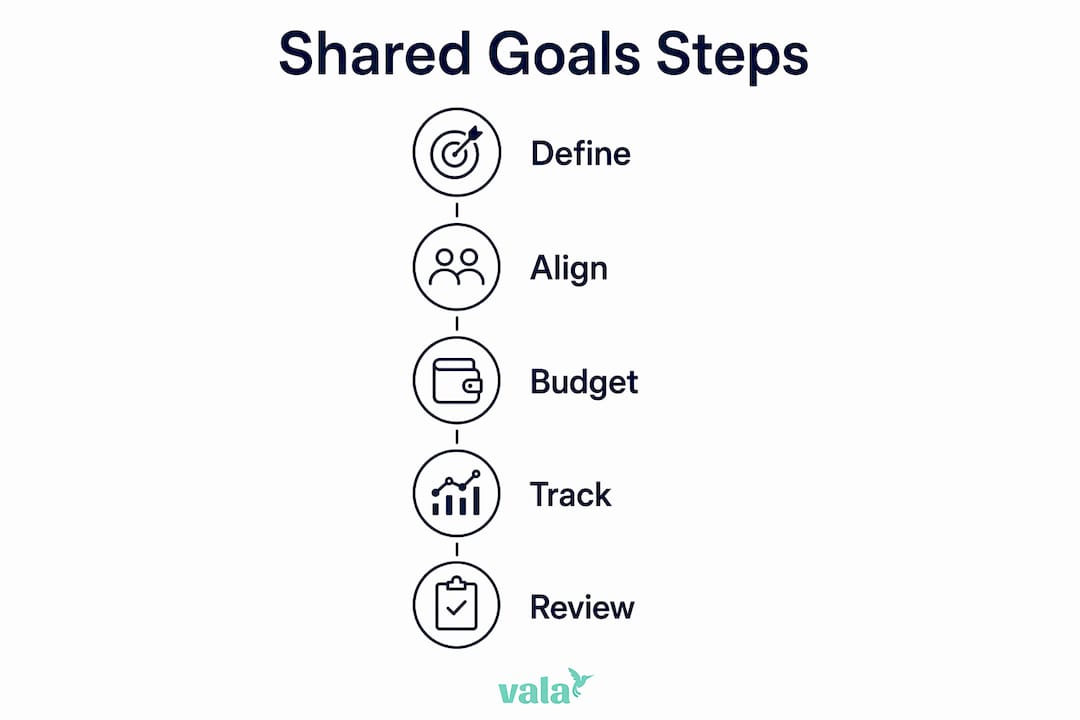
The SMART framework is the industry standard for setting financial goals that actually get reached. SMART stands for Specific, Measurable, Achievable, Relevant, and Time-bound. Applied to shared goals, it turns “we want to save more” into “we will save $2,000 in 6 months by setting aside $330 each month.”
Follow these steps to build your first shared goal together:
- Name the goal clearly. Write down exactly what you are saving for and why it matters to both of you. Vague goals lose momentum fast.
- Set a dollar amount. Attach a specific number to the goal. “Save for a vacation” becomes “save $3,000 for a trip to Costa Rica.”
- Agree on a deadline. A target date creates urgency and makes it easy to calculate monthly contributions.
- Divide contributions fairly. Decide how much each person contributes based on income, expenses, and capacity. Fair does not always mean equal.
- Open a dedicated account. Keeping goal money separate from daily spending reduces the temptation to dip into it.
- Schedule a monthly check-in. Review progress together and adjust contributions if circumstances change.
Aligning goals with shared values is what keeps motivation high over time. If one partner values travel and the other prioritizes home ownership, both goals deserve a place in the plan. Ignoring one person’s priorities creates resentment and kills cooperation.
Pro Tip: Use the AI budgeting tools available through apps like Valapoint to automate your monthly goal contributions. Automation removes the friction of manual transfers and keeps you on track without constant effort.
Joint budgeting strategies that support shared goals
Budgeting is the engine behind every shared financial objective. Without a clear spending plan, even well-defined goals stall. The 50/30/20 rule is widely recommended for managing cash flow: 50% of income goes to needs, 30% to wants, and 20% to savings and debt repayment. Applied to shared finances, the 20% savings slice funds your joint goals directly.
Defining financial roles prevents confusion and conflict. Assign one person to track daily spending and another to manage the monthly budget review. Rotating these roles every few months keeps both partners informed and prevents one person from carrying all the mental load.
Practical steps to avoid common budgeting pitfalls:
- Use a shared tracking tool. A joint budget tracker gives both partners real-time visibility into spending. Hidden purchases are the fastest way to erode trust.
- Separate goal money immediately. Transfer your agreed contribution to the goal account on payday, before spending anything else.
- Build in a buffer. Incorporating a buffer category for unexpected expenses prevents stress and blame when plans are disrupted. Think of it as emotional padding for your budget.
- Review subscriptions and recurring costs. Shared households often accumulate duplicate subscriptions. Auditing these quarterly frees up money for goals.
- Avoid the “all or nothing” trap. If you miss a contribution one month, adjust the next month’s amount rather than abandoning the goal entirely.
Pro Tip: Valapoint’s expense tracking features automatically categorize your spending, so you can see at a glance whether your 50/30/20 split is on track. No manual spreadsheets required.
Shared bank accounts work well for couples with fully merged finances. Roommates and family members often prefer a hybrid model: individual accounts for personal spending and one shared account for joint goals and household expenses. The structure matters less than the transparency. Both parties need to see the same numbers.
How do you communicate about shared financial goals?
Communication is where most shared financial plans succeed or fail. Financial discussions are most effective in relaxed, neutral environments, which reduces defensiveness and builds openness. A coffee shop or a quiet dinner at home works better than a tense kitchen-table confrontation.
Framing budgeting as a shared vision rather than a restrictive task increases cooperation and motivation. The language you use matters. “We are building toward our dream home” lands differently than “we need to cut spending.” Both statements can be true, but one creates energy and the other creates resistance.
Practices that keep communication healthy over time:
- Schedule regular money talks. Couples who schedule regular financial update meetings maintain clearer alignment and adapt better to changing circumstances. Monthly is a good baseline; quarterly deep reviews work well for longer-term goals.
- Lead with curiosity, not criticism. Ask “what felt hard about our budget this month?” before pointing out what went wrong.
- Revisit goals when life changes. A job change, a new baby, or a medical expense all require a goal adjustment. Treating the plan as flexible keeps both partners engaged.
- Acknowledge progress out loud. Celebrating milestones, even small ones, reinforces the habit of working together.
Unexpected expenses are the most common reason shared goals fall apart. Including a budget category for surprises is critical to avoid derailing shared financial plans due to life’s unpredictability. A $200 car repair should not wipe out three months of savings progress.
Key Takeaways
Shared financial goals work because they combine clear targets, coordinated effort, and regular communication into a plan both partners own equally.
| Point | Details |
|---|---|
| Define goals jointly | A shared goal requires a specific amount, a deadline, and agreed contributions from all parties. |
| Use the SMART framework | Specific, Measurable, Achievable, Relevant, and Time-bound goals are far more likely to be reached. |
| Apply the 50/30/20 rule | Directing 20% of shared income to savings and debt repayment funds goals without sacrificing daily needs. |
| Communicate in neutral settings | Regular money talks in relaxed environments reduce conflict and keep both partners aligned. |
| Build in a buffer | A dedicated category for unexpected expenses protects goal progress when life gets unpredictable. |
Why shared goals changed how I think about money
The conventional advice on joint financial planning focuses almost entirely on the mechanics: open a shared account, set a budget, track your spending. That advice is not wrong. It just misses the part that actually determines whether you succeed.
The real work is emotional. Most financial disagreements are not about money. They are about values, priorities, and the fear of losing control. When I started treating budget conversations as a way to understand what my partner cared about most, the whole dynamic shifted. The numbers became easier to agree on because we understood the “why” behind them.
The insight I rarely see discussed: your first shared goal should be small and winnable. Save $500 for a weekend trip. Pay off one small credit card together. The goal itself matters less than the experience of succeeding together. That first win builds the trust and the habit that makes every future goal easier.
Flexibility is not a sign of failure. Revising a goal because circumstances changed is exactly what good planning looks like. The couples and groups I have seen struggle most are the ones who treat their original plan as sacred. Life does not cooperate with rigid budgets. Build in room to adjust, and you will stay in the game long enough to actually win.
— SaverStride
How Valapoint helps you track shared financial goals
Reaching a shared financial objective is much easier when you can see your progress in real time.

Valapoint’s personal finance app is built for exactly this kind of collaborative planning. You can track expenses by category, set savings goals with target amounts and deadlines, and get AI-powered insights that flag spending patterns before they become problems. The app works for individuals, couples, and groups, so whether you are splitting costs with a roommate or building a retirement fund with a partner, the tools fit your situation. Valapoint also offers a goal tracking module that shows your progress toward each shared goal at a glance. Clear numbers, no guesswork, and no spreadsheets.
FAQ
What is a shared financial goal?
A shared financial goal is a mutually agreed money target that two or more people work toward together, such as building an emergency fund, paying off debt, or saving for a home.
How do you set financial goals as a couple or group?
Use the SMART framework to define a specific amount, a deadline, and fair contribution amounts, then track progress with a shared budgeting tool and review monthly.
What is the 50/30/20 rule in joint financial planning?
The 50/30/20 rule allocates 50% of income to needs, 30% to wants, and 20% to savings and debt repayment, making it a practical structure for funding shared goals.
How often should partners review shared financial goals?
Monthly check-ins work well for short-term goals, while quarterly deep reviews are better suited to long-term objectives like retirement or home savings.
Why do shared financial goals fail?
Most shared goals fail due to poor communication, no buffer for unexpected expenses, or misaligned priorities. Regular neutral-setting money talks and a dedicated surprise fund address all three causes.