
A basic financial management system comes down to four things: your net income, a categorized list of expenses, one budgeting method you’ll actually stick with, and a weekly tracking habit. That’s it. Everything else, apps, spreadsheets, envelopes, is just a delivery mechanism for those four pieces.
Here’s what to do today, in order. First, pull your last one to three months of bank and credit card statements. Second, calculate your net income (what actually lands in your account after taxes) and total your recurring monthly outflows. Third, pick one tracking method, an app, a spreadsheet, or plain cash in envelopes, and log every expense for the next seven days.
The rest of this guide walks through how to choose a budgeting method that fits your income and personality, how couples and roommates can split shared costs without resentment, a sample budget you can copy directly into a spreadsheet or an app like Vala, and the habits that make a budget last longer than a New Year’s resolution.
Key Takeaways
Consistent weekly tracking, one clear budgeting method, and upfront rules for shared expenses matter more than finding a “perfect” financial system.
| Point | Details |
|---|---|
| Gather your numbers first | Pull one to three months of statements and calculate net income before choosing a method. |
| Pick one method and commit | Choose 50/30/20, zero-based, envelope, or pay-yourself-first based on your income stability. |
| Set one savings goal | Divide the total cost by months remaining to get a concrete monthly savings target. |
| Agree on shared-cost rules upfront | Couples and roommates avoid conflict by setting split methods before spending happens. |
| Start tracking with Vala | Vala automates expense tracking, shared splitting, and savings goals in one free-to-start app. |
Table of Contents
- Why a Budget Matters More Than You Think
- Your Quick-Start Checklist: What to Gather First
- How Do You Choose a Budgeting Method You’ll Stick With?
- Apps, Spreadsheets, or Cash: Which Tracking Method Fits You?
- Splitting Costs Fairly With a Partner or Group
- Turning Savings Goals Into Monthly Numbers
- A Sample Monthly Budget You Can Copy
- Building a Routine That Keeps the Budget Alive
- Keeping Your Financial Data Private and Secure
- What Actually Makes a Budget Work Long-Term
- Where Vala Fits Into Your Budgeting Plan
- Frequently Asked Questions
- Sources
Why a Budget Matters More Than You Think
A budget isn’t a leash. It’s a planning tool that shows you where your money is already going, so you can point more of it toward what you actually care about. The Bank of America Better Money Habits guide makes a point worth repeating: there’s no single “correct” budgeting method, and the people who succeed are the ones who check in on their numbers regularly, not the ones who found some perfect system.
Think about what a working budget actually gives you:
- Clarity between income and expenses, so you stop guessing whether you can afford something.
- Debt control, because you can see exactly how much is going toward interest versus principal.
- Faster savings progress, since idle cash gets assigned a job instead of disappearing.
- Leak detection, catching forgotten subscriptions and creeping costs before they add up.
- Fewer money arguments, if you’re sharing finances with a partner or roommates.
That last point deserves its own callout. Couples and small groups who set spending roles and expectations upfront report far less friction than those who wing it. A budget doesn’t remove flexibility. It just makes sure flexibility is a choice, not an accident.
Your Quick-Start Checklist: What to Gather First
You don’t need a financial planning degree to start. You need paperwork and about 45 minutes.
- Pull your pay stubs from the last one to three months, or your last several deposits if you’re self-employed.
- Download bank and credit card statements covering the same window.
- Collect recent bills and receipts, rent, utilities, insurance, groceries, so you can separate fixed from variable costs.
- List upcoming annual or irregular expenses, car registration, holiday spending, annual subscriptions, and divide each by 12 to get a monthly equivalent.
- Flag every recurring subscription you can find, streaming services, apps, memberships, and mark which ones you actually use.
If your income varies week to week, average your last three to six paychecks to estimate a realistic monthly baseline rather than budgeting off your best month. Mycreditunion uses this same gather-then-calculate approach, and it works whether you’re salaried, hourly, or freelance. Beginner guides also tend to recommend tracking spending for a full three months before making major changes, since one month rarely captures your real spending pattern.
How Do You Choose a Budgeting Method You’ll Stick With?
The best budgeting method is the one you’ll still be using in three months. That’s not a cop-out. It’s the actual finding from budgeting research: consistency beats sophistication every time.
Here are the four approaches worth trying:
The 50/30/20 rule splits net income into 50% needs, 30% wants, and 20% savings and debt repayment. Fidelity’s budgeting guide treats this as a strong starting range rather than a rigid formula, and it’s a good fit if you want simplicity over precision.
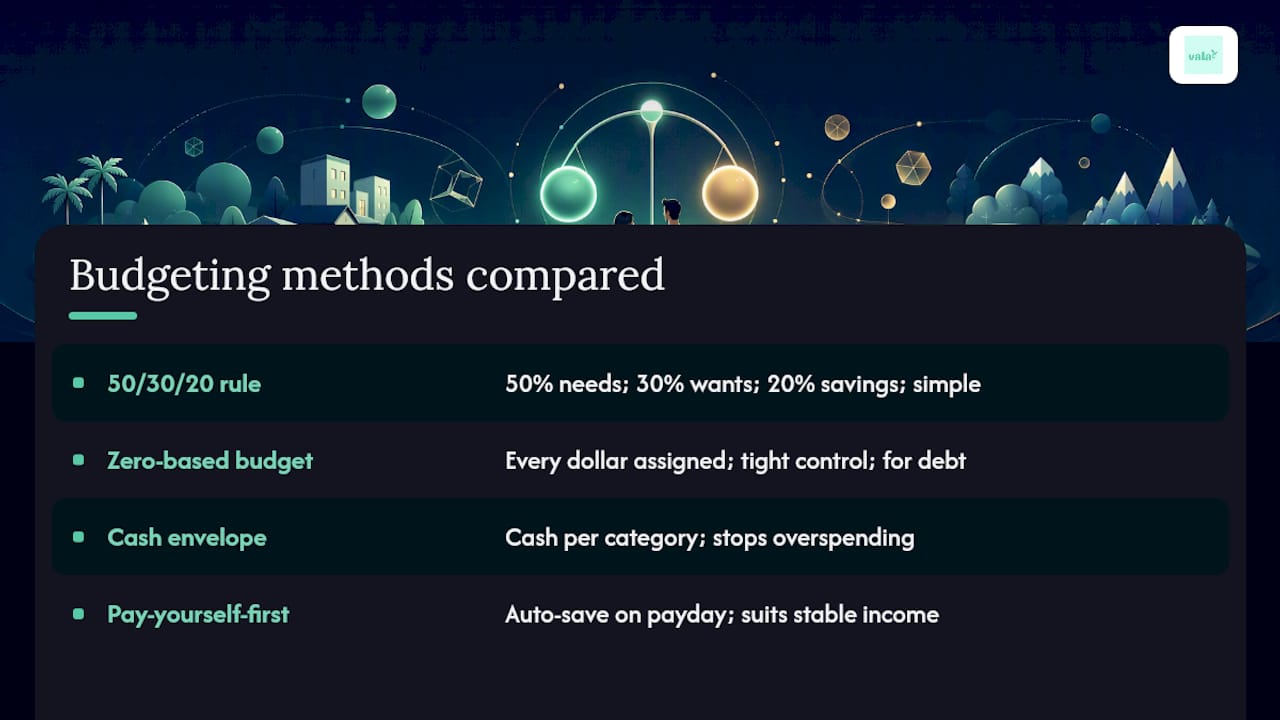
Zero-based budgeting assigns every dollar of income a job, expenses, savings, debt, discretionary spending, until nothing is left unaccounted for. It takes more setup but gives you the tightest control, which suits detail-oriented budgeters or anyone working through debt.
Cash envelope budgeting puts physical cash into labeled categories and stops spending once an envelope is empty. It’s blunt, but that bluntness is the point: it works especially well for people who overspend on cards without noticing.
Pay-yourself-first automates a savings transfer the moment income arrives, then lets you spend freely from what’s left. It suits people with stable income who want savings on autopilot without micromanaging every category.
If your income is irregular, lean toward zero-based budgeting built around your average income, with a buffer category absorbing the difference in strong months.
Apps, Spreadsheets, or Cash: Which Tracking Method Fits You?
Use whatever tracking method removes the most friction from your week. For most people starting out, that means an app paired with a five-minute weekly check-in, since automation removes the manual entry that kills most budgeting attempts within a month.
Each method has real trade-offs:
- Apps sync transactions automatically and categorize spending in real time, but they require linking financial accounts, which raises legitimate privacy questions.
- Spreadsheets give you full customization and don’t require linking any accounts, but every transaction has to be entered by hand.
- Cash envelopes create the strongest behavioral guardrails because running out of physical cash is an immediate, tangible stop signal, but they don’t work for online purchases or recurring bills.
Consumer Reports notes that budgeting apps offer real convenience and automation, but also come with data-sharing trade-offs worth understanding before you connect a bank account. That’s a reasonable trade rather than a reason to avoid apps altogether.
Pro Tip: Before linking any bank account to an app, check whether it offers a read-only connection. Read-only access lets the app see transactions without being able to move money, which meaningfully lowers your risk exposure.
Vala approaches this by combining automated transaction tracking, subscription detection, and spending pattern analysis in one place, so the weekly check-in takes minutes instead of an hour of manual entry. If you want a deeper comparison of tracking approaches before committing, Vala’s budgeting apps guide walks through the feature set in more detail.
Splitting Costs Fairly With a Partner or Group

Shared finances work best with three things in place: agreed-upon rules set before spending happens, one shared ledger everyone can see, and clarity on who pays what. Without those, even small purchases turn into recurring arguments.
Couples generally land on one of three structures, according to the California DFPI’s guide to couples’ finances: merged accounts, hybrid joint and separate accounts, or fully separate finances with joint cost sharing systems. The hybrid model tends to cause the least friction for couples who value both togetherness and independence.
For roommates and friend groups, three splitting methods cover most situations:
- Equal split. A $120 grocery run among four roommates means $30 each, regardless of who ate more.
- Proportional by income. If Partner A earns $4,000/month and Partner B earns $2,000/month, a $600 rent bill splits roughly $400/$200, keeping the burden proportional rather than identical.
- Rotating payer. One person covers the full bill this month, the next person covers it next month, evening out over time without anyone tracking every transaction.
A 2026 guide on splitting bills recommends keeping digital receipts and agreeing on the split method upfront, both of which prevent the “I thought we already settled that” conversation. When you’re comparing tools for this, look for shared wallets, automated settlement between members, and recurring split rules so you’re not re-splitting the same rent bill by hand every month.
Turning Savings Goals Into Monthly Numbers
A savings goal only becomes real once you turn it into a monthly number. Take the total cost of what you want, divide by the number of months until you need it, and that’s your target. A $1,200 emergency fund goal over eight months means $150 a month, treated as a fixed expense rather than whatever happens to be left over.
Longer-term goals work the same way, just with more months in the denominator. A $6,000 down payment goal over two years is $250 a month, small enough to automate without noticing the hit to your checking account.
Three habits make this stick:
- Run a 21-day savings challenge. Automate a small transfer, even $10, every day for three weeks. The habit matters more than the amount at this stage, and MyCreditUnion.gov uses this exact exercise to build early savings momentum.
- Automate the transfer on payday, not at the end of the month, so saving happens before spending has a chance to eat it.
- Build sinking funds for irregular costs, car maintenance, gifts, annual renewals, so a single unexpected bill doesn’t derail your entire month.
A Sample Monthly Budget You Can Copy
Here’s a starter template using the 50/30/20 framework as a baseline, adjusted for a worked example with $4,000 in monthly net income.
Now say actual spending comes in at $2,300 for needs and $1,100 for wants, $400 over budget combined. Rather than cutting savings to compensate, trim the wants category first: canceling two unused subscriptions and cooking three more meals at home might recover $150 to $200, with the rest absorbed by a temporary reduction in discretionary spending. If your income is irregular, budget against your average from the last three months and route any month that comes in above average straight into your sinking fund.
Building a Routine That Keeps the Budget Alive
Short, consistent check-ins beat occasional deep dives every time. A budget you revisit for fifteen minutes every week will outlast one you obsess over for an hour once a quarter and then ignore.
Your weekly checklist:
- Review the last seven days of transactions and categorize anything unassigned.
- Compare spending against your budgeted amounts for the week.
- Flag any subscription or recurring charge you don’t recognize.
- Adjust one category if you’re consistently over or under.
Once a month, go deeper: reconcile your full budget against actual bank balances, rebalance categories that are consistently off, and move any surplus into savings goals rather than letting it sit in checking. Block these check-ins on your calendar the same way you’d block a recurring meeting. Habits that depend on remembering rarely survive a busy week.
Keeping Your Financial Data Private and Secure
Convenience and data exposure sit on opposite ends of a trade-off, and you get to decide where on that spectrum you’re comfortable. Apps that link directly to your bank accounts can automate almost everything, but that automation depends on sharing account access with a third party.
A few settings meaningfully reduce your exposure:
- Use a strong, unique password for any financial app and enable multi-factor authentication wherever it’s offered.
- Choose read-only bank connections when the option exists, rather than connections that can initiate transfers.
- Review what permissions an app actually requests before granting them, not after.
- Read the privacy policy section on data sharing and third-party access before linking accounts.
Consumer Reports frames this clearly: the risk isn’t necessarily disqualifying, but it’s real, and it deserves a few minutes of attention before you connect anything. If full automation feels like too much exposure, a hybrid approach, manual entry for sensitive accounts and automation for the rest, is a reasonable middle ground.
What Actually Makes a Budget Work Long-Term
Budgeting advice tends to obsess over finding the “right” system, when the harder problem is almost always follow-through. Most people don’t fail because they picked 50/30/20 instead of zero-based. They fail because life changed, and their budget didn’t change with it.
The single biggest shift I’d encourage is treating your budget as a living draft instead of a locked contract. A month where you overspend on wants isn’t a failure to fix with stricter rules. It’s information. Maybe your “wants” allocation is genuinely too small for your life right now, and adjusting it honestly beats pretending you’ll white-knuckle through the next twelve months.
Small, consistent wins compound faster than most people expect. Someone who tracks spending for just one week and catches a single forgotten $15 subscription has already recovered $180 a year, without cutting a single meal out or canceling a vacation. That’s the real value of financial literacy for beginners: not perfection, but momentum you can build on.
Start with one week of tracking. Pick one method. Revisit it in a month, and change whatever isn’t working. That’s the whole system.
Where Vala Fits Into Your Budgeting Plan
Vala takes everything covered above, tracking, categorizing, shared splitting, savings goals, and money-leak detection, and bundles it into one app you can start using free. Instead of manually reconciling spreadsheets or splitting rent through a text thread, Vala automates the parts that usually cause people to quit within a month.

Here’s how the features map to what you just read: automated transaction tracking and categorization handle your weekly check-in, shared wallets and recurring split rules manage roommate or partner expenses without manual math, savings goal tools convert your target numbers into automated monthly transfers, and built-in subscription review catches the leaks before they cost you a full year of forgotten charges. Security controls include read-only bank connections and permission settings you control directly.
If you’re ready to put this guide into practice instead of managing it by hand, start with the Vala personal finance app and set up your first budget in one sitting.
Frequently Asked Questions
What are the basics of financial management for someone just starting out?
The core basics are knowing your net income, categorizing your monthly expenses, choosing one budgeting method, and tracking spending weekly. Everything else builds on those four fundamentals.
How much should I save each month as a beginner?
It depends on your goal and timeline. Divide the total cost of what you’re saving for by the number of months until you need it, that’s your monthly target, rather than following a fixed percentage that ignores your actual goals.
Is it better to use an app or a spreadsheet for budgeting?
Use whichever removes more friction from your week. Apps automate categorization and reduce manual entry, while spreadsheets offer more customization without linking bank accounts. Most beginners stick with tracking longer when it’s automated.
How do couples split expenses fairly?
Most couples use a hybrid approach: a joint account for shared bills like rent and groceries, with separate personal accounts for individual spending. Proportional splitting by income is common when earnings differ significantly.
What should I do if my income is irregular?
Average your last three to six months of income to set a realistic monthly budget baseline, and route any above-average months into a buffer or sinking fund to cover leaner months.
Sources
- Your guide to creating a budget plan
- How to budget — Fidelity Learning Center
- Benefits and risks of using personal financial apps and websites — Consumer Reports
- Mycreditunion
- Personal finance for couples: Managing joint finances — DFPI