
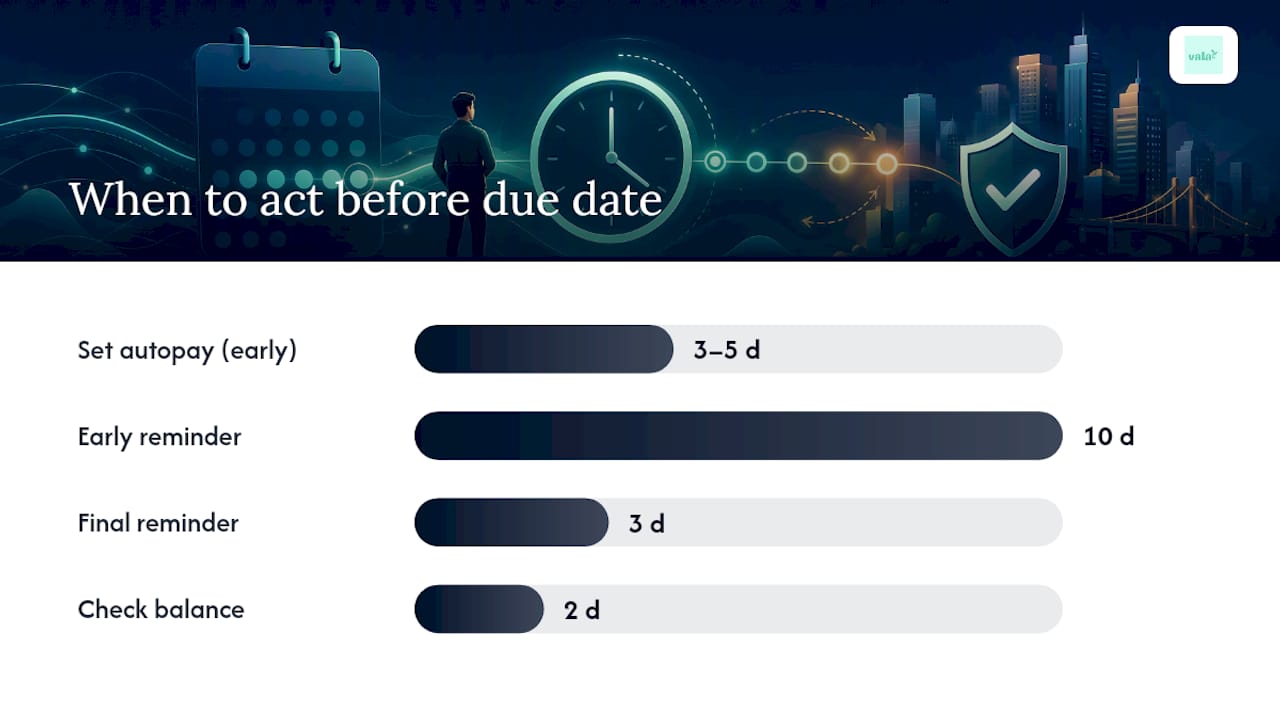
Set autopay for at least the minimum payment and schedule it 3 to 5 days before your due date. This one step eliminates most late-fee risk by covering delays in payment processing. If a payment does slip past due, pay it immediately and call your issuer before you hit 30 days late to request a waiver and protect your credit report.
TL;DR:
- Setting autopay at least three to five days before the due date and choosing statement balance payment minimizes late fee risks from processing delays.
- Confirm your account balances two days before autopay and maintain backup payment methods to prevent missed payments due to cash-flow issues.
- Aligning your due date after your payday reduces cash-flow problems, and using consistent autopay and reminder routines makes late payments less likely.
- Payments made through direct issuer portals are faster and more reliable than mailed checks or bank bill pay, decreasing accidental late postings.
- If you miss a payment, paying immediately and requesting a goodwill waiver can help prevent credit report damage, especially if caught before 30 days late.
Table of Contents
- What Causes a Late Fee, and Why Does Timing Matter?
- Your Step-by-Step Plan to Prevent Late Fees
- Cutoff Times and Payment Methods That Trip People Up
- What to Do If You Already Missed a Payment
- How Automation Closes the Gaps Manual Tracking Misses
- Why Timing Discipline Beats Willpower Every Time
- A Simpler Way to Stay Ahead of Every Due Date
- Sources
What Causes a Late Fee, and Why Does Timing Matter?
A late fee is a charge your card issuer adds when your payment arrives after the due date on your statement. Fees vary by issuer, but federal rules cap them so they can never exceed your minimum payment amount for that billing cycle. Most issuers also build in a grace period, meaning you owe no interest on new purchases if you pay your full balance by the due date each cycle.
Timing trips people up more than forgetfulness does. The Consumer Financial Protection Bureau notes that payments received by 5 p.m. on the due date, in the time zone printed on your statement, generally count as on time. But that clock is stricter than it looks. Payments made through bank bill pay or mailed checks often take 1 to 3 business days to clear, so a payment submitted the morning of the due date can still post late.
The bigger risk sits at the 30-day mark. Issuers typically don’t report a late payment to credit bureaus until it’s 30 days past due, and that kind of mark can sit on your credit report for up to seven years. A few days late costs you a fee. Thirty days late can cost you years of credit score recovery.
Your Step-by-Step Plan to Prevent Late Fees
Here’s the sequence that actually works, in the order you should tackle it.
1. Turn on autopay and schedule it early.
Set autopay through your card issuer’s portal, not a third-party bill-pay service, and choose a payment date 3 to 5 days before your actual due date. That buffer absorbs processing delays without you having to think about it again. Most issuers let you pick from a few autopay amounts:
- Minimum payment due: protects you from late fees but leaves interest accruing on the remaining balance.
- Statement balance: pays off everything you owed at the last billing cycle close, avoiding interest entirely if you don’t carry a balance.
- Fixed amount: useful if you’re paying down a balance faster than the minimum requires, but risky if it ever falls short of the minimum.
For most people trying to avoid fees without overthinking it, statement balance autopay is the safest default.
2. Build layered reminders on top of autopay by setting up automated notifications; this approach is explained in detail in the guide to invoice payment reminders to help SMBs and individuals avoid missed payments.
Autopay fails sometimes. Cards get replaced, banks flag transactions, linked accounts get unlinked. A second layer of reminders catches what automation misses. Set one alert 10 days before your due date and another 3 days before. That combination of an early flag and a final reminder catches most failures before they become fees. Calendar apps, your bank’s text alerts, and your card issuer’s app notifications all work, and using more than one costs you nothing.
3. Align your due date with your paydays.
If your due date consistently lands a week before payday, you’re setting yourself up for a cash-flow problem, not a memory problem. The CARD Act requires issuers to keep your due date consistent from month to month, and most issuers let you request a due-date change through their app, phone line, or online account settings. Moving your due date to two or three days after a paycheck lands removes the guesswork entirely.
4. Check your balance before autopay pulls, and keep a backup.
Two days before an autopay date, glance at your checking account. If a paycheck got delayed or an unexpected expense drained your buffer, you want to know before the payment bounces, not after. Keep a backup payment method, like a second checking account or a debit card, on file with your issuer so a failed transfer doesn’t automatically become a missed payment.
5. Keep one master list of every due date.
If you’re juggling more than two or three cards, due dates blur together fast. A single running list, whether it’s a spreadsheet, a notes app, or a dedicated bill reminder tool, keeps every payment visible in one place instead of scattered across five different apps and inboxes. Pair that list with a monthly bill-check routine: pick one day a month, review every upcoming due date, and confirm autopay is active on each account.
Pro Tip: Set your autopay date to the same day every month, like the 5th, regardless of when each card’s due date actually falls. One consistent day is far easier to remember and audit than five different dates scattered across the calendar.
Cutoff Times and Payment Methods That Trip People Up
Cutoff times aren’t uniform across issuers, and that inconsistency is where a lot of “on time” payments accidentally become late ones. One issuer’s online cutoff might be 8 p.m. Eastern, while another closes the window at 5 p.m. Pacific. Because cutoff times and processing windows vary by issuer, your cardmember agreement or the fine print on your monthly statement is the only place to confirm your exact deadline. Don’t assume it matches your last card.
Payment method matters just as much as timing:
- Mailed checks are the slowest and least predictable option, subject to postal delays you can’t control.
- Bank bill pay routes through a third party before it reaches your issuer, which adds a processing lag.
- Direct payment through the card’s own portal or app is usually fastest since the funds move within the issuer’s own system.
- Autopay set directly with the issuer is generally the safest choice because it removes manual timing risk entirely, since payments through the card’s own portal post faster than third-party routes.
Redundancy is what separates people who occasionally get hit with a fee from people who never do. That means a backup funding source linked to your account, an alert set for autopay failures, and a quick manual balance check a day or two before the payment date. After any payment posts, whether automatic or manual, check your account online and save or screenshot the confirmation. If a fee ever shows up on a payment you know was on time, that confirmation is your proof when you call to dispute it.
What to Do If You Already Missed a Payment
A missed payment isn’t a crisis yet, but the clock is working against you. Move fast and follow this order.
- Pay the overdue amount immediately. Every day that passes adds risk, and paying before you hit 30 days past due keeps the missed payment off your credit report entirely.
- Call your issuer and ask for a goodwill waiver. Reference your account history directly. Many issuers will grant a one-time courtesy waiver for customers with a track record of on-time payments, and a calm, specific request works better than a vague apology.
- Ask whether a penalty APR applies. Some issuers raise your interest rate after a missed payment. Ask directly whether reinstatement to your regular rate happens after a set number of consecutive on-time payments, which is often several months out.
- Save every confirmation and check your credit report afterward. Keep records of the payment date, the waiver request, and any written confirmation from the issuer, then monitor your credit report to confirm nothing was reported incorrectly.
How Automation Closes the Gaps Manual Tracking Misses
Autopay and reminders handle most of the work, but they still depend on you noticing a low balance, a canceled card, or a subscription quietly draining your account before a payment date. That’s the gap automation software is built to close. Tools that forecast balances ahead of a due date and scan for recurring subscriptions cut down on the insufficient-funds scenarios that cause autopay to fail in the first place.
An app-based approach helps most in situations where manual tracking breaks down:
- Shared bills across roommates or partners, where nobody’s sure who paid what.
- Irregular income, where a due date might land during a low-cash week.
- Subscription creep, where small recurring charges quietly erode the balance you were counting on for autopay.
If you’re evaluating a personal finance app for this purpose, look for four things: autopay scheduling, syncing across multiple accounts, balance forecasting before due dates, and stored payment confirmations you can pull up later.
Pro Tip: Set up one automated rule first: a low-balance alert triggered three days before your largest autopay date. That single rule catches the majority of insufficient-funds surprises before they turn into a fee.
Why Timing Discipline Beats Willpower Every Time
Most advice on late fees leans on willpower: be more organized, remember your due dates, pay attention. That framing misses the actual problem. People don’t miss payments because they’re careless. They miss payments because processing delays, inconsistent cutoff times, and cash-flow timing work against them in ways no amount of good intention fixes.
The overlooked detail here is the buffer, not the reminder. Reminders help you notice a due date. A buffer, autopay scheduled days early instead of on the due date itself, protects you even when you don’t notice. That distinction is why the CFPB’s guidance on cutoff times matters more than it first appears: it tells you exactly how much margin you’re working with, and margin is what a missed reminder can’t replace.
If you take one thing from this, prioritize the buffer over the memory trick. Set autopay early, confirm your balance before it pulls, and let the calendar reminders serve as backup rather than your main defense.
— SaverStride
A Simpler Way to Stay Ahead of Every Due Date
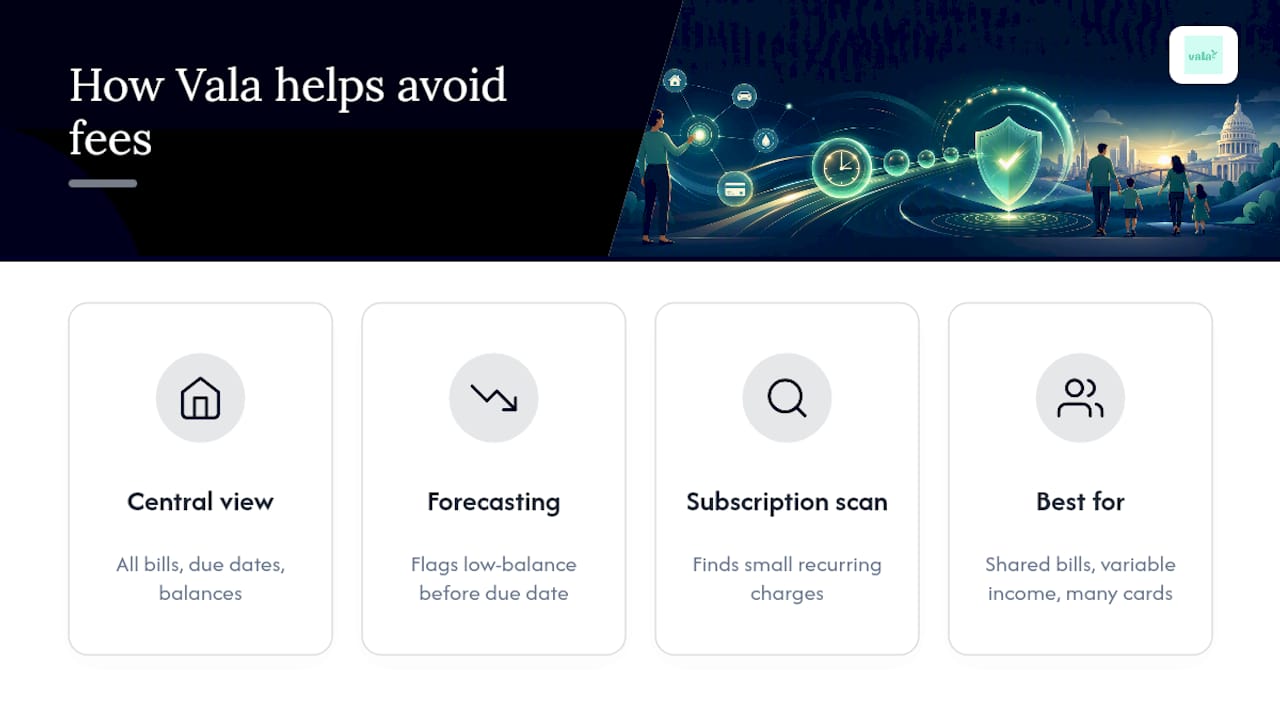
Valapoint gives you one place to see every bill, due date, and account balance instead of piecing it together across five different bank apps and a mental checklist. Where autopay alone still leaves you exposed to low-balance surprises, Vala’s forecasting flags a shortfall before your payment date arrives, and its subscription scan catches the small recurring charges that quietly eat into the cash you were counting on.

That matters most if you’re managing shared bills with a partner or roommates, dealing with income that doesn’t land the same day every month, or simply juggling more cards than you can track in your head. The Vala bill reminder app syncs your accounts, layers reminders on top of your existing autopay, and stores payment confirmations so you’re never scrambling for proof if a fee shows up by mistake.
Start with the personal finance app and set up your first low-balance alert today. It’s the single rule most likely to save you from your next fee.
This article is general information, not a substitute for advice from a qualified financial advisor. Consult a qualified financial professional about your own circumstances before acting on anything here.
Sources
- 4 Ways to Avoid Credit Card Late Fees
- When is my credit card payment considered to be late?
- How To Avoid Late Credit Card Payment Fees