
Start with a small, doable target like a few hundred dollars, then build toward covering several months of essential expenses. Automate a recurring transfer into a separate, liquid savings account so the saving happens without you thinking about it. Your very next move: calculate your essential monthly expenses so you know exactly what number you’re working toward.
TL;DR:
- Building an emergency fund should start with a goal of at least $250 to $1,000 before aiming for three to six months of essential expenses.
- Automating regular transfers into a separate high-yield savings account ensures consistent savings without relying on willpower.
- The ideal emergency fund is kept in liquid accounts like FDIC-insured HYSAs, avoiding locked-up or market-risk assets, for quick access during emergencies.
- Replenishing the fund after use and regularly reassessing the needed amount are key to maintaining its effectiveness against changing circumstances.
- Habitual, automated savings methods outperform reliance on willpower and help reach larger financial goals over time.
Table of Contents
- What Is an Emergency Fund, and Why Does It Matter?
- How Much Should You Save: Starter Goals and the 3-6 Month Rule
- How Do You Build an Emergency Fund Step by Step?
- Where Should You Keep Your Emergency Fund?
- How Do You Maintain and Reassess Your Emergency Fund?
- How Automation and Tools Help You Save Faster
- Why Habit Beats Willpower When Building Savings
- Let Vala Handle the Transfers While You Watch the Balance Grow
- Trusted Resources and Calculators
- Sources
What Is an Emergency Fund, and Why Does It Matter?
An emergency fund is cash set aside strictly for unexpected, essential costs, not for planned purchases or things you simply want. A vacation is discretionary. A car repair that gets you to work is not.
Legitimate emergencies typically include:
- Job loss or a sudden drop in income
- Urgent medical or dental bills
- Essential car or home repairs
- Unplanned travel for a family emergency
Without a dedicated cushion, these costs usually land on a credit card. Consumer finance guidance from the CFPB points to emergency savings as the primary defense against high-interest borrowing when life throws a curveball. Keep the definition tight. If you start letting “emergency” stretch to cover a sale or a spontaneous weekend trip, the fund stops doing its actual job.
How Much Should You Save: Starter Goals and the 3-6 Month Rule
Skip the temptation to calculate a scary six-month number on day one and give up before you start. Build in stages instead.
- Milestone 1: $250 to $1,000, your first real cushion against a flat tire or an overdraft fee.
- Milestone 2: One full month of essential expenses.
- Milestone 3: Three to six months of essential expenses, the standard target most advisors recommend.
Financial experts commonly point to that three-to-six-month range as the core benchmark, with $1,000 or one month of expenses treated as the sensible first step rather than the finish line.
Where you land inside that range depends on your situation. Stable salaried income with no dependents leans toward three months. Freelance or commission income, a mortgage, kids, or a chronic health condition pushes you toward six, sometimes nine to twelve months. If cash is tight right now, don’t try to solve for the full range at all. Hit $1,000 first. Everything else can wait until that buffer exists.
Pro Tip: If the “right” number feels paralyzing, ignore it for now. Save toward one month of expenses first, then reassess. Momentum beats precision every time.
How Do You Build an Emergency Fund Step by Step?
This is the operational part. Four moves, done in order, turn a vague goal into an actual balance.
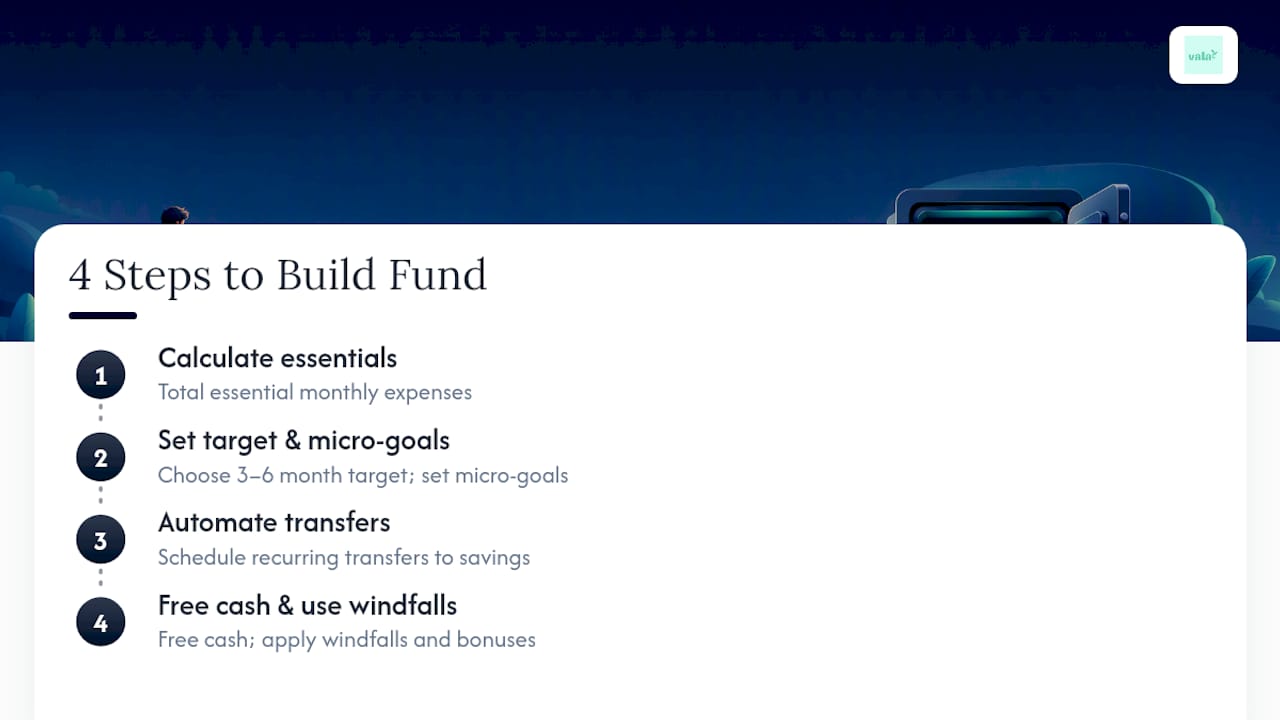
1. Calculate your essential monthly expenses
Pull up twelve months of bank and card statements. Add up housing, utilities, groceries, insurance, minimum debt payments, transportation, and childcare. Leave out restaurants, subscriptions, and entertainment; those are not essentials. Divide the twelve-month total by twelve to get your true monthly baseline. A monthly budget planner makes this faster if you’d rather not build a spreadsheet from scratch.
2. Set a target and break it into micro-goals
Multiply your monthly essentials by your chosen timeline (three, six, or more months) to get the full target. Then chop it into pieces you can actually hit: a weekly transfer, a biweekly transfer timed to payday, or a monthly milestone. A $3,000 goal becomes $58 a week for a year, which feels far more achievable than “$3,000” ever will.
3. Automate the transfers
Split your direct deposit so a fixed slice routes straight into savings before it ever touches your checking account. This single habit does more for consistency than any amount of willpower, according to the CFPB’s guidance on emergency savings. If your paycheck arrives biweekly or your hours vary week to week, time the transfer to land the same day your deposit clears. Round-up tools that sweep spare change from purchases into savings work well as a background booster, layered on top of your main transfer, not instead of it.
4. Free up cash and use windfalls
Cancel subscriptions you forgot you had. Audit recurring charges for “phantom” services you no longer use. Sell equipment, clothes, or electronics sitting in a closet. Consumer finance advisors at AARP point to these small cuts as reliable, repeatable ways to redirect cash without touching your actual budget. Then treat windfalls as accelerators: put half of a tax refund or work bonus straight into the fund and keep the other half guilt-free.

If you’re living paycheck to paycheck, start absurdly small. Even $5 to $25 per pay period builds the habit of saving before the amount matters, and you can raise the contribution once it feels automatic rather than forced. A pay-yourself-first approach works especially well here because it removes the decision from every single payday.
Where Should You Keep Your Emergency Fund?
Liquidity matters more than yield. Your emergency fund needs to be reachable within a day or two, without penalties, without market risk, and without a phone call to unlock it. That rules out the stock market and rules out long-term CDs for the bulk of the money.
- Use a high-yield savings account (HYSA) at an FDIC or NCUA-insured institution.
- Online banks typically post better rates than brick-and-mortar counterparts, according to American Express’s guidance on emergency fund accounts.
- Keep the account separate from checking so the balance doesn’t get spent by accident.
- Factor in ACH transfer delays; some people keep a small cash buffer locally for same-day needs while the bulk sits in the HYSA.
- A limited CD ladder can work for a small slice of a larger fund, but never lock up money you might need next week.
Comparing rates before you pick a bank is worth the ten minutes it takes; tracking bank spreads across providers shows how much the gap between banks can actually cost you over a year.
How Do You Maintain and Reassess Your Emergency Fund?
Using the fund isn’t a failure. It did its job. The mistake is leaving it depleted and hoping nothing else happens.
- Replenish on a schedule. Add $25 to $100 extra per week, on top of your normal contribution, until the balance is back to full.
- Re-evaluate your target after major changes: a new baby, a job switch, a move, a new health diagnosis, or a new dependent all shift your real number.
- Separate true emergencies from irregular but predictable costs. Annual insurance premiums, car registration, or holiday spending belong in a sinking fund, not the emergency fund. Mixing the two erodes the cushion you built for actual emergencies.
How Automation and Tools Help You Save Faster
Automation removes the daily decision of “should I transfer money today?” and replaces it with a rule that runs itself. Split direct deposits, recurring transfers on payday, and round-up tools all work by taking your willpower out of the equation entirely.
The app supports this habit-first approach with capabilities such as automated recurring transfers into a savings goal, money-leak detection to flag forgotten subscriptions and phantom charges, and goal tracking to show progress toward your target in real time.
For a deeper walkthrough, Vala’s guide on automating personal savings goals and its breakdown of annual savings milestones both offer concrete starting points.
Why Habit Beats Willpower When Building Savings
Most advice on emergency funds focuses on the number: three months, six months, whatever multiple fits your risk profile. That number matters far less than whether the transfer actually happens every single payday without you deciding to make it happen. Willpower runs out. A standing transfer doesn’t.
If you take nothing else from this guide, take two things. Calculate your true monthly essentials this week, not “someday.” Then set up a $25 automatic weekly transfer into a separate account, even if $25 feels almost pointless. It isn’t. It’s the habit that eventually carries a $1,000 goal, then a full month’s expenses, then the real target.
— SaverStride
Let Vala Handle the Transfers While You Watch the Balance Grow
Vala turns the steps in this guide into something that runs in the background instead of something you have to remember. It automates split deposits and recurring transfers into your savings goal, tracks your progress toward whatever target you set, whether that’s $1,000 or six months of expenses, and flags money leaks like forgotten subscriptions so you have more to redirect into savings each month.

None of this requires you to overhaul your budget or change how you live day to day. You set the goal, Vala automates the transfer and tracks the number, and you check in when you want an update instead of doing the math yourself. Start with the Vala personal finance app to set up your first automated transfer today.
Trusted Resources and Calculators
- CFPB’s guide to emergency funds: official guidance on starter goals and automation.
- Federal Reserve emergency savings data: national context on household savings gaps.
- NerdWallet’s emergency fund calculator: run your own numbers against your expenses.
- Bankrate’s guide to starting an emergency fund: compares HYSA rates and account options.
Sources
- An essential guide to building an emergency fund — CFPB
- Median emergency savings by age — Forbes
- HYSA for emergency funds — American Express
- Emergency savings data — Federal Reserve
- How to build an emergency fund — AARP