
Budget scenario planning means building a few simple versions of your next month’s money, a best case, a base case, and a worst case, so you can see problems before they happen. The most useful version covers just 30 to 60 days, not a full year. Start today by pulling last month’s income and expenses from your bank account or pay stubs. That one step gives you everything you need to build your first scenario.
TL;DR:
- Annualize each irregular or annual expense by dividing its yearly total by 12, then use bank transactions and recent bills instead of estimates from memory.
- Build a base case and alter only one or two assumptions for each best or worst case so you can trace each effect.
- A negative worst case calls for cutting a variable expense before the month starts, while a buffer under five days calls for delaying a nonessential payment.
- Test one risk at a time by delaying a deposit a week, shifting a bill five days, or adding an unplanned $200 to $400 expense.
- Review actual spending monthly, refresh the three scenarios with current figures, and spend five minutes each week checking for early bills or timing conflicts.
Table of Contents
- What numbers to collect before you build a scenario
- Build a base, best, and worst case scenario
- Reading your results and setting decision rules
- Finding your biggest risk with quick stress tests
- A simple monthly rhythm that keeps the plan alive
- Templates and automation that speed up scenario planning
- Why imperfect scenarios beat perfect forecasts
- Run your scenarios faster with Vala
- FAQ
- Sources
What numbers to collect before you build a scenario
Good scenarios depend on good inputs. Before you open a spreadsheet or an app, gather the numbers that actually move your cash flow.
- Recurring income: paychecks, benefits, or any deposit that lands on a predictable schedule.
- Irregular income: freelance payments, tips, or bonuses, averaged over the last few months.
- Fixed expenses: rent, insurance, loan payments, anything with a set due date and amount.
- Variable spending: groceries, gas, entertainment, the categories that shift month to month.
- Savings contributions: transfers you make on purpose, not what happens to be left over.
- Lumpy annual costs: car registration, holiday spending, annual subscriptions.
For anything that is not monthly, divide the yearly total by 12 and treat that as a monthly placeholder. Annualizing lumpy expenses this way keeps a single big bill from blowing up an otherwise solid month. Pull your raw numbers from bank transactions, pay stubs, subscription lists, and recent bills rather than guessing from memory.
If you are building this with a partner or roommates, mark each line as shared or personal, and agree ahead of time on who is responsible for recording which category. Our guide to shared budgeting for couples walks through a simple way to split that work.
Build a base, best, and worst case scenario
Once your inputs are in place, build three short versions of next month.
- Base case: your normal month, using the numbers you just collected with no changes.
- Best case: one or two realistic upgrades, like a bonus arriving on time or a lower grocery bill.
- Worst case: one or two realistic setbacks, like a missed freelance payment or a surprise repair.
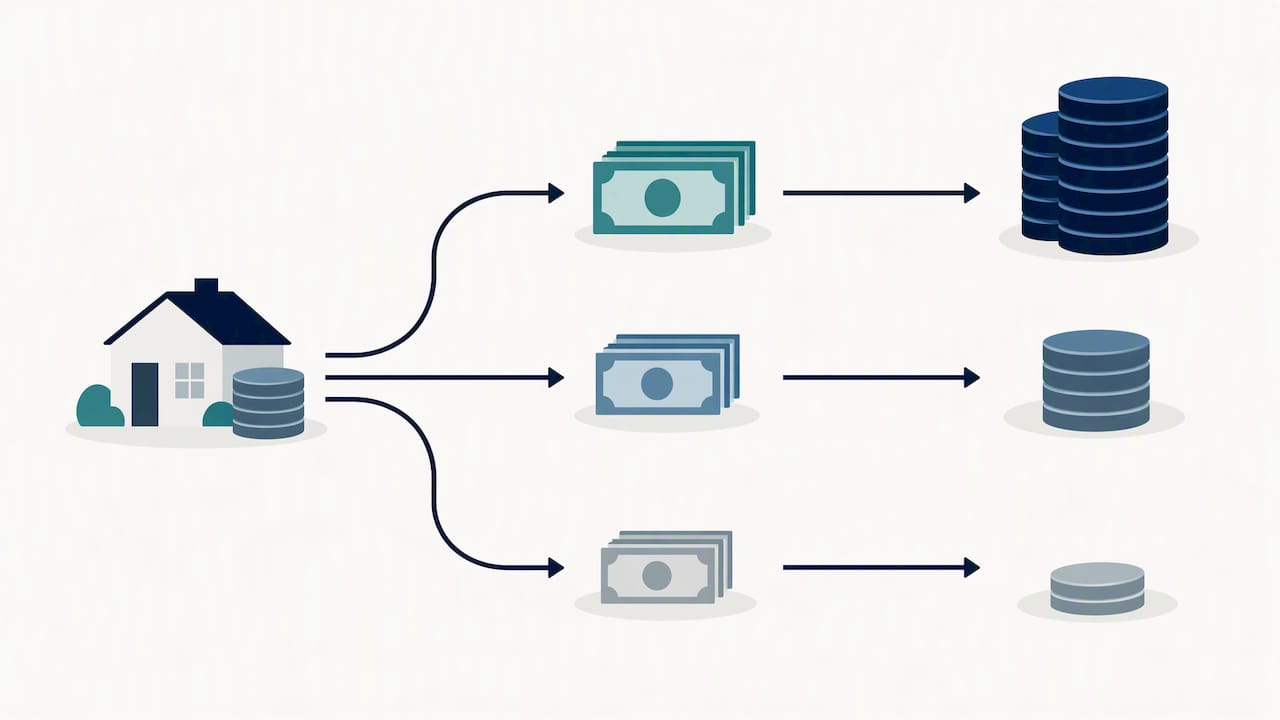
A single person might build a worst case around a late paycheck and a $150 car repair. A couple might model one partner’s hours getting cut for a week. A shared household might test what happens if one roommate pays rent three days late. Each scenario should change only one or two assumptions from the base case, never everything at once, so you can tell exactly what caused the difference.
Write down the assumption behind every number you change. “Freelance income drops to $0 for 30 days” is a assumption you can test again next month; “things go badly” is not.
Pro Tip: Keep your worst case realistic, not catastrophic. A scenario built on your actual bank history is useful; one built on a rare disaster mostly just causes stress.
Reading your results and setting decision rules
A scenario is only useful once it tells you what to do. After you run the numbers, look at three things: your projected ending balance, how many days of buffer you have left before the next paycheck, and whether your essential bills are fully covered in every version.
Set simple threshold rules ahead of time so you are not deciding under pressure.
- If your worst case ends below $0, cut one variable expense category before the month starts.
- If your buffer drops under five days in any scenario, delay a non-essential payment.
- If an essential bill like rent or a loan payment is at risk in more than one scenario, that payment gets priority over discretionary spending.
Rank your bills by consequence, not size: a missed rent payment matters more than a missed streaming charge, even if the streaming bill is smaller. If a scenario shows a real shortfall, contact the creditor or biller before the due date. Adjusting your bill due dates or splitting a large payment into two smaller ones can smooth out a tight week without cutting your actual spending.
Finding your biggest risk with quick stress tests
Not every assumption matters equally. A one-variable sensitivity check, changing a single number and watching how much your ending balance moves, shows you which inputs deserve the most attention.
- Missed paycheck: delay one income deposit by a week and see how fast your buffer disappears.
- Delayed bill: push a due date back by five days and check whether it collides with another payment.
- One-off emergency: add a $200 to $400 unplanned expense and see what gets squeezed.
Whichever change causes the biggest swing is your highest-priority risk; tracking subscription charges can help identify redundant payments you might cut to reduce interest and improve cash flow management (Track subscription charges to cut interest on multiple cards). Fix the cheapest, most feasible issue first, usually a due date or a redundant subscription, before tackling anything that requires a bigger lifestyle change. Building in even a small buffer, a few days of extra cash on hand, absorbs most of these surprises before they turn into missed payments.
A simple monthly rhythm that keeps the plan alive
A 30 to 60 day horizon works because it is long enough to catch real risks but short enough to stay accurate. Forecasting much further out usually just produces guesses dressed up as numbers.
- Review: compare last month’s actual spending against what you planned.
- Set: build next month’s base, best, and worst scenarios using fresh numbers.
- Celebrate: name one thing that went right, even a small one.
Add a short weekly check, five minutes to scan for timing issues or a bill that is about to hit early. For couples or small groups, the full monthly session usually takes 15 to 30 minutes when everyone comes with their numbers ready. Our monthly budget planner and guide to reviewing your finances effectively both walk through this same rhythm in more detail.
Templates and automation that speed up scenario planning
A basic spreadsheet template needs just a few columns: category, base amount, best case adjustment, worst case adjustment, and a note for your assumption. That structure is enough to run your first few months by hand.
Automation removes most of the manual work once you are ready for it.
- Transaction import pulls your real numbers instead of requiring manual entry.
- Recurring detection flags subscriptions and bills you might forget to include.
- Auto-annualizing spreads lumpy costs across months without separate math.
- Timing insights flag when a due date is about to collide with a low-balance week.
- Shared budgeting views let couples or groups see the same scenario without passing spreadsheets back and forth.
Vala’s Money Leak Check scans your accounts for the recurring charges and small leaks that quietly throw off a scenario, and the SaverPro plan builds on that with shared expense splitting and timing-aware insights built for couples and groups. Our breakdown of budgeting and expense tracking apps covers more on how automation compares to spreadsheet workflows.
Pro Tip: If you are sharing scenarios with a partner or roommates, set view permissions early so everyone sees the same numbers without accidentally editing someone else’s entries.
Why imperfect scenarios beat perfect forecasts
The biggest mistake we see is treating a budget scenario like a prediction that has to be right. It does not. A scenario is a test, and the point is to learn something from it, not to nail the exact number. Perfectionism here causes paralysis: people wait for complete data instead of running a rough version today.
Start with one month. Adjust once you see what actually happened.
— SaverStride
Run your scenarios faster with Vala
Building scenarios by hand works, but it takes time you could spend on the decisions that actually move your money. We built Vala to pull your real transactions automatically, flag recurring charges before they quietly inflate your worst case, and spread lumpy annual costs across months without manual math.

For couples and small groups, shared views mean everyone works from the same base case instead of comparing separate spreadsheets.
- Run a free Money Leak Check to see which recurring charges are already distorting your numbers.
- Upgrade to our premium plan to unlock shared expense splitting and timing-aware insights across every scenario.
- Use our free versus paid budgeting comparison if you are deciding whether automation is worth it for your situation yet.
Start at Valapoint and build your first scenario with real numbers instead of guesswork.
This article is general information, not a substitute for advice from a qualified financial advisor. Consult a qualified financial professional about your own circumstances before acting on anything here.
FAQ
What is budget scenario planning in simple terms?
Budget scenario planning means building a few versions of your upcoming income and expenses, typically a best case, base case, and worst case, so you can see risks and make decisions before they happen. It works best over a short window, usually 30 to 60 days, rather than a full year.
How far ahead should I plan my budget scenarios?
A 30 to 60 day horizon gives you enough runway to catch real risks like a late paycheck or an upcoming bill, without the guesswork that comes from forecasting a year out. Shorter horizons also make it easier to stick with the habit since you revisit and adjust the numbers every month.
How do I handle irregular or annual expenses in a scenario?
Divide the yearly total by 12 and treat that as a monthly placeholder inside your scenario, a method CFPB’s cash flow budgeting tool recommends for smoothing out lumpy costs. This keeps a single large bill, like car registration or holiday spending, from distorting one month’s results.
What should couples or roommates do differently when building scenarios together?
Mark each expense as shared or personal, and agree ahead of time on who records which category so the numbers stay consistent. Running the monthly review together, even for 15 to 30 minutes, keeps everyone working from the same assumptions instead of separate guesses.
How much of a cash buffer should I build into my worst case scenario?
There is no single number that fits every household, but CFPB’s guidance on building emergency savings points to automating small, regular transfers and monitoring progress as the most reliable way to build one over time. Start with whatever buffer covers your biggest recurring risk, like a late paycheck, and grow it gradually.
Sources
- Adjusting your bill due dates can help you stay on top of your bills and manage your cash flow | CFPB blog
- Creating a cash flow budget | CFPB Your Money Your Goals cash flow tool (PDF)