
Student loan budgeting comes down to three moves. List every loan and its due date. Put the required payment in your budget first, as a fixed cost. Then divide what’s left between everyday spending, savings and any extra payments. If the payment still doesn’t fit, you have federal options to lower it, and the sooner you ask, the more choices you have.
This guide walks through each move with real numbers. It covers budgeting while you’re still in school and after you graduate. It also covers how to decide which loan to pay first and what to do if you fall behind.
TL;DR
- Gather every loan’s balance, interest rate, minimum payment, loan type (federal or private) and servicer before you build anything.
- Treat the minimum payment as a fixed cost. One common guide is the 50/30/20 rule, with loans split between needs and savings.
- Turn lump sums like financial aid refunds into a monthly amount by dividing them by the months they must last.
- Pay extra only after you have a starter emergency fund and any employer retirement match, then aim at the highest-interest loan.
- If a payment doesn’t fit, call your servicer before you miss one. Federal borrowers can ask about an income-driven plan.
Table of Contents
- Start with a full list of your loans
- Build the monthly budget
- Using the 50/30/20 rule with student loans
- Budgeting while you’re still in school
- Making room: where to adjust
- Automate the payment
- Paying extra: when it makes sense
- If the payment doesn’t fit
- Use tools to stay on track
- Perspective: why we start with leaks, not limits
- See where your payment room is hiding
- A simple monthly routine
- FAQ
- Sources
Start with a full list of your loans
You can’t budget for a payment you haven’t pinned down. Sallie Mae says the first step is to figure out what loans you have, how much your payments will be and when they are due.
A simple list works. For each loan, write down:
- The current balance
- The interest rate
- The monthly minimum payment
- Whether it is federal or private
- Your servicer’s name and contact details
Navy Federal Credit Union recommends keeping all of this in one place, and the list takes about twenty minutes to build. It also makes the later decisions easier: which loan to pay first, whether to ask for a different plan, and how much room you really have.
Know when payments start
For most federal loans, you have a six-month grace period after you graduate, leave school or drop below half-time enrollment. MOHELA explains that interest still accrues on most loans during that time and is added as unpaid interest to your balance, though it isn’t capitalized yet.
Use those six months as practice. Federal Student Aid notes that adding the payment to your expenses has a big impact on your budget, so update the budget to include loan payments, new income and new living costs. If you can live on your budget with a pretend loan payment moved into savings, the first real bill won’t be a shock.
Build the monthly budget
Federal Student Aid lays out the basic steps in its repayment checklist: set a timeframe and goals, pick a budgeting tool that works for you, list your income and expenses, subtract expenses from income, and adjust if you have a shortfall.
Step 1: Find your real monthly income
Use take-home pay, not salary. Navy Federal suggests counting income after taxes and deductions, including every source. If your income changes from month to month, use your lowest typical month as the baseline. Anything above that becomes a bonus you can assign to savings or extra payments.
Step 2: List fixed costs first
Chase classes student loan payments as a fixed expense, alongside rent, car payments, subscriptions and insurance, and suggests setting money aside for fixed costs before other line items. That order matters. The loan payment has a due date and a penalty for missing it, so it comes off the top.
Subscriptions are fixed costs too, and they are easy to forget. Streaming, apps, cloud storage and gym memberships can add up to real money, and you may not notice one you stopped using. A money leak check is a quick way to see recurring charges in one list so you can decide which ones stay.
Step 3: Set limits for everything else
Variable costs are groceries, gas, dining out, shopping and fun. Give each a monthly limit. Track your spending for a month or two, then adjust the limits based on what actually happened rather than what you hoped would happen.
If you want a ready-made template, our monthly budget planner guide walks through the layout.
Using the 50/30/20 rule with student loans
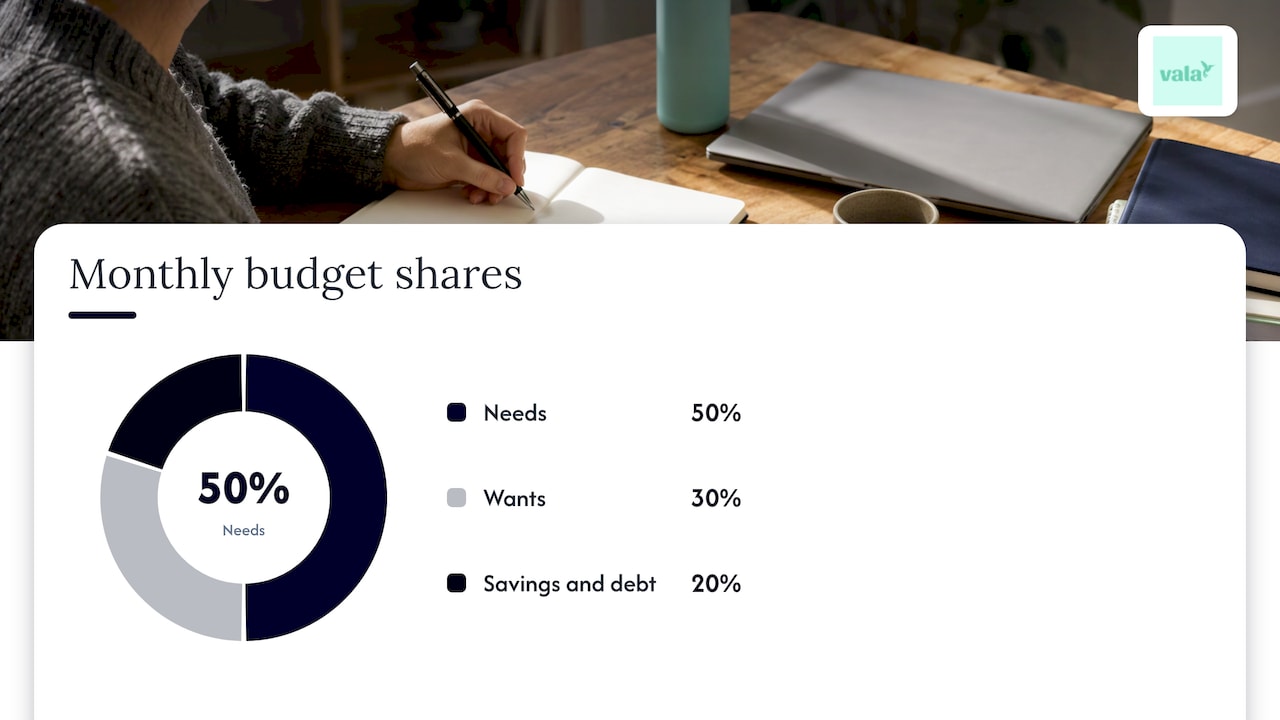
The 50/30/20 rule is a starting point many lenders and publications use. Sallie Mae describes it this way: 50% of your budget for necessities such as rent, utilities, transportation, insurance and groceries, 30% for wants such as dining out and entertainment, and 20% for savings and debt repayment, including student loans.
Here is a made-up example. Say you take home $3,000 a month.
| Category | Share | Amount | What goes in it |
|---|---|---|---|
| Needs | 50% | $1,500 | Rent, utilities, groceries, transportation, insurance, minimum loan payment |
| Wants | 30% | $900 | Dining out, shopping, entertainment, subscriptions you chose |
| Savings and extra debt | 20% | $600 | Emergency fund, retirement, extra loan payments |
Where should the loan go? Admire.org places the minimum payment in the needs bucket and anything above the minimum in the savings bucket, since extra payments are a choice. That split is a practical way to see how much room you have for extra payments.
If the minimum payment pushes needs well above 50%, that’s common, especially in expensive cities. Don’t give up on the plan. Trim wants first, and see the section on adjusting expenses below.
A sanity check on the size of the payment
As a rough guide, U.S. News reports that Department of Education guidelines suggest student debt payments stay around or below 20% of discretionary income, or 8% of total income. MOHELA advises that if your payment is more than 10 or 15 percent of your income, you should contact it to explore a different repayment option.
If your payment is above those marks, don’t just cut your food budget to the bone. Ask about other plans first (see below).
Budgeting while you’re still in school
If you’re a student, your income may be a lump sum: a financial aid refund, savings or a loan disbursement. Spread it out so it lasts.
The rule from Duke University’s Office of Student Loans & Personal Finance is to divide the money by the number of months it needs to cover. Their example: $5,000 in savings used over nine months, mid-August to mid-May, gives a monthly income of $555.55.
The same applies to borrowing. Say you borrow $6,000 to cover four months. That’s a monthly budget of $1,500 ($6,000 divided by 4), and you have to hold yourself to it each month, as one university budgeting guide from CCSF puts it, by knowing what is coming in and when each expense is due.
Two habits help:
- Plan for a late refund. Duke advises assuming refunds won’t arrive until two to three weeks into the semester, so have another source ready for early expenses.
- Borrow only what the budget needs. Every dollar you borrow has to be repaid with interest, so a monthly figure makes it easier to see when you’re taking more than you’ll use.
For more on student money, see our guides on how to manage finances as a student, a student budget checklist and why student budgeting is different.
Making room: where to adjust
If the payment takes a big share of each paycheck, Fidelity suggests looking at savings on groceries, rent, utilities, gas, commuting, dining out and health care. You don’t need to cut everything. Pick the one or two areas where a change is easy to keep.
A short order that works for many people:
- Recurring charges. Cancel or pause what you don’t use. This costs you nothing in daily life.
- Dining out and delivery. Cut back instead of cutting out, and set a weekly limit.
- Groceries and utilities. Small habits, like planning meals, add up over a year.
- Housing and transportation. The biggest levers, but they take longer. Roommates or a cheaper commute can change the whole picture.
Our penny saver habits guide has daily moves that make this easier to keep up.
Also build a little cushion. Navy Federal recommends starting an emergency fund with $500 to $1,000, working toward one month of expenses, and keeping it in a separate high-yield savings account. A cushion keeps a surprise car repair from becoming a missed loan payment.
Automate the payment
Autopay protects you from forgetting. Federal Student Aid says automatic debit takes payments from your bank account each month, and borrowers with Direct Loans may get a 0.25% interest rate reduction for enrolling.
Set the payment date for a day or two after payday. Then add a reminder for the bills that are not automatic. Bill reminders are one of the things Vala is built for, so you see upcoming charges before they land.
Paying extra: when it makes sense
The minimum keeps you in good standing. Paying more cuts interest. But the order of your priorities matters.
Before you pay extra
U.S. News advises building an emergency fund of three to six months of expenses and capturing any employer retirement match first. If you carry other debt, it says extra money should go to the one with the highest interest rate. A credit card at 21% beats a student loan at 6%.
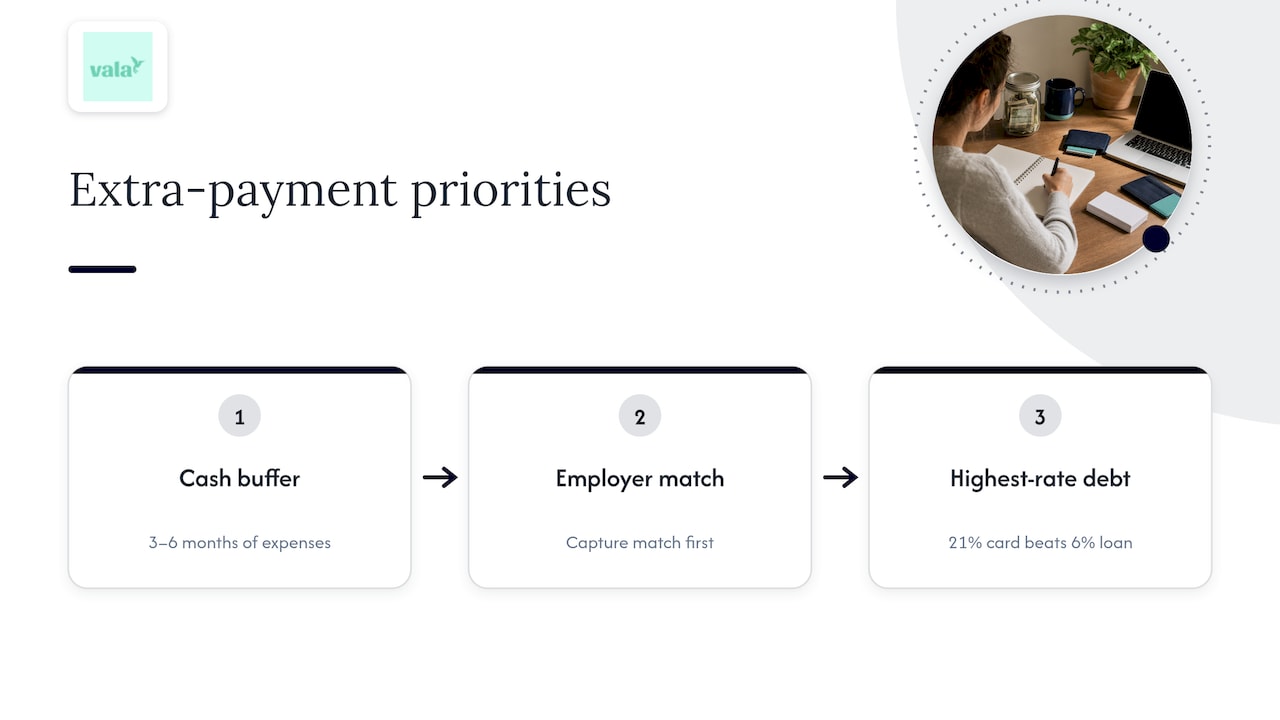
Admire.org gives a gentler path: reach one month of expenses, then three, before you start extra loan payments. Either way, a cash buffer comes first.
Which loan to pay first
Two common methods, as ELFI describes them:
- Debt avalanche: pay the highest interest rate first. This saves the most interest.
- Debt snowball: pay the smallest balance first. This gives you quick wins that keep you motivated.
With similar rates, ELFI says unsubsidized loans make sense first, because they accrue interest from the day they are disbursed.
Private versus federal matters too. Investopedia says prioritizing private loans often makes sense, because federal loans offer more flexibility. Under some income-driven plans, federal payments can be as low as $0, and public service workers could be eligible for Public Service Loan Forgiveness after 120 monthly payments.
How federal servicers apply extra money
If you pay more than what’s due on federal loans, Edfinancial Services says the overpayment goes to the loan with the highest interest rate first. If rates match, it goes to unsubsidized loans, then subsidized. There’s no prepayment penalty. If you want the extra to hit a specific loan, contact your servicer and ask how to direct it.
If the payment doesn’t fit
This is the part many people avoid, and it’s the part where acting early helps most.
Call your servicer first. Federal Student Aid says a loan is delinquent if you miss even one payment, and late fees may apply. If you can’t pay, contact your servicer right away. It can talk through changing repayment plans, deferment, forbearance and consolidation.
Ask about an income-driven plan. The Consumer Financial Protection Bureau says an income-driven repayment plan can lower your monthly payment to as low as $0, and the Education Department’s Loan Simulator can help you choose. These plans require paperwork every year, so set a reminder a month early. The CFPB’s debt booklet adds that payments are based on family size and household income, you don’t need a job to qualify, and there is never a fee to change your plan.
Know the stakes of default. The CFPB warns that defaulting on a federal loan (missing nine or more payments) can lead to wage and tax refund garnishment and credit problems. That’s why a call now beats silence later.
Private loans are different. The CFPB notes that federal loans offer several repayment plans unlike most private student loans. If you have private loans, call the lender and ask what hardship options exist.
Use tools to stay on track
A budget only works if you look at it. Pick a tool you’ll actually open, whether that’s a spreadsheet or an app. The habit that matters most is a short weekly check: What came in? What went out? Is the loan payment covered?
This is where building financial literacy skills pays off over time. Budgeting technology can balance loan payments, everyday expenses and savings in one view, so you spend less time on the math and more time making decisions. If you’re comparing options, our guide to the best budget app for college students covers what to look for.
Perspective: why we start with leaks, not limits
Most advice about student loans starts with cutting back. We start by finding money you didn’t know you were losing.
Many budgets don’t fail because of a big purchase. They fail because small recurring charges, forgotten subscriptions and bill spikes quietly take a share of every month. When you recover that money first, the loan payment feels lighter without a single painful cut.
That’s why we built Vala around money leak detection, recurring charge review and a clear recovery plan, rather than a dashboard that only tracks what already happened. Connecting your bank through Plaid lets the app show where money goes. Future cash flow simulations let you see how a payment, or an extra one, will affect the weeks ahead.
For borrowers, we think this is the most practical way to budget: protect the loan payment, plug the leaks, then decide where the recovered money goes. Our customers report ongoing progress toward their savings goals this way.
SaverStride
See where your payment room is hiding
If you want to find extra room for your loan payment, start with a look at your recurring charges. Vala’s Money Leak Check scans your spending for subscriptions, repeat charges and bill spikes, and gives you a plan to recover the money. You can also share costs with friends or a partner, which helps if you split rent, trips or dinners.

SaverLite is $2.99 per month, and SaverPro is our fuller plan. Start your free money leak check and see what you could put toward your loans.
A simple monthly routine
Once the budget exists, keep it small and repeatable:
- Payday: Confirm the loan payment is covered and set aside savings first.
- Weekly, 10 minutes: Check spending against your limits and note any new recurring charges.
- Monthly: Compare planned and actual spending, then adjust limits. If you have a surplus, send it where your priorities say: emergency fund, match, then the highest-interest debt.
- Yearly: If you’re on an income-driven plan, renew your paperwork on time. Review your loans and rates, and redo the budget when your income changes.
If you’re budgeting as a young professional with a first salary, our financial planning for young professionals guide helps you plan for what comes next, and our family budget planner is a good fit if you’re budgeting for a household.
FAQ
How much of my income should go to student loans?
There’s no single number. U.S. News reports that Department of Education guidelines suggest keeping payments around or below 8% of total income. If you’re well above that, ask your servicer about other repayment options.
Is a student loan payment a need or a want?
The required minimum is a need. It has a due date and penalties, so it belongs with rent and groceries. Admire.org puts anything above the minimum in the savings category, since extra payments are your choice.
Should I pay off student loans or build an emergency fund first?
Build at least a starter emergency fund first. Navy Federal suggests starting with $500 to $1,000, then working toward one month of expenses. A cushion keeps a surprise bill from forcing you to miss a loan payment or use a credit card.
What if I can’t make my payment this month?
Contact your servicer before the due date. Federal Student Aid says even one missed payment makes a loan delinquent. Your servicer can discuss changing plans, deferment, forbearance or consolidation, and federal borrowers can apply for an income-driven plan.
Sources
- Student Loan Repayment Checklist, Federal Student Aid
- Budgeting, Federal Student Aid
- Saving and Budgeting, MOHELA
- Borrower In Grace, MOHELA
- How to Budget Student Loan Payments Effectively, Sallie Mae
- Budgeting After College, Navy Federal Credit Union
- Budgeting in School, Duke University
- Budgeting, CCSF
- How Much of My Monthly Budget Should Go to Student Loans?, U.S. News
- Fixed vs Variable Expenses, Chase
- How to pay off student loans, Fidelity
- Budgeting Student Loans Around Rent, Travel and a House, Admire.org
- How to Decide Which Student Loan to Pay Off First, ELFI
- Which Student Loans Should I Pay Off First?, Investopedia
- How Payments Are Applied, Edfinancial Services
- Options for repaying your federal student loan, CFPB
- Options for repaying your federal and private student loans, CFPB
- Debt getting in your way? Get a handle on it, CFPB
- Financial literacy skills for career growth