
Most people have tried a budget at least once. They set spending limits, track for two weeks, then give up because the numbers feel disconnected from real life. Generic budgeting templates are built for an average person who doesn’t exist. Understanding how AI personalizes budgets changes that equation completely. AI looks at your actual income, your specific spending patterns, and your personal goals, then builds something that fits you rather than a spreadsheet template.
Table of Contents
- Key takeaways
- How AI personalizes budgets using your financial data
- AI budgeting frameworks and how they adapt to your life
- How AI keeps your budget accurate over time
- Practical tips for using AI safely with your finances
- What is coming next in AI-driven financial planning
- My honest take on AI budgeting
- Take control of your budget with Valapoint
- FAQ
Key takeaways
| Point | Details |
|---|---|
| AI reads your real data | AI uses your actual transactions, income, and goals to build budgets that reflect your life, not a generic template. |
| Framework choice matters | Telling AI which budgeting method you prefer produces far better results than letting it guess. |
| Budgets improve over time | AI refines your budget continuously by tracking spending deltas and adjusting categories based on real patterns. |
| Privacy requires care | Share summary-level financial info with AI tools, never account numbers or Social Security numbers. |
| Active input drives accuracy | The quality of your inputs directly determines how useful and accurate your AI-generated budget will be. |
How AI personalizes budgets using your financial data
The core of AI budgeting is data. Not your neighbor’s data or a national average. Your data.
When you connect your financial accounts to an AI tool, it pulls in your actual transaction history. From there, it does several things automatically. It groups similar transactions together (grocery runs, streaming subscriptions, gas stations), normalizes the names so “AMZN” and “Amazon Prime” become one clear category, and maps your spending against your income and stated goals.
Here is what the AI is actually analyzing:
- Fixed expenses: Rent, insurance, loan payments, anything that hits every month with little variation
- Variable spending: Dining out, clothing, entertainment, and other categories that shift month to month
- Income patterns: Whether you get paid bi-weekly, have freelance income, or receive irregular deposits
- Stated goals: Saving for a vacation, paying off a credit card, building an emergency fund
The AI then uses historical spending averages to forecast what next month will likely look like. If you have six months of grocery data, it knows your real grocery spend, not what you hope it will be. Personalized budgets are grounded in connected account data combined with your stated goals and priorities. That grounding is what separates AI budgeting from a static spreadsheet.
Conversational AI tools take this further. ChatGPT connects securely to financial accounts and lets you ask questions directly about your budget. You can ask, “Where am I overspending compared to last month?” and get a specific answer, not a generic tip.
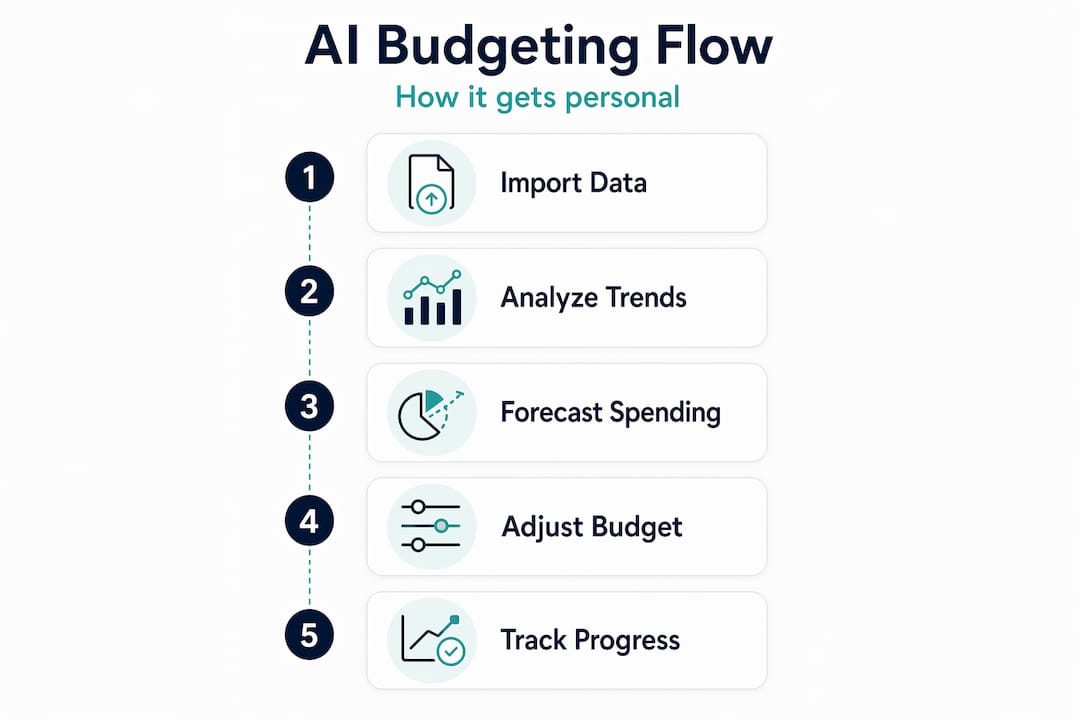
Pro Tip: Connecting all your accounts, checking, savings, and credit cards, gives AI a full picture. Limited data connections reduce budget accuracy, so more account access leads to better personalization.
AI budgeting frameworks and how they adapt to your life
AI does not invent new budgeting rules. It applies proven frameworks to your specific situation. The difference is that it adapts those frameworks based on your constraints rather than forcing you into a rigid mold.
Here are the most common frameworks AI works with:
| Framework | How it works | Best for |
|---|---|---|
| 50/30/20 | 50% needs, 30% wants, 20% savings | Stable income earners starting out |
| Zero-based budgeting | Every dollar assigned to a category until income minus expenses equals zero | Detail-oriented budgeters who want full control |
| Envelope method | Fixed cash amounts per category, stop spending when the envelope is empty | People who overspend in specific categories |
| Goal-first budgeting | Savings goal comes first, then remaining income is distributed | People building toward a specific milestone |
The critical insight from U.S. Bank’s AI budgeting guidance is that you must tell the AI which framework to use. Without that direction, it defaults to guesses and can produce budgets that feel unrealistic or irrelevant to your life. Telling the AI “I want a zero-based budget with $200 reserved for fun spending each month, no matter what” produces a far more useful output than asking it to “make me a budget.”
AI also handles personal constraints well. If you have irregular income as a freelancer, it can build a conservative base budget and treat extra income as a bonus allocation. If your rent increases mid-year, you update that one input and the AI redistributes everything else accordingly. Specifying your budgeting method and adding personal constraints like preserving fun spending or accounting for seasonal expenses produces the most accurate results.

This kind of flexibility is exactly where personalized financial planning through AI pulls ahead of traditional budgeting apps that lock you into preset categories.
How AI keeps your budget accurate over time
Building a budget once is the easy part. Sticking to it and adjusting it as life changes is where most people fall short. AI-driven budget management addresses this directly by treating budgeting as a continuous loop rather than a one-time task.
Here is how that loop works in practice:
- Transaction categorization: Each new transaction gets sorted and labeled automatically. This keeps your spending picture current without manual entry.
- Delta analysis: AI compares your current spending to your historical average. A 42% overspend on dining versus last month triggers an alert before the month ends, not after.
- Goal alignment check: AI cross-references your spending trends against your savings goals and flags when you are off track.
- Budget regeneration: Based on the latest data, AI recalculates budget allocations to better reflect your actual patterns and upcoming bills.
This iterative feedback approach is what makes AI budgeting more accurate over time. The longer you use it, the better it understands your rhythms.
Scenario planning is another underused feature. You can ask your AI tool, “What happens to my budget if I get a $200 raise?” or “Can I afford a trip to Mexico in March if I save $300 per month starting now?” These what-if questions help you make confident decisions without guessing.
Pro Tip: Review your AI-generated budget at the start of each month and make one deliberate update, whether that is a new goal, a changed expense, or a category limit. Regular input keeps the AI sharp and your budget realistic.
Think of AI as a budgeting partner that tracks everything and flags problems early, but still needs you to make the final calls. You bring the context. It brings the math.
Practical tips for using AI safely with your finances
AI budgeting tools are powerful, but they require some thoughtfulness around what you share and how you share it.
Use these principles to stay safe and get the most out of AI budgeting:
- Share summary-level information only. Your monthly income, fixed expenses, variable spending totals, and savings goals are all the AI needs. Avoid sharing account numbers, Social Security numbers, passwords, or full card details with any AI tool, especially general-purpose chatbots.
- Use specific prompts. Vague prompts produce vague budgets. “Create a zero-based budget for a $4,200 monthly take-home income, with $1,400 for rent, $300 for groceries, and a goal to save $500 per month” gives AI the specificity it needs to help. Accuracy depends heavily on the quality and clarity of your inputs.
- Pair AI with a secure tracking app. General AI tools are great for planning and analysis. For real-time tracking, use a dedicated expense tracking app that connects directly to your bank securely.
- Know the limits. AI is not a licensed financial advisor. It cannot account for your full tax situation, estate planning needs, or complex investment decisions. For major financial moves, consult a certified financial planner.
- Verify the output. Always review what AI generates before acting on it. Cross-check totals, confirm categories make sense, and adjust anything that does not reflect your real life.
The machine learning in budgeting works best when you stay engaged. AI handles the number crunching. You supply the judgment.
What is coming next in AI-driven financial planning
The current generation of AI budgeting tools is impressive, but the next wave is genuinely exciting.
Conversational AI with persistent financial memory is already emerging. Instead of re-explaining your situation every time you open an app, future AI tools will remember your history, goals, and past decisions. You will be able to say “How am I doing compared to my goal from six months ago?” and get an instant, accurate answer. More than 200 million users already turn to ChatGPT monthly for personal finance help, and demand for this kind of continuous AI guidance is accelerating fast.
Integration across the financial ecosystem is also deepening. AI tools are forming partnerships with tax software, investment platforms, and banking providers to pull in more data. When your AI budget tool can see not just your checking account but also your 401(k) contributions, tax withholdings, and subscription renewals, its recommendations get sharper and more complete.
“The future of personalized financial planning is AI that understands your full financial life, not just your checking account balance, and guides you proactively rather than reactively.”
Beyond budgeting, AI is moving toward holistic financial guidance. That means spotting when you are underinsured, flagging when your emergency fund falls below a safe threshold, or noticing that a subscription you forgot about has been quietly draining $40 per month. The innovative AI strategies shaping finance in 2026 point toward AI that acts more like a proactive financial coach than a passive reporting tool.
My honest take on AI budgeting
I’ve spent years watching people try and abandon budgeting tools. The pattern is always the same. The tool is generic, the person does not see themselves in it, and motivation collapses within weeks.
What I’ve found with AI budgeting is that personalization is the missing ingredient, but it does not come automatically. The AI needs you to meet it halfway. I’ve seen people hand an AI vague inputs, get a generic budget back, and then conclude “AI doesn’t work for budgeting.” That is not a technology failure. That is a communication failure.
My take: the best results come from treating AI like a smart collaborator, not a magic solution. You share your real numbers, tell it your actual priorities, and then actually read what it produces instead of just accepting it. In my experience, people who do that consistently see their budgets become genuinely useful within two or three months.
The other misconception I hear often is that AI will solve your budgeting problems on its own. It will not. It will give you better information, faster. But you still have to make the decisions. Think of it as upgrading your tools, not outsourcing your responsibility. And if your financial situation is complex, pairing AI with a human advisor is still the smartest move.
— SaverStride
Take control of your budget with Valapoint
If you are ready to move beyond generic budgeting apps, Valapoint is built for exactly this. Vala is an AI-powered personal finance app that tracks your expenses automatically, identifies hidden spending patterns, and gives you clear, personalized insights without the overwhelm.
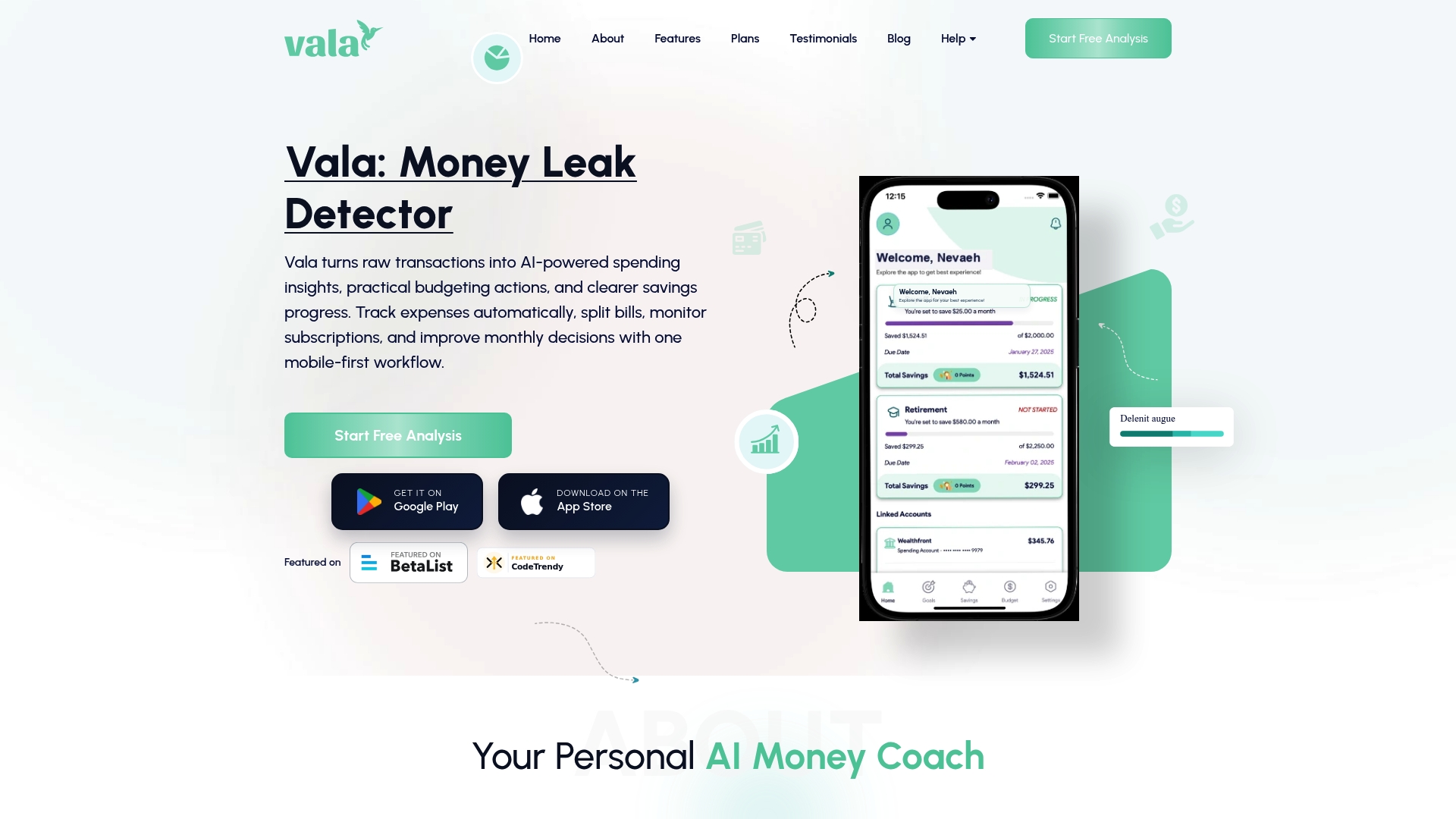
With Vala, you can connect your accounts, set goals, and let the AI surface exactly where your money is going and where you can save more. It works for individuals, couples, and groups, so whether you are managing solo finances or splitting costs with a partner, Vala adapts to your situation. You can also explore Vala’s AI budgeting tools to start building a budget that actually reflects how you live. Try Valapoint today and see the difference personalized, AI-driven budget management makes.
FAQ
How does AI personalize a budget for me?
AI personalizes your budget by analyzing your actual income, transaction history, fixed expenses, and stated goals, then building spending allocations based on your real patterns rather than national averages or generic templates.
What budgeting method works best with AI?
The best results come when you explicitly choose a framework like 50/30/20 or zero-based budgeting and tell the AI your constraints. Without clear direction, AI defaults to assumptions that may not match your financial situation.
Is it safe to share my financial data with AI tools?
It is safe to share summary-level information like monthly income, total fixed expenses, and savings goals. Never share account numbers, passwords, or Social Security numbers with any AI tool, including general-purpose chatbots.
Can AI update my budget automatically each month?
Yes. AI budgeting tools use a loop of categorizing new transactions, analyzing spending changes, and regenerating budget plans aligned to your goals, which means your budget becomes more accurate over time without manual rebuilding.
When should I use a human advisor instead of AI?
Use a human financial advisor for complex decisions involving taxes, estate planning, insurance, or major investments. AI budgeting is excellent for day-to-day money management but does not replace licensed financial guidance for high-stakes situations.