
When you share a home with someone, money disagreements can sneak up fast. You buy groceries, they pay the electric bill, and suddenly nobody remembers who owes what. Learning to track shared household purchases before tension builds is one of the most practical things you can do for your household. This guide walks you through exactly what you need to set up a clear system, how to run it day to day, and how to know when it’s actually working.
Table of Contents
- Key takeaways
- What you need before tracking shared household purchases
- Step-by-step methods to track joint spending
- Common mistakes when managing shared expenses
- What results to expect from your tracking system
- My honest take on tracking shared expenses
- Track smarter with Valapoint
- FAQ
Key takeaways
| Point | Details |
|---|---|
| Agree on rules first | Decide how you split costs before tracking anything to prevent recurring arguments. |
| Use the right tools | Apps reduce errors and save time compared to manual methods like notebooks or spreadsheets. |
| Log purchases immediately | Recording expenses right after they happen prevents forgotten costs and inaccurate balances. |
| Schedule regular reviews | Monthly check-ins help you catch discrepancies and adjust your system before small issues grow. |
| Communication beats tools | The most important factor in shared expense success is honest, consistent conversation. |
What you need before tracking shared household purchases
Getting the tools right matters. Getting the agreements right matters more. Most households that struggle with shared spending do not have a tool problem. They have a rules problem. Before you download any app or open a spreadsheet, you need a clear conversation about how you will split costs.
About 77% of couples use joint accounts for shared bills, while others prefer proportional splits or rolling tabs. There is no single right answer. What works is the method you both agree on and stick to.
Choosing your cost-sharing model
The three most common models are:
- Equal split (50/50). Every shared expense is divided equally, regardless of income. Simple to track, but can feel unfair if incomes differ significantly.
- Proportional split. Each person contributes based on their share of the household income. More equitable, but requires a bit more math when reviewing costs.
- Rolling tab. One person pays for purchases as they come up, and you reconcile the balance weekly or monthly. Works well for variable costs like groceries.
Many households combine methods. A hybrid approach works well: use a joint account for fixed bills like rent and utilities, then use a rolling tab or app for variable costs like food and household supplies. This keeps things simple without requiring every dollar to go through one account.
Picking your tracking tools
Here is a quick breakdown of the main options:
| Tool type | Best for | Drawback |
|---|---|---|
| Shared finance app | Real-time tracking, automated splits | Requires both parties to use it consistently |
| Spreadsheet | Customizable and free | Easy to neglect; no automatic reminders |
| Shared notebook | Simple, no tech required | Hard to search, easy to lose |
| Joint bank account | Fixed recurring bills | Less visibility into who spent what |
Pro Tip: Pick the simplest tool your whole household will actually use. The best system is the one you stick to, not the most feature-rich one.
Finally, set a recurring money meeting. Regular financial check-ins are more important than the tools you use. Even a 15-minute weekly review prevents misunderstandings from piling up.
Step-by-step methods to track joint spending
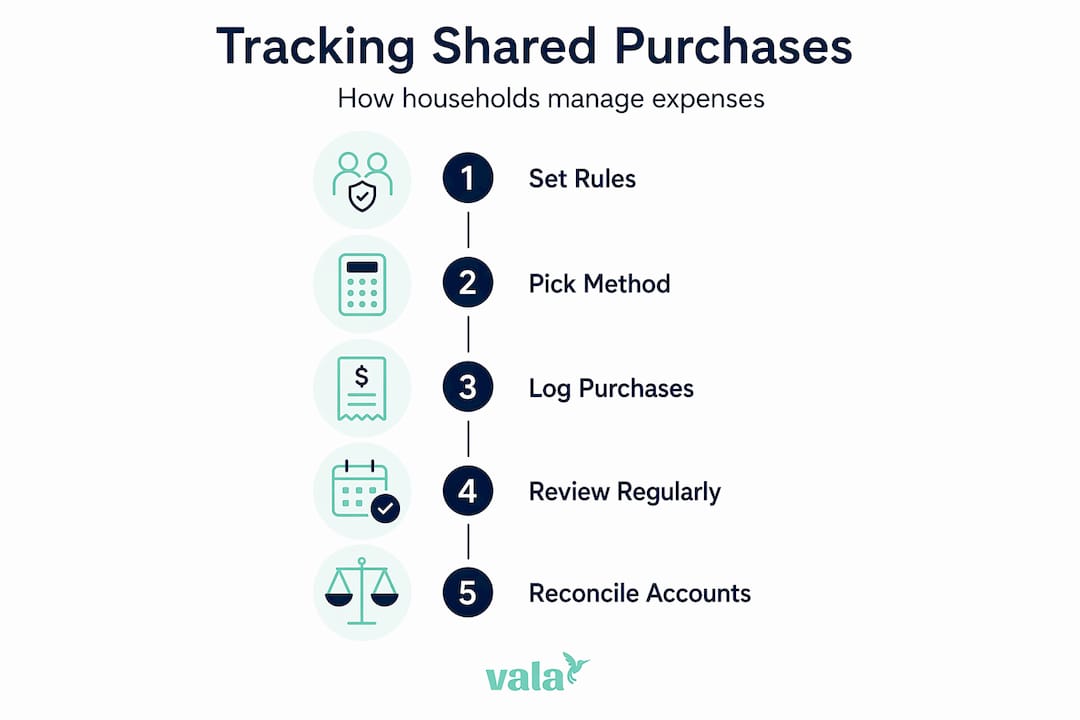
Once your agreements are in place, you need a reliable process. Here is a clear sequence you can follow starting today.
-
Choose one central location. Every expense goes in one place, whether that is a shared app, a Google Sheet, or a notebook on the kitchen counter. Splitting records between two places creates gaps.
-
Log purchases immediately. Do not wait until the end of the day. Record the expense right after you pay. Manual expense tracking has errors in roughly 19% of reports when people rely on memory instead of real-time entry.
-
Categorize every purchase. Create simple categories: groceries, utilities, rent, household supplies, dining out. Categories let you see where money actually goes, not just how much you spent total.
-
Assign the payer. Note who paid for each item. This is how you calculate who owes what at reconciliation time.
-
Upload receipts when possible. Even without automated scanning, receipt uploads keep your records accurate and give you something to reference during disagreements.
-
Reconcile balances regularly. Pick a frequency: weekly works well for busy households, monthly is fine for simpler setups. Calculate the running balance and settle up through a transfer or by adjusting who pays next.
-
Review and adjust categories quarterly. Your spending patterns change. A category review every three months keeps your tracking system aligned with real life.
If you want to simplify expense tracking further, look for apps that support shared access, automatic categorization, and balance summaries. These features cut the manual work significantly.
Pro Tip: Automate as much as possible. Linking your accounts to a household budgeting app means purchases get logged without anyone having to remember. Automated tracking systems reduce errors by 65% and cut reconciliation time by 50% compared to manual methods.

The most overlooked step is step 6. Many households track well but never reconcile. Tracking without settling up creates a growing ledger that eventually causes real friction. Build reconciliation into your calendar the same way you would a bill payment.
Common mistakes when managing shared expenses
Even well-intentioned households make the same mistakes. Knowing them in advance saves a lot of frustration.
- Skipping small purchases. A $4 coffee or a $12 household item feels too minor to log. Over a month, those small purchases add up to real money and real imbalance.
- Not agreeing on splitting rules upfront. Without clear agreed rules, tracking can cause more conflict than it prevents. One person expects 50/50; the other assumed it would be proportional.
- Overcomplicating the system. Fifteen expense categories, color-coded spreadsheets, and multiple apps sounds thorough. In practice, complexity is the fastest way to abandon a system entirely.
- Inconsistent logging. One person logs every purchase in real time. The other logs everything once a week from memory. The records never match, and reconciliation becomes an argument.
- Avoiding the money conversation. Tools do not fix communication problems. If one person feels the system is unfair, that feeling needs a direct conversation, not a new spreadsheet column.
“Tracking shared expenses effectively is not just math. It depends heavily on communication, mutual trust, and scheduling regular finance reviews to adjust systems as needed.”
When your system breaks down, do not just abandon it. Reset it. Pick a date to start fresh, agree on clearer rules, and simplify the process. Joint financial arrangements work best when both people feel the system reflects trust and cooperation, not surveillance.
If tensions rise around money, shift the conversation from “who owes what” to “how do we make this easier for both of us.” That reframe matters more than any tool upgrade.
What results to expect from your tracking system
A good shared expense system does not just prevent arguments. It gives your household a real financial picture you can both act on.
Here is what you can realistically expect once your system is running well:
| Benefit | Sign it’s working | How to maintain it |
|---|---|---|
| Less financial conflict | Fewer disputes about who paid what | Keep records current and reconcile regularly |
| Clearer budget visibility | You know exactly where shared money goes | Review category totals monthly |
| Shared financial awareness | Both people understand the household spend | Hold brief weekly check-ins together |
| Faster reconciliation | Settling balances takes minutes, not hours | Log purchases immediately and consistently |
| Better saving habits | Surplus money is visible and plannable | Adjust budget categories based on tracked data |
Most households notice a real improvement within 60 days of consistent tracking. The first month usually surfaces surprises, such as categories where you spend far more than expected. The second month is where you start making real adjustments.
Pro Tip: Celebrate small wins. If your first monthly review shows that both of you logged consistently and your balance reconciled cleanly, acknowledge that. Positive reinforcement makes the habit stick.
To verify your system is working, ask these questions at your monthly review: Are both people logging purchases consistently? Does the reconciled balance feel fair to both of you? Are there categories that need to be added, removed, or adjusted? If you can answer yes to the first two and have a clear answer to the third, your system is healthy.
Using a household budgeting app that gives both people visibility into the same data makes these reviews faster and more productive. You spend less time comparing notes and more time making actual decisions.
My honest take on tracking shared expenses
I’ve talked with a lot of people about their household finances, and the pattern I keep seeing is this: the households that fight about money the most are not the ones with complicated finances. They are the ones who never made their financial agreements explicit.
In my experience, the tool matters far less than the conversation that happens before you pick one. I’ve seen couples use a basic notes app and never argue about money. I’ve also seen households with premium tracking software have the same disputes month after month because they never agreed on who was responsible for what.
What I’ve learned is that shared expense tracking is really a trust-building exercise disguised as a financial task. When both people see the same numbers and had a hand in setting up the system, they feel more confident in the process. When one person controls the tracking and the other just gets told what they owe, resentment builds quietly.
The other thing I’d push back on is the idea that the perfect system exists. It does not. Your spending patterns change, your income changes, and your household priorities change. The households that do well long-term are the ones who treat their tracking system as something to maintain and update, not something to set up once and forget.
Start simple. Review often. Talk honestly. Adjust when something is not working. That process, done consistently, outperforms any app or spreadsheet every time.
— SaverStride
Track smarter with Valapoint
If you want to cut down on manual tracking and get a clearer picture of your shared finances, Valapoint is built for exactly that.

With Valapoint, you and your household can track shared costs in real time, split expenses clearly, and get automatic summaries of where your money is going. The app handles categorization, balance calculations, and spending insights so your monthly reviews take minutes instead of an hour. Whether you are managing groceries, utilities, or irregular household purchases, Valapoint gives everyone in your household full visibility and zero guesswork. You can also explore Valapoint’s personal finance tools to build a budget around your tracked data. Ready to take control? Start with the Vala personal finance app today.
FAQ
How do I track shared household purchases without an app?
Use a shared spreadsheet or a physical notebook where both people log every purchase with the date, amount, category, and payer. Reconcile balances weekly to keep records accurate.
What is the best way to split household costs fairly?
The fairest method depends on your household. Equal 50/50 splits work well for similar incomes, while proportional splitting based on income works better when earnings differ significantly.
How often should we review our shared expense records?
Monthly reviews work well for most households. A quick weekly check-in to confirm purchases are logged prevents errors from building up before the full review.
Why does our shared expense tracking keep failing?
The most common reason is skipping small purchases or logging inconsistently. Failing to agree on splitting rules upfront is the other major cause of tracking breakdowns.
Can one app work for couples, roommates, and families?
Yes. Most shared expense apps let you create a group, assign payers, and split costs any way you choose. Look for apps that support shared access and categories so everyone sees the same data in real time.