
Yes, if you need a predictable monthly number and hate surprises. No, if you want direct feedback on your usage or you’re about to change how much energy you use. Budget billing averages your annual costs into equal monthly payments, and for most households that trade off is worth making. But three things flip the answer to “no”: a recent jump in usage, a planned move within the next year, and an upcoming purchase like an EV or a new HVAC system that changes your consumption pattern.
Before you decide anything, pull up your last 12 months of bills. You’re checking three numbers: your actual usage trend, any program fees your utility charges, and how the true-up (the annual reconciliation) gets handled if you cancel or move.
A few conditions that should make you pause before enrolling include having had a major life change recently, planning to move or sell soon, or having fallen behind on payments, since many utilities require a clean payment history to qualify.
Key Takeaways
Budget billing works best as a cash-flow stabilizer for predictable-usage households, not as a way to lower total energy costs.
| Point | Details |
|---|---|
| It’s about timing, not savings | Your annual total stays the same; only the monthly payment schedule changes. |
| Predictability favors fixed incomes | Retirees and seasonal-spike households benefit most from flat payments. |
| True-ups can surprise you | Rising usage or rate hikes can create a lump-sum balance at reconciliation. |
| Run the math first | Average your last 12 bills and compare against your highest and lowest months. |
| Vala helps you track the gap | Use Vala to monitor actual spending against your budgeted amount and build a true-up buffer. |
Table of Contents
- Is Budget Billing Worth It, and How Does It Work?
- What Are the Real Benefits of Budget Billing?
- What Are the Drawbacks and Risks of Budget Billing?
- Who Should Enroll, and Who Should Skip It?
- How to Decide: A Six-Point Checklist
- Try This Three-Step Calculation on Your Own Bills
- What If Budget Billing Isn’t the Right Fit?
- What Actually Decides This for You
- Simulate Your True-Up Before Your Utility Does
- Where to Verify These Rules Yourself
- Frequently Asked Questions
- Sources
Is Budget Billing Worth It, and How Does It Work?
Budget billing, sometimes called levelized billing, replaces your fluctuating monthly bill with a flat, predictable payment based on your average usage. The goal isn’t to save you money. It’s to smooth out the swings that come from seasonal heating and cooling demand, so your July bill doesn’t triple your March bill.
Here’s how utilities typically calculate your number:
- They pull your usage history, usually a rolling 12 months.
- They calculate the average monthly cost across that period.
- They set your flat payment at that average, sometimes rounding up slightly as a buffer.
- They review the number periodically, often quarterly, and adjust it if your usage or rates have shifted meaningfully.
- At the 12-month mark, they reconcile what you’ve paid against what you actually used, called the true-up.
Enrollment usually comes with a few conditions:
- Your account needs to be in good standing, with no past-due balance.
- Some utilities require at least a few months of billing history at your address before you qualify.
- You’ll typically see a running “deferred balance” line on your statement showing whether you’re ahead or behind.
What Are the Real Benefits of Budget Billing?
The single biggest advantage is predictability. When your payment is the same every month, it’s easier to budget, easier to automate through autopay, and easier to avoid surprise spikes that disrupt your budgeting.
That predictability translates into fewer missed payments. Budget billing stabilizes cash flow and can help you avoid late fees, which matters more than people expect. A late fee here and there doesn’t sound like much, but it compounds if you’re already stretched thin.
Certain households get outsized value from this:
- Retirees or anyone on a fixed monthly income who needs every expense locked in.
- Households in climates with harsh winters or summers, where a $400 August bill next to a $90 April bill makes planning nearly impossible.
- Anyone who relies heavily on autopay and wants one less variable expense to track.
| Point | Details |
|---|---|
| Predictable payment | Your monthly amount stays flat, which simplifies budgeting and autopay setup. |
| Fewer late fees | Consistent payments reduce the odds of missing a due date during a high-usage month. |
| Best for seasonal swings | Households with big winter or summer usage spikes see the most benefit. |
| No cost savings | Your total annual bill doesn’t change, just the timing of when you pay it. |
What Are the Drawbacks and Risks of Budget Billing?
The trade-off nobody mentions enough: budget billing doesn’t lower what you owe, it just changes when you owe it. If your usage rises during the year, whether from a hotter summer, a new appliance, or working from home more, your true-up at reconciliation can land as a lump-sum bill you didn’t plan for.
Utility program pages are consistent on this point. FPL’s budget billing page states plainly that the program evens out payment timing without reducing total energy costs, and it shows a deferred balance on your statement so you can see the gap building in real time. Some utilities also charge modest program fees, and none of them will stop a disconnection if you fall behind on the total amount owed, budget billing or not.
A few risk-mitigation habits keep this from catching you off guard:
- Check your utility’s online portal monthly to compare actual usage against your budgeted amount.
- Request a mid-cycle adjustment if you notice a sustained gap rather than waiting for the annual true-up.
- Ask exactly how your utility handles cancellation, since some apply the balance immediately rather than spreading it out.
Pro Tip: Set a calendar reminder every quarter to check your deferred balance line. Catching a $150 gap in month six is far easier to manage than discovering a $600 true-up in month twelve.
Who Should Enroll, and Who Should Skip It?
Budget billing tends to work best for people who value stability over usage feedback. Good candidates include fixed-income households, families with predictable but seasonally spiky heating and cooling costs, and anyone who already runs their finances on autopay and wants one fewer variable line item.

It’s a weaker fit for low-usage households that already have small, stable bills, anyone planning to move soon, and people who are actively trying to cut consumption and want to see the direct financial reward of that effort each month.
If you’re behind on payments already, talk to your utility about an arrearage management program or assistance plan instead. Budget billing requires a clean account to enroll, and it’s not designed to dig you out of existing debt. Consumer advocates specifically frame it as a cash-flow tool, not a savings or hardship program.
How to Decide: A Six-Point Checklist
Before you call your utility, run through these six checks against your own account:
- Pull your last 12 months of usage and look for a clear upward or downward trend.
- Check whether your utility has a pending rate increase that could throw off the averaged number.
- Confirm your account meets the minimum payment history and standing requirements.
- Ask what fees, if any, apply to enrollment or ongoing maintenance.
- Find out exactly how cancellation and true-up work if you leave mid-year.
- Decide whether you’d rather see monthly usage feedback or trade it for a flat number.
When you call or email your utility, ask these directly:
- “How is my budget amount calculated, and how often is it reviewed?”
- “What happens to my balance if I move or cancel mid-cycle?”
- “Are there any enrollment or maintenance fees?”
- “Will you notify me before adjusting my monthly amount?”
Pro Tip: If four or more of the six checklist items point toward stability (flat usage, no pending rate hikes, clean account, low fees), budget billing is worth it. If your usage is trending up or you’re planning a move, hold off.
Most utilities, including Eversource, require your account to be current before you can enroll, so settle any outstanding balance first.
Try This Three-Step Calculation on Your Own Bills
You don’t need to guess. Run this against your last year of statements.
- Add up your actual bills from the past 12 months and divide by 12. That’s your rolling average, which mirrors how utilities like APS calculate the budget billing figure.
- Compare that average to your highest and lowest monthly bills. A $60 spread barely matters. A $250 spread means budget billing would meaningfully smooth your cash flow.
- Multiply your average by 12 and compare it to your actual annual total. They should be close. If they’re not, factor in a likely rate change for the coming year.
If your usage is trending upward, rerun the math assuming a 10 to 15 percent increase, especially if you’ve added an EV or upgraded your HVAC system.
Pro Tip: Re-run this calculation any time your household changes meaningfully. A new appliance or a shift to working from home can move your average enough to justify requesting a mid-cycle adjustment before your true-up hits.
What If Budget Billing Isn’t the Right Fit?
A few alternatives deserve consideration:
- Standard actual billing paired with a usage-tracking habit, if you want direct feedback on conservation efforts.
- Fixed-rate or flat-bill plans, which lock in a price differently than budget billing’s averaging model.
- Utility payment arrangements or assistance programs, better suited to households working through past-due balances.
- Energy-efficiency upgrades, which actually lower your total cost rather than just its timing.
A budgeting tool that models your monthly cash flow can help you test any of these paths before you commit.
What Actually Decides This for You
The real question isn’t whether budget billing sounds convenient. It’s whether you’d rather have a flat, predictable number or the monthly feedback loop that pushes you to cut usage when a bill spikes. Households chasing stability should enroll. Households chasing savings should skip it and track usage directly instead.
Before signing up anywhere, run the worked calculation above and confirm your utility’s true-up rules. That five minutes of homework prevents most of the surprises people complain about later.
Simulate Your True-Up Before Your Utility Does
Budget billing asks you to trust an average. Vala lets you verify one. Instead of waiting twelve months to find out whether your flat payment matches reality, you can track your actual utility costs against your budgeted number every month and see a projected true-up building in real time.

Vala’s personal finance app pulls your spending into one place, so you can set aside a small buffer each month in case reconciliation lands in your favor or against it. Pair that with automated bill reminders and you get the predictability budget billing promises, minus the guesswork about what you’ll owe later. Download Vala and run your own 12-month usage check this week before you decide.
Where to Verify These Rules Yourself
- FPL’s budget billing page for how one major utility explains deferred balances.
- Eversource’s program page for typical eligibility requirements.
- PG&E’s budget billing program for cancellation and reconciliation rules.
Frequently Asked Questions
Is budget billing worth it if my income is steady but my usage varies a lot by season?
Yes. This is the exact scenario budget billing was built for. It won’t lower your annual total, but it will stop your bill from tripling in summer or winter.
Does budget billing hurt my credit if I owe money at the true-up?
Not directly, but an unpaid true-up balance can lead to the same collections process as any other unpaid utility bill, including possible disconnection.
Can I cancel budget billing whenever I want?
Usually yes, but expect an immediate reconciliation. Utilities like PG&E apply your remaining credit or debit to your final bill right away rather than spreading it out.
Will enrolling in budget billing save me money?
No. It changes your payment schedule, not your total cost. If you’re focused on savings, pair it with efficiency upgrades or usage tracking instead.
What happens if I move while enrolled in budget billing?
Your utility will typically reconcile your account and either bill you for the remaining balance or issue a credit, similar to what happens if you cancel voluntarily.
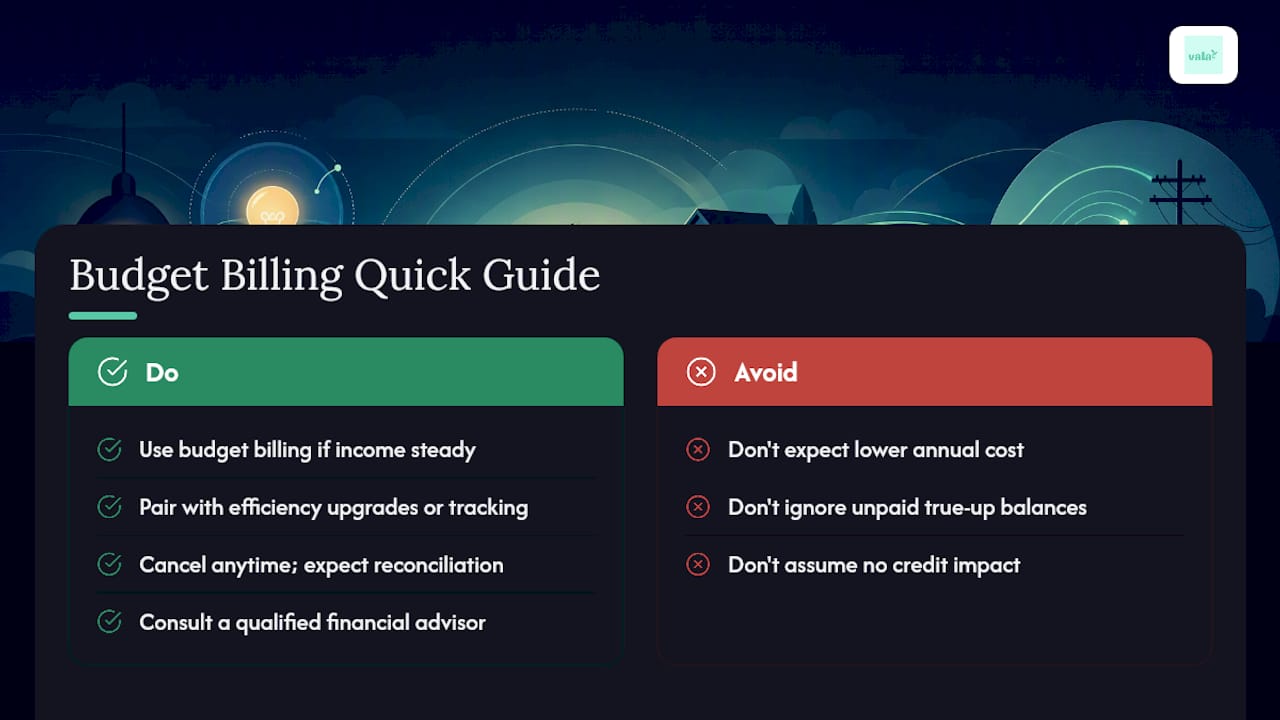
This article is general information, not a substitute for advice from a qualified financial advisor. Consult a qualified financial professional about your own circumstances before acting on anything here.
Sources
- How Budget Billing Makes Your Utility Bills Predictable – CNET
- Budget Billing for Utilities: How Does it Work and Is It Right for You? – EnergyBot
- Budget billing — Eversource
- Residential Budget Billing Program | APS
- Budget billing program — PG&E