
Your first paycheck calls for five moves in order: confirm direct deposit landed correctly, automate a small transfer into savings, enroll in your retirement plan to capture any employer match, check your pay stub against your W-4, then build a simple budget using your real net pay. Do these in the first week and everything else gets easier.
TL;DR:
- Automate saving at least 10% of net pay immediately after your first paycheck to build a starter emergency fund and avoid relying on discretionary spending.
- Enroll in your retirement plan within the first week and contribute enough to capture your full employer match to maximize your long-term growth.
- Create a cash-flow calendar that maps pay dates against bill due dates to prevent overdrafts caused by timing mismatches, shifting due dates to after paydays if needed.
- Set up a basic, easy-access savings account for initial buffers and automate funds transfer using either split direct deposit or standing bank transfers.
- Review your pay stub against your W-4 form and run a withholding estimator to ensure accurate taxes and avoid surprises during tax season.
Table of Contents
- Your first-paycheck action checklist
- Build a simple budget that actually works
- Set up accounts and automate your savings
- Understand your pay stub, taxes, and withholding
- Start an emergency fund and short-term savings plan
- Enroll early and capture your employer match
- Track your spending with tools that actually stick
- Common first-job money mistakes to avoid
- Why starting small and systemizing beats a perfect plan
- How Vala helps you run this plan without the manual work
- Sources
- FAQ
Your first-paycheck action checklist
The first two weeks of a new job set the pattern for how you handle money going forward. Work through these tasks in order, and most can be done in under an hour total.
- Confirm direct deposit through your payroll portal. Check that the amount matches your offer letter’s stated pay after typical withholding, usually within a day of your first pay date.
- Open or confirm your accounts. You want at least one checking account for bills and one savings account that is separate enough that you will not casually dip into it. Most banks let you open an account online in 15 minutes.
- Set up an automatic transfer from checking to savings, timed to land the day after payday. Five minutes in your bank’s app.
- Enroll in your retirement plan through HR or your plan provider’s portal. This often has a deadline, so check it in week one, not month three.
- Check benefits enrollment windows. Health insurance, dental, and other benefits usually have a limited sign-up period after your start date, so confirm the deadline with HR right away.
- Save a starter buffer. Move your first $100 to $200 into savings before you spend on anything discretionary.
Each of these tasks lives in a different place: payroll or HR for the stub and benefits, your retirement plan provider’s site for enrollment, and your bank’s app for the transfers. None of it requires a financial background, just a short to-do list and a free afternoon.
Build a simple budget that actually works
If 20% feels out of reach in month one, start at 10% and raise it as you adjust to your real expenses. The CFPB frames a similar idea: begin with a consistent automatic savings amount, often cited as around 10% of net pay, rather than an all-or-nothing target you abandon in week two, as suggested in CFPB guidance on saving as a new earner.
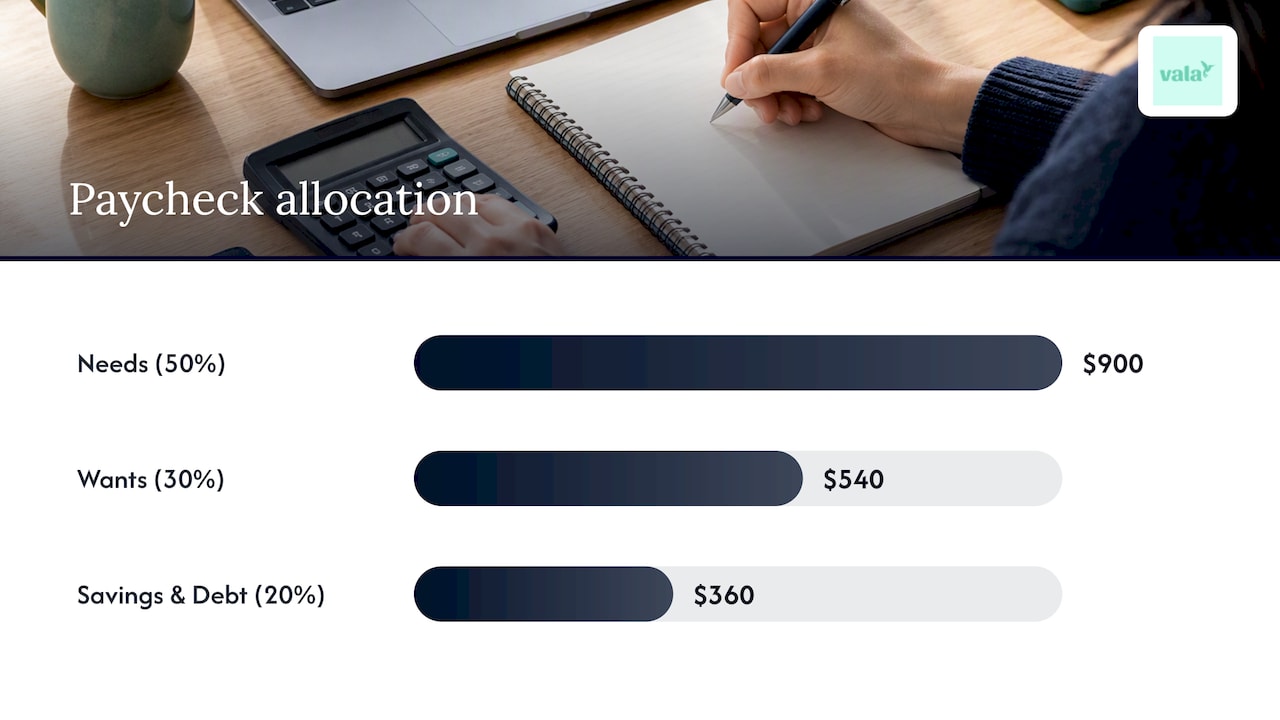
Say your net pay is $1,800 every two weeks. A 50/30/20 split puts $900 toward needs, $540 toward wants, and $360 toward savings and debt. If that savings number feels aggressive next to rent and a car payment, drop to $180 and build from there.
The piece most new earners miss is timing, not totals. You can have enough money for the month and still overdraft because a bill hits three days before payday. A cash-flow calendar fixes this: map every paycheck date against every bill due date for the next 60 days, as recommended in Consumer.
- List every fixed bill and its due date for the next two pay cycles.
- Mark your paycheck dates on the same calendar.
- Flag any bill due before its matching paycheck arrives.
- Call the biller and request a due-date change for anything that clashes, most will accommodate this.
- Rerun the calendar each month until your dates settle into a rhythm.
Pro Tip: Shift one or two bill due dates to fall right after payday. It’s a five-minute phone call that eliminates most timing-based overdrafts.
For a deeper walkthrough of this method, see our budget calendar guide for irregular incomes.
Set up accounts and automate your savings
Liquidity matters more than yield when you are building a starter fund. A basic savings account you can transfer from in seconds beats a higher-yield account that locks your money up for days.
- Easy-access savings works best for your first $500 to $1,000, since you may need it fast.
- A high-yield savings account is worth adding once your starter buffer is solid and you are saving beyond the basics.
- Split direct deposit lets your employer route a fixed amount or percentage straight into savings before it ever touches checking.
- A standing bank transfer does the same job if your employer does not offer a payroll split.
Pick one automation method and set it once. A fixed dollar amount (say $50 per paycheck) is predictable and easy to plan around. A percentage of pay scales automatically as your income changes, which matters if you get a raise or switch to commission-based pay. Either way, the goal is the same: money moves to savings before you see it in your checking balance. Our guide on pay-yourself-first budgeting walks through sample transfer setups if you want to compare approaches.
Understand your pay stub, taxes, and withholding
Your pay stub tells you more than your bank balance does. Gross pay is what you earned before anything is taken out. Net pay is what actually lands in your account, after federal and state income tax, FICA (Social Security and Medicare), health insurance premiums, and any retirement contributions.
- Gross pay minus taxes and FICA gets you to your taxable-income deductions.
- Pre-tax deductions, like health insurance premiums and traditional 401(k) contributions, lower your taxable income and your take-home pay at the same time.
- Post-tax deductions, like Roth retirement contributions, come out after taxes are calculated.
Review your first stub against the Form W-4 you filled out when you were hired. The IRS withholding estimator can tell you whether your withholding lines up with your actual tax situation, and it is worth running once in your first month and again if your pay or filing status changes. If the estimator flags a mismatch, file a new W-4 with HR rather than waiting until tax season to find out you owed more than expected.
Budget around your net pay, not your advertised salary. A 401(k) contribution that lowers your paycheck by $75 also lowers what you owe in taxes, so the real cost to your spending budget is smaller than the number on the stub suggests.
Start an emergency fund and short-term savings plan
Build your starter emergency fund in two stages. Stage one is a small buffer, enough to cover one unplanned expense without reaching for a credit card. Stage two is a fuller cushion, which the CFPB frames as at least three months of essential expenses, or six to nine months when that is realistic for you, according to CFPB guidance on emergency savings.
Many households are closer to stage one than stage two. Federal Reserve survey data found that most households could cover a $400 emergency, but far fewer had three months of expenses set aside. That gap is exactly why a starter buffer, even a modest one, is worth prioritizing before you stretch into discretionary spending.
- Stage one target: one paycheck or $500, whichever you reach first.
- Stage two target: three months of essential expenses, built gradually.
- Pay-yourself-first automation moves the savings transfer before you budget the rest.
- Windfalls like a tax refund or bonus go straight into the fund rather than into spending.
- Keep it in a federally insured account that you can access within a day or two, not an investment account.
Our piece on building an emergency fund from small, consistent contributions breaks this into a week-by-week plan if $500 feels far off right now.
Enroll early and capture your employer match
An employer retirement match is money your employer pays you for saving, and skipping it is the costliest mistake a new earner can make. Investor treats automatic payroll contributions and full match capture as the top priority for someone starting their first job, since the match produces an immediate return that ordinary saving cannot match.
- Find the match formula in your plan documents or by asking HR directly, it is often something like “50% up to 6% of pay.”
- Contribute at least enough to get the full match, even if that means trimming your discretionary spending temporarily.
- Ask about Roth versus traditional options, Roth contributions are taxed now and grow tax-free, traditional contributions lower your taxable income today.
- Confirm eligibility and vesting, since some employers require a waiting period before contributions or matches are available.
Ask HR these questions directly: When am I eligible to enroll? What is the exact match formula? Is there a vesting schedule for employer contributions? Is there a contribution limit I should know about this year?
Track your spending with tools that actually stick
Budgeting only works if you can see where your money went, which means a weekly habit, not a one-time setup. Record transactions as they happen, then reconcile once a week against your bank balance. At the end of your first full month, compare your plan to what actually happened and adjust your percentages for month two.
- Bank sync saves you from manually entering every transaction.
- Automatic categorization turns raw transactions into a picture of spending by category.
- Recurring-charge detection flags subscriptions you forgot you signed up for.
- A spreadsheet works fine if you are disciplined, but most people stick with an app longer because it requires less manual upkeep.
Pro Tip: Review your recurring charges in month one, before they blend into your baseline spending and become invisible.
An app like Vala builds this routine in, with automatic categorization and leak detection handling the tracking so the weekly check-in takes minutes instead of an hour. For more on daily tracking habits, see our guide to expense tracking practices, or compare free options in this roundup of budgeting apps.

Common first-job money mistakes to avoid
New earners tend to trip over the same handful of mistakes, and most have a one-line fix.
- Skipping benefits enrollment because the deadline sneaks up. Fix: put the deadline in your calendar the day you get your offer letter.
- Lifestyle inflation from spending the whole raise. Fix: automate the savings increase before the higher paycheck hits your account.
- Timing mismatches that cause overdrafts despite having enough money overall. Fix: run the cash-flow calendar every month.
- Ignoring withholding until tax season. Fix: check your stub against your W-4 in month one.
- Skipping the employer match to free up cash now. Fix: treat the match contribution as non-negotiable, like rent.
Why starting small and systemizing beats a perfect plan
The new earners who stay on track are not the ones with the most detailed spreadsheet. They are the ones who automated a small, boring habit early and let it run. A $50 transfer you never have to think about beats a 20% savings goal you abandon by March. Systems survive bad months. Willpower does not.
— SaverStride
How Vala helps you run this plan without the manual work
Everything in this guide works better when it runs on autopilot, which is the gap Vala is built to close. Instead of manually checking your stub, reconciling transactions, and hunting for forgotten subscriptions, Vala’s Money Leak Check scans your accounts for recurring charges and spending patterns that quietly drain your budget.
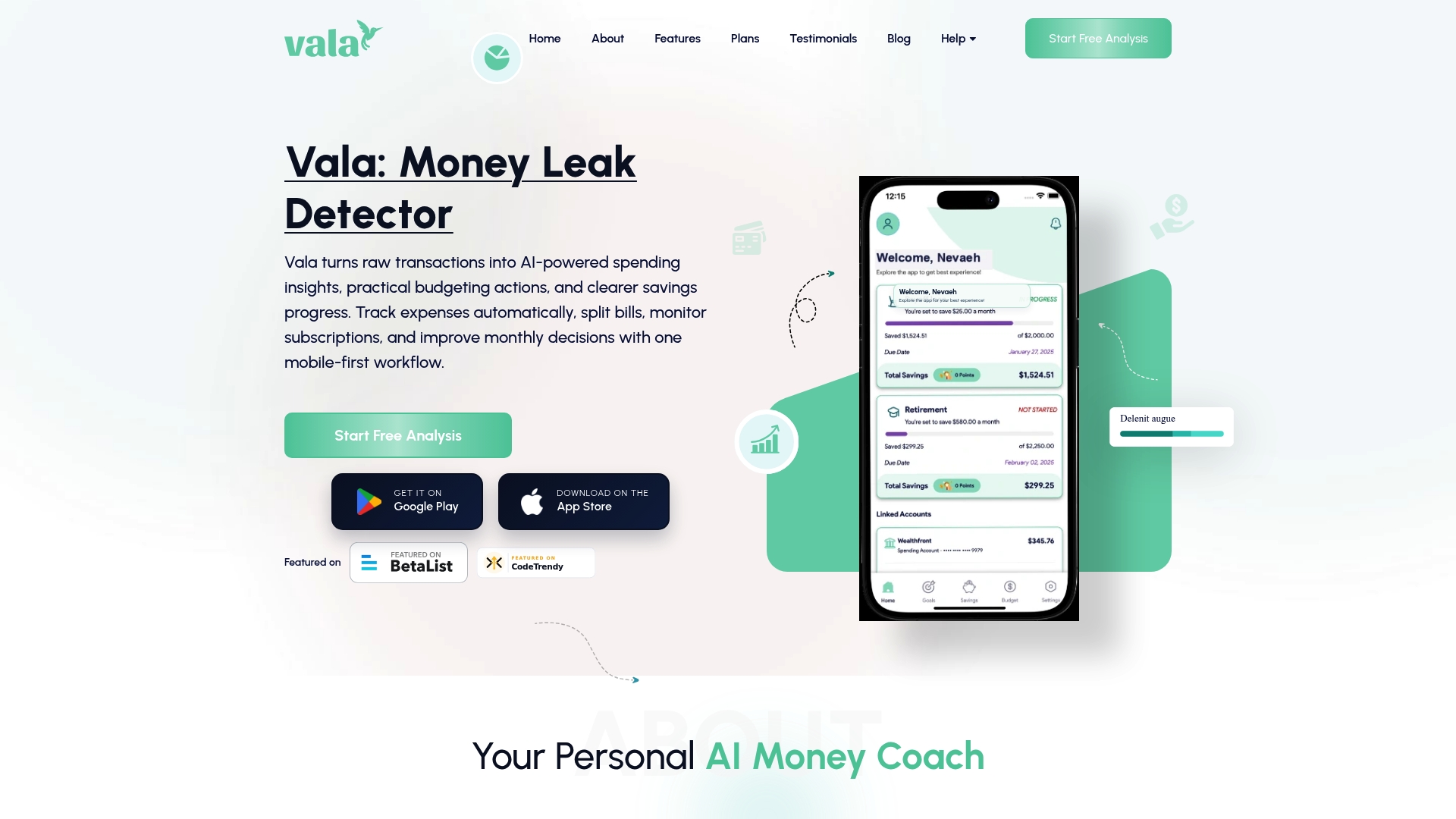
- Money Leak Check finds recurring charges and spending leaks automatically, so you catch them before they become part of your baseline.
- SaverPro ($2.99 per month) adds deeper budgeting tools, AI-driven insights, and shared expense tracking if you are splitting costs with roommates or a partner.
- Automated tracking and savings goals mean the pay-yourself-first habit from this guide happens without a monthly spreadsheet update.
If your first-month goal is to get your budget running without babysitting it, start with Vala and let the automation carry the routine.
Sources
- Consumer
- About Form W-4, Employee’s Withholding Certificate | IRS
- Teenagers and saving | Consumer Financial Protection Bureau
- Investor
FAQ
What is the $27.40 rule?
This figure is not a standard budgeting rule found in government or established financial guidance, so a reliable definition is not publicly available. If you have seen it referenced, treat it as informal advice rather than an established framework, and rely on tested approaches like the 50/30/20 split instead.
Is $200 a week enough to live on?
Whether $200 a week covers your needs depends entirely on your rent, location, and fixed bills, so there is no universal answer. Build your own number by listing your actual monthly bills, as outlined in consumer.gov’s budgeting worksheet, and compare that total against your real income.
Is saving $100 every paycheck good?
Saving $100 every paycheck is a solid habit, especially as a starter buffer while you work toward a fuller emergency fund. The CFPB frames the right target as a consistent, sustainable amount, often cited as around 10% of net pay, so whether $100 is “enough” depends on your own paycheck size, per CFPB guidance.
What is the $1000 a month rule?
This is not a recognized government or financial-planning standard, so there is no official definition to point to. If you are looking for a savings target, a more reliable starting point is the CFPB’s guidance to automate a consistent percentage of net pay and build toward three months of essential expenses.
How much of my paycheck should go to savings as a beginner?
A reasonable starting point is 10% of net pay, automated so it happens without a decision each payday, based on CFPB guidance for new earners. Raise the percentage gradually as your budget settles and your starter emergency fund grows.