
Expense tracking best practices are the combination of habit formation, automation, and decision-focused categories that give you real control over your money. The industry term for this discipline is personal expense management, and it covers everything from how you log a coffee purchase to how you review your budget each month. Done right, it takes less than 15 minutes a week and tells you exactly where your money goes. Done wrong, it creates data overload and zero behavior change. This guide covers what actually works.
1. expense tracking best practices start with a spending baseline
The most effective first step is to track 30 days of spending without changing a single habit. This gives you an honest picture of where your money actually goes, not where you think it goes. Most people are surprised by the gap between the two.
During this baseline period, do not cut subscriptions, skip dinners out, or adjust your grocery runs. Any change you make distorts the data. Your goal is observation, not optimization. Once you have 30 days of clean data, patterns become obvious and decisions become easy.
- Record every transaction, including small ones like coffee or parking
- Use one account or card if possible to simplify capture
- Note the category for each purchase as you go, not at the end of the month
- Do not judge the spending yet. Just record it.
Pro Tip: Set a recurring phone reminder for the same time each day to log any cash purchases. Digital transactions capture themselves, but cash disappears from memory fast.
2. build a weekly 15-minute review habit
A weekly 15-minute review is the single habit that separates people who track expenses from people who actually manage them. Fifteen minutes is short enough to stay consistent and long enough to catch budget leaks before they compound.

Pick a fixed day and time, like Sunday evening or Monday morning, and treat it like a standing appointment. During the review, check your category totals against your budget, flag any unusual charges, and note one thing you want to adjust in the coming week. That’s it. The review does not need to be a deep analysis every time.
Consistency in routine reviews reduces friction and builds the habit faster than any app feature will. The tool matters less than the schedule.
3. use automation to track expenses in real time
Automation shifts expense management from reactive to proactive. Instead of scrambling at month-end to reconcile transactions, you get real-time visibility as each purchase happens. That shift alone reduces errors and removes the stress of catching up.
The core automation features worth prioritizing are:
- Automatic categorization: Transactions are sorted by merchant type the moment they post
- Bank account integration: Your app pulls transactions directly, so nothing gets missed
- Spending alerts: You get notified when a category approaches its limit
- Receipt capture: Mobile tools that photograph and attach receipts to transactions eliminate lost-receipt problems entirely
Automation does not replace your judgment. It removes the manual work so your judgment can focus on decisions, not data entry.
Pro Tip: When choosing a tracking app, test whether it connects directly to your bank before committing. An app that requires manual imports will get abandoned within 60 days.
You can learn more about how this works in practice with Valapoint’s guide to automated expense tracking.
4. choose budgeting frameworks that match your life
The 50/30/20 rule is the most widely used personal budgeting framework: 50% of take-home pay goes to needs, 30% to wants, and 20% to savings or debt repayment. If your needs category consistently exceeds 50%, that is a direct signal your budget needs adjustment, not just your spending.
Other frameworks serve different goals. Zero-based budgeting assigns every dollar a job before the month begins, which works well for people who want maximum control. The pay-yourself-first method moves savings out automatically before you spend anything, which works well for people who struggle to save at the end of the month.
| Framework | Best For | Main Advantage | Main Limitation |
|---|---|---|---|
| 50/30/20 Rule | Most individuals and couples | Simple, flexible, easy to start | Less precise for irregular income |
| Zero-Based Budgeting | Detail-oriented planners | Every dollar has a purpose | Time-intensive to maintain monthly |
| Pay-Yourself-First | Savers who overspend | Savings happen automatically | Does not address spending categories |
| Envelope Method | Cash spenders | Hard spending limits per category | Difficult to use with digital payments |
Choose the framework that you will actually use. A simple system you follow beats a complex one you abandon.
5. build expense categories that drive decisions
Tracking without decision-oriented categories creates data overload and ineffective reviews. Every category in your system should answer a specific question, like “Am I spending too much on food?” or “How much are my subscriptions costing me each month?”
Start with five to seven core categories: housing, food, transportation, subscriptions, health, entertainment, and savings. Add subcategories only when the data from a parent category is too broad to act on. For example, splitting “food” into “groceries” and “dining out” makes sense if you are trying to reduce restaurant spending. Splitting it further into “breakfast,” “lunch,” and “dinner” rarely helps.
Simplifying categories increases consistent use. Overly complex systems lead to errors and, eventually, abandonment. Use Valapoint’s subscription cost calculator to get a clear view of how recurring charges stack up across your categories.
6. separate needs from wants before you spend
The 50/30/20 rule only works if you correctly classify your expenses. Rent is a need. A streaming service is a want. A gym membership could be either, depending on your health goals and income. The classification matters because it determines which category absorbs the cost and whether you flag it for review.
A practical rule: if you would cut it first in a financial emergency, it is a want. If cutting it would directly harm your health, housing, or employment, it is a need. Apply this test to every recurring charge during your 30-day baseline. You will likely reclassify several items.
AI-powered budget personalization can help you identify which categories are misclassified and where your spending patterns suggest a need for rebalancing.
7. run monthly reviews to adjust and improve
A 30-minute monthly review builds the cadence that keeps your tracking system accurate over time. Weekly reviews catch small leaks. Monthly reviews tell you whether your budget targets still reflect your actual life.
During the monthly review, compare your category totals to your targets, identify any category that exceeded its limit two or more times, and decide whether to adjust the target or the behavior. Both are valid responses. Sometimes your grocery budget is too low. Sometimes you genuinely overspent.
| Review Type | Frequency | Time Required | Primary Focus |
|---|---|---|---|
| Weekly Check-In | Every week | 15 minutes | Catch overspending early, flag unusual charges |
| Monthly Deep Review | Once a month | 30 minutes | Adjust targets, assess category trends, plan ahead |
Pro Tip: Schedule your monthly review on the first weekend of each month. Pair it with something you enjoy, like a good coffee or a favorite playlist, to reduce resistance and build the habit faster.
8. keep records the right way
The IRS recommends keeping expense documentation for 3 years for standard audits and 7 years for major purchases. Digital scanned receipts are legally accepted if they are complete and legible. This matters even for personal finances if you claim deductions or run a side business.
The easiest approach is to photograph receipts immediately after purchase and attach them to the transaction in your tracking app. Apps that support this feature make the process take under 10 seconds. Waiting until the end of the month to sort receipts is where documentation habits break down.
For a deeper look at how digital records work within a broader financial system, the guide on digital document transformation covers IRS-compliant digital recordkeeping in practical terms.
Key takeaways
Consistent expense tracking requires a 30-day baseline, weekly reviews, automation, and categories built around decisions you actually need to make.
| Point | Details |
|---|---|
| Start with a baseline | Track 30 days without changing habits to get accurate spending data. |
| Review weekly | A 15-minute weekly check catches budget leaks before they grow. |
| Use automation | Real-time categorization and bank integration remove manual data entry. |
| Match your framework | Choose 50/30/20, zero-based, or pay-yourself-first based on your actual behavior. |
| Keep categories simple | Five to seven core categories drive better decisions than twenty narrow ones. |
What i’ve learned from tracking expenses for years
Most people fail at expense tracking not because they lack discipline but because they start with too much complexity. They download three apps, create 25 categories, and try to log every transaction manually. By week two, the system collapses under its own weight.
The approach that actually works is almost embarrassingly simple. One app. Five categories. Fifteen minutes on Sunday. That’s it. You build from there only when the data tells you to, not because a budgeting article told you to add more structure.
The other thing I’ve noticed is that the review habit matters more than the tool. I’ve seen people manage their finances well with a plain spreadsheet and others fail with the most sophisticated app on the market. The difference is always the weekly review. Without it, tracking becomes a passive record of the past instead of an active guide for the future.
Start simple. Stay consistent. Add complexity only when a specific question demands it. Your system should answer questions, not create them.
— SaverStride
Take control of your spending with Valapoint
If you want a system that handles the hard parts automatically, Valapoint’s personal finance app is built for exactly this. Vala connects to your bank accounts, categorizes transactions in real time, and sends weekly spending summaries so your 15-minute review takes even less effort.
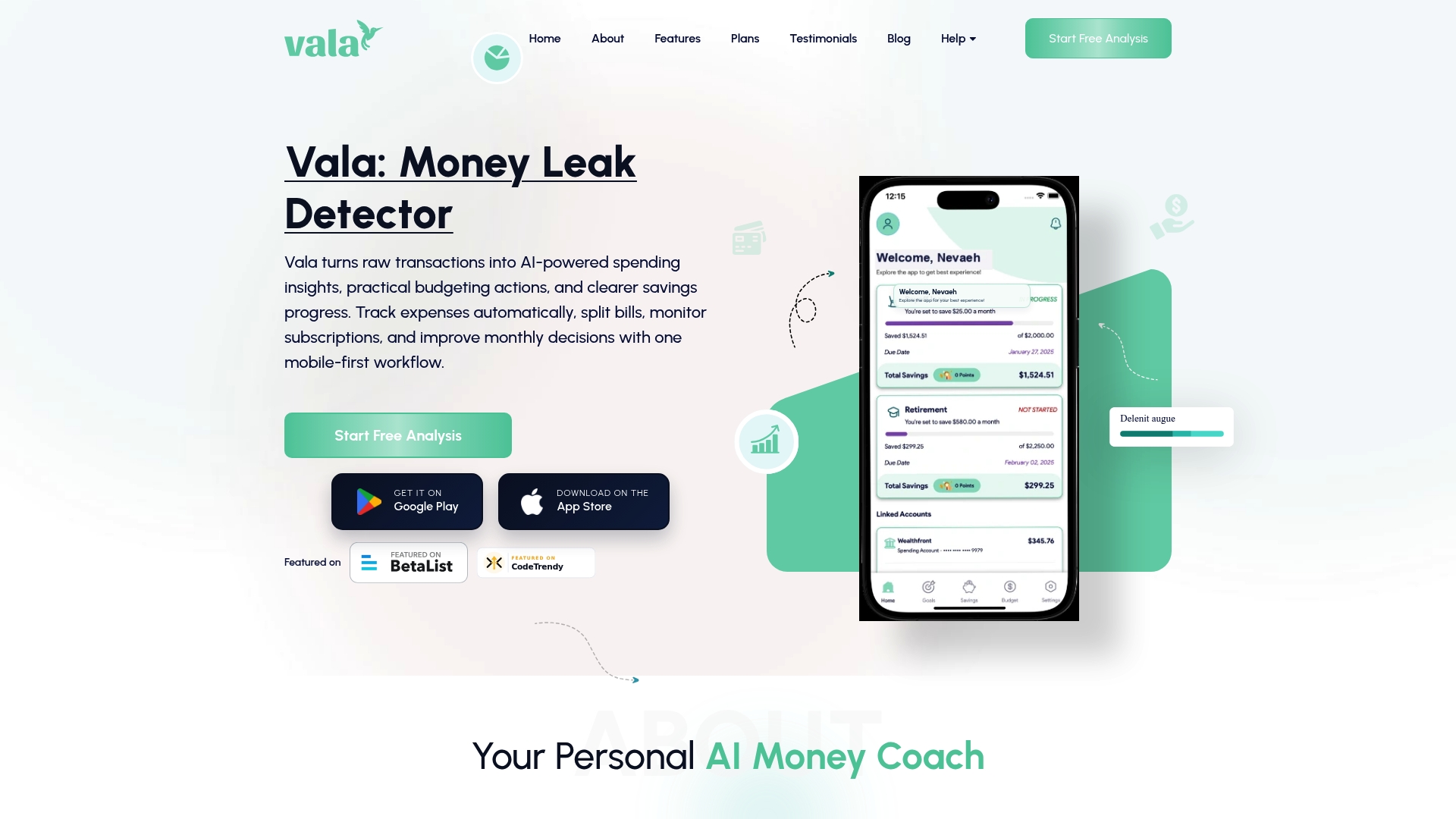
You can set custom budget targets, track progress toward savings goals, and spot recurring charges that are quietly draining your budget. Vala also supports group expense splitting, which makes it useful for couples and roommates managing shared costs. Whether you are just starting your first budget or refining a system you have used for years, Valapoint gives you the clarity to make confident money decisions. Start tracking for free and see where your money actually goes.
FAQ
What are expense tracking best practices?
Expense tracking best practices are the habits and systems that make your financial data accurate and useful. They include establishing a spending baseline, running weekly reviews, using automation, and organizing expenses into decision-focused categories.
How do i start tracking expenses effectively?
Start by recording every transaction for 30 days without changing your spending. Then set a weekly 15-minute review to check category totals and catch any budget leaks early.
Which budgeting framework works best for personal finance?
The 50/30/20 rule works best for most individuals: 50% to needs, 30% to wants, and 20% to savings or debt. If your needs consistently exceed 50% of your income, that signals a need for budget adjustment.
How many expense categories should i use?
Five to seven core categories is the right range for most people. More categories create complexity without improving decisions, and overly complex systems get abandoned faster than simple ones.
Do i need an app to track expenses?
An app is not required, but it removes the manual work that causes most people to quit. Apps with bank integration and automatic categorization reduce the time commitment to under 15 minutes a week.