
A budget category limit is the maximum dollar amount you assign to a specific spending area within your budget, giving you a clear cap that keeps your expenses in check. Think of it as a personal spending rule for each part of your financial life, from rent to groceries to entertainment. This concept sits at the heart of effective personal finance management, and frameworks like the 50/30/20 rule are built entirely around it. Understanding what is a budget category limit, and how to set one, is the first step toward spending with confidence and saving without stress.
What is a budget category limit and why does it matter?
A budget category limit is a defined spending cap for one area of your budget, such as $400 for food or $150 for entertainment each month. The formal term in personal finance is a “spending limit by category,” though most budgeting guides and apps simply call it a category limit or category cap. Budget categories help organize spending and set clear boundaries that make it easier to follow any budgeting method you choose.
Without category limits, money tends to disappear into vague, untracked spending. You might know you spent “a lot” on food last month, but without a set limit, you have no reference point for whether that amount was reasonable or excessive. Category limits turn abstract intentions into concrete numbers, which makes accountability possible.

Category limits also connect directly to your financial goals. If you want to save $200 a month, you need to cap your discretionary spending tightly enough to make that happen. The limit is not a punishment. It is a plan.
How do budget category limits fit within popular budgeting strategies?
Every major budgeting method uses category limits in some form. Understanding how each method assigns those limits helps you pick the approach that fits your life.
The 50/30/20 rule is one of the most widely used frameworks. It allocates 50% of your after-tax income to needs, 30% to wants, and 20% to savings and debt repayment. Needs include housing, utilities, minimum loan payments, and childcare. Wants cover dining out, entertainment, and gifts. Each of those broad buckets then breaks down into individual category limits.
The envelope budgeting system takes a more hands-on approach. The envelope system enforces strict spending limits by assigning a fixed amount of money to each category, either in a physical envelope or a digital equivalent. Once the envelope is empty, spending in that category stops for the month. This method works especially well for controlling discretionary spending because the limit is physical and immediate.
Zero-based budgeting assigns every dollar of income a specific job until your income minus your expenses equals zero. Each category gets a limit, and the total of all limits must equal your total income. This method requires more upfront work but gives you complete visibility into where every dollar goes.
Common budget categories across all three methods include:
- Housing: rent or mortgage payments
- Food: groceries and dining out
- Transportation: car payments, gas, or transit passes
- Utilities: electricity, water, and internet
- Savings: emergency fund, retirement contributions
- Insurance: health, auto, and renters insurance
- Entertainment: streaming services, events, and hobbies
- Debt repayment: credit card minimums and student loans
Your category limits reflect your income and your priorities. A student with a $1,500 monthly income will set very different limits than a young professional earning $4,000. The categories stay the same. The numbers change.
What are the benefits of setting budget category limits?
Setting category limits gives you control over your money before you spend it, rather than regret after. Budget category limits reduce overspending and increase financial confidence, two outcomes that matter whether you are managing $800 a month or $8,000.
The core benefits include:
- Reduced financial stress. Knowing exactly how much you can spend in each area removes the anxiety of wondering whether you can afford something.
- Better spending awareness. Limits force you to notice where your money actually goes, not where you think it goes.
- Faster savings progress. When discretionary spending has a cap, the money you do not spend stays in your account and builds toward your goals.
- Easier debt repayment. A dedicated debt repayment category with a firm limit keeps you consistent, even when other expenses compete for attention.
- Flexibility over time. Limits are not permanent. You can adjust them as your income grows or your priorities shift.
Pro Tip: If a category limit causes consistent frustration or feels impossible to stick to, that is a signal to adjust the limit, not abandon budgeting altogether. Adjusting limits improves sustainability and reduces the chance of giving up entirely.
The biggest misconception about category limits is that they feel restrictive. The opposite is true. When you know your food budget is $350 and you have $200 left with two weeks to go, you feel in control. Without a limit, you have no idea where you stand until the month is over.
How to set effective budget category limits for your lifestyle
Setting limits that actually work requires a few deliberate steps. Guessing at numbers leads to limits that are either too tight to follow or too loose to matter.
-
List all your expenses. Write down every recurring cost you pay each month. Fixed expenses like rent and insurance stay constant, so they are easy to assign. Variable expenses like groceries and gas fluctuate, so you need to average two to three months of past spending to get a realistic number.
-
Separate fixed from variable costs. Fixed costs go directly into your budget at their exact amount. Variable costs need a limit based on your average spending, with a small buffer built in.
-
Apply a percentage framework. Housing typically consumes 25–30% of take-home pay. Food runs 10–15%. Transportation lands around 10–15%. These ranges give you a starting point, not a final answer.
-
Prioritize savings as a category. Treat savings like a bill. Assign it a limit and pay it first. The 50/30/20 rule recommends 20% of after-tax income for savings and debt repayment.
-
Add a miscellaneous category. Life produces unexpected costs. A small miscellaneous limit, around 3–5% of income, prevents those surprises from breaking your entire budget.
-
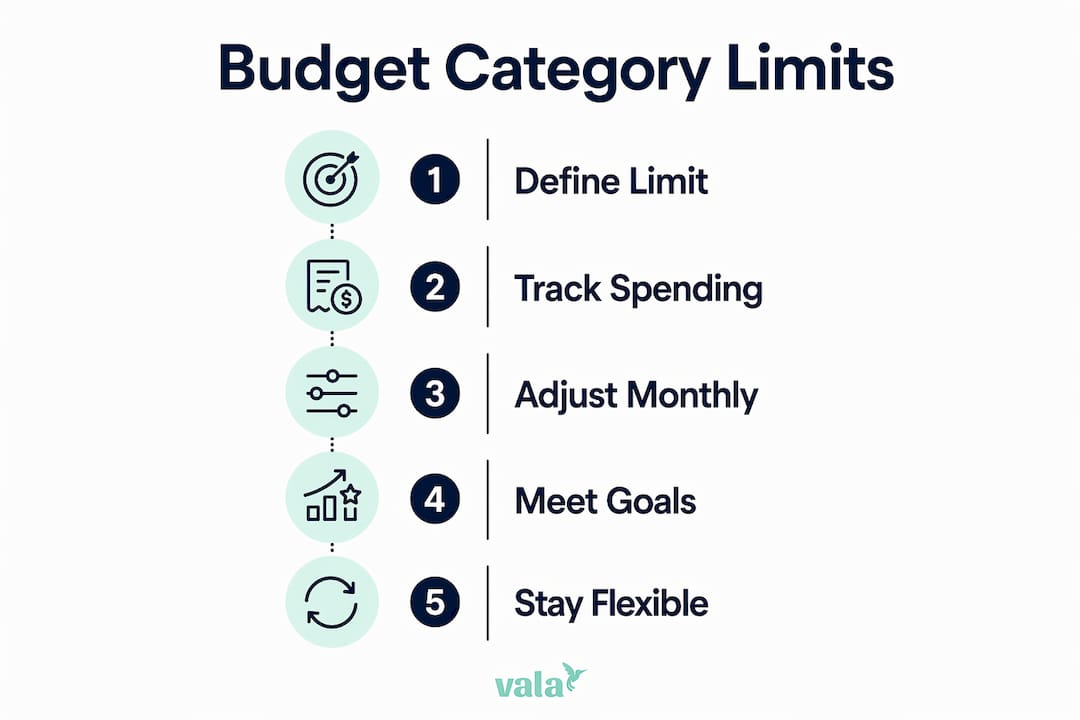
Track and adjust monthly. Monitoring actual spending against your limits is what makes the system work. Use an app or a spreadsheet to compare what you planned against what you actually spent, then adjust limits that are consistently off.
Pro Tip: Use automated expense tracking to remove the manual work of comparing your spending to your limits. Automation catches overspending in real time, before it becomes a problem.
The goal is limits that reflect your real life, not an idealized version of it. A limit you can follow 90% of the time beats a perfect limit you abandon after two weeks.
Common budget categories and example limits for beginners
A practical starting point for budgeting categories explained with percentage ranges gives you a concrete framework to build from. The table below uses the recommended percentage ranges from widely cited personal finance guidelines.
| Budget category | Recommended range | Example limit ($3,000/month) |
|---|---|---|
| Housing | 25–30% | $750–$900 |
| Food | 10–15% | $300–$450 |
| Transportation | 10–15% | $300–$450 |
| Utilities | 5–10% | $150–$300 |
| Insurance | 5–10% | $150–$300 |
| Savings | 15–20% | $450–$600 |
| Entertainment | 5–10% | $150–$300 |
| Miscellaneous | 3–5% | $90–$150 |
These ranges are starting points. Your actual limits depend on your city, income, and lifestyle. Someone living in New York City will spend a larger share on housing than someone in a smaller city, which means other categories need to shrink to compensate.
A miscellaneous category deserves special attention. Most beginner budgets skip it, then blow up their entire plan the first time an unexpected cost appears. A small buffer category absorbs those costs without forcing you to raid your savings.
The best budgeting apps let you set these category limits digitally and alert you when you approach or exceed them. That real-time feedback is what turns a static spreadsheet into an active financial tool.
Key Takeaways
A budget category limit is the single most practical tool for controlling spending, because it converts financial intentions into specific, trackable numbers.
| Point | Details |
|---|---|
| Budget category limit defined | It is the maximum dollar amount you assign to one spending area each month. |
| Popular frameworks use limits | The 50/30/20 rule, envelope system, and zero-based budgeting all rely on category caps. |
| Limits reduce financial stress | Clear spending caps give you confidence and prevent end-of-month surprises. |
| Fixed vs. variable expenses | Fixed costs are easy to cap; variable costs need a two-to-three-month average to set accurately. |
| Adjust limits, do not quit | If a limit feels impossible, revise it. Sustainable limits outperform perfect ones you abandon. |
Budget limits should guide you, not cage you
Budgeting advice often presents category limits as rigid rules you must follow perfectly or fail. I disagree with that framing entirely. After working through my own budgets across different income levels and life stages, the limits that actually stuck were the ones I treated as guides, not laws.
The first time I set a food budget, I made it too tight. I hit the limit by the third week every single month and felt like I was failing. The fix was not more discipline. It was raising the food limit by $50 and cutting entertainment instead. The total budget stayed the same. The stress disappeared.
Your category limits should reflect the life you actually live, not the one you think you should live. If you love cooking at home and hate going out, your food limit can be generous and your dining-out limit can be tiny. That is not cheating. That is expense tracking best practices in action.
The readers who succeed with budgeting long-term are not the ones with the most disciplined limits. They are the ones who revisit their limits regularly and adjust without guilt. Treat your budget like a living document, and it will serve you for years.
— SaverStride
Valapoint makes budget category limits easy to set and track
Setting category limits is straightforward once you know the numbers. Keeping track of them every day is where most people struggle.
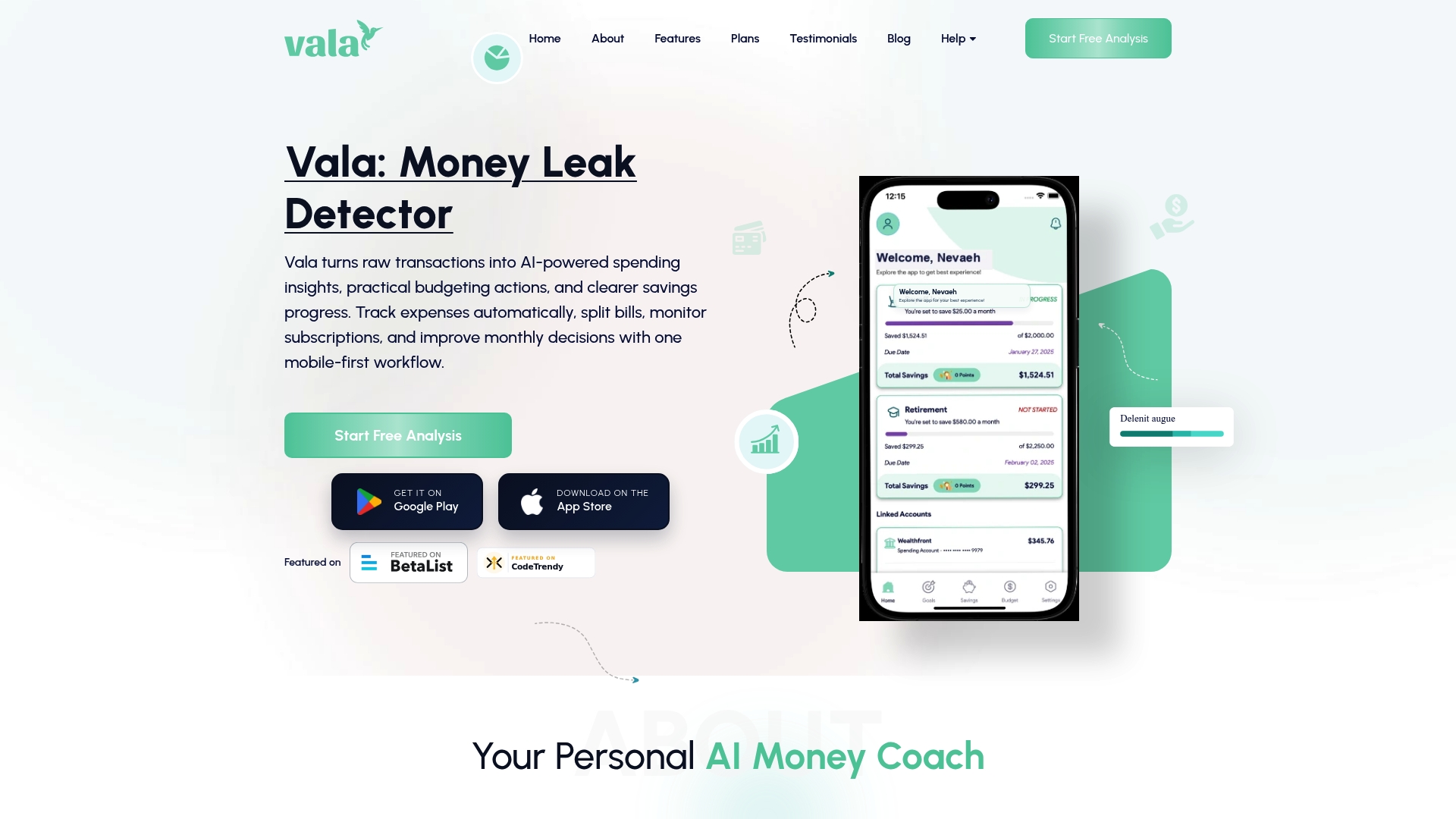
Valapoint is built for exactly that challenge. The Vala personal finance app lets you set spending limits for every category, then tracks your expenses in real time so you always know where you stand. You get instant alerts when you are close to a limit, clear visuals of your spending by category, and AI-powered insights that flag patterns you might miss on your own. Whether you are a student building your first budget or a young professional managing multiple financial goals, Valapoint gives you the clarity to spend confidently and save consistently.
FAQ
What is a budget category limit in simple terms?
A budget category limit is the maximum amount you allow yourself to spend in one area, such as $200 for groceries or $100 for entertainment, within a set time period like a month.
How many budget categories should a beginner use?
Most beginners do well with six to eight categories: housing, food, transportation, utilities, savings, and entertainment, plus a small miscellaneous buffer. Starting simple makes the system easier to follow.
What happens if I go over a budget category limit?
Going over a limit means you need to pull money from another category or adjust the limit for next month. Tracking spending against limits regularly helps you catch overages early before they compound.
Is the 50/30/20 rule a good starting point for category limits?
Yes. The 50/30/20 rule gives you a clear percentage-based structure for needs, wants, and savings that works well as a first framework, especially for people new to budgeting for expenses.
Can I change my budget category limits over time?
Absolutely. Limits should change as your income, expenses, and goals evolve. Reviewing and adjusting your limits every one to three months keeps your budget accurate and realistic.