
The fastest reliable way to settle shared expenses is to agree on a split method, log every purchase in a shared ledger, and run one net settlement on a fixed date. That three-step rhythm keeps money clean and friendships intact. Roommates who stick to a clear cost-sharing agreement can save an average of roughly $6,500 per person annually compared to living solo, so protecting that arrangement with a simple system is worth the small upfront effort.
Start here:
- Agree on rules in writing (what’s shared, how it splits, when you settle)
- Choose a tracker: a shared spreadsheet, a ledger app, or Valapoint
- Schedule a monthly settle-up date and stick to it
The rest of this guide walks through every method, the math, and the tools to make it work.
Table of Contents
- What are the main ways to divide costs fairly?
- How do you settle shared costs step by step?
- How do you handle small recurring household supplies without friction?
- What payment methods and tools work best for settling up?
- How do you keep transfers safe and records clean?
- Three worked examples showing the math
- When should you automate instead of tracking manually?
- Key Takeaways
- Why the “just Venmo me” approach keeps failing
- Valapoint makes settling shared costs straightforward
What are the main ways to divide costs fairly?
Not every group splits the same way, and the right method depends on your situation. The primary splitting methods are equal split, proportional, usage-based, shares/ratio, and hybrid models.
- Equal split: Everyone pays the same amount. Simple, fast, and works well when incomes and usage are roughly comparable. The main drawback: it feels unfair when one person has a much larger room or earns significantly more.
- Proportional (income- or value-based): Each person pays a percentage tied to income or room size. A split where partners pay in proportion to their incomes, such as when one partner earns significantly more than the other, is a common example. More fair in theory, but it requires sharing financial details.
- Usage-based: You pay for what you use. Works for utilities with individual meters or groceries bought separately. Tracking burden is high, so it suits situations where usage genuinely varies a lot.
- Shares/ratio: Assign weighted shares (e.g., 2:2:1:1 for a four-person trip). Flexible for mixed groups where one person uses more or earns more. Slightly more math, but easy to automate.
- Hybrid: Combine methods by category. Split rent proportionally by room size, utilities equally, and groceries by usage. This is the most accurate approach for long-term roommates with unequal rooms.
Quick rules of thumb: Use equal split when rooms and incomes are similar. Switch to proportional when income gaps exceed roughly 25–30% or room sizes differ meaningfully. Use ratio-based splits for short trips with mixed group sizes. Hybrid models pay off for arrangements lasting more than three months.
How do you settle shared costs step by step?
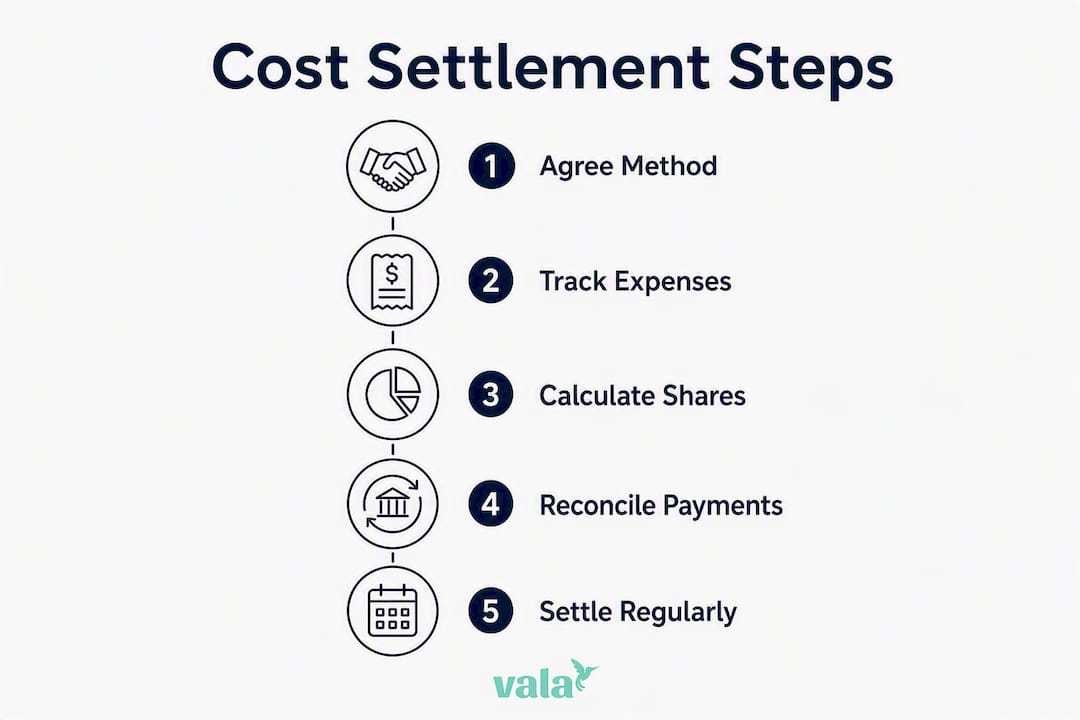
A net-settlement workflow keeps the process clean: track everything in one place, then settle with the fewest possible transfers. Here’s the full process.
- Agree on rules in writing. Define which expenses are shared, which split method applies to each category, the deadline for logging receipts, and your settle-up cadence (monthly works for most groups). A written roommate agreement prevents most disputes before they start.
- Choose your tracking method. A shared Google Sheet works for two people with low transaction volume. A ledger app or Valapoint handles larger groups, mixed split rules, and automatic balance calculations.
- Log expenses as they happen. Record the date, payer, amount, category, and split method. Tag each entry so you can filter by category at month-end.
- Run net settlement on the agreed date. Calculate each person’s net balance (what they paid minus their fair share). One person owes; one person collects. Settle with a single transfer per person rather than multiple back-and-forth payments.
- Reconcile and keep records. Match receipts to ledger entries, export a monthly report, and store copies in a shared folder. Update your rules if a new expense category comes up.
Simple ledger fields: Date | Payer | Amount | Category | Split method | Each person’s share | Running balance
Sample payment request message:
Settle-up checklist:
- All receipts logged before the cutoff date
- Net balances calculated and reviewed by all parties
- Payment sent and confirmed
- Ledger exported and saved
How do you handle small recurring household supplies without friction?
Toilet paper, dish soap, trash bags: these small purchases create outsized resentment when tracked individually. The fix is to stop tracking them one by one and use a system instead.
Three options:
- Pooled household fund: Each person contributes $10–$20 per month into a shared cash envelope or a dedicated account. Whoever buys supplies draws from the fund. Top it up when it drops below $20 total. This works best for groups of three or more.
- Rotating purchaser: One person buys all household supplies for a month, then the next person takes the next month. No tracking required. Works well for two-person households with similar consumption habits.
- Recurring auto-buy: Set up a shared subscription (Amazon Subscribe & Save, for example) for staples. Split the charge equally at month-end as a single line item.
A monthly pooled fund of $10–$20 per person typically covers most household basics for a small apartment, with amounts adjusted based on the number of contributors. Review the fund every 90 days and adjust if it’s consistently running short or building up a surplus.
Pro Tip: Treat small consumables as a shared overhead, not individual IOUs. The moment you start logging who bought the last roll of paper towels, you’ve created a tracking burden that costs more in goodwill than the item is worth. A pooled fund or rotating system removes the friction entirely.

What payment methods and tools work best for settling up?
Ledger apps and payment apps do different jobs, and mixing them up is where most groups run into trouble.
- Ledger/tracker apps (including Valapoint): Record who paid what, calculate net balances, and support multiple split methods. They do not move money.
- P2P payment apps (Zelle, Venmo, Cash App): Move money quickly but don’t reconcile multiple reciprocal IOUs. Sending five small payments back and forth is not net settlement.
- Pooled accounts / joint checking: Useful for couples who share most expenses. Carries account-holder risk (see Section 6). Works best when both parties are named on the account.
- Cash and IOUs: Fine for two people with high trust and low transaction volume. Hard to audit and easy to forget.
Recommended pairing: Use a ledger app to track and calculate, then settle once per month with a bank-linked transfer (Zelle is free and instant for most US bank accounts). This combination avoids credit-card funding fees and keeps a clean paper trail.
The core principle: Track in a ledger, settle with one transfer. Every extra payment you make mid-month adds friction, fees, and the chance of a mistake. Monthly net settlement is the method that reduces transactions and keeps relationships smoother long-term.
How do you keep transfers safe and records clean?
Security and record-keeping are where most groups cut corners, and that’s exactly when disputes get expensive.
P2P transfer safety:
- Double-check the recipient’s username, phone number, or email before every transfer. Misdirected payments are often irreversible.
- Enable two-factor authentication on every payment app you use.
- Never initiate a transfer on public Wi-Fi.
Record-keeping:
- Photograph receipts immediately and upload them to a shared Google Drive or Dropbox folder.
- Export your ledger at the end of each month and save the file.
- Set account alerts for any transaction above $50 on accounts used for shared payments.
Dispute prevention:
- Put your cost-sharing agreement in writing, even a shared Google Doc works.
- Set a hard deadline for logging receipts (e.g., within 48 hours of purchase).
- Schedule a 10-minute monthly check-in to review balances before the settle-up.
Pro Tip: If only one person’s name is on a utility account, that person carries the legal and credit risk for late or missed payments. Spread account names across housemates where possible, or document in your written agreement who is responsible for each bill and what the reimbursement deadline is.
When furniture or appliances are bought jointly, define the exit terms at purchase: a buy-out price formula, a plan to sell and split proceeds, or a donation agreement. Waiting until someone moves out to figure this out is how shared costs turn into shared disputes.
Three worked examples showing the math
Roommates splitting a $3,600 apartment
| Participant | Room type | Share % | Monthly rent |
|---|---|---|---|
| Alex | Master bedroom | 40% | $2,010 |
| Jordan | Standard room | 33% | $990 |
| Sam | Smaller room | 33% | — |
| Total | 100% | $3,600 |
Utilities ($150/month) split equally: $50 each. Alex pays the most for rent but the same for utilities.
Couple with income-based split
Partner A earns $80,000; Partner B earns $40,000. Combined income: $120,000. Partner A’s share: 67%; Partner B’s: 33%. On $3,000 in monthly shared expenses, Partner A pays $2,010 and Partner B pays $990.
Weekend trip with ratio-based net settlement
Four friends share a $600 trip. Two friends (Maya and Chris) use a private room; two (Dana and Lee) share a bunk. Ratio: 2:2:1:1. Total shares: 6. One share = $100.
- Maya: $200 | Chris: $200 | Dana: $100 | Lee: $100
Maya paid $350 upfront. Net: Maya is owed $150. One transfer from the group to Maya closes the trip.
Sample trip close-out message:
When should you automate instead of tracking manually?
Manual tracking works fine in simple situations. A ledger-first app pays off when complexity grows.
Automate when:
- Your group has more than three people
- You use different split methods for different expense categories
- Purchases happen frequently (weekly or more)
- You want to minimize the social friction of chasing payments
- You’ve had at least one dispute about who paid what
Stay manual when:
- It’s just two people with high trust
- You share only one or two expense categories
- Transaction volume is low (fewer than 10 shared purchases per month)
The practical path: start with a shared spreadsheet, switch to a real-time group tracking app once you hit three or more people or two or more split methods, then enable automated settle-up once the behavior is stable. Automating too early, before everyone agrees on the rules, creates confusion. Automating too late means you’re already managing resentment.
Key Takeaways
Settling shared costs smoothly requires one agreed method, a shared ledger, and a fixed monthly settle-up date — everything else is optional.
| Point | Details |
|---|---|
| Agree in writing first | Define which costs are shared, the split method, and the settle-up date before any money moves. |
| Net settlement saves friction | Calculate net balances monthly and settle with one transfer per person instead of multiple spot payments. |
| Pool small consumables | Use a $10–$20 monthly pooled fund per person for household supplies to avoid micro-tracking and low-grade resentment. |
| Secure every transfer | Double-check recipients, enable two-factor authentication, and keep exported ledger records each month. |
| Valapoint automates the workflow | Valapoint tracks expenses, supports multiple split methods, and runs net settlements so you spend less time chasing and more time saving. |
Why the “just Venmo me” approach keeps failing
Most groups skip the ledger and go straight to payment apps. The result: someone forgets a purchase, balances drift, and by month three nobody agrees on who owes what. The problem isn’t the payment app. It’s the absence of a ledger.
Net settlement works because it separates the tracking function from the payment function. You track continuously, you pay once. That single discipline eliminates the cognitive load of remembering every IOU and removes the social awkwardness of sending five small payment requests in a week.
The groups that handle shared money best aren’t the ones with the most sophisticated tools. They’re the ones who agreed on the rules early, wrote them down, and picked a settle-up date they actually keep. The tool just makes it easier to follow through.
A written agreement also protects the person whose name is on the lease or the utility accounts. That person carries real legal exposure if payments fall behind. Documenting responsibilities isn’t bureaucratic; it’s the minimum protection for the person taking on the most risk.
Valapoint makes settling shared costs straightforward
Tracking shared expenses manually works until it doesn’t. Missed receipts, forgotten reimbursements, and escalating balances are the predictable result of relying on memory and group chats. Valapoint is built to close that gap.

With Valapoint’s split-bills features, you get a shared ledger that supports equal, proportional, ratio, and hybrid splits in one place. The app logs expenses in real time, calculates net balances automatically, and schedules settle-ups so nobody has to chase anyone. It also flags recurring subscriptions and spending patterns that quietly drain shared budgets, which is the kind of visibility a spreadsheet won’t give you.
Key features that map directly to the problems covered here:
- Shared ledger with multiple split methods — no more separate spreadsheets per category
- Automated net settlement — one transfer per person, on your schedule
- Receipt capture and record export — audit-ready records without the manual filing
- Spending insights — spot financial leaks before they become disputes
Start tracking shared expenses with Valapoint for free and see how much smoother your next settle-up can be.