
Personal cash flow is the difference between the money coming in and the money going out each month. Positive cash flow means you keep more than you spend. Negative cash flow means the opposite, and that gap tends to grow quietly until it becomes a real problem. By the end of this guide, you’ll be able to calculate your net cash flow, set up a simple tracking routine, and take concrete steps to improve it starting today.
Three actions you can take right now:
- Calculate this month’s net cash flow. Add up your take-home income, then subtract every expense you can find. The number you get is your starting point.
- Find one avoidable outflow to cut. Check your bank statement for subscriptions, auto-renewals, or recurring charges you forgot about.
- Automate one small saving. Automating a small saving each paycheck builds the habit before the amount matters.
Pro Tip: Experian recommends listing every inflow and outflow for a full calendar month before drawing conclusions. One month of data is a snapshot; two or three months reveal a pattern.
Key Takeaways
Understanding and managing your personal cash flow comes down to one repeatable habit: calculate your net cash flow monthly, find one leak, and automate one saving, then build from there.
| Point | Details |
|---|---|
| Core formula | Net cash flow = total inflows minus total outflows; a positive result means you have a surplus to direct intentionally. |
| Sinking funds prevent surprises | Divide annual and quarterly bills by 12 and treat each as a monthly outflow to avoid false surpluses. |
| Variable income needs a conservative baseline | Build your budget on your lowest reasonable monthly income from the past 6–12 months, not your average. |
| Weekly reps build the habit | A 15-minute weekly review and a 30-minute monthly statement are enough to stay accurate and catch problems early. |
| Valapoint’s Vala automates the routine | Vala handles categorization, leak detection, sinking funds, and bill reminders so your cash flow statement stays current without manual effort. |
Table of Contents
- What does personal cash flow actually measure?
- How to calculate your personal cash flow step by step
- Which tracking method will you actually stick with?
- How to improve weak or negative cash flow
- How to handle variable or irregular income
- A simple weekly and monthly routine that keeps you on track
- Common cash flow mistakes and red flags to watch for
- Your copyable monthly cash flow template
- What a short weekly cash flow check actually looks like
- Valapoint’s Vala app puts this guide on autopilot
- Sources
What does personal cash flow actually measure?
Personal cash flow measures money movement over a specific period, usually a month. It answers one question: did more money arrive than leave? That makes it your short-term financial vital sign, distinct from two other tools you may already use.
Here’s how the three concepts differ:
- Cash flow statement: Records what actually happened. Inflows minus outflows equals your net position. It looks backward.
- Budget: A forward-looking plan for how you intend to spend and save. It looks ahead.
- Net worth: A snapshot of assets minus liabilities at a single point in time. It doesn’t tell you whether you can pay next month’s bills.
Bank of America’s Better Money Habits makes the distinction clear: a budget is your intent, and a cash flow statement is your record. Using both together gives you the full picture. The budget tells you where you planned to go; the cash flow statement tells you where you actually went.
Cash flow also affects your credit and borrowing capacity. Lenders and financial advisors look at whether your income reliably covers your obligations. A consistently positive net cash flow signals financial stability, while repeated shortfalls can push you toward credit reliance and higher utilization. Before seeking personalized borrowing advice, you can verify any financial professional’s credentials through FINRA BrokerCheck.
How to calculate your personal cash flow step by step
The formula is straightforward:
Net cash flow = Total cash inflows − Total cash outflows
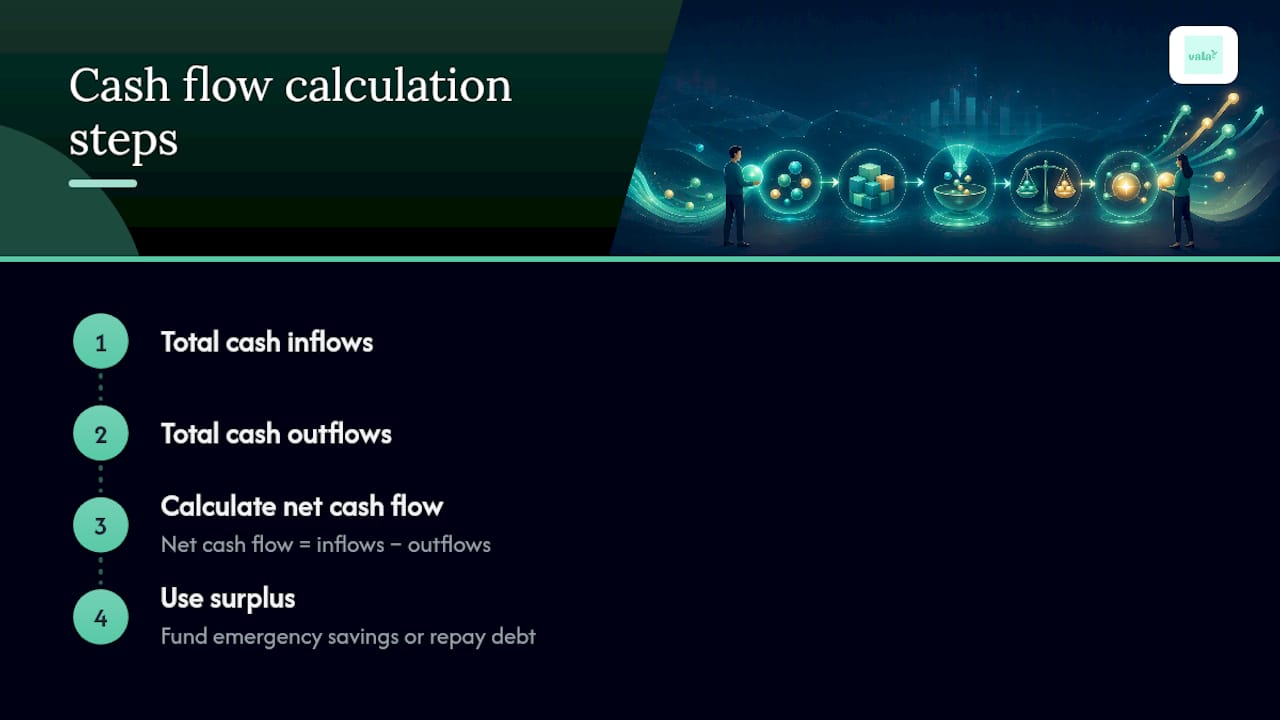
K38 Consulting’s cash flow guide confirms this core formula and notes that a surplus can immediately fund emergency savings or debt repayment.
What counts as an inflow
Include money you actually receive and can spend:
- Net (take-home) pay from your job
- Freelance or side income received this month
- Rental income
- Interest or dividends paid out in cash
- Government benefits or alimony received
Exclude reinvested dividends or unrealized investment gains. Those don’t hit your checking account, so they can’t pay your bills.
What counts as an outflow
Outflows fall into four categories:
- Fixed: Rent or mortgage, car payment, insurance premiums, loan minimums
- Variable: Groceries, utilities, gas
- Discretionary: Dining out, streaming services, clothing
- Lumpy/annual: Car registration, holiday gifts, annual subscriptions
That last category trips most people up. LegalClarity’s cash flow analysis guide recommends converting every nonmonthly bill into a monthly sinking-fund line. Divide the annual amount by 12 and treat that figure as a monthly expense. A $600 car insurance payment due in October becomes $50 per month in your cash flow statement, every month.
Pro Tip: Taxes deserve the same treatment. If you pay quarterly estimated taxes, divide your annual tax bill by 12 and include that as a monthly outflow. Ignoring it creates a false surplus that disappears four times a year.
Worked monthly example
This reader has a positive net cash flow of $1,490. That surplus is available for an emergency fund, debt paydown, or savings goals.
Which tracking method will you actually stick with?
The best tracking method is the one you use consistently. Here are the three main options and their real trade-offs:
Manual ledger (pen and paper or a notes app)
- Setup time: 10 minutes
- Automation: None
- Best for: People who want full control and spend mostly cash
- Downside: Easy to miss transactions; requires daily discipline
Spreadsheet template
- Setup time: 20–30 minutes
- Automation: Partial (formulas auto-calculate totals)
- Best for: People comfortable with Google Sheets or Excel who want flexibility
- Downside: You still enter transactions manually; no bank sync
Dedicated finance app
- Setup time: 15–30 minutes including bank connection
- Automation: High (auto-categorization, alerts, recurring tracking)
- Best for: Anyone who wants real-time visibility without manual entry
- Downside: Requires sharing bank credentials; subscription cost for premium features
Investopedia’s monthly budget guide suggests starting with broad spending buckets rather than tracking every penny. That approach reduces friction and builds the habit before you refine the categories.
Valapoint’s Vala app covers the app-based route with automatic categorization, spending leak detection, sinking fund tracking, and bill reminders. It maps directly to the steps in this guide. You can explore Vala’s finance app features to see how it handles each piece.
For readers who prefer a cash-first system, tracking cash spending without stress offers practical low-friction workflows that don’t require an app at all.
To start today: Open your bank’s transaction history for the past 30 days. Copy the totals into the template in Section 9 or a blank spreadsheet. That single step gives you your first real cash flow number.
How to improve weak or negative cash flow
If your net cash flow is negative or barely positive, these actions tend to move the needle fastest. Work through them in order.
- Cancel or pause unused subscriptions. Pull your last two bank statements and highlight every recurring charge. Cancel anything you haven’t used in 30 days. This is the fastest win because the savings repeat every month automatically.
- Refinance or consolidate high-interest debt. A lower interest rate on a credit card or personal loan reduces your fixed monthly outflow immediately. Even a 3–4 percentage point reduction on a $5,000 balance saves meaningful money each month.
- Adjust your tax withholding. If you consistently get a large refund, you’re giving the IRS an interest-free loan. Adjusting your W-4 through your employer adds money to each paycheck now. Northwestern Mutual’s budgeting guide includes this as a practical step in any cash flow review.
- Add an income stream. Freelance work, selling unused items, or a part-time shift adds to inflows without touching your current lifestyle.
- Automate savings before you spend. Set up a direct deposit split so a fixed amount moves to savings the moment your paycheck arrives. Automating personal savings goals removes the decision entirely.
Pro Tip: Round-up features in finance apps move spare change from every purchase into savings automatically. It’s not a wealth-building strategy on its own, but it builds the savings habit and adds up faster than most people expect.
Once you have a surplus, allocate it in this order:
- First: Build a one-month cash reserve (your immediate liquidity buffer)
- Second: Pay down high-interest debt (credit cards, payday loans)
- Third: Fund short-term goals (vacation, car repair fund)
- Fourth: Invest for long-term goals
How to handle variable or irregular income
Freelancers, gig workers, and anyone with seasonal income face a specific challenge: their cash flow varies month to month, so a single month’s calculation can mislead them.

The fix is a conservative baseline. Fidelity’s budgeting guide recommends building your budget on the lower end of your recent monthly income. Look at 6–12 months of income history and use a figure close to your lowest reasonable month, not your average. If your income ranged from $2,800 to $5,400 over the past year, plan around $3,000. Any month you earn more is a surplus you can direct intentionally.
A practical smoothing checklist for variable earners:
- Separate bill account: Move your fixed monthly obligations (rent, utilities, insurance) into a dedicated account. Fund it first from every payment you receive.
- Sinking funds for irregular bills: Annual and quarterly expenses get their own monthly line, as described in the calculation section.
- Quarterly tax sinking fund: If you’re self-employed, divide your estimated annual tax by 12 and set that aside monthly. Quarterly deadlines stop being a crisis when you’ve been saving for them all along.
- Larger emergency buffer: Fidelity’s guidance points toward a 6-month liquidity buffer for variable-income earners, compared to the 3-month baseline often cited for salaried workers.
- Conservative discretionary spending: In a high-income month, resist the urge to expand lifestyle spending. Treat the surplus as next month’s safety net first.
A quick numeric example: you earn $48,000 in a good year but your income swings by $1,500 month to month. Your annual car insurance is $720, your quarterly estimated tax is $1,800, and you have a $240 annual software subscription.
- Car insurance: $720 ÷ 12 = $60/month
- Estimated tax: ($1,800 × 4) ÷ 12 = $600/month
- Software subscription: $240 ÷ 12 = $20/month
Those three lines alone add $680 to your monthly outflows. Miss them and your cash flow statement shows a surplus that evaporates four times a year.
A simple weekly and monthly routine that keeps you on track
Consistency beats perfection. A short, repeatable routine is more useful than a detailed review you do once and abandon.
- Weekly (15 minutes): Open your bank or app and categorize any uncategorized transactions from the past seven days. Flag anything that looks wrong or unexpected. That’s it. Investopedia’s budget guide calls these short sessions “reps” and notes that they build a durable habit without creating burnout. A weekly spending plan can make this even faster.
- Monthly (30 minutes): Complete your cash flow statement for the month just ended. Compare your actual net cash flow to your planned budget. Note any category that ran over. Adjust next month’s plan accordingly.
- Quarterly (60 minutes): Review your sinking funds. Are they on track? Revisit your savings goals. Check whether any fixed costs have crept up (insurance renewals, subscription price increases). If a major life event happened (new job, new baby, large purchase), treat this as a full reset.
When to do an immediate review: A job change, a new lease, a major medical expense, or a new loan all shift your cash flow significantly. Don’t wait for the quarterly slot. Run a fresh calculation within the first week of any major financial change.
Common cash flow mistakes and red flags to watch for
Most cash flow errors fall into a few predictable categories. Catching them early saves real money.
Measurement mistakes:
- Using gross pay instead of net (take-home) pay inflates your inflows
- Forgetting lumpy annual bills creates a false monthly surplus
- Ignoring subscriptions and auto-renewals, which LegalClarity notes are among the most common sources of undetected outflows
- Counting reinvested dividends or unrealized gains as spendable income
Behavioral traps:
- Reviewing cash flow only when something goes wrong (reactive instead of proactive)
- Treating a one-month surplus as permanent and expanding spending before the pattern holds
- Skipping the sinking fund step and then scrambling when annual bills arrive
Red flags that signal a structural problem:
- Repeated overdrafts or overdraft fees
- Rising credit card utilization month over month
- Two or more consecutive months of negative net cash flow
A persistently negative net cash flow signals that either fixed costs are too high or income is insufficient. The first move is to cut fixed costs, not discretionary ones, because fixed cuts repeat every month. The second move is to build a short-term cash reserve, even a small one, to absorb the next unexpected expense without going further into debt.
First-fixes checklist:
- Tighten discretionary spending by 10–15% for 60 days
- Create a temporary $500–$1,000 cash reserve before paying extra on debt
- Call service providers (insurance, internet, phone) and ask for a lower rate
Your copyable monthly cash flow template
Use this template as your starting point. Copy the structure into a Google Sheet, Excel file, or your finance app’s custom categories.
Worked example (using the numbers from Section 3):
How to use this in a spreadsheet:
- Enter your planned amounts at the start of each month
- Update actuals weekly during your 15-minute review
- Add a formula in the Net Cash Flow row:
=Total Inflows − Total Outflows - Color-code the net row: green for positive, red for negative
For readers who want a deeper look at cash flow optimization beyond the basics, Wealth Assimilation’s cash flow guide covers advanced strategies worth reading once you have the fundamentals in place.
What a short weekly cash flow check actually looks like
The routine described in this guide isn’t theoretical. A 15-minute weekly review, done consistently, surfaces problems before they compound. The monthly net cash flow check takes about 30 minutes and answers one question: did the plan match reality?
What tends to happen in practice is that small automations do the most work. Moving a fixed amount to a sinking fund the day after payday removes the temptation to spend it. Setting a bill reminder two days before a due date eliminates late fees. These aren’t dramatic changes. They’re small, repeatable behaviors that add up over months.
The specific behavior worth copying: when you cancel a subscription, immediately redirect that exact dollar amount to a sinking fund or savings goal. The money was already leaving your account. Redirecting it rather than absorbing it back into discretionary spending is what turns a one-time cut into a permanent improvement.
Valapoint’s Vala app puts this guide on autopilot
Tracking cash flow manually works. But the step most people skip is the weekly review, and that’s exactly where Vala removes the friction.

Vala connects securely to your bank accounts and automatically categorizes every transaction, so your cash flow statement builds itself in real time. Spending leak detection flags recurring charges you may have forgotten. Sinking fund tracking lets you set monthly targets for annual bills and watch them fill. Bill reminders keep due dates visible before they become overdrafts. The personal finance tools inside Vala also include calculators you can use to run your first net cash flow number in minutes.
When choosing a cash flow app, look for: bank-level encryption and read-only account access, automatic categorization with manual override, sinking fund or savings bucket features, and spending alerts you can customize.
Vala’s freemium plan lets you start tracking at no cost. The premium tier unlocks AI-driven insights, shared expense splitting for couples and groups, and advanced goal tracking. You can get set up in about 15 minutes. Try the Vala personal money app and run your first cash flow calculation today.
Sources
These sources back the key claims in this guide and are worth bookmarking for further reference.
- How To Build a Monthly Budget That Actually Fits Your Life
- Guide to creating a budget plan — Better Money Habits (Bank of America)
- How to create a personal cash flow statement — Experian
- Personal cash flow analysis: How to calculate and interpret — LegalClarity
- How to budget — Fidelity Learning Center
- How to create a monthly budget — Northwestern Mutual
- How to master personal cash flow management — K38 Consulting
- BrokerCheck — FINRA
This article is general information, not a substitute for advice from a qualified financial advisor. Consult a qualified financial professional about your own circumstances before acting on anything here.