
For most people, a budgeting app wins for everyday tracking because it removes the friction that kills most spreadsheet habits within weeks. A spreadsheet wins when you want full control over categories, formulas, and long-term modeling. If you want both speed and depth, a hybrid setup, an app for daily tracking and a spreadsheet for monthly analysis, works best. Start with a 30-day app trial, then decide if you need a spreadsheet on top of it.
TL;DR:
- Automated bank syncing in apps reduces manual data entry, making daily tracking more sustainable and decreasing the likelihood of abandonment.
- Spreadsheets excel at modeling complex scenarios and maintaining full control, especially for users who enjoy hands-on customization and precision.
- A hybrid approach combines app automation for daily updates with spreadsheet analysis for in-depth trend tracking, ideal for irregular income or major financial plans.
- Giving each tool a 30-day trial and monitoring actual usage behavior provides better insight than feature lists alone when choosing between app and spreadsheet.
- Privacy-conscious users should consider local or encrypted spreadsheet storage, while app users must review data security policies and enable multi-factor authentication.
Table of Contents
- App vs Spreadsheet Budgeting: A Side-by-Side Look
- Who Should Use an App, a Spreadsheet, or Both?
- How Do You Build a Hybrid Budgeting Workflow?
- How Do You Choose Between a Budgeting App and a Spreadsheet?
- What Are the Privacy and Security Trade-Offs?
- How Do You Switch Between an App and a Spreadsheet Safely?
- How Vala Supports Both Sides of This Decision
- Why the Right Budget Tool Is the One You Actually Open
- Find Your Money Leaks Before You Pick a Tool
- Sources
- FAQ
App vs Spreadsheet Budgeting: A Side-by-Side Look
The choice between app vs spreadsheet budgeting comes down to six things that actually affect whether you stick with it: automation, customization, setup time, mobile access, cost, and accuracy.
Automation and maintenance. Apps sync directly with your bank accounts and update your spending automatically. Spreadsheets require you to type every transaction by hand. That gap matters more than it sounds. Automated transaction syncing reduces the friction that causes most people to abandon manual spreadsheet budgets within a few weeks. You don’t fail at budgeting because you’re bad with money. You fail because you stopped updating the file.
Customization and limits. Spreadsheets let you build anything: custom formulas, scenario models, a five-year savings projection, a shared ledger with your own logic. Apps give you pre-built categories and dashboards, which is faster but less flexible. If you want to model “what happens if I pay off the car early,” a spreadsheet handles it better than most apps.
Setup time vs ongoing time. Apps take minutes to link your accounts. Spreadsheets can take an hour or more to build from scratch, though free templates cut that down. The ongoing time investment flips the equation: apps need occasional check-ins, while spreadsheets need consistent manual entry to stay accurate.
Mobile access. Apps are built for your phone. You can check a balance standing in a checkout line. Spreadsheets work on mobile but feel clunky, small cells, awkward typing, formulas that don’t render well on a five-inch screen.
Cost. Many budgeting apps offer free tiers, with premium features typically running $0 to $15 a month. Spreadsheets are free if you already have Google Sheets or Excel, though a polished template or add-on can cost a one-time fee.
Accuracy and trust. Apps reduce manual entry errors but depend on clean bank connections. Spreadsheets are only as accurate as the person entering the data, which is powerful when you’re careful and risky when you’re not.
Here’s the quick version:
- Apps win on automation, mobile access, and low daily effort.
- Spreadsheets win on customization, transparency, and zero recurring cost.
- Both can be accurate. The difference is whether you’ll keep feeding the system.
Who Should Use an App, a Spreadsheet, or Both?
Your lifestyle matters more than the feature list. Here’s how to match yourself to the right tool.
- Choose an app if you have a busy schedule, multiple accounts to track, or you’re managing shared expenses with a partner. Mobile-first users who check their balance daily instead of monthly almost always stick with an app longer than a spreadsheet.
- Choose a spreadsheet if privacy is your top concern, you enjoy hands-on bookkeeping, or you want to model complex goals like a debt payoff timeline or a custom net worth tracker. Hobbyist builders who like tweaking formulas tend to thrive here.
- Choose a hybrid if you’re a freelancer with irregular income, you’re planning a major financial move like a home purchase, or you’re a power user who wants automation for daily tracking and a spreadsheet for deeper trend analysis.
A fast gut check: if you’ve abandoned a spreadsheet before, don’t rebuild the same habit and expect a different result. Start with an app instead.
How Do You Build a Hybrid Budgeting Workflow?
A hybrid setup takes the best of both without doubling your workload. Here’s how to run it:
- Let an app auto-import your transactions daily. Use it for quick checks: did that subscription charge hit, is your grocery spending on pace this week.
- Schedule a 10-minute weekly reconciliation. Open the app, confirm categories are correct, and flag anything that looks off.
- Export a CSV monthly or quarterly. Pull the data into a spreadsheet for trend analysis, scenario planning, or a savings projection the app can’t build on its own.
- Keep category names consistent between the app and the sheet. If your app calls something “Dining Out” and your spreadsheet calls it “Restaurants,” your monthly comparisons will drift out of sync fast.
Pro Tip: Set a recurring calendar reminder for your CSV export instead of relying on memory. The moment reconciliation feels optional, it becomes the first habit you drop.
This pattern, automated daily tracking paired with periodic spreadsheet exports for deeper analysis, is common among people who’ve tried both tools separately and kept the parts that worked.
How Do You Choose Between a Budgeting App and a Spreadsheet?
Run through this checklist before committing to either tool:
- Time: How many minutes a week are you realistically willing to spend on manual entry?
- Privacy: Are you comfortable linking bank credentials, or do you want your data to stay local?
- Complexity: Do you need multi-account tracking, shared access, or custom formulas?
- Cost: Is a $0 to $15 monthly fee acceptable, or do you need a free option?
- Sharing: Will a partner, roommate, or family member need real-time access to the same budget?
Watch for red flags before you commit to any tool: no CSV export option, poor data portability, or subscription fees that only appear after you’ve already linked your accounts.
If you’re evaluating an app, ask directly: Can I export my data anytime? How is my bank connection secured? What happens to my data if I cancel? If you’re leaning spreadsheet, ask: Does a free template exist for this, or do I need to build from scratch? Are there automation add-ons that reduce manual entry?
Government budgeting guidance recommends a simple starting method regardless of tool: list your monthly bills and expenses, then subtract them from your income. That single exercise often reveals which tool actually fits your habits before you spend a dollar on either one.
The best test isn’t theoretical. Run a 30-day trial with whichever tool you’re leaning toward and track two things: how many days you actually opened it, and how often you updated it without being reminded. That behavior tells you more than any feature comparison.

What Are the Privacy and Security Trade-Offs?
Apps require bank access through secure connectors, which means reviewing what permissions you’re granting. Spreadsheets store data locally or in your own cloud account, giving you more control but less automatic protection.
Practical mitigations either way:
- Use apps that rely on tokenized bank connections rather than storing your actual login credentials.
- Turn on multi-factor authentication for any financial app or cloud storage account.
- Keep encrypted backups of spreadsheet files, especially if they live on a personal laptop.
- Audit app permissions every few months and revoke access to accounts you no longer use.
Privacy-conscious users can keep spreadsheets local or store them with strong encryption, while app users should read the privacy policy before linking anything. That single document tells you exactly what’s being collected and shared.
How Do You Switch Between an App and a Spreadsheet Safely?
Switching tools doesn’t have to mean starting over. Follow these steps to migrate without losing history:
- Export your raw data first. Pull a full CSV with dates, categories, and metadata before making any changes.
- Normalize the format. Match date formats and category names to whatever system you’re importing into, then test the import on a duplicate file, never your only copy.
- Reconcile starting and ending balances. Confirm the new system’s opening balance matches your old tool’s most recent closing number.
- Keep the old export archived. A continuous record matters for tax season or any future financial review.
How Vala Supports Both Sides of This Decision
Vala is built as an AI-powered personal finance app for people who want automation without giving up visibility into their own numbers. It tracks expenses, manages budgets, and splits shared costs for couples and groups, while surfacing spending patterns that quietly drain money each month.
If your goal is a hybrid setup, daily automation in an app plus deeper analysis on your own terms, Vala fits the automation half of that equation. It handles the daily syncing and leak detection, and you can still export your data for the spreadsheet-side modeling described earlier in this guide. That combination is exactly what research on hybrid budgeting workflows points to as the pattern that sticks for people who’ve tried both tools before.
Why the Right Budget Tool Is the One You Actually Open
The feature comparisons in this guide matter less than one blunt fact: the best budgeting system is the one you open without being reminded. I’ve seen the same pattern play out over and over. People build a beautiful spreadsheet, use it for three weeks, then quietly stop. It’s not a discipline problem. It’s a friction problem.
Experiment before you commit. Give an app 30 days, or build a simple spreadsheet if the process itself appeals to you. Track your own behavior, not just the numbers. For templates and next steps, the monthly budget planner on the Vala blog is a good place to start either path.
— SaverStride
Find Your Money Leaks Before You Pick a Tool
Before you commit to a full budgeting rebuild, it helps to know exactly where your money is disappearing. Vala’s Money Leak Check scans your spending for forgotten subscriptions, creeping fees, and patterns you’ve stopped noticing, the same blind spots that make spreadsheets feel incomplete no matter how many formulas you add.
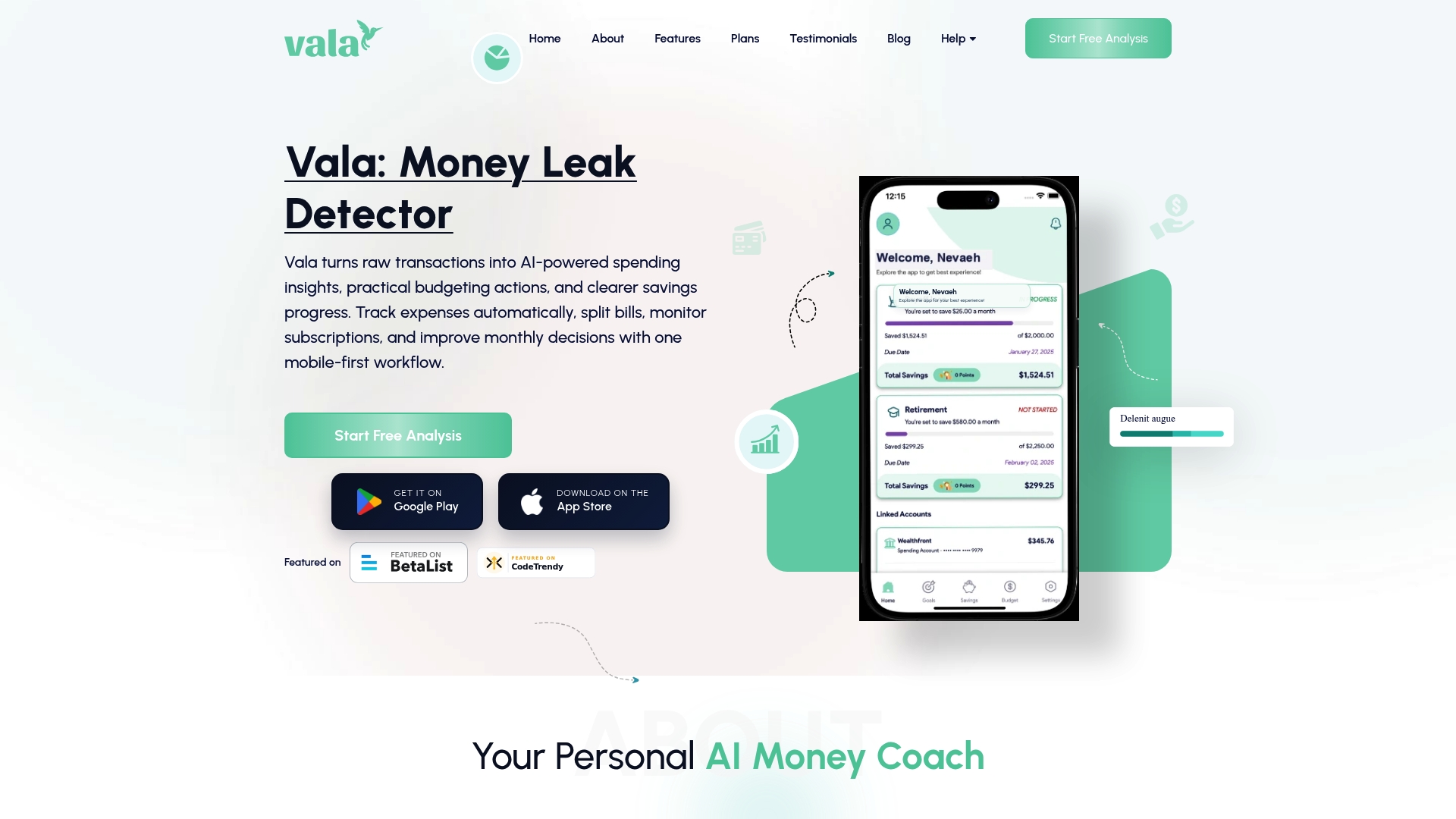
The check runs on a free trial, so you can see your leaks before deciding whether you need the full toolkit. If the automation clicks for you, SaverPro unlocks the deeper features, budget tracking, shared expense splitting, and savings goal management, for $2.99 a month. That’s a lower monthly cost than most people spend on the subscriptions they forgot they had. Start with the Money Leak Check and see what your current budget, app or spreadsheet, has been missing.
Sources
This article draws on practical guidance from Investopedia on monthly budgeting, consumer.gov on stepwise budget building, Fidelity on budget categories, and USA Today on app versus spreadsheet trade-offs.
FAQ
What Is Dave Ramsey’s Favorite Budgeting App?
Dave Ramsey’s team promotes EveryDollar, a zero-based budgeting app built around his own method. The underlying principle, assigning every dollar a job before the month starts, works in a spreadsheet just as well as in any app.
What Is the 50/30/20 Rule Budget?
The 50/30/20 rule splits after-tax income into 50% needs, 30% wants, and 20% savings or debt payoff. Fidelity recommends it as a simple starter framework for people who don’t want a highly detailed category system.
What Is the 70-10-10-10 Budget Rule?
This is a less common variation of percentage-based budgeting: 70% for living expenses, and 10% each toward savings, debt, and giving or investing. Definitions vary across sources, so treat it as one flexible framework rather than a fixed standard, and adjust the splits to match your own income and obligations.
What Is the Most Trusted Budgeting Tool?
Trust comes down to transparency and consistency of use, not brand recognition alone. Apps that clearly explain their bank security, like Vala’s approach to leak detection and expense tracking, tend to earn more consistent daily use than spreadsheets people build once and abandon.
Should I Track Spending Before Building a Budget?
Yes. Financial experts recommend tracking spending for one to two months before locking in a rigid budget structure. This shows your real spending patterns instead of guesses, which makes whatever tool you choose next far more accurate.