
Personal cash flow forecasting is a week-by-week projection of your bank balance, built to catch tight weeks before they catch you. The fastest way to start: open a spreadsheet or app, set up a short rolling forecast (weekly or 13-week), and update it every week with real numbers. Either a spreadsheet or an app works as long as you actually keep it current.
TL;DR:
- Personal cash flow forecasting is most effective when updated weekly to catch tight weeks before they cause overdrafts, especially for irregular income.
- A 13-week rolling forecast projects weekly inflows and outflows, with the first four weeks being most accurate due to scheduled payments; accuracy diminishes over time.
- Using a conservative income baseline from the slowest month and routing surplus into buffers helps manage unpredictable earnings without risking shortfalls.
- Automating transaction syncing and recurring charge detection with tools like Vala reduces maintenance time and improves forecast accuracy.
- Regular weekly updates, ideally right after payday or on a set day, are essential for maintaining a reliable forecast and avoiding costly timing surprises.
Table of Contents
- Cash Flow Forecasting vs. a Budget: Why Timing Wins
- The Rolling 13-Week Forecast: Structure and Cadence
- How to Build a Personal Cash Flow Forecast Step by Step
- Forecasting When Your Income Isn’t the Same Every Month
- Tools, Templates, and the Visuals Worth Tracking
- How Vala Fits Into Your Weekly Forecasting Routine
- Why Forecasting Beats Willpower
- Try Vala for Automated Cash Flow Tracking
- Templates and Explainers Worth Bookmarking
- Sources
- FAQ
Cash Flow Forecasting vs. a Budget: Why Timing Wins
A budget tells you where your money should go. A forecast tells you when it actually moves. Those are two different jobs, and mixing them up is the single most common mistake people make with their money.
You can hit every budget target for the month and still overdraft on a Tuesday because your rent cleared three days before your paycheck landed. A budget and a cash flow forecast serve different purposes, and timing problems don’t show up in a monthly budget review at all.
That’s why the goal of forecasting isn’t precision. It’s early warning. The purpose of cash flow forecasting is to identify tight weeks in advance so you can act before the shortfall hits, not predict your balance down to the dollar.
Here’s the distinction in practice:
- Budget: “I plan to spend $400 on groceries this month.”
- Forecast: “My checking account drops to $62 on the 14th because rent and my car payment land the same week.”
Once you see the second sentence, you have options: delay a nonessential purchase, move a bill’s due date, or shift money from savings early. Without the forecast, you find out the hard way.
The Rolling 13-Week Forecast: Structure and Cadence
A 13-week rolling cash flow forecast is the standard short-term tool for exactly this problem. It covers roughly one financial quarter, broken into individual weeks, and it moves forward every week instead of resetting on a calendar month.
Each week in the forecast needs four numbers:
- Opening balance — what’s in your account at the start of the week
- Inflows — every paycheck, deposit, or transfer scheduled that week
- Outflows — every bill, subscription, and payment due that week
- Closing balance — opening balance plus inflows, minus outflows
The method that matters here is the direct method: project by actual date, not by average monthly totals. Averages hide the week your insurance premium, your rent, and your car payment all land within 48 hours of each other. Date-by-date projection catches it.
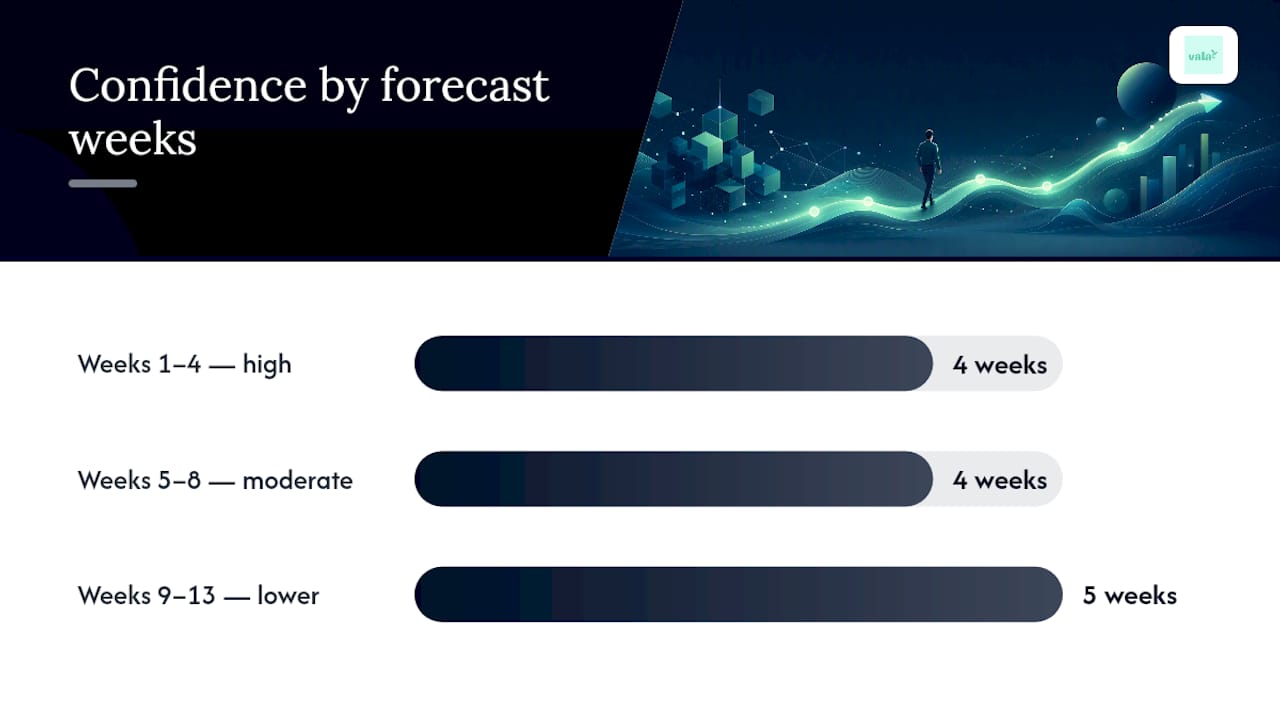
Accuracy isn’t even across the 13 weeks. The first four weeks carry the highest confidence because they’re built from scheduled, known items. Weeks 9 through 13 rely more on run-rate assumptions and get fuzzier. That’s normal. It’s also why weekly reconciliation matters: swap projected numbers for actual numbers every week, and the whole forecast sharpens instead of drifting further off course.
How to Build a Personal Cash Flow Forecast Step by Step
You don’t need accounting software to do this. A spreadsheet, a personal finance dashboard, or a notebook will work if you follow the sequence.
- Record your opening balance. Check your actual bank balance today. That’s week one’s starting number, no rounding.
- List every scheduled inflow by date. Paychecks, freelance deposits, reimbursements, transfers from savings. Put a date on each one, not just a total for the month.
- List every scheduled outflow by date. Rent, utilities, minimum card payments, subscriptions, sinking fund contributions. Include amounts you can already predict before payday, even the small recurring ones people forget.
- Set a minimum cash floor and calculate closing balances. Decide the lowest number you’re comfortable hitting, then run the math week by week. Flag whichever week comes closest to that floor. That’s your tightest week, and it’s the one that needs attention now.
- Do weekly maintenance. Replace this week’s projected numbers with what actually happened, add a new week 13 weeks out, and note what caused any gap between projection and reality.
Pro Tip: Do this on the same day every week, right after payday or your Sunday budget check. A forecast you update sporadically is really just a guess with extra steps.
Forecasting When Your Income Isn’t the Same Every Month
Irregular income doesn’t break cash flow forecasting. It just changes your starting assumptions.
Start with a conservative baseline: use your lowest-earning month from the past six to twelve months as your planning floor, not your average or your best month. Budgeting effectively with irregular income means building your fixed expenses around that floor, so a slow month never becomes a crisis.
From there, three habits make the forecast reliable:
- Route all income into a buffer or holding account first, then pay yourself a fixed, consistent amount each month, the way budgeting for irregular income as a freelancer recommends.
- Treat that fixed monthly transfer as the only number your weekly forecast needs to know. The buffer account absorbs the lumpiness upstream.
- Send surplus from high-earning months straight to your emergency fund, debt payoff, or sinking funds rather than letting it inflate your spending baseline.
Zero-based budgeting, where every dollar gets assigned a job before the month starts, pairs especially well with this approach because it forces you to plan around the buffer transfer rather than the raw, unpredictable deposit.
Tools, Templates, and the Visuals Worth Tracking
The right tool depends on how much time you want to spend maintaining the forecast, not how much money you have.
A few visuals matter more than the rest of the dashboard combined:
- Balance-over-time graph — shows the trend line, not just today’s number
- Tightest-week callout — the single week your closing balance gets lowest
- Inflow/outflow calendar — a day-by-day view of what’s landing and what’s leaving
- Run-rate assumptions — clearly labeled estimates for weeks that don’t have scheduled data yet
For templates, a free 13-week Excel or Google Sheet works well for people who want full control and don’t mind manual entry. A simpler rolling four-week sheet suits anyone who just wants a quick gut check before payday. If a large scheduled outflow like a mortgage payment is part of your picture, a mortgage calculator can help you model that cost accurately inside the forecast.
The moment manual entry starts eating more than 20 minutes a week, or you keep forgetting a recurring charge, that’s the signal to move to an app that automates the update.
How Vala Fits Into Your Weekly Forecasting Routine
Some apps are designed to assist with the tasks a rolling forecast requires every week: pulling in transactions, spotting recurring charges, and flagging where money is quietly leaking out.
- Automated recurring-charge detection catches subscriptions and bills you’d otherwise have to type into a spreadsheet by hand.
- Real-time balance tracking keeps your opening balance accurate without a manual bank login every Monday.
- Money Leak Check surfaces forgotten charges that quietly shrink your closing balance week after week.
- Savings goal tracking connects surplus weeks directly to the reserves you’re building.
A practical starting workflow: build your first 13-week forecast in a spreadsheet so you understand the mechanics, then connect your accounts and let automated tracking take over the weekly update.
Why Forecasting Beats Willpower
The conventional advice on personal money management leans hard on discipline: spend less, save more, stick to the plan. That advice isn’t wrong, but it skips the actual mechanism that causes most short-term money stress, which is timing, not total spending.
You can be a disciplined saver with a healthy monthly surplus and still bounce a payment because three bills landed the same week your freelance client paid late. No amount of willpower fixes a timing problem. Only visibility does.

The reader mistake I see most often is treating a forecast like a one-time project instead of a habit. A forecast built in January and never touched again is worthless by March. The ten-to-twenty-minute weekly check is the part people skip, and it’s the part that actually makes the forecast work.
If you take one thing from this: stop trying to predict your finances perfectly. Start trying to spot next week’s tight spot. That’s a much smaller, much more achievable job, and it’s the one that actually keeps you out of overdraft.
— SaverStride
Try Vala for Automated Cash Flow Tracking
Building a 13-week forecast by hand teaches you the mechanics, but keeping it current every single week is where most spreadsheets quietly die. Vala automates the parts that eat your time: transaction syncing, recurring-charge detection, and real-time balance updates, so your rolling forecast stays accurate without a Sunday-night spreadsheet session.

A good first move is running a Money Leak Check to see what recurring charges might already be shrinking your closing balances without your notice. If the free tier shows you enough value, the SaverPro plan unlocks the full automated tracking and insights for $2.99 per month. Either way, the next step takes less time than filling in one week of a manual spreadsheet.
Templates and Explainers Worth Bookmarking
- Free 13-week cash flow template and calculator for a ready-made rolling forecast.
- Zero-based budgeting explainer for pairing irregular income with intentional monthly allocations.
- Budget vs. cash flow forecast breakdown for a clearer look at why the two tools solve different problems.
Download the template and try one full week of roll-forward before deciding whether a spreadsheet or an app fits your routine better.
Sources
- What is cash flow forecasting? — Sage
- Free 13-Week cash flow forecast template + calculator — Transformance
- What is zero-based budgeting and how does it work? — Fidelity
- Budget vs cash flow forecast — Red Earth CPA
- The complete guide to budgeting — BankingDeal
FAQ
How do you do cash flow forecasting?
Start by recording your current bank balance, then list every scheduled inflow and outflow by date for the next several weeks. Calculate a closing balance for each week and flag whichever one comes closest to your minimum comfortable balance, then update the numbers weekly as actuals come in.
What does a 13-week cash flow forecast look like?
It’s a spreadsheet or app view broken into 13 individual weeks, each showing an opening balance, scheduled inflows, scheduled outflows, and a closing balance. The first four weeks are typically the most accurate since they’re based on known, scheduled items rather than estimates.
How can I forecast my personal finances?
Pick a rolling window, weekly or 13-week, and fill in real dates for paychecks and bills rather than monthly averages. Tools like Vala can automate this by pulling transactions directly from your accounts and flagging recurring charges you might forget to include manually.
What does “personal cash flow” mean?
Personal cash flow is the actual movement of money in and out of your accounts over time, tracked by date rather than by category. It’s distinct from a budget, which sets spending targets, because cash flow problems can happen even when your budget is on track if the timing of payments doesn’t line up with income.